DD
MM
YYYY

PAGES

DD
MM
YYYY

spot_img

PAGES

Home Blog Page 4109

Trump’s Indictment and His Quest to Return to The White House

0

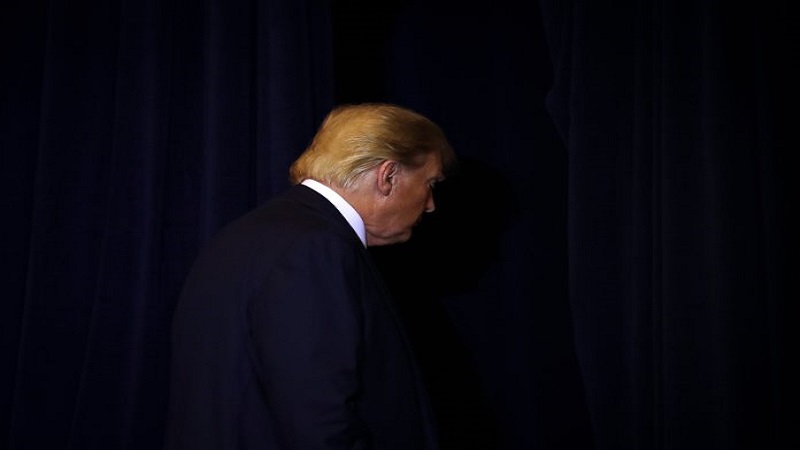
Former US president Donald Trump is facing an uphill climb in his quest to return to the White House, following his indictment on Friday on federal criminal charges.

Trump, who is seeking to secure the GOP presidential nomination once again, faces 31 counts over his handling of classified documents after he left office. His indictment, which marks the first time a former president will face federal criminal charges, puts his presidential ambition in jeopardy as he squares up to others, including his former vice president Mike Pence.

Trump’s Mar-a-Lago, Florida home was raided by the FBI in August last year, with tens of classified documents recovered. Following a special counsel inquiry, the former president and his aides were found wanting for mishandling classified documents.

“Today, an indictment was unsealed charging Donald J. Trump with felony violations of our national security laws as well as participating in a conspiracy to obstruct justice,” special counsel Jack Smith said in brief remarks Friday. “I invite everyone to read it in full to understand the scope and the gravity of the crimes charged.”

Trump’s aide, Walt Nauta, was charged as a co-conspirator with six felony counts.

The former president had lied to the FBI and his lawyer that he had no more classified documents in his possession, only for about 100 more to be discovered in his home’s restroom.

According to the charges, Trump faces 37 counts of willful retention of national defense information under the Espionage Act. He is also accused of conspiring to obstruct justice; corruptly concealing a document or record; concealing a document in a federal investigation; and making false statements.

Though he denied any wrongdoing, describing the charges as a hoax, the former president may be spending a long time in prison if found guilty of just one count.

GOP Sen. Lisa Murkowski of Alaska, who voted for Trump’s impeachment in 2021, over his involvement in the Jan 6 Capitol riot, described the charges as ‘quite serious.’

“Mishandling classified documents is a federal crime because it can expose national secrets, as well as the sources and methods they were obtained through,” she said in a statement.

“Anyone found guilty – whether an analyst, a former president, or another elected or appointed official – should face the same set of consequences.”

While Trump has attempted to downplay the weight of the charges, legal experts have described them as ‘overwhelming’ and ‘serious’, indicating a potential severe consequence that may cost him his presidential ambition.

“It is an extremely damning indictment,” said Jonathan Turley, a George Washington University law professor who testified in Trump’s defense during the first impeachment effort against him in 2019, on Fox News.

“It’s overwhelming in details. And the Trump team should not fool itself; these are hits below the water line. This is not an indictment that you can dismiss.”

The 37-count indictment against former President Donald Trump reveals that each willful retention charge is associated with a classified document discovered at Mar-A-Lago. These documents were labeled as “SECRET” or “TOP SECRET” and covered various topics such as U.S. nuclear weapons, the nuclear capabilities of a foreign nation, and the military activities and capabilities of other countries.

According to the indictment, Donald Trump disclosed a classified military map and discussed a “plan of attack” developed by the Pentagon. This information was shared with a member of his political action committee who did not possess the necessary security clearance.

“In July 2021, at Trump National Golf Club in Bedminster, New Jersey (‘The Bedminster Club’), during an audio-recorded meeting with a writer, a publisher, and two members of his staff, none of whom possessed a security clearance, TRUMP showed and described a ‘plan of attack’ that TRUMP said was prepared for him by the Department of Defense and a senior military official,” the indictment said.

Trump’s two indictments, including several other criminal charges, are the biggest hurdle in his quest to return to the Oval Office.

Norm Eisen, senior fellow of the Brookings Institution, said in his assessment of the indictment that “Trump will very likely be convicted.”

While the US Constitution does not impose any limitations on individuals indicted or convicted of a crime, or even those currently serving prison time, from running for or winning the presidency, Trump’s conviction will probably result in lengthy imprisonment.

The most severe charges he faces could entail individual prison terms of up to 20 years. This means, even though the judges could give Trump consideration as a former president by reducing his sentence, his jail term will likely overlap the 2024 presidential campaign and tenure.

Tinubu Signs Nigerian Students Loan Into Bill Law, Nigerians Not Excited

1

President Bola Tinubu on Monday, signed the Student Loan Bill into law; setting up access to loans for students who come from economically disadvantaged backgrounds.

The official announcement was made on Monday by the spokesperson for the Federal Government, Mr. Dele Alake. According to Alake, the funds allocated for the students’ loans will be held within the Ministry of Education and will exclusively be available to financially disadvantaged students attending tertiary institutions.

The Student Loan Bill dubbed; “A Bill For An Act To Provide For Easy Access To Higher Education For Nigerians Through Interest-free Loans From The Nigerian Education Bank,” was sponsored by the Speaker of the 9th House of Representatives, Femi Gbajabiamila, in 2016, successfully passed the third reading in the House two weeks ago. 

The bill outlines provisions for interest-free loans to support economically challenged Nigerian students. It said that beneficiaries are those whose parents and guardians earn below N500,000 per annum. 

The newly enacted law aims to facilitate accessible higher education for financially disadvantaged Nigerians through interest-free loans sourced from the Nigerian Education Loan Fund, but it carries two years imprisonment for defaulters, N500,000 fine or both.

However, Nigerians don’t seem to be excited about the signing of the bill for several reasons.

In December last year, when the bill was passed by both chambers of the National Assembly, the Academic Staff Union of Universities (ASUU) criticized it, alleging that it was an attempt by the Nigerian government to ‘systematically’ halt the funding of public universities. 

“We find it troubling that the proponents of the policy are so eager to foist it down the throat of Nigerians when they have done more to push the working people of this country into poverty through sheer incompetence in handling the economic fortunes of our nation,” the statement issued by the union reads in part.

Nigerians on social media have expressed concerns about factors that could derail the implementation of the Students Loan Act. 

“The Government could have solved the massive unemployment crisis the country is facing before signing the Student Loan Bill.

“Taking a loan just to graduate and join the long list of unemployed graduates? I’m sorry but this is an excellent bill signed at the wrong timing “IMHO”,” Asiwaju Lerry tweeted.

“This student loan scheme Tinubu just signed simply means subsidy for Tertiary education will be removed. Anyone that wants to go to school should prepare their 100k (minimum) per session/semester or queue up to obtain a Tinubu student loan. Those in charge will make money. NIRSAL 2.0”

Someone seems to agree with ASUU that the Student Loan Bill is a ploy by the government to stop funding tertiary education.

So what if students that took the loan aren’t able to get a job after completion of NYSC?

A Twitter user attempts to answer the question by referencing Tinubu’s campaign promise to recruit 50 million youths into the Nigerian military to fight insecurity.

The Student Loan scheme was part of Tinubu’s campaign promises, but the assent of the bill has not been welcomed with excitement due to the high rate of unemployment in Nigeria. Although currently the largest economy in Africa, Nigeria has 33.3% unemployment rate.

In an attempt to prove that the Student Loan Act will fail, some of its critics have referenced the United States, which although has less than a 4% unemployment rate, still struggles to manage the crisis emanating from students loan.

How To Set Up A Licensed Mobile Virtual Network Operator (MVNO) Company in Nigeria

0

As an investor, one way of gaining entry into the Nigerian telecomms sector is by the means of MVNO or Mobile Virtual Network Operator licensing which is a comparatively less expensive way of rendering a bouquet of services in the telecomms value chain while achieving ICT inclusion/penetration which remains an important development objective for Nigeria which still has a lot of rural areas that are deficient of any widespread form of modern communication facilities.  

This article will be looking at how to secure MVNO licensing and some of the permissible business possibilities that come with acquiring MVNO licensing as well as the compliance framework governing MVNO businesses in Nigeria. 

Which government agency is in charge of licensing MVNOs in Nigeria? 

MVNO licensing and post-licensing regulatory compliance is under the jurisdiction of the Nigerian Communications Commission (NCC) pursuant to the Nigerian Communications Act. 

What exactly are the objectives of MVNO licensing introduction as envisaged by the NCC?

 By introducing MVNO licensing, the NCC aims to achieve the following objectives :- 

– Ensuring that all core stakeholders are adequately catered for and protected within a virtual network operator-enabled environment. 

– Giving providers of virtual mobile communications services an opportunity to participate in the Telecommunications provisioning market of Nigeria, with an emphasis on improving the Telecomms output of the country. 

– The provision of operational guidelines within which Telecomms businesses at the medium scale can flourish within the Nigerian Telecomms sector. 

– To provide an avenue for further contribution to the availability and expansion of quality mobile coverage through redundant capacity utilization, active infrastructure sharing, national roaming & other telecommunications elements that enable it. 

What exactly is the application scope of the NCC regulatory guidelines governing MVNO businesses in Nigeria? 

The scope of NCC regulations governing MVNOs revolve around the following services :- 

Sales & Distribution – providing adequate SIM card sales and distribution channels, registration of subscribers, sales and distribution of devices, etc. 

Tariff & Billing – which involves the development of an efficient tariff structure, ensuring adequate & accurate billing systems, etc. 

Customer Relationship Management – in terms of the provision of necessary customer relationship management systems for catering to customers and their needs, resolving issues and disputes with customers, etc.  

Devices, Application Services & SIM Management – which involves the provision of application of value added services(VAS) , ensuring proper SIM Management operations, meeting Quality of Service(QoS) Key Performance Indicators (KPIs) with regards to VAS and related services,etc. 

International Data & Voice Services. 

Facility Management – which involves ensuring that devices and facilities meet the technical standards outlined by the NCC. 

Core Network Functions & Spectrum Access – which involves the provision of network access to ensure quality delivery of mobile telecommunications services to the end users, ensuring that frequency standards are met for spectrum access,etc. 

What exactly is an MVNO? 

An MVNO as defined under Nigerian Telecomms regulations is defined as a Telecomms product and service operator that rides on the capacity of a fully licensed Telecomms service provider or Mobile Network Operator (MNO) through the means of a negotiated Wholesale agreement or a revenue sharing agreement for the purpose of bulk purchasing resources from the MNO or Telecomms company for onward delivery to consumers. 

What is the actual difference between an MVNO and MNO? 

An MVNO simply has no ownership of spectrum elements regardless of its operations model.  

Do operational tier systems exist for MVNOs as with other Telecoms business licenses in Nigeria? If they do, which services are allowed to be rendered within those tiers? 

Yes, tier-based operational levels exist for MVNO licensing in Nigeria. These tiers and their permissible activities are as follows :- 

Tier 1 (Services Virtual Operator) 

1).Within this category, an MVNO can leverage on its ability to offer services to customers without owning any switching or IN(Intelligent Network) infrastructure .  

2). MVNOs in this category also do not control any numbering resources & it is the responsibility of the host MNO to provide wholesale capacity to the MVNO for delivery of its products and services. 

3). MVNOs in this category can operate in at least one of several operation areas that include brand ownership, sales and distribution channelling, or running SMSC for SMS services.

Tier 2  ( Simple Facilities Virtual Operator)  

1). An MVNO in this category has more control of the Telecomms service value chain that can enable it clearly differentiate itself from its host MNO.  

2). While an MVNO on this level cannot possess or acquire core switching & interconnect capabilities but can set up its own IN(Intelligence Network) to provide IN services to customers. 

3). MVNOs in this category can establish their own subscriber registers or authentication centers, equipment identity register & home location registers. 

4). MVNOs in this category can also own & issue their SIM cards as well as own and operate EIR/HLR/AUC/HSS. 

– Tier 3( Core Facilities Virtual Operator) 

1). An MVNO in this category can rely on its technical and commercial capacities to launch and operate a full core network with switching & interconnect capabilities. 

2). MVNOs in this category rely on their host MNOs to provide radio access capacity at wholesale to deliver its products and services to its customers. 

3). MVNOs within this category are typically urged by the NCC to target underserved and unserved areas via subsidized requirements to operate in such areas. 

4). MVNOs in this category can own and manage core network elements of switching & interconnection services that include IP Multimedia subsystems, MSC & GMSC, PGSN/PGW, SGSN/SGW & MME.
Tier 4 ( Virtual Aggregator/Enabler) 

1). MVNOs within this category are responsible for aggregating and/or enabling MVNO services within the market and relies on a model in which it stands as a middleman between an MNO and several MVNOs. 

2). MVNOs within this capacity can :-

a). install capacity to serve its aggregation/enabling platform; and 

b). perform the additional role of a Tier 3 MVNO where the region being served is underserved or unserved.

Tier 5 ( Unified Virtual Operator) 

1). An MVNO in this category can operate on what in reality is a unified license, choosing the services it can offer to customers from Tier 1 to Tier 4. 

2). MVNOs in this category can engage in what are known as “shared rural coverage agreements” to enable operations in underserved and unserved regions of Nigeria.

Who are the recognized market players within the MVNO service value chain as outlined by the NCC?

 An MVNO service value chain or arrangement is made of the following players :- 

Host Network Operators – which can be : 

a). Spectrum license holders 

b). Universal access services license holders 

c). Digital Mobile license holders 

d). VSAT license holders 

e). GMPCS license holders

National Carriers, NLDOs(National Long Distance Operators)& International Gateway Providers :-  

Which can provide MVNOs with the capacity to deliver services beyond what the typical host network operator might be able to offer. 

It should be noted that MVNOs that enter into agreements with license holders in this sector must be looking to deliver focused services that involve nationwide provisioning and/or international telecomms products and services. 

Infrastructure Companies :-Full facility based MVNOs according to NCC regulations require backhaul connectivity to and from its MSC & the host network operator’s radio access sites. This can be done through agreement-based deployment and maintenance of infrastructure with companies licensed for that purpose.

Value Added Service (VAS) Aggregators :- The NCC stipulates that VAS provisioning by an operator must be deployed through a VAS Aggregator. MVNOs can also be network providers for VAS Aggregators.

 Can Host Network Operators own or purchase equity or share options in MVNOs? 

 They can only own not more than 10% equity of a Tier 1 – Tier 4 MVNO and 5% of a Tier 5 MVNO.

 What are the general obligations/requirements for MVNO licensing in Nigeria?

 An applicant for a MVNO license must have the following :-

 – A company registered with the Corporate Affairs Commission (CAC).

 – A wholesale license leveraging agreement with a host network operator or national carrier.

 – Proof of financial capabilities to cover its CAPEX( Capital Expenditure) & OPEX (Operations Expenditure) for strategic business operations. 

– Proof of meeting technical requirements set by the NCC. 

– Proof of secured reservation or assignment of resources required to operate, numbering resources in particular. 

– Proof of local content in ownership and service delivery. 

What are the specific requirements for MVNO licensing applicants? 

You need to consult your lawyer on this as specific licensing requirements which differ for each NCC Business License.  

What are some of the steps involved in an MVNO licensing application process?

 The process for MVNO licensing is covered by general NCC processes for Telecomms business individual licenses, however for MVNOs the following steps must be complied with :-

 – The completion of an individual introduction form furnishing the NCC with information needed to process a license upon the completion of agreement execution with a host MNO.

 – The submission of a Performance Bank Guarantee (PBG), a Financial Bank Guarantee (FBG) & a capital structure summary proving capacity to fund & maintain operations throughout the tenure of the license. 

 What are the applicable fees for MVNO licensing in Nigeria?

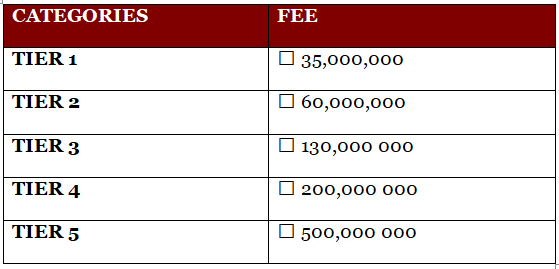
 The regulatory fees for MVNO licensing are as follows :-

 Tier 1 – 35 Million Naira

 Tier 2 – 60 Million Naira

 Tier 3 – 130 Million Naira

 Tier 4 – 200 Million Naira

 Tier 5 – 500 Million Naira

 What is the tenure validity period of an MVNO license?

 MVNO licenses have a validity tenure of 10(Ten) years. 

 Can MVNO licenses be renewed, suspended or revoked? 

 MVNO licenses can be renewed on request by a licensee not later than 12 months before the expiration of a current license. It should be noted that renewal requests can be rejected by the NCC based on a negative performance rating of the applicant’s existing MVNO license tenure. 

 And yes, an MVNO license revocation or suspension is possible through:-

 – An MVNO violating relevant NCC regulations.

 – An MVNO violating its agreement with an MNO.

 – An MVNO operating beyond the scope of its granted Tier license category. 

What are some of the post-licensing compliance requirements for MVNOs as outlined by the NCC?

 -The Licensee shall ensure that it complies with the Consumer Code of practice approved by the NCC.

 -The Licensee shall be bound by all information provided and its commitments made when acquiring its license, agreeing with a Host MNO and other agreements required to obtain legibility to deliver mobile telecommunications services within the MVNO regulatory regime. 

-The Licensee must comply with National Security Protocols and Consumer information protection as required by the regulations of the NCC, where applicable. 

-An MVNO Licensee must ensure that it meets the KPIs that pertain to its operating model as detailed within the NCC QoS regulations and guidelines. 

Time for Nigeria’s SportsTech to Emerge

0

More congrats to Enyimba FC- the people’s elephant – for winning the Nigerian football league. Congratulations. Yet, besides winning trophies, we need to make this a business. That brings me to ask: is it time for Nigeria’s sportstech?

I mean, can someone use digital technologies to aggregate and unlock value in the nation? From handball to football to basketball, there are many exciting things in Nigeria which could be leveraged to build a modern digital-native media empire, based purely on sports.

Edward Ansah, Abdullahi Alausa, Uwe, Boateng, and many of their generations gave us reasons to connect to Radio Nigeria in the village. We memorized their names and they inspired us. The Football federation should issue licenses to sportstech so that our digital entrepreneurs can build businesses around these games.

Nigeria Football Federation (NFF): the Nigerian Communication Commission (NCC) issues rights to communication frequencies,  work  to issue digital broadcasting rights to startups.

Filecoin (FIL) Price Drops, Holders Invest in Collateral Network (COLT) for 3500% Returns

0

In the highly dynamic world of cryptocurrencies, trends shift rapidly, opening up new investment opportunities while causing others to lose steam. One recent example involves Filecoin (FIL), a decentralized storage system, and Collateral Network (COLT), a web3 peer-to-peer lending platform.

As the value of FIL experiences a downturn, savvy investors are channeling their assets into COLT, lured by the promise of staggering returns during its presale.

>>BUY COLT TOKENS NOW<<

Filecoin (FIL): The Decentralized Storage System

The token that allegedly stores humanity’s most important information, Filecoin, is making news. Filecoin has increased its utility lately, possibly leading to becoming a more popular platform.

Filecoin, also known as FIL, is a decentralized storage platform designed to “store humanity’s most important information.” This ambitious project was first proposed in 2014 as an incentivized layer for the Interplanetary File System (IPFS), a peer-to-peer storage network. The system allows users to pay for data storage and distribution services using the platform’s native currency, FIL. Filecoin’s blockchain, backed by proof-of-replication and proof-of-spacetime mechanisms, records all commitments made by the network’s participants.

Juan Benet, an American computer scientist, and Stanford University alum, founded Filecoin. Benet, who also created IPFS, founded Protocol Labs in May 2014, aiming to support both IPFS and Filecoin, along with other projects. Filecoin’s unique feature is its dedication to storing data in a decentralized manner, differing from centralized cloud storage companies like Amazon Web Services or Cloudflare. This decentralization aims to ensure the integrity of a data’s location, making it easily retrievable and hard to censor.

Recently, Filecoin introduced Filecoin Data Tools (FDT) for seamless data onboarding, further strengthening the platform’s utility. However, despite the platform’s innovative features and potential, FIL has experienced a recent price drop.

Collateral Network (COLT): An Opportunity for Significant Returns

Collateral Network is an upcoming project that aims to disrupt the traditional lending industry. It is an Ethereum blockchain-based web3 peer-to-peer lending platform that enables users to unlock liquidity by using physical items, such as fine wines, artwork, vintage cars, watches, and jewelry, as collateral.

The distinctive offering from Collateral Network is that it fractionalizes the NFTs it mints against borrowers’ tangible assets and enables multiple people to fund the loans. As a result, it is the first project that allows borrowers to unlock liquidity by bringing their tangible assets on-chain through NFTs.

On Collateral Network, both lenders and borrowers stand to gain significantly from its proposal. The loans lenders provide are secured by actual, tangible assets, and they earn weekly passive income. On the other side, borrowers can swiftly and discretely access cash from their assets with customizable terms and competitive rates.

With a projected 3500% (35x) increase during the presale and a 100x increase once it is listed on major exchanges, analysts see a big price spike for COLT. The token is currently available at $0.014, following a 40% increase from its original price. Collateral Network may be the first asset-backed loan marketplace for physical assets on the blockchain.

Find out more about the Collateral Network presale here:

Website: https://www.collateralnetwork.io/

Presale: https://presale.collateralnetwork.io/register

Telegram: https://t.me/collateralnwk

Twitter: https://twitter.com/Collateralnwk