DD
MM
YYYY

PAGES

DD
MM
YYYY

spot_img

PAGES

Home Blog Page 4109

The Trilogy of Central Bank of Nigeria’s Lifting of Domiciliary Account Restrictions

3

One of the finest Igbo novels ever written remains “Isi Akwu Dara N’ala” by Tony Ubesie. Think of a trilogy of James Hadley Chase (There’s Always a Price Tag), Thomas Hardy (The Mayor of Casterbridge) and peerless Bertha M Clay (Beyond Pardon, A Woman’s Temptation) all lumped into one novel. In Isi Akwu Dara N’ala, Ubesie chronicled romance, pains, wars, etc using Chike and Ada.  Then, the war ended, and heavens opened opportunities for Chike through his “Osisi Na Ami Ego” [literally, a  tree (indeed a factory) which produces money as leaves]. Yes, he built factories and wealth returned through huge profits.

But how can you build factories when governments will not allow you to use your money as you wish? If you check 2,000 years of global GDPs, you would notice that no nation has developed faster and better than its property rights regime. I have written extensively on that in Harvard.

In other words, if the ownership of properties and the capacity to use those properties as desired by owners are not freely allowed by the ordinances in nations, no serious growth will happen. All nations which have developed have always seen first an improvement in property rights.

When you have money in your domiciliary account in Nigeria and the central bank regulates what you can do with that money, that is not a free market system because the velocity of money, and freedom to use at will, under a strong property right is a key tenet of entrepreneurial capitalism.

But there is good news: “The Central Bank of Nigeria (CBN) has announced the removal of cash deposit limitations on domiciliary accounts, days after the deregulation of the Nigerian forex market.” I commend the CBN for killing this mindless policy. Now, we can go and grow Osisi Na Ami Ego”. Yes, build those factories, warehouses – the old and the modern versions.

Comment on Feed

Comment 1: “If the ownership of properties and the capacity to use those properties as desired by owners are not freely allowed by the ordinance in nations, no serious growth will happen”.

Substituting nations with states in the above quote, I think this statement also explains the reason why Lagos real estate markets developed faster than states in the Niger Delta regions, not discounting the advantages of being a former capital city. Foreigners, or do I say non-indigenes of Lagos were freely allowed to own and develop the real estate markets extensively, turning forests, swarms and wastelands into beautiful cities.

It’s a shame that today, pronouncements are being made by politicians without understanding impacts and repercussions of trying to restrict free market systems.

The former Governor of the CBN caused so much damage to the economy with his policies, never really understood why he thought restrictions on domiciliary accounts would encourage flow of FDI or FPI into our economy. He drove legal funds flow into invisible flows.

I think we need to all learn from the damaging effects market restrictions have on national economies.

Comment 2: I am really happy about this news Prof. I remember going to bank sometime last month and I was informed that I can’t withdraw more than#50,000 from my personal account, it was really a terrible experience. The next they should do for us is to lift the ban on using our local ATM cards for international transactions, this is killing a lot of business on daily basis and some end up in the hands of scammers in their search for alternative routes.

Comment 3: Some of the policies implemented by the immediate past CBN governor were clearly antithetical, or so they seem to me.

Can’t imagine wanting to boost forex inflow/remittances and at the same taking actions that’ll impede the same. Some of his actions have a colortion of economic sabotage, albeit, maybe not intentional.
In order not to crucify or persecute ‘Big Meffy’, I’ll end by saying “incompetence is not a crime”


CBN Lifts Deposit Restrictions on Domiciliary Accounts, Allows $10,000 Withdrawal Per Day

1

The Central Bank of Nigeria (CBN) has announced the removal of cash deposit limitations on domiciliary accounts, days after the deregulation of the Nigerian forex market.

The move comes barely a week after the apex announced new guidelines guiding the nation’s new forex regime.

A statement issued by the CBN following an extraordinary Bankers’ Committee meeting held on Friday, June 16, where a discussion about implementation and implications of floating the naira was held, said domiciliary account holders can withdraw up to $10,000 per day.

“Domiciliary account holders are permitted to utilize cash deposits not exceeding USD$ 10,000 per day or its equivalent via telegraphic transfer. DMBs shall provide returns to the CBN, including the “purpose” for such transactions,” the circular said.

“Cash deposits into domiciliary accounts will not be restricted, subject to DMBs conducting proper KYC, due diligence and adhering to the spirit and letter of extant AML/CFT laws and other relevant rules and regulations.”

The central bank said it will give priority to the timely and orderly settlement of any committed Foreign Exchange (FX) forward transactions to enhance market confidence.

The apex bank added that it will work towards standardizing its Cash Reserve Ratio (CRR) maintenance processes and ensure fair implementation across the banking industry.

See the full statement below:

CBN Issues Further Guidance on Operational Changes to Foreign Exchange Market

Following the Central Bank of Nigeria (CBN) press statement of June 14, 2023, on new guidelines in the foreign exchange market, an extraordinary Bankers’ Committee meeting was held on Friday, June 16, 2023, to discuss its implementation and implications for the banking public.

These policy changes aim to promote transparency, liquidity and price discovery in the FX market in order to improve FX supply, discourage speculation, enhance customer confidence and ensure overall stability in the FX market.

According to the Director, Corporate Communications, Dr. Isa Abdulmumin, the CBN, in line with deliberations at the meeting, provided further guidance to Deposit Money Banks (DMBs) as follows:

All visible and invisible transactions (medicals, school fees, BTA/PTA, airline and other remittances) are eligible for the Investors’ and Exporters’ (I & E) window.

DMBs shall ensure expeditious processing of all eligible invisible transactions on behalf of their customers using the applicable rate at the I & E window.

Ordinary domiciliary account holders shall have unfettered and unrestricted access to funds in their accounts. Domiciliary account holders are permitted to utilize cash deposits not exceeding USD$ 10,000 per day or its equivalent via telegraphic transfer. DMBs shall provide returns to the CBN, including the “purpose” for such transactions.

Cash deposits into domiciliary accounts will not be restricted, subject to DMBs conducting proper KYC, due diligence and adhering to the spirit and letter of extant AML/CFT laws and other relevant rules and regulations.

The CBN will prioritize orderly settlement of any committed FX forward transactions as they fall due in order to boost market confidence further.
The Bank will normalize its CRR maintenance processes and ensure equity in its implementation across the banking industry.

The CBN will continue to engage stakeholders and issue further guidance as it implements the ongoing reforms.

Building Your Portfolios When Investing in US and Nigerian Stock Markets; Note This

0

The table shows the best performing stocks in Nigeria (Year to Date, May 2023), according to Nairametrics. What do you see? Any pattern? None that is very clear (except tech, agro and telecoms, most core sectors are largely represented from the mainboard). In other words, you cannot say this sector is outperforming which means a sector-based strategy would have missed many things. So, it comes to individual companies here, and how you’re able to pick them.

Contrast with the US where a playbook on semiconductors/microelectronics would have unlocked alpha, with Nvidia, AMD, etc leading the pack, on the wave of AI exuberance. If that is the case, a sector-based mutual fund/ETF strategy in Nigeria will underperform while in the US, you could pick some home runs.

The verdict: you need a different portfolio management strategy if you are investing in Nigeria from whatever you are doing in the US stock market. At Tekedia Capital, our members will be attending this FREE course (Venture Investing and Portfolio Management) on July 3-29 on click . Join us!

Central Bank of Nigeria Lifts Restrictions on Cash Deposits into Dorm Accounts

0
Naira USD

The Central Bank of Nigeria (CBN) has lifted restrictions on cash deposits into domiciliary accounts. Part of the statement below.

“All visible and invisible transactions (medicals, school fees, BTA/PTA, airline, and other remittances) are eligible for the investors’ and exporters’ (I&E) window.”

“DMBs shall ensure expeditious processing of all eligible invisible transactions on behalf of their customers using the applicable rate at the I&E window. Ordinary domiciliary account holders shall have unfettered and unrestricted access to funds in their accounts. Domiciliary account holders are permitted to utilise cash deposits not exceeding $10,000 per day or its equivalent via telegraphic transfer.

“DMBs shall provide returns to the CBN including the purpose for such transactions. Cash deposits into domiciliary accounts will not be restricted, subject to DMBs conducting proper KYC (know your customer), due diligence, and adhering to the spirit and letter of extant anti-money laundering/ combating the financing of terrorism laws and other relevant rules and regulations.

“The CBN will prioritise orderly settlement of any committed FX forward transactions as they fall due in order to further boost market confidence.”

Jungle Destruction of Properties in Nigeria Should STOP

0

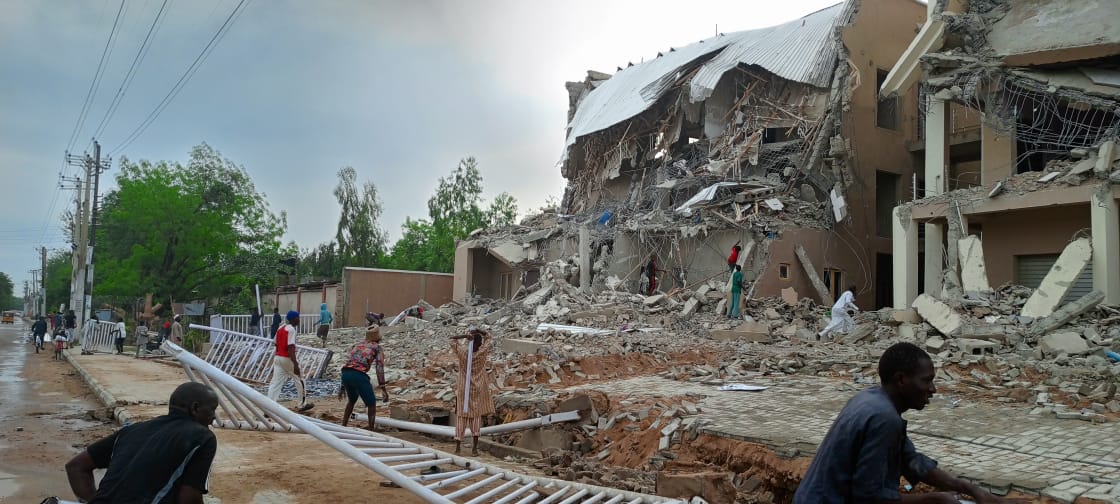
We are lacking empathy in Nigeria and this is very unfortunate. We’re finding it easier to tear down buildings in Kano, Alaba Market and other areas when we have no plans on how new ones could be built. No matter how you see politics, Nigerians must condemn these acts.

If  residents of Salanta Quarters in Kano followed due process for these lands, as stated by a previous government, it is just bluntly unfair to punish them this way. Why not go to the Court and give them the space to defend their rights? It is either Nigeria wants to advance or move backwards. But one thing is clear: jungle destruction will bring more hatred and animosity.

Many years ago in Ovim (Abia State), my village wanted a math teacher to teach the JS3 class as the government option was not “well qualified”. They hired a young teacher named Bukar. Bukar taught me Math in JS3. We became all members of “Bukar for Math”.  In Oriendu Market, he never paid for anything because people paid for whatever he needed for his family. Today, can Bukar live in Abia State?

People, the animosity across Nigeria makes me unhappy. And if you check, most are coming from politicians who are causing troubles because of power.  I used to visit Usman Danfodio University Sokoto which remains the most hospitable university to me in Nigeria. Yes, they treat you really fine when you visit to spend time teaching electronics (I setup their embedded systems lab with Dr Ibrahim). Today, I cannot travel there anymore. Yes, it is impossible.

Nigeria needs help and these leaders should work to bring ALL together. Why destroy these properties even if we assume the last government made a mistake which ordinary families who bought the lands were not parties to?

Residents of Salanta Quarters in the Kano metropolis have accused the state government of demolishing their buildings without prior notice and compensation.

The residents, who described the demolition of their houses as illegal, said they followed due process in acquiring the land on which their houses were built from the immediate past government of the state.

There was tension in the area on Saturday as the residents tried to physically prevent officials, who arrived their community, from demolishing the buildings.

A viral video of the altercation scene showed an injured victim making a phone call, pleading for help from loved ones, whilst alleging that one of his phones was damaged by an official.

“You cannot demolish our properties overnight without prior notification after we have all our documents intact. We all have our families here, and this is injustice. They have voted calamity for us.

Comment on Feed

Comment: You are very correct sir, the demolitions carried out in Kano is not justified. But before demolitions were carried out in alaba a letter have been issued to them you need to see the infrastructures sir it has really decayed. At first I also condemned the demolition at alaba but after watching the clips it is better those buildings are brought down to avert future disaster.

My ResponseThe Nigerian law does not say a LETTER has to be issued to destroy a building. It says a COURT Order. There is a reason for that and that happened in Owerri a couple of years ago. A governor went after an opponent and destroyed a building citing that the structure was not approved and the height was above limit. 

Later, it was realized that the same building was bought by the man from the same government a decade ago. In other words, if it was not just a LETTER but a court order, that would have become evident. 

Alaba was built by the government from grounds-up. If the government built poor structures which citizens bought, it can compensate property owners instead of destroying properties it has already sold and collected money. The same thing is about to happen in an estate in Abuja; the government put nonsense structures; people bought. Then later, you say they’re not habitable anymore and should be taken down without returning the money with interest!

Comment 2: When you hear rascality and illegality, you will over time appreciate how encompassing those two words are in Nigeria.

When we are done tearing down everything that binds people together, in the name of supporting your own and hating on others, our eyes will finally open, of course it’s late by then.

Building materials are very costly now, so anytime a politician is tearing down structures, any other reason outside not meeting integrity test, that politician should tell us where he expects the owners to get money for another one.

One day this sky will drop here and cover everyone, and no single person will escape.

Comment 3: What I see everyday and everywhere is hate. There is no attempt whatsoever to create love and unite the country. When you wantonly destroy peoples source of living or their hard earned assets, they simply never forget.

Comment 4: And you know what’s worse? The social and intellectual framework that serve to legitimize these devious political actors are well entrenched in our ranks: the so-called working class.

It may not take more than a handful of comments to this post before you find one of these scoundrels trying to either justify or euphemize these horrible anti-people actions.

And no, the word ‘scoundrel’ isn’t an insult; it’s a perfectly valid description for dishonesty, especially the dangerous kind we see displayed here every other day. I assure you, these evil politicians would be mostly ineffectual without these lot.

There is nothing as dangerous to a society as intentionally creating moral ambiguity and muddying the waters in terms of what constitutes ‘right’ and ‘wrong’, or more simply ‘just’ and ‘unjust’.

Comment 5: Stop concluding every action taken is politically motivated, have you been to Alaba market.. go and see how people have encroached into areas that are not supposed… right of way, alternative routes and makeshift that has been used by criminals for gun running, drugs and other crimes.. and besides the majority of people affected are the hausa in the Alaba Ravi area… empathy can not fix a country, rule of law and adherence with respect for constituted authority and laws … for the Alaba case, it has nothing to do with politics, it is pure sanity… have you seen trade fair too and encroachment on the Festac area too… we want government to be decisive and also be empathetic… we can have both…

My Response: I have not been to those areas including Kano, Alaba, Festac, Owerri, etc for years. Tell me what you have seen in Kano and these areas and explain if previous governments were not leading them. My position is that some of these citizens are also victims as some of these properties/lands were genuinely sold by the government which wants to destroy them now. 

Take people to a fast-track court system so that the bad government actors will be brought into the midst. In Kano, people have documents duly signed by the government; another comes to destroy their properties. In Alaba, the government built some of those properties and sold them to citizens. In Festac, the government approved some of these illegal structures. A court process will make sure everyone’s voice is heard instead of the jungle you think is “firm” without addressing the root cause.