DD
MM
YYYY

PAGES

DD
MM
YYYY

spot_img

PAGES

Home Blog Page 4164

How US Debt Ceiling Paralysis Could Affect Your Investments

0

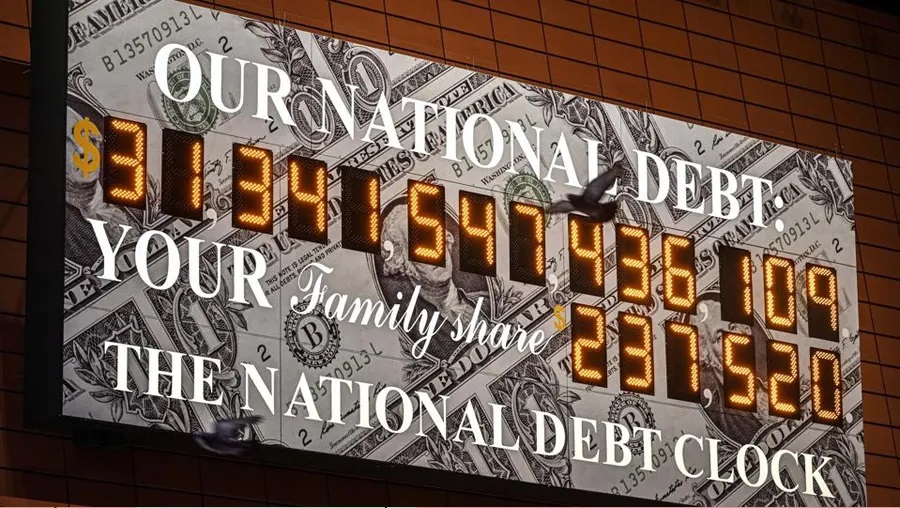
Good People, some of our learners in the Tekedia Investment and Portfolio Management program have asked me how the paralysis on the US debt ceiling could affect some of their investments. Our subject matter experts will examine this in our June edition, but as a former banker, I will offer some perspectives here. If the United States does not resolve this quickly, here are things you should expect.

  1. For currency traders, the US dollar will fall. 
  2. US stocks will fall with negatives for most indices.
  3. Bond yields will spike. The implication is that bond prices will go down.
  4. Many will lose their jobs as growth will stall.
  5. More so, if this should happen, it could cause severe economic pains across the globe since the US dollar is the leading currency for global trade.

That said, I do not believe that the US will not break this ceiling; it has always been doing that for generations. That the US will default is academic because it will not happen. They will play politics and then get serious just hours to any default. 

That said, if you are investing in the US,  we posit that you create a US entity and use that entity to invest if you are unable to work directly under a US entity. We have looked at recent recoveries/settlements and observed that settlements are first extended to US persons and entities before international persons and entities. 

In other words, US persons and entities are being prioritized during recoveries and settlements:  “Meanwhile, the new FTX CEO John Ray, who replaced Bankman-Fried to guide FTX’s restructuring, is trying to rescue funds that were lost by the crypto company’s depositors when the firm spiraled into bankruptcy in November last year….John Ray III, while testifying to the U.S house committee, disclosed that U.S. customers are more likely than other customers to get their money back.”

Implications of Ripple’s Battle with U.S. Securities and Exchange Commission (SEC)

0

The legal battle between Ripple Labs and the U.S. Securities and Exchange Commission (SEC) over the status of XRP, the world’s seventh-largest cryptocurrency, has reached a critical stage. Both parties have filed their final briefs in support of their summary judgment motions, asking the court to rule in their favor without a trial. This case has been hanging in court for over two and half years with no clear direction on reaching a logical resolution.

The SEC claims that Ripple sold XRP, its native cryptocurrency, as an unregistered security, violating federal laws and harming investors. Ripple denies these allegations and argues that XRP is not a security, but a digital asset that facilitates cross-border payments on its decentralized network.

The case hinges on whether XRP meets the criteria of the Howey test, a legal framework that determines whether an asset is a security or not. According to the Howey test, an asset is a security if it involves an investment of money in a common enterprise with an expectation of profits from the efforts of others. Ripple contends that XRP does not satisfy these conditions, as it has utility and value independent of Ripple’s actions, and that XRP holders do not have any contractual or ownership rights in Ripple.

The SEC, on the other hand, asserts that Ripple created and distributed XRP as part of a scheme to raise funds for its business operations and to enrich its founders and executives. The SEC also accuses Ripple of making false and misleading statements about XRP to influence its price and market perception. The SEC seeks to stop Ripple from selling XRP and to impose civil penalties and disgorgement of ill-gotten gains.

One of the key points of contention in the case is the speech given by former SEC director William Hinman in 2018, in which he stated that neither Bitcoin nor Ethereum were securities. Ripple wants to use this speech as evidence that the SEC did not provide clear guidance on the status of XRP and other cryptocurrencies. The SEC, on the other hand, wants to keep the speech and related documents sealed, claiming that they are internal deliberations and not official statements.

However, a federal judge recently ruled that the documents related to Hinman’s speech should be made public, giving Ripple a significant win in its legal battle. The judge said that sealing the documents would not serve the public interest or protect the SEC’s candor. The documents could reveal how the SEC formed its opinion on crypto assets and whether it applied consistent standards to different tokens.

The court’s decision has also boosted XRP’s price, which rose by 8% after the news broke. Many crypto enthusiasts see the case as a potential precedent for how U.S. regulators will treat cryptocurrencies in the future. Ripple’s CEO Brad Garlinghouse said he was happy with the transparency and hoped that the unredacted Hinman emails would be available soon.

The outcome of the case could affect not only Ripple and XRP, but also other cryptocurrencies and blockchain projects that may face similar regulatory challenges in the future. The case could also set a precedent for how the SEC approaches crypto regulation and enforcement in general.

Jigbo Launches To Take Up Indomie Noodles

1
Exif_JPEG_420
Abacha (the dried shredded cassava delicacy which is very popular in Southeast Nigeria) is going global [I do not have the correct Igbo alphabet on my laptop to differentiate the pronunciation from a human “Abacha”]. Some smart guys have pre-processed abacha with spices to go. So, you do not need the raw cassava and all the efforts needed to shred it.
 
It seems Jigbo has NAFDAC seal already and is exporting to US, UK, etc from Ogbete, Enugu. Indomie noodles, you have a decent competitor right now, because the brand Jigbo is here.
 
When we say low level semi-manufacturing, this is what it is. As they scale, they can reduce cost while improving quality. Magically, this becomes another category in the FMCGs. Yes, Flour Mills of the world will quickly adopt and add. If we cannot make a rocket, we can at least shred cassava, package and reduce food wastages.

Comment on Feed

Comment 1: This one enter, I will be interested in the spices and the number of ingredients baked in there. Indomie and co now have a rival, abacha has been christened, and it’s now going global.

We need another miracle on bread, all the key ingredients must be sourced locally, we eat a lot of bread in this country, and buying one small loaf for N1000 was not part of the original agreement.

Substitution method is what we need in the food space now, foods must be abundant and affordable. To eat food is a right, and not a privilege.

Comment 2: Excellent to see. Have had this many times and reminds of childhood! Can be had hot or cold! That said, appalled by the translation of what he is saying – so much off the point!

My Response: “That said, appalled by the translation of what he is saying – so much off the point!” – you need to be in Ogbete, Kano market, Ariaria, Ogbomosho, etc to understand why he emphasized on those. Making a point that it was not from China, while unnecessary, is addressing more than 80% of the questions. Nigeria does not make anything and many buyers will need answers on those.

That said, the days when Nigerian makers can find ways to engage professional sales people, we will advance. In other words, getting someone to polish the product  communication to appeal to more customer bases.

The CBN Circular on Placements in Uninsured Entities By OFIs in Nigeria

0

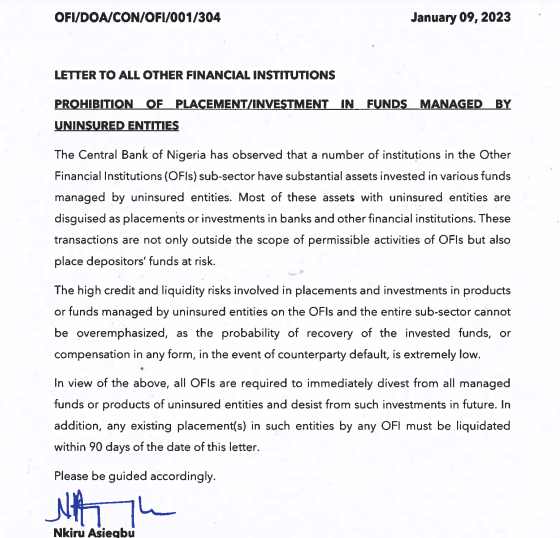
The Central Bank of Nigeria CBN on the 9th of January, 2023 formally released a circular in response to the widespread practice of Other Financial Institutions (OFIs) having substantial assets invested in various funds managed by uninsured entities.

Most of these assets were typically designed as placements or investments in banks & OFIs and as a result,not only fell outside the scope of permissible activities of OFIs but also placed depositors funds at risk.

The high credit & liquidity risk to OFIs involved in placements and investments in products or funds managed by uninsured entities cannot be overemphasized as the probability of recovering such invested funds or compensation in any form,  in the event of counterparty default, is low.

Consequently, this led to the CBN directing in its circular that all OFIs are required to immediately :-

– Divest from all managed funds or products of uninsured entities and to desist from such investments in future.

– Liquidate within 90 days of the release of the CBN letter/circular, all existing placements in such entities.


Submission of Abia State Governorship Transition Council Recommendations to Dr. Alex Otti

1
Good People, today, the Abia State Governorship Transition Council submitted the recommendations for the development and advancement of Abia State to Dr. Alex Otti, Governor-elect of Abia State.
 
On behalf of all our members, I want to thank everyone who contributed in the surveys and commentaries we posted here as part of our processes on this assignment. Your generosity with knowledge and broad fellowships are appreciated.
 
The next bus stop is #execution. And Mr. Governor-elect will drive it. We The People are Ready. Abia is open for business and your investments.
 
May the good Lord bless Abia, the God’s Own State, and bring the fulfillment of “prosperity through enterprise” which is encapsulated in the coat of arms.
 
Prof Ndubuisi Ekekwe
-Co-Chair, Abia State Economic Transformation Transition Council