DD
MM
YYYY

PAGES

DD
MM
YYYY

spot_img

PAGES

Home Blog Page 4182

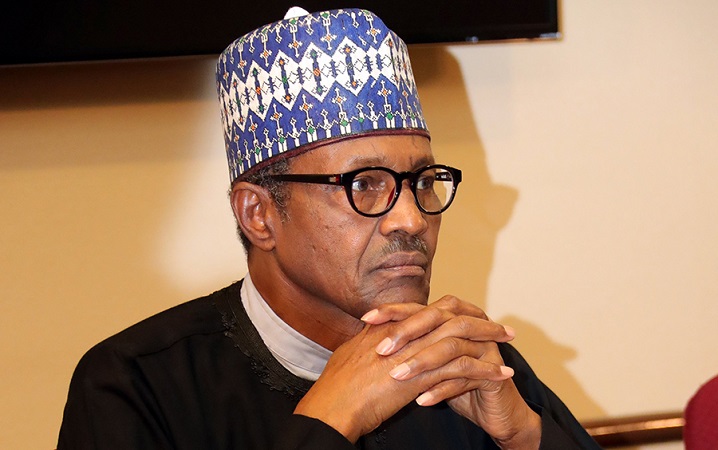
Buhari’s Failed Promises, Policies and Nigerians’ Memories of His Dark Foot Prints

0

In 2015, when Muhammadu Buhari won the presidential election, actualizing his long-term dream to lead Nigeria for the second time – after his dictatorial spell as a military head of state, a large section of the country was filled with hope of a better future.

The hope, which was evident in the Sai Baba mantra and its emotionalism – buoyed by overwhelming clamor for leadership change, eclipsed the scanty voices calling out his antecedents.

During his campaign pre-2015, Buhari, in the All Progressive Congress (APC) policy document and manifesto, made nearly 100 promises to Nigerians. He promised among many things to: Make Nigeria one of the fastest-growing, emerging economies in the world with a real GDP growth averaging 10% annually; eradicate state of origin, replacing that with state of residence to ensure Nigerians are Nigerians first, before anything else; creation of 720,000 jobs by the 36 states (20,000 per state) in the federation per annum; generate, transmit and distribute at least 20,000 MW of electricity within four years and increasing to 50,000 MW with a view to achieving 24-7 uninterrupted power supply within 10 years.

Buhari also promised to ban all government officials from seeking medical care abroad; preserve the independence of the central bank and strengthen INEC to reduce, if possible, eliminate electoral malpractices in Nigerian’s political life.

These promises kept the bubbles of Sai Baba emotionalism afloat, as they were largely anchored on the perception of Buhari as Mr. Integrity, who is incorruptible, and who has, based on his military background, the will to execute his promises.

But on the eve of the inauguration of Buhari’s successor, Bola Ahmed Tinubu, whose election is being challenged in the Presidential Election Petition Tribunal (PEPT), Nigerians, looking back at the past eight years – rued the time, decisions, events and memories that characterized Buhari’s presidency.

“He led the country without any economic direction. He presided over a Government that failed to secure the lives of Nigerians; 63k dead, 3m IDPs & 366k refugees in neighboring countries. He failed to restructure as he promised. He granted waivers to the rich & impoverished the poor,” Senator Shehu Sani wrote.

The Nigerian economy started on a downward trend soon after Buhari assumed office, erasing the progress made under the preceding government. One of his most impactful economic policies was the closure of land borders and the ban on some food importation, especially rice, which experts believe to have contributed immensely to food inflation hitting its highest level in years at more than 24%.

In its November 2022 ‘Nigeria Poverty Assessment’, report, the World Bank noted that the economic progress recorded by Nigeria between 2001 and 2014, stagnated from 2015, owing to poor economic policies that ensued after Buhari became president.

“Nigeria’s development progress has stagnated. Between 2001 and 2014, Nigeria was a rising star in West Africa, with an average growth rate of seven percent per year, and it ranked among the top 15 fastest-growing economies in the world.

“However, this trend ended abruptly in 2015, as oil prices fell, the security situation deteriorated, macroeconomic reforms were reversed, and economic policies became increasingly unpredictable,” it said.

Buhari was also accused of nepotism, which resulted in the appointments of unqualified men into key positions of leadership. “He appointed & retained failures and rewarded them with extensions,” Sani added.

The abysmal economic performance, which Buhari’s critics said could only be compared to the nation’s economic performance during his time as the military Head of State, became the star of all his other failed promises.

Against this backdrop, the naira took a nosedive – falling to its lowest level in history at more than N800/$1 at the parallel market – following repeated devaluations.

With the economy in shambles, Buhari’s promises to make Nigeria one of the fastest-growing economies in the world with a real GDP growth averaging 10% annually, and to facilitate the creation of 720,000 jobs by the 36 states in the federation per annum, gradually became wishful thinking. It was exacerbated by his failure to increase power generation to 50,000 MW with a view to achieving 24-7 uninterrupted power supply within 10 years.

In July 2015, during his official state visit to the United States, Buhari in his address at the United States Institute of Peace (USIP), made the infamous 97% – 5% speech while answering a question on how he plans to protect the interest of Niger-Deltans.

“I hope you have a copy of the election results. The constituents, for example, who gave me 97% [of the vote] cannot in all honesty be treated on some issues with constituencies that gave me 5%,” Buhari said to Dr. Pauline Baker, the President Emeritus of The Fund for Peace.

His response riled up a national concern about his promise to “eradicate state of origin, replacing that with state of residence to ensure Nigerians are Nigerians first, before anything else.” Months later, Buhari would show his commitment to the above statement by carrying out what is believed to be lopsided appointments that sidelined the South-south and Southeast regions of the country.

Buhari went further, in a rare interview with ChannelsTV, to describe the Southeast region as “a dot in a circle,” lending credence to the belief that he’s indignant toward the Igbos. The former president is believed to be the most divisive leader that Nigeria has ever had, with many saying that since the civil war, Nigeria has never been divided like it was under his leadership.

On February 5, 2016, eight months after assuming office, Buhari went on his first medical trip to London, the United Kingdom; a trip which eventually culminated in more than seven months of medical tourism, breaching again his campaign promise, this time – in the most hypocritical way.

As Nigeria’s economic situation bites harder, following the plunge in oil revenue, the Buhari-led administration took to borrowing. In eight years, the federal government had moved Nigeria’s public debt profile from N12.6 trillion in 2015 to over N46 trillion in 2023. The staggering debt includes N23 trillion the federal government illegally borrowed from the Central Bank of Nigeria through Ways and Means advancement. The Ways and Means allows the CBN to lend to the federal government. But under the CBN Act, the central bank is not allowed to lend more than 5% of the total revenue generated by the federal government the previous year.

That blatant disregard for the CBN Act, flagrantly opposed Buhari’s promise to preserve the independence of the central bank.

Toward the end of his second term, Buhari signed the Electoral Bill into law. The Electoral Act was seen as a recipe for credible election in line with the former president’s promise to strengthen the Independent National Electoral Commission (INEC) to reduce, or if possible, eliminate electoral malpractices in Nigerian’s political life.

This was seen as a parting gift from the president. With the changes in electoral laws, which allow for the use of technology such as Bimodal Voter Accreditation System, BVAS, and the IREV to be used for accreditation and transmission of results from polling units to the INEC portal in real time, Nigerians were hopeful of free and fair election.

But as it turned out, the election was marred by allegations of irregularities that significantly compromised the credibility of the results and questioned the integrity of the electoral umpire.

“Public confidence and trust in INEC were severely damaged on 25 February due to lack of transparency and operational failures in the conduct of the federal level polls,” the European Union Election Observation Mission noted about the election.

Based on the conduct of the election which failed to follow electoral laws, many believe that the Electoral Act was after all, a Greek gift from Buhari. To a large section of Nigerians, Buhari’s promise of credible election is prominent among his failed promises.

Besides his promises

Besides Buhari’s failure to keep many of his promises, other events born of his decisions left indelible dark marks on his leadership and dented what’s left of his image before most Nigerians, especially the youths.

In 2020, Nigerian youths took to the streets to protest incessant harassment, extortion and killings by the Special Anti Robbery Squad, SARS, a rogue police unit. The protest eventually turned into a global movement. It was described as the most successful protest that has ever happened in Nigeria.

Startled by the relentless determination of the youths to stay in the streets until their demands, which included the disbandment of SARS and the improvement of police welfare – are met, the Lagos State government, in collaboration with the federal government, unleashed soldiers on the protesting youths, killing and injuring many.

A panel of inquiry set up by the Lagos State government a year later, found that officers of the Nigerian Army “provocatively and unjustifiably” shot live bullets and killed several protesters at the Lekki Tollgate, and then took their corpses away.

The incident, which is widely known as Lekki Massacre, drew worldwide condemnation.

But prior to that, there were mass killings of members of the Islamic Movement of Nigeria (IMN) also known as Shiites and members of the Indigenous People of Biafra (IPOB) by the Nigerian security agents under Buhari’s watch.

As Buhari handed the baton to Tinubu on the 29th of May, many Nigerians are happy that they will never have to live under his leadership again. But his footprints, notable in the 133 million Nigerians that fell under multidimensional poverty, more than 18 million jobs lost, 33.3% unemployment rate, booming corruption, 63,000 deaths and grossly divided nation; will remain a lifetime in the minds of many.

The World Bank said that “it would take roughly a decade for Nigeria to return to the level of GDP per capita seen in 2014.”


Investor Panic: Dogecoin (DOGE) and Shiba Inu (SHIB) Prices Dive Amid TMS Network (TMSN) Growing Popularity

0

Both Dogecoin (DOGE) and Shiba Inu (SHIB) have experienced significant price falls, leaving investors uncertain about their holdings. However, amidst this chaos, one emerging player, TMS Network (TMSN), has been quietly gaining popularity and offering a glimmer of hope.

Dogecoin (DOGE) Dismays Investors as Elon Musk Issues a Word of Caution

The once-beloved Dogecoin (DOGE) has fallen from grace, leaving investors in dismay. Elon Musk, who previously championed Dogecoin (DOGE), has issued a word of caution against investing heavily in this meme token. At a conference in London, he advised against putting all of one’s wealth into Dogecoin (DOGE), emphasizing that it may be unwise to do so. While Musk still finds humor and charm in Dogecoin (DOGE), its recent price fall cannot be ignored. The decline in Dogecoin’s (DOGE) value can be attributed to various factors. The fall in investors’ interest in Dogecoin (DOGE), and the collapse of prominent companies like FTX have taken a toll on digital assets. Dogecoin (DOGE) is currently trading at just over $0.07. Dogecoin (DOGE) has plummeted by 90% from its high of $0.74. These significant losses highlight the risks associated with investing in speculative assets like Dogecoin (DOGE).

Shiba Inu (SHIB) Struggling to Find Solid Ground

Similar to Dogecoin (DOGE), Shiba Inu (SHIB) has also suffered setbacks in recent times. Despite showcasing increasing activities across its test network, including over 11 million transactions processed over the Puppynet testnet, Shiba Inu (SHIB) has struggled to maintain its value. The mainnet launch, expected later this year, could potentially act as a catalyst for the Shiba Inu (SHIB) token’s revival. However, Shiba Inu (SHIB) faces stiff competition in the form of established Layer 2 network solutions like TMS Network (TMSN). Shiba Inu (SHIB) community’s goal of reducing the circulating supply through token burns has been met with mixed success. The current price of Shiba Inu (SHIB) stands at $0.00000862, a considerable drop from its all-time high of $0.000032. While the community remains hopeful, Shiba Inu’s (SHIB) struggle to gain solid ground raises concerns among investors. Shiba Inu’s (SHIB) value has dropped 73.33% from its all-time high. Despite the community’s efforts to burn Shiba Inu (SHIB) tokens and establish a strong base, the current market conditions have made it challenging for the token to maintain its momentum.

TMS Network (TMSN): A Beacon of Stability and Growth Amidst Market Turbulence

Amidst the turbulence in the market, TMS Network (TMSN) is acting as a beacon of hope for investors seeking stability. With its advanced tools and features, TMS Network (TMSN) empowers traders to make informed decisions and effectively manage risks. One of TMS Network’s (TMSN) key strengths lies in its scalability. Together with the decentralized nature of TMS Network (TMSN), this scalability factor facilitates community trading among token holders, and fosters a sense of ownership. Since its inception, TMS Network (TMSN) has made steady progress, garnering attention through its impressive price performance. With its presale opening at $0.003, TMS Network (TMSN) has experienced a remarkable surge, currently trading at $0.097 — a staggering 4300% increase in value. Moreover, TMS Network (TMSN) has raised $6 million, demonstrating the confidence and support it has garnered from investors. As the market grapples with the uncertainties surrounding Dogecoin (DOGE) and Shiba Inu (SHIB), TMS Network’s (TMSN) growing popularity comes as a breath of fresh air.


Presale: https://presale.tmsnetwork.io/

Website: https://tmsnetwork.io/

Telegram: https://t.me/tmsnetworkio

Twitter: https://twitter.com/tmsnetwork_io

Tradecurve to support it’s traders with Automated Trading (AI) feature rival Binance to launch NFT Loan Feature

0

Tradecurve is a hybrid exchange that features trading algorithms, ones that utilize artificial intelligence trading systems and have a proven track record, and can provide increased profitability for investors. The competing exchange Binance also announced that its NFT marketplace now features a new borrow feature for NFTs. We will analyze both of these projects to see which one can provide more value in the long term.

>>BUY TCRV TOKENS NOW<<

Binance and Its NFT Loan Feature

Binance, as an exchange, features a dedicated marketplace for non-fungible tokens (NFTs). This marketplace recently introduced a feature through which users have the ability to borrow cryptocurrencies by using their NFTs as collateral. At launch, the NFT marketplace supports only Ethereum borrowing against blue-chip NFTs, such as Ape Yacht Club (BAYC), Mutant Ape Yacht Club (MAYC), Azuki, and Doodles.

The interest rate on NFT loans is 7.91% p.a., and loan to value ratio can range between 40% to 60%, based on data gained from the official Binance NFT website. There are also no gas fees or Ethereum transaction fees that occur on each trade. As of May 26, 2023, BNB (BNB), the utility token of Binance, trades at $306.21. In the last 30 days, BNB saw a decrease in its value by 11.2%. In the last week alone, it’s down 1.2%. This new feature could bring the altcoin to new heights, but for the time being, it is still in the red zone.

>>BUY TCRV TOKENS NOW<<

Tradecurve and Automated Trading with AI

The Tradecurve exchange is at the forefront of technological advancements and enables algorithmic trading. Through this feature, each user can utilize an algorithm powered by artificial intelligence that will enhance and optimize the performance of their portfolio.

As centralized exchanges like Binance require users to complete a KYC procedure and have hefty fees associated with other trades that are a part of its offering. Moreover, it can be difficult to navigate through for newcomers.

>>BUY TCRV TOKENS NOW<<

Tradecurve is a new, innovative exchange that combines the best elements of DEXs and CEXs to provide a truly borderless and inclusive experience. Users are not required to complete the KYC procedure, and the exchange features the lowest fees in the industry.

In addition, Tradecurve is fully decentralized, which means that users control their own assets and can hold their own private keys. It also implements Proof of Reserves (PoR) to maintain transparency and features its own trading academy so that newbies can get familiar with using it.

During its Stage 2 presale, the TCRV utility token behind Tradecurve trades at $0.012. Analysts predict that its value can jump 50x during the presale and 100x at launch.

The team also plans on onboarding 100,000 new users during its first three months of operation, and the token will get listed on Tier-1 CEXs and on Uniswap.

For more information about TCRV presale tokens:

Website: https://tradecurve.io/

Buy presale: https://app.tradecurve.io/sign-up

Twitter: https://twitter.com/Tradecurveapp

Telegram: https://t.me/tradecurve_official

Kenyan President William Ruto Urges African Leaders to Embrace Pan-African Payments to Reduce Reliance on US Dollar

0

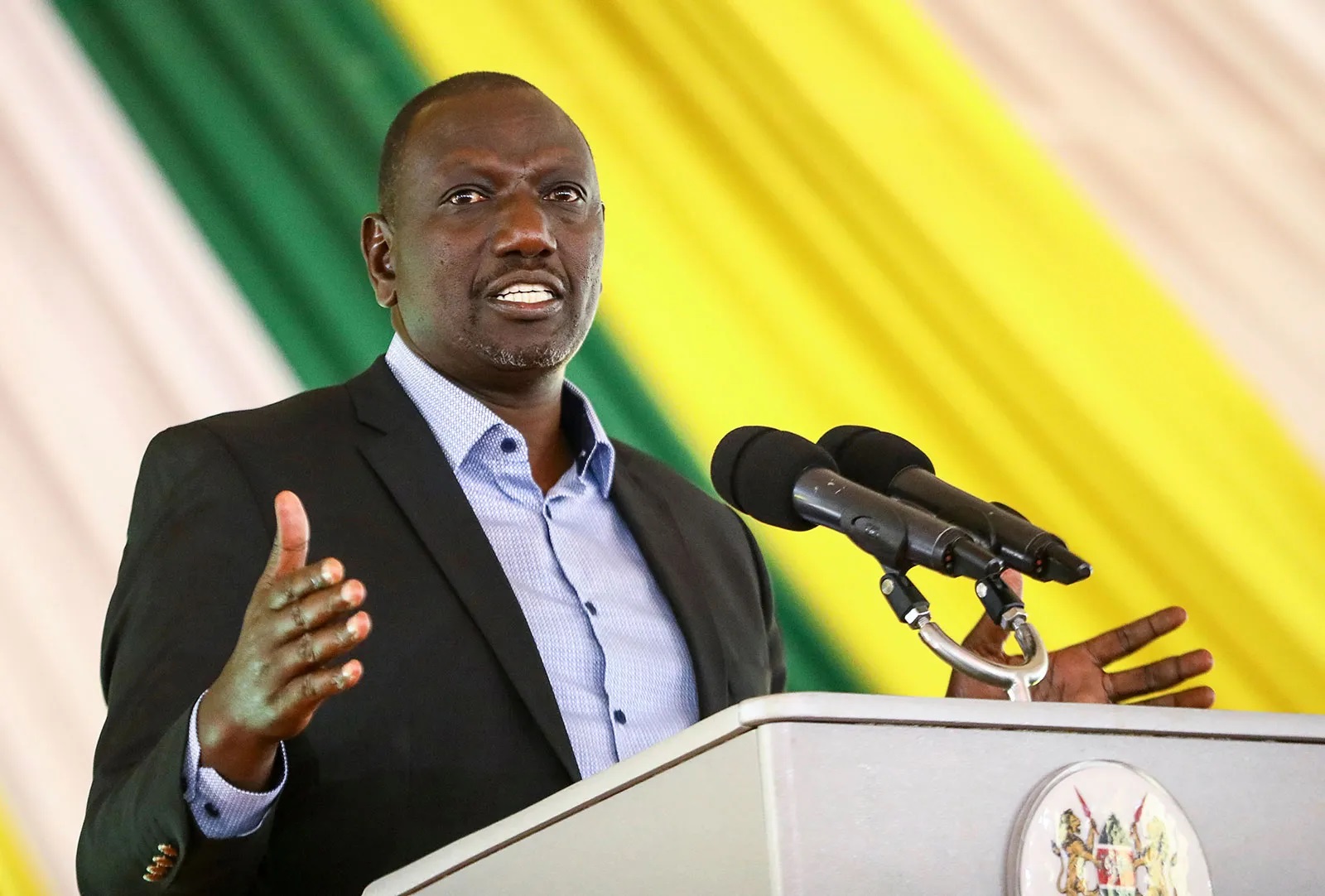
Kenyan President William Ruto has called on all African leaders to embrace pan-African payments to reduce reliance on the globally-bullish US dollar.

Speaking at a forum on the African Continental Free Trade Area (AfCFTA) on Monday, Ruto urged his peers in Africa to mobilize central and commercial banks to join Pan-African Payments and Settlement System (PAPSS) which was formed in January 2022.

He expressed concerns over the challenges faced by African countries and local banks, who often rely on correspondent banks in the US and Europe to complete payments between African currencies, resulting in delays and additional charges.

In his words,

“We are all’ struggling to make payments for goods and services from one country to another because of differences in currencies. And in the middle of all these, we are all subjected to a dollar environment. There has been a mechanism where all our traders can trade in the local currency and we leave it to the Afreximbank to settle all the payments. We do not have to look for dollars; our businessmen will concentrate on moving goods and services and leave the arduous task of currencies to Afreximbank.

“I suggest that we have a mechanism where we can settle all our payments whether between our countries or externally using our local currencies. And we have a mechanism like the one that has been put up by the Afreximbank so that we don’t have to be hostage to any one currency. Without a single payment platform, payment instructions from one African country to another typically pass through several intermediary financial institutions, leading to increased costs, complications, problems, and unnecessary currency fluctuations and it ends up being a whole ecosystem of confusion.”

A 2021 business day report revealed that African countries with 42 different currencies are losing $5 billion annually, which is why intra-African trade is constrained and the Small and Medium Enterprises (SMEs) are the most affected. The current reliance on US dollars has led to a mismatch between demand and supply, causing importers including oil marketers and manufacturers to face difficulties. The shortage of the dollar has also put pressure on the Kenyan shilling, which saw it depreciate by 12.1% since the beginning of the year.

This saw Ruto call for the adoption of PAPSS in the wake of challenges faced by Kenya, such as fuel shortages and economic problems attributed to a dollar shortage. Reports reveal that African traders and their local banks are using correspondent banks, usually in Europe to complete payments between two African currencies largely in dollars, and sometimes in euros. Payment usually takes up to three to five days to get to the recipient’s bank.

Importers such as oil marketers and manufacturers have since last year complained of a gaping mismatch in demand and supply of the US dollars, prompting them to buy it in batches and levels way above the official rate. The Kenya Association of Manufacturers, for example, last year said the dollar crunch strained relations with suppliers at a time competition for raw materials had intensified due to rising demand amid lingering supply chain constraints.

The unit has remained under sustained pressure from the US dollar due to higher demand than supply in a high-inflation environment that has seen investors shift their assets to a haven. Kenya suffered an acute shortage of fuel which the oil marketers largely linked to delays in releasing cash for fuel subsidies creating cash flow challenges, while the government accused the firms of hoarding the commodity.

As part of efforts towards addressing this challenge, AfCFTA is reportedly working with Afreximbank to establish a Pan-African Payment and Settlement System (PAPSS), which will enable Africans to transact in real-time on a digital platform with some entity in other parts of the continent using their local currency, so they will not have to worry about converting to a dollar, Euro, or any currency.

As more countries move away from the US dollar, there is a growing shift in the focus on international trade. Countries are increasingly looking to trade with each other using their currencies, rather than using the dollar as a medium of exchange. This shift has the potential to reshape the global economy, as it could reduce the dominance of the US and increase the influence of other countries.

One of the main benefits of using alternative currencies in international trade is that it can reduce the risks associated with exchange rate fluctuations. When countries trade using the dollar, they are exposed to the risk of fluctuations in the value of the dollar, which can impact the profitability of their trade. By using their currencies, countries can reduce this risk and ensure that they are not impacted by external factors beyond their control.

China’s UnionPay Takes The Crown On Debit Cards

0

UnionPay, the gigantic Chinese payment company, has overtaken Visa on the global debit card market, commanding 40.03% in 2022, with Visa 38.8%, on settlement volume of $16.227 trillion and $14.109 trillion respectively. A decade ago, Visa held 80% of the market while UnionPay was just around 1-2%. The country called China has bulldozed itself into the center of the world economy in many domains.

The Report

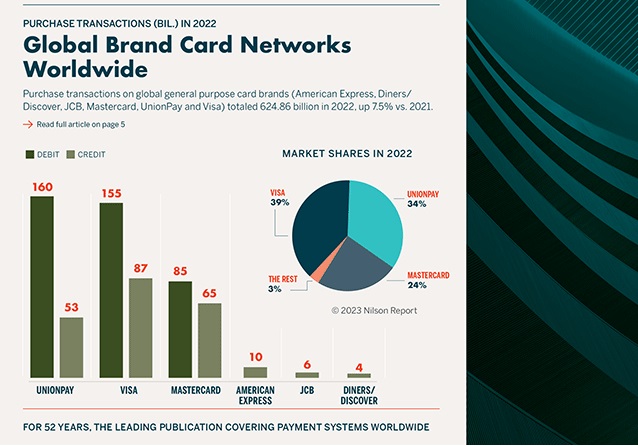
Credit, debit and prepaid cards carrying the brands of Visa, UnionPay, Mastercard, American Express, JCB and Diners Club/Discover—the global card networks—generated a combined 624.86 billion purchase transactions worldwide for goods and services in 2022, up 7.5% over 2021. Consumer, small business and commercial card products are included in those purchase transactions. All debit card figures mentioned in the text and used in the charts and tables on this page and pages 6, 7 and 8 include prepaid cards.

Of all global network purchase transactions worldwide in 2022, Visa brand credit and debit cards generated a 38.76% market share. This was a decline of 10 basis points (bps) from 38.86% in 2021. Visa credit cards generated 38.73% of credit card purchase transactions, an increase of 121 bps. Visa’s share of debit card transactions was 38.78%, down 82 bps.

UnionPay credit and debit cards accounted for a 34.04% share of global network purchase transactions, a slip of 4 bps from 2021. Debit cards with the UnionPay brand held a market share of 40.03% of all debit card purchase transactions, an increase of 139 bps. The market share for UnionPay credit cards among all credit card purchase transactions was 23.45%, a decrease of 230 bps.

Credit and debit cards with the Mastercard brand held a 24.00% market share of all global network purchase transactions worldwide, down 11 bps from 2021. Debit cards with the Mastercard brand held a 21.19% share of all debit card purchase transactions, a decline of 57 bps. Mastercard brand credit cards had a 28.97% share of all credit card purchase transactions, up 56 bps.

American Express credit card purchase transactions had a 4.61% market share of all global network credit products in 2022, up 37 bps from 2021. JCB cards had a 2.53% share, up 12 bps. Diners Club/Discover cards had a 1.72% share, up 4 bps.

Debit cards accounted for 63.88% of total purchase transactions on the global networks in 2022. This was a decline of 78 bps from 2021. For Visa, debit card purchase transactions were 63.91% of the network’s worldwide total, down 198 bps. UnionPay purchase transactions were 75.12% debit, an increase of 182 bps. Mastercard purchase transactions were 56.40% debit, a drop of 196 bps.

Total volume—purchases of goods and services combined with cash advances and withdrawals—was $40.645 trillion in 2022, a local percentage increase of 4.4% over 2021. Visa and Mastercard cards combined accounted for 54.83% of total volume, an increase of 283 bps. UnionPay cards generated 39.93%, a decline of 357 bps. American Express, JCB and Diners/Discover accounted for 5.24%, up 75 bps.

Debit card purchase volume, which excludes debit card cash withdrawals, tied to UnionPay, Visa and Mastercard cards reached $16.711 trillion in 2022. This was up 1.2% from 2021. Credit card purchase volume for all network brands, which excludes credit card cash advances, reached $19.462 trillion, up 8.7% from 2021.

When comparing worldwide purchase volume—spending for goods and services—by product type, UnionPay debit cards had the largest market share for the 10th consecutive year. The second-largest product based on 2022 purchase volume was UnionPay credit cards, followed by Visa credit cards (which overtook Visa debit cards), Mastercard credit cards, Mastercard debit cards, American Express credit cards, JCB credit cards and Diners Club/Discover credit cards.

UnionPay cards accounted for $44 of every $100 in purchase volume handled by the global networks. This was down from $48 in 2021. Mastercard and Visa combined accounted for $50 of every $100, up from $47 in 2021. Visa cards accounted for $32 of every $100. Mastercard cards accounted for $18 of every $100.

On the Visa global network, credit cards accounted for 50.40% of its credit and debit card purchase volume, an increase of 248 bps from 2021. Credit cards accounted for 56.63% of Mastercard’s global purchase volume for all products, an increase of 104 bps. On the UnionPay global network, credit cards accounted for 49.02% of its credit and debit purchase volume, an increase of 61 bps.

When measuring only credit card purchase volume for all global networks, UnionPay held a 39.91% market share, a drop of 487 bps versus 2021. Visa credit cards held a 30.22% share, an increase of 218 bps. Mastercard’s credit card share grew 154 bps to 19.11%. American Express’s share grew 98 bps to 7.92%. JCB’s share was up 7 bps to 1.60% and Diners Club/Discover’s share was up 9 bps to 1.25%.

When measuring only debit card purchase volume, UnionPay’s market share fell 342 bps to 48.33%. Visa’s share increased 160 bps to 34.63% and Mastercard’s share grew 182 bps to 17.04%.

Cash withdrawals using debit cards plus cash advances using credit cards reached $4.471 trillion in 2022. This was 11.00% of total global network volume. In 2021, that figure was 11.64%.

Global network brand credit, debit and prepaid cards in circulation reached 16.72 billion at the end of 2022, up 4.2% from 2021. Of the global total, UnionPay cards accounted for 56.49%, down 101 bps from 2021. Visa cards held a 25.09% share, up 76 bps. Mastercard cards held a 16.23% share, up 12 bps. JCB’s share was 0.91%, up 2 bps. American Express’s share was 0.80%, up 4 bps, and Diners Club/Discover’s share was 0.48%, up 6 bps.

Visa, Mastercard, American Express and Discover credit cards issued in the US generated $5.451 trillion in purchase volume in 2022, an increase of 19.5%. US credit cards accounted for 28.01% of all global network credit card purchase volume.

Their market share grew 252 bps over 2021. Purchase volume tied to credit cards issued outside the US increased 5.1% to $14.012 trillion.

Mastercard credit card purchase volume generated by cards issued in the US grew 21.8% to $1.320 trillion. Outside the US, purchase volume on Mastercard credit cards increased 16.4% to $2.399 trillion. Visa purchase volume from credit cards issued in the US reached $2.840 trillion, an increase of 18.2%. Outside the US, credit card purchase volume tied to Visa cards grew to $3.041 trillion, an increase of 16.3%. American Express purchase volume generated by US credit cards reached $1.080 trillion, an increase of 20.9%. Amex credit cards issued outside the US increased 32.6% to $460.39 billion.

Purchase volume on Visa and Mastercard debit cards issued outside the US was $4.526 trillion, an increase of 11.3% over 2021. Purchase volume on debit cards issued in the US reached $4.109 trillion, up 5.4%.

Mastercard purchase volume tied to debit cards issued outside the US grew 21.6% to $1.728 trillion. Purchase volume on Mastercard debit cards issued in the US increased 2.6% to $1.120 trillion. Visa purchase volume tied to debit cards issued in the US grew 6.5% to $2.989 trillion. Outside the US, Visa debit card purchase volume grew 5.7% to $2.798 trillion.

Purchase transactions initiated by Visa credit cards issued in the US increased to 31.25 billion, up 14.1%. Outside the US, Visa credit card purchase transactions grew to 56.17 billion, up 13.0%. Debit card purchase transactions tied to Visa cards issued in the US were up 5.7% to 60.78 billion. Outside the US, Visa debit card purchase transactions reached 94.03 billion, up 2.9%.

Credit card purchase transactions tied to Mastercard cards issued in the US totaled 14.02 billion, an increase of 18.3%. Outside the US, Mastercard credit card purchase transactions grew to 51.37 billion, up 10.4%. Debit card purchase transactions initiated by Mastercard cards issued in the US were up 0.2% to 23.26 billion. Outside the US, Mastercard debit card purchase transactions reached 61.32 billion, up 4.7%.