DD
MM
YYYY

PAGES

DD
MM
YYYY

spot_img

PAGES

Home Blog Page 4187

The United States’ $31.4 trillion Debt Ceiling and The Wisdom from Uwadiegwu

1
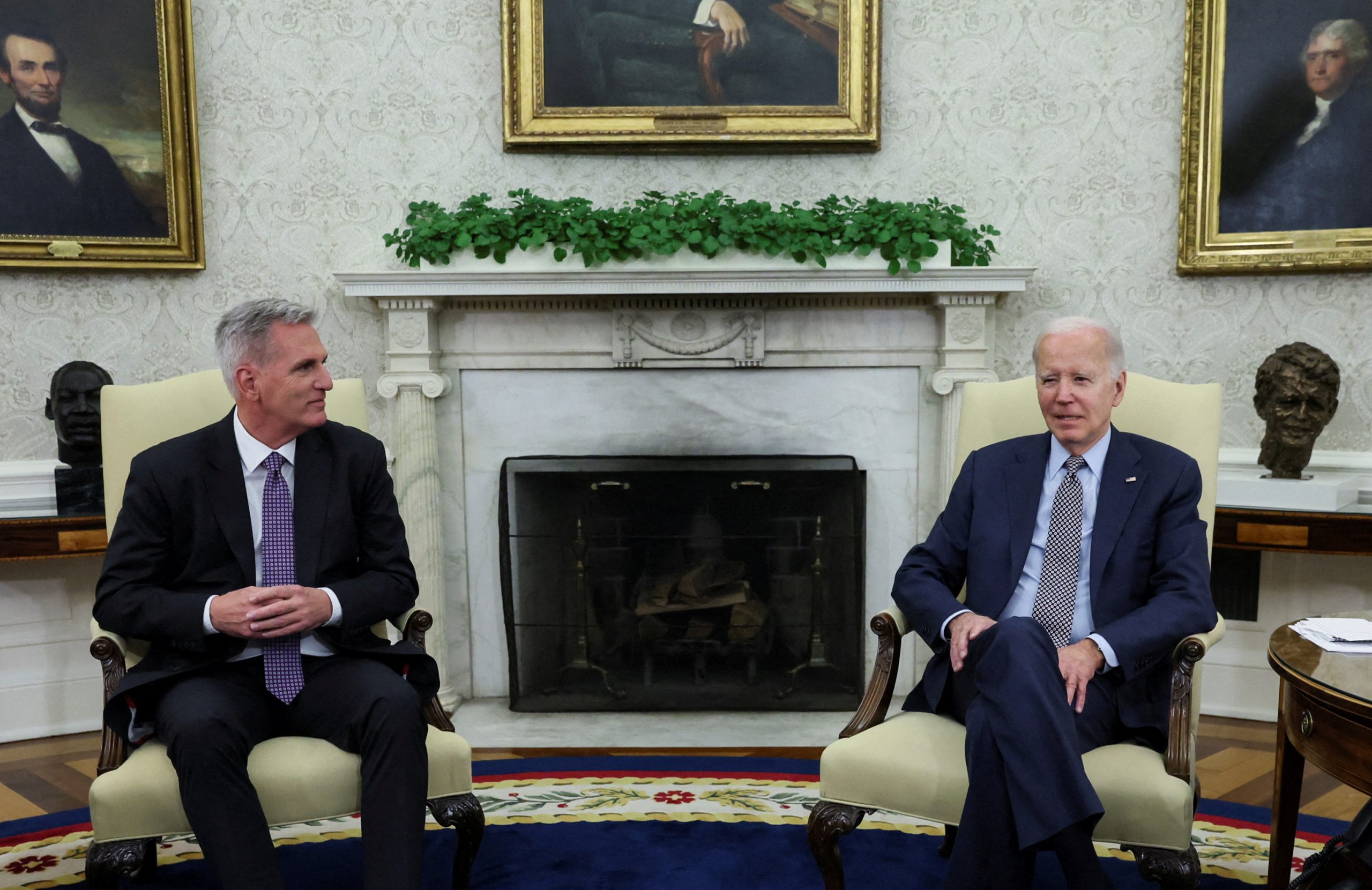
FILE PHOTO: U.S. President Joe Biden hosts debt limit talks with U.S. House Speaker Kevin McCarthy (R-CA) in the Oval Office at the White House in Washington, U.S., May 22, 2023. REUTERS/Leah Millis

Only in America. Yes, “The US Senate has passed a bipartisan bill to raise the nation’s debt ceiling… averting a potential default on the nation’s obligations.” It is very magical how one country could do this and markets will cheer in ecstasy. If any other country tries it as America does in perpetuity, it will receive downgrades from rating agencies.

The Senate passed the debt ceiling bill late Thursday in a 63-36 vote, sending the legislation to President Joe Biden to sign, and avoiding a potentially calamitous default. The Fiscal Responsibility Act suspends the country’s $31.4 trillion debt ceiling until 2025 and cuts federal spending. The Treasury Department had indicated that June 5 was the date the government would run out of cash. Biden said he would sign the bill into law as soon as possible, and he is expected to address the nation at 7 p.m. EDT on Friday.

The bill would: End Biden’s freeze on student-loan payments, Accelerate energy and infrastructure projects, and Expand the age/work requirements for those who receive food aid

In business, we call it positioning. It is that state where head, tail and in between, you win. Because of the US dollars, the United States has this positioning that it cannot be affected by debts in ways other countries could be.

In an Igbo novel (Uwadiegwu), the man dropped a great hint: when you borrow, go to your kinsman so that if the debt goes bad, he may lock you up but at the same time he would be expected to take care of your family since he is your kinsman! That is how debts work: pains are lesser when the debt is home. America borrows dollars and they’re responsible for printing dollars. No other country enjoys that combo.

Next year – America will raise the debt ceiling again. And the trajectory continues. You will be jealous of that economic positioning.

The US Senate has passed a bipartisan bill to raise the nation’s debt ceiling and avoid a default on its obligations. The bill, which was approved by the House of Representatives on Wednesday, will now go to President Joe Biden for his signature. The US Senate raised the debt ceiling by $2.5 trillion, averting a potential default on the nation’s obligations.

Debt ceiling is the legal limit on how much money the federal government can borrow to pay its bills. It covers spending that Congress has already authorized, such as Social Security benefits, military salaries, interest on the national debt and more. The debt ceiling does not authorize new spending; it only allows the government to pay for what it has already agreed to spend.

Comment on Feed

Comment 1: Thank you for this exposé, Prof. Ndubuisi Ekekwe. The America Empire has always positioned itself to win Head or Tail. Its strategic governance, reliability, openness to criticism, and continuous process of fine-tuning its politico-economic playbook have made it possible to be believed whenever it makes moves like this.

Will this continue forever? I don’t know. But no matter the issue, America will still hold the ace for at least the next 50 years.

Whatever it’s worth, the Debt Market is rejoicing at this news!

Comment 2: Prof, yes we can say it’s positioning because at the time the World needed someone to trust post-World War 2, at Bretten-Woods conference, America proved itself to be trustworthy and based on that trust, Dollars was pegged to Gold and other countries pegged theirs to dollar. However, ever since in 1970s, the gold peg to the dollar was removed by President Nixon, global trade consummated in dollars has continued to boost the dollar.

But it’s just mind blowing the privileges the US enjoy. I once argued with a friend that only in US did I see drama on debt ceiling and investors supposedly bought dollars as their safe haven( Yes you heard right! People struggling to buy the currency of a country that’s about to default in its obligations).

I must commend US either ways as they have shown trust and transparency in managing their exchange rate. Even the world may not trust the BRICS with its reserve as these economies are not free economies and dictatorship are very much common.
America has built strong institutions that rescue nations and companies in time of distress. This act remains lacking in Russia and China where all major help comes directly from government.

My Response: American has done well. Winning anything at a global level is never a birthright. But they need to watch BRICs


US Senate Passes National Debt Ceiling by $2.5 Trillion

0

The US Senate has passed a bipartisan bill to raise the nation’s debt ceiling and avoid a default on its obligations. The bill, which was approved by the House of Representatives on Wednesday, will now go to President Joe Biden for his signature. The US Senate raised the debt ceiling by $2.5 trillion, averting a potential default on the nation’s obligations.

Debt ceiling is the legal limit on how much money the federal government can borrow to pay its bills. It covers spending that Congress has already authorized, such as Social Security benefits, military salaries, interest on the national debt and more. The debt ceiling does not authorize new spending; it only allows the government to pay for what it has already agreed to spend.

Why was the debt ceiling an issue?

The US government has been operating under a temporary suspension of the debt ceiling since August 2019. That suspension expired on July 31, 2021, and since then, the Treasury Department has been using extraordinary measures to keep paying the bills without exceeding the limit. However, those measures were expected to run out by Monday, according to Treasury Secretary Janet Yellen. If that happened, the US would have faced a default on its obligations for the first time in history, which could have triggered a financial crisis and a recession.

After months of partisan deadlock, President Biden and House Speaker Kevin McCarthy reached a deal on Monday, to raise the debt ceiling by $480 billion, enough to cover the government’s borrowing needs until early December 2024. The deal also included a two-year budget agreement that set spending caps for defense and nondefense programs, as well as some provisions to reduce spending and increase revenues.

The House passed the bill on Wednesday, by a vote of 271-165, with 50 Republicans joining 221 Democrats in support. The Senate followed suit on Thursday, by a vote of 63-36, with 17 Republicans joining 46 Democrats in support.

Implications of the bill

The bill will allow the US government to avoid a default and continue paying its bills until early December 2024. It will also provide some fiscal certainty for the next two years by setting spending levels for defense and nondefense programs. However, it will not resolve the underlying issue of the debt ceiling, which will likely resurface again in December when the new limit is reached. Moreover, it will not address the long-term challenges of reducing the national debt and balancing the budget, which will require bipartisan cooperation and hard choices on spending and taxes.

The bill will allow the US to pay its existing debts and avoid a default that would have severe economic consequences.

The bill will also set spending limits for defense and nondefense programs, with some adjustments for Covid relief funds, IRS funding and energy projects.

The bill will resume federal student loan payments, impose work requirements for some welfare recipients, and extend the debt ceiling until after the 2024 presidential election.

Bitcoin Recovers momentum after a Bearish May

0

Bitcoin is facing its first monthly decline of 2023, as the cryptocurrency market struggles to maintain its momentum after a brief recovery earlier this year. According to Coin Metrics, Bitcoin lost about 4.6% of its value in May, ending the month at around $26,950. This is the worst monthly performance for Bitcoin since November 2022, when the FTX exchange collapsed and triggered a massive sell-off in the crypto space.

The main factors behind Bitcoin’s slump include the rising interest rates by the Federal Reserve, which have dampened the appeal of alternative assets, and the increasing competition from other cryptocurrencies and blockchain applications, such as Ether and Ordinals.

The latter are a new type of non-fungible token (NFT) that use the smallest unit of Bitcoin to store media on the blockchain. While some see Ordinals as a way to expand Bitcoin’s use cases and network activity, others argue that they deviate from Bitcoin’s original purpose as a peer-to-peer electronic cash system.

Despite the monthly loss, some analysts remain optimistic about Bitcoin’s long-term prospects, citing its strong fundamentals and growing adoption by institutional and retail investors. They also point out that Bitcoin is still up more than 60% since the start of the year, and that volatility is a natural feature of the crypto market.

However, others warn that Bitcoin may face further challenges in the coming months, such as regulatory uncertainty, environmental concerns, and technical issues. – Bitcoin is facing increasing competition from other cryptocurrencies that offer faster transactions, lower fees, and more privacy.

Bitcoin’s dominance in the market has declined from over 80% in 2017 to less than 40% in 2023, as more investors diversify their portfolios with alternative coins. Bitcoin’s scalability issues have not been resolved despite several attempts to upgrade the network, such as SegWit and Lightning Network.

Bitcoin’s environmental impact has become a major concern for regulators and consumers, as the network consumes more electricity than some countries and generates a large carbon footprint. Bitcoin’s volatility and security risks have deterred some institutional investors and mainstream adoption, as the price fluctuates unpredictably and hackers target exchanges and wallets.

Bitcoin Real-Time (BRTI) is an index that tracks the price of bitcoin across major exchanges in real time. In May 2023, BRTI showed a volatile and bearish trend, with several candlestick patterns indicating a reversal or a continuation of the downtrend.

Some of the notable patterns that occurred in May 2023

Engulfing Bearish (1M): This pattern formed at the end of May, suggesting a strong selling pressure and a possible change in the trend direction.

Doji Star Bearish (1M): This pattern formed in February and was confirmed in March, indicating indecision and uncertainty among traders and investors.

Three Inside Up (1D): This pattern formed on May 26, signaling a bullish reversal after a downtrend. However, it was not followed by a strong upward movement and was soon overshadowed by the Engulfing Bearish pattern.

Evening Doji Star (15): This pattern formed on May 29, indicating a bearish reversal after an uptrend. It was followed by a sharp decline in the price.

The chart movement of BRTI in May 2023 reflected the overall sentiment and events in the crypto market, such as the launch of Ethereum’s Shanghai upgrade, which improved its scalability and reduced its gas fees, boosting its price and popularity. Lastly, the increased regulatory scrutiny and crackdown on crypto exchanges and mining operations in China, which caused fear and uncertainty among crypto investors and miners.

Capillary Technologies Raises $45 Million in Series D Funding Round to Expand to Global Market

0

Leading cloud-based omnichannel platform Capillary Technologies has raised $45 million in a Series D funding round to expand into the global market and widen its reach through mergers and acquisitions.

The funding round was led by Avataar Ventures and its LPs Pantheon, 57 Stars, and Unigestion. It also saw participation from InnoVen Capital and Filter Capital.

Speaking on the funds raised, founder and managing director of Capillary Aneesh Reddy said,

With this new funding, we are poised to expand our footprint in North America and Europe and pursue strategic acquisitions that align with our vision of becoming the preeminent loyalty company globally”.

Also speaking on the recent funds raised, managing partner at Avataar Ventures Mohan Kumar said,

It has been remarkable witnessing Capillary’s business transformation over the past four years. The strategic decision to diversify from Asia into the US and Europe, encompassing various consumer verticals beyond retail, has been short of impressive. This move has catapulted Capillary into a leadership position in loyalty software and this has been recognized by external mentions like the Forrester Wave. Given the expanded addressable market and the immense potential that lies ahead, Avataar is wholeheartedly committed to supporting Capillary in its pursuit to become a global market leader”.

Founded in 2012 by Reddy, Ajay Modani, and Krishna Mehra, Capillary Technologies through its Software As A Service (SaaS) products, helps large corporations around the world to grow amidst changing consumer expectations, collect more data and insights into their consumers and business with Capillary’s comprehensive AI-powered consumer experience platform.

Capillary platform provides enterprise-ready security features enabling its customers to operate safely. It has a presence across the United States, India, the Middle East, and Asia, in particular, Southeast Asia.

The company claims to have worked with over 250 brands, which includes Tata, PUMA, Shell, Al-Futtaim, Petron, Domino’s, Kanmo Group, and Marks & Spencer. Capillary’s platform currently powers over 100 loyalty programs across more than 30 countries and it claims to have a reach of over one billion consumers, processing more than 5 billion annual transactions.

Over the last decade, Capillary has built expertise across a wide range of industries- Fuel Retail, CPG, Conglomerates, Aviation, Hospitality, and Retail (Apparel, Footwear, Hypermarkets, F&B, Luxury and Jewelry, CD & IT, Health and Beauty).

Notably, it witnessed exceptional growth in the United States, expanding 3.5 times since the acquisition of Persuade in 2021. The US now accounts for more than a third of Capillary’s revenue. The company thrives on making customer-focused choices through validation, continuous feedback, and co-creation with customers that result in better solutions.

Stripe Rolls Out Credit Card to Make it Easier For Small Businesses to Access Capital

0

Financial services company Stripe has rolled out credit cards for customers to enable fintech to create and distribute credit cards for customers, providing new revenue streams and giving easier access to capital for small businesses.

Stripe revealed that this service will allow other fintech platforms to create virtual or physical cards that customers can spend on credit, rather than funds in their account.

Speaking on the rollout of the card, the Head of Product for BaaS at Stripe Denise Ho said,

“Whether a small business is just starting or looking to expand, access to capital can make all the difference. Our new charge card allows FinTechs and SaaS platforms to provide access to a reliable source of credit for the many small businesses they work with”.

Stripe stated that these cards will provide new revenue streams for platforms and provide smaller businesses with easier access to capital. Also, the new service will remove some of the challenges other platforms would face in developing their credit offerings, such as repayment collection and licensing requirements.

The fintech’s charge card scheme will offer adjustable settings, so businesses can set individual credit limits and repayment schedules. The program runs on Stripe Issuing, which the company claims already supports around half a million transactions per day.

The charge card offers will be linked with other Stripe services, as platforms will be able to use features like Invoicing and Checkout when they need to collect repayments.

While supporting the finances of small businesses, Stripe said this scheme will also make funding easier for platforms offering credit, as funds issued out can be sent back to Stripe after the transaction settlement date.

Also, businesses can set individual credit limits and repayment schedules, including flexible weekly, monthly, or set-day repayment options. When businesses need to collect repayments from customers, they can use Stripe’s suite of products, including no-code and embeddable options like Invoicing and Checkout.

The charge card program also provides flexible funding options for platforms. Once a card is used to purchase, the transaction must be funded. Most charge card programs require the platform offering the card to cover the

transaction immediately, which forces platforms to maintain large cash balances.

For its part, Stripe will make money off interchange fees, so as customer volume grows and users spend more, the financial giant will earn more.

Launched in 2011, Stripe has been investing in global payments and treasury networks to help solve the pain point for ambitious, global platforms and marketplaces that want to connect retailers with consumers. The financial giant’s remarkable offering has seen Millions of companies of all sizes from startups to Fortune 500s, use Stripe’s software and APIs to accept payments, send payouts, and manage their businesses online.

Stripe makes moving money as easy and programmable as moving data. Also, users can use Stripe not only to accept payments but also to quickly support new markets, upgrade existing systems and tools, go direct-to-consumer, and engage customers with subscriptions and marketplaces.