DD
MM
YYYY

PAGES

DD
MM
YYYY

spot_img

PAGES

Home Blog Page 4249

FTX (FTT) Surges Amid Reopening Rumors, How Will This Impact Uniswap (UNI) and Collateral Network (COLT)?

0

The FTX (FTT) scandal caused havoc throughout the cryptocurrency market, attracting bad publicity and causing investors to lose millions. While a new team attempts to relaunch the exchange, the rumors of a reopening caused a spike in the price of FTX (FTT) before its value gradually declined. So what could a reopening mean for Uniswap (UNI) and Collateral Network (COLT)?

>>BUY COLT TOKENS NOW<<

FTX (FTT) Price Spike Followed By Slow Decline

On April  12, rumors caused the value of FTX (FTT) to spike to $2.56, almost doubling its previous value of $1.32. This caused on-chain activity to spike exponentially, with 879 new addresses being created in just two days. Additional rumors now suggest that FTX (FTT) has managed to recover over $7.3 billion in cash and liquid crypto assets, which could potentially turn the project around.

While this is huge news for token holders and individuals who formally held assets on the FTX (FTT) exchange, not everyone is confident. Many analysts are still bearish toward FTX (FTT), and the tokens value has dropped by 18.64% in the last five days alone.

Despite this decrease, the value of FTX (FTT) is 20% higher than its price just one month before, which suggests we could see an FTX (FTT) revival in 2023.

>>BUY COLT TOKENS NOW<<

Uniswap (UNI) Price Slips 10% In The Third Week Of April

Over the past week, the value of Uniswap (UNI) had dropped from over $6 to $5.33. This decline has triggered a crash in trading volume, with many investors selling their Uniswap (UNI) tokens to buy better-performing cryptocurrencies. The decrease has been linked to Bitcoin (BTC) falling below $30k, thus triggering a decline in Uniswap (UNI) trading.

Given that Uniswap (UNI) is a decentralized exchange, some investors also believe that the growing influence of regulation could further impact its price. Although Uniswap (UNI) continues to offer a number of great decentralized options, exchanges such as Kraken have already been fined by the SEC.

As a result, Uniswap (UNI) could attract unwanted attention from regulators, which would significantly influence Uniswap (UNI) operations and the Uniswap (UNI) token value.

Collateral Network (COLT) Could Revolutionize Crowdlending

While FTX (FTT) rumors flood the crypto market, Collateral Network has been gaining traction with market experts. The project has already increased in value by 40% and is on track for further growth as its presale is selling out.

Collateral Network (COLT) is the world’s first DeFi project that lets individuals unlock liquidity from their real-world alternatives assets on the blockchain. Instead of selling the asset forever, individuals can take a short-term loan against them to unlock liquidity.

Collateral Network solves many of the issues associated with the $trillion traditional lending sector, offering affordable rates and a seamless borrowing experience.

Borrowers can receive cash within 24 hours, and loans never impact their credit file. With borderless transactions, individuals can also borrow and lend worldwide without worrying about exchange rates or complex fees.

Colt tokens are selling fast with only 38% of the total tokens available to purchase. With demand far outstripping supply  predictions anticipate the price going as high as $0.35 in the next six months. Current price is $0.014 so there is a lot of upside potential in getting involved in the project now.


Find out more about the Collateral Network presale here:

Website: https://www.collateralnetwork.io/

Presale: https://app.collateralnetwork.io/register

Telegram: https://t.me/collateralnwk

Twitter: https://twitter.com/Collateralnwk

The Nigeria’s Huge Voice Translation Opportunity

0

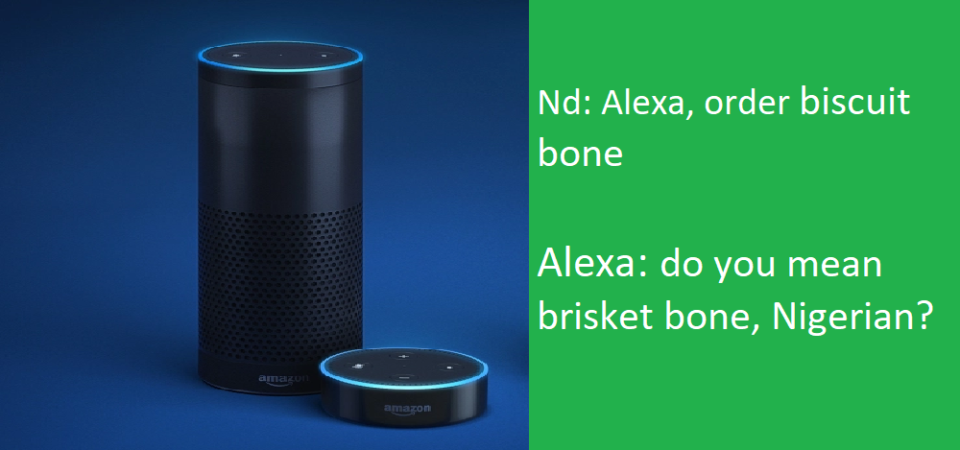
Amazon’s Alexa, an  intelligent personal assistant, “discriminates”. It struggles with my nice Nigerian accent. It gets so bad that most times I just give up.  Sure, it is not Alexa’s problem. It is also not my problem. But someone has to make it easy for me to participate in the voice-activated ecosystem.

My accent is truly Nigerian. I keep working to make sure I do not lose it. In Ovim,  I asked  “redy made” cloth instead of “already made” cloth. I knew I ate many “biscuit bones” when I had in mind “brisket bones”. Coming with that background, I am making life harder for Alexa!

If you are dreaming, there is a business opportunity here. After all, the BBC has gone pidgin. Alexa needs to interpret that also. This is huge because in the next ten years, translators will be gone like typists, and our phones will do translations synchronously. The question is this: Will Nigerians be part of that? Only Nigerian  entrepreneurs can help, because that is not a Silicon Valley problem! I want to be understood, digitally!

Nigeria’s Alexa Opportunity


Amazon is Developing an Efficient Large Language Model to Power Voice-Enabled Assistant Alexa

0

Giant tech company Amazon is developing a more generalized and capable large language model (LLM) to power its voice-enabled assistant Alexa.

During the company’s first-quarter earnings call, Amazon CEO Andy Jassy disclosed that the company has an LLM that powers Alexa, but it is working to develop a more improved model than the current one. Jasst believes that an improved LLM will help the company in working towards its goal of building the world’s best assistant.

In his words,

We’ve had a large language model underneath it, but we’re building one that’s much larger and much more generalized and capable,” Jassy said. “And I think that’s going to rapidly accelerate our vision of becoming the world’s best personal assistant. I think there’s a significant business model underneath it.”

Jassy further disclosed that Amazon’s vision to build the world’s best personal assistant would however be difficult across a lot of domains which is a very broad surface area. He however acknowledged that the advent of Large language models (LLM) and Artificial Intelligence (AI) has made such models more effective.

Jassy went on to say that he believes Amazon has a good starting point with Alexa, as it has a couple of hundred million endpoints being used across entertainment, shopping, and smart homes. He also noted that there is a lot of involvement from third-party ecosystem partners.

It is however interesting to note Amazon wasn’t the only company that proposed to invest in AI during its first quarter earnings call, other tech giants such as Meta, Alphabet, and Microsoft, also disclosed their investment plans in large language models.

With all the hype surrounding ChatGPT, it’s no surprise that major tech companies are looking to incorporate LLM-based improvements to their offerings to keep up with the fast-paced AI space. The arrival of OpenAI chatbot ChatGPT last year marked the clear coming out of a different kind of LLM as the foundation of generative AI and transformer neural networks. They are increasingly heralded as a revolutionary disruption of AI.

In the last two years, LLM has been reported to quietly expand AI’s impact in healthcare, finance, gaming, robotics, etc, and functions including enterprise development of software and machine learning. These language models have been proven to be flexible and capable to answer deep domain questions, translate languages, comprehend and summarize documents, and many more.

The creation of specialized software and tools has made LLM more feasible and within reach, propelling new use cases. New advances are already driving a wave of innovation in AI and machine learning. For enterprises, LLMs offer the promise of boosting AI adoption hindered by a shortage of workers to build models.

With just a few prompts, LLMs can easily be leveraged by organizations without AI expertise which is a huge plus. Many analysts have predicted that LLM will continue to mature and grow rapidly.

The outlaw of barbaric cultural practices in Nigeria

0

Culture and tradition and their corresponding practices have always been a symbol of African communities.

Despite the wide spread of civilization and Western culture that tends to have overshadowed some African cultural practices, some conc cultures and traditions that are deeply rooted are still practiced in some African cities alongside the adopted Western cultures but some cultural practices have outlived their acceptance and usefulness.

The old Yoruba empires like Oyo, Ekiti, Ijebu, Iwo, Akure etc are known for their facial tribal marks. Tribal marks are symbols of identity in that region. You can only be identified as a member of that community through the tribal marks inscribed on you by your parents or guardians at birth. For instance, one can easily identify an Ijebu person (even up to date) merely by the strokes of lines on his face inscribed on him as a tribal mark at birth.

There is also a tribe in South Africa, as a way of their own cultural identity, community members who belong to that culture cut their index fingers immediately after birth. That barbaric act stands as a mark of identity or their own tribal marks.

Another African tribe known as the Danis tribe located in the Southern and Eastern regions of Africa till date also practices a jungle culture and tradition which requires “Finger Cutting” as well. The Women of the tribe must cut off a part of their fingers when a member of the family does. While in some other cultures, women are to (as a matter of cultural and traditional obligation ) shave their heads or rub themselves with mud when a family member dies.

Members of these cultural communities who do not identify with these cultural and traditional practices are regarded as outcasts or infidels.

Thank God for civilization and Westernization. Most of these rituals, cultures and traditions are getting outlawed hugely because of westernization and civilization and also due to the fact that most of these cultures and traditions are (in all honesty) mundane, barbaric, inhuman or “repugnant to natural justice, equity and good conscience”, and they are also some health concerns surrounding it. For instance, female genital mutilation or female circumcision which is practised in some cultural communities as we have come to know placed the girl child at grave health risk; as for tribal marks, babies can be infected or permanently disfigured with the sharp (unsterilized) objects that are used to tear their flesh in the name of tribal mark placements.

These cultures and rituals are no longer accepted and now jungle practices, hence why some have been outlawed. Some of the notable cultural and traditional practices that have been outlawed in Nigeria include female circumcision and tribal marks. Female circumcision which used to be a big deal in some Nigerian communities has been outlawed in Nigeria and it is now a criminal offense to mutilate female genitals in the name of circumcision. So also, tribal marks on babies have as well been outlawed in some states in Nigeria and it is a criminal offense to inscribe a man on a baby in the name of placing a tribal mark.

In Oyo State, for example, one of the provisions of the Child Rights Law is the prohibition of tribal marks on babies. According to the law, “No person shall tattoo or make a skin mark or cause any tattoo or skin mark to be made on a child” and as a punishment for offenders, the law imposes a fine or one-month imprisonment or both for violation.

A child when grown up and has attained the age of majority can consciously decide if he or she wants a tribal mark or not but that decision is never to be made by the parents or guardian.

Conservatives can argue that cultures and traditions are the foundation upon which African communities are built and allowing civilization to overshadow African cultures and traditions may not end well but we can all see for ourselves that some of the old cultures are mundane, inhumane and barbaric, hence why it is necessary to put laws in place to checkmate some of those cultures and outlaw the ones that are out of place.

The unregulated BBL (Brazilian butt lift) industry in Nigeria: a death trap

0

The new current wave amongst ladies in Nigeria today is the Brazilian butt lift. It is the goal of most ladies to save up money so as to be able to afford it. It is the new rave and the proliferation of corresponding quack bbl clinics intending to satisfy this craving needs amongst young ladies in Nigerian big cities like Lagos and Abuja is worrisome.

Bbl is now the new social status symbol and Quack doctors are beginning to take advantage of desperate young ladies who aspire to enlarge their asses, offering them a cheap and affordable service and at the same time putting them at risk.

Due to the fact that the Nigerian BBL industry is yet to be regulated, it has been posing a grave concern as many young ladies have died due to health complications arising from BBL they did in quack clinics while the fortunate ones are down with incurable infection they got as a result of the procedure. Dr Anu’s (an infamous Lagos-based BBL surgeon) case is one of those that made it to the public hence why we have been raising the alarm that an unregulated BBL industry in Nigeria is surely a death trap.

During Dr Anu’s infamous BBL scandal, more than ten ladies spoke up about the health challenges they have been facing since they passed through the surgical blade of Dr. Anu, in her clinic in Lagos. Some of those ladies unfortunately died.

The Lagos state government may have closed down Dr Anu’s clinic and the medical board may have withdrawn her medical license but there are other numerous clinics out there that have also been risking the lives of young ladies in Nigeria and the cases are yet to make it to social media. Just this year I have been briefed twice by different ladies who are having health complications ever since they underwent a bbl procedure in a popular Abuja-based bbl clinic.

This is why the Nigerian government need to step in to regulate this industry so as to crack down on quack doctors and save the lives of numerous young ladies and here are some ways the Nigerian government can control BBL operations in Nigeria, especially through legislation

1. Legislation should be passed mandating that only licensed and certified surgeons are allowed to open and run a bbl clinic, with this legislation, quack doctors will be fished out and prosecuted. Being just a doctor does not qualify one to carry out a BBL surgery on a patient, BBL is a surgical procedure and it must be carried out by certified, certificated and licensed surgeons alone.

2. Legislations as to standards for the facilities where BBL procedures are performed should be made. It should not just be any kiosk. This standard should include the procedure equipment, location, staffing, post-surgery care equipment and infection control procedures.

3. Laws should be made to place limits on the amount of fat that can be transferred from the stomach to other parts of the body during a BBL procedure. This can help reduce the risk of fat embolism which is one of the complications faced by BBL patients after the procedure.

4. The Legislation should require that all adverse events related to BBL procedures must be reported to the government control board which will now carry out investigations as to what went wrong.

5. Regular reporting and unprecedented visitation by government bodies to the bbl clinics to ensure they are abiding by regulations.

6. Advertising and soliciting especially on social media should be banned. The law should prohibit the advertisements of BBL procedures so as to ensure that patients are not misled or given unrealistic expectations.

7. Continuing education requirements: Legislations can require that BBL surgeons undergo continuing education and training to stay up-to-date on the latest techniques and safety standards.

The earlier these laws are passed the better it will be for the Nigerian society.