DD
MM
YYYY

PAGES

DD
MM
YYYY

spot_img

PAGES

Home Blog Page 4258

The world order is broken!

0
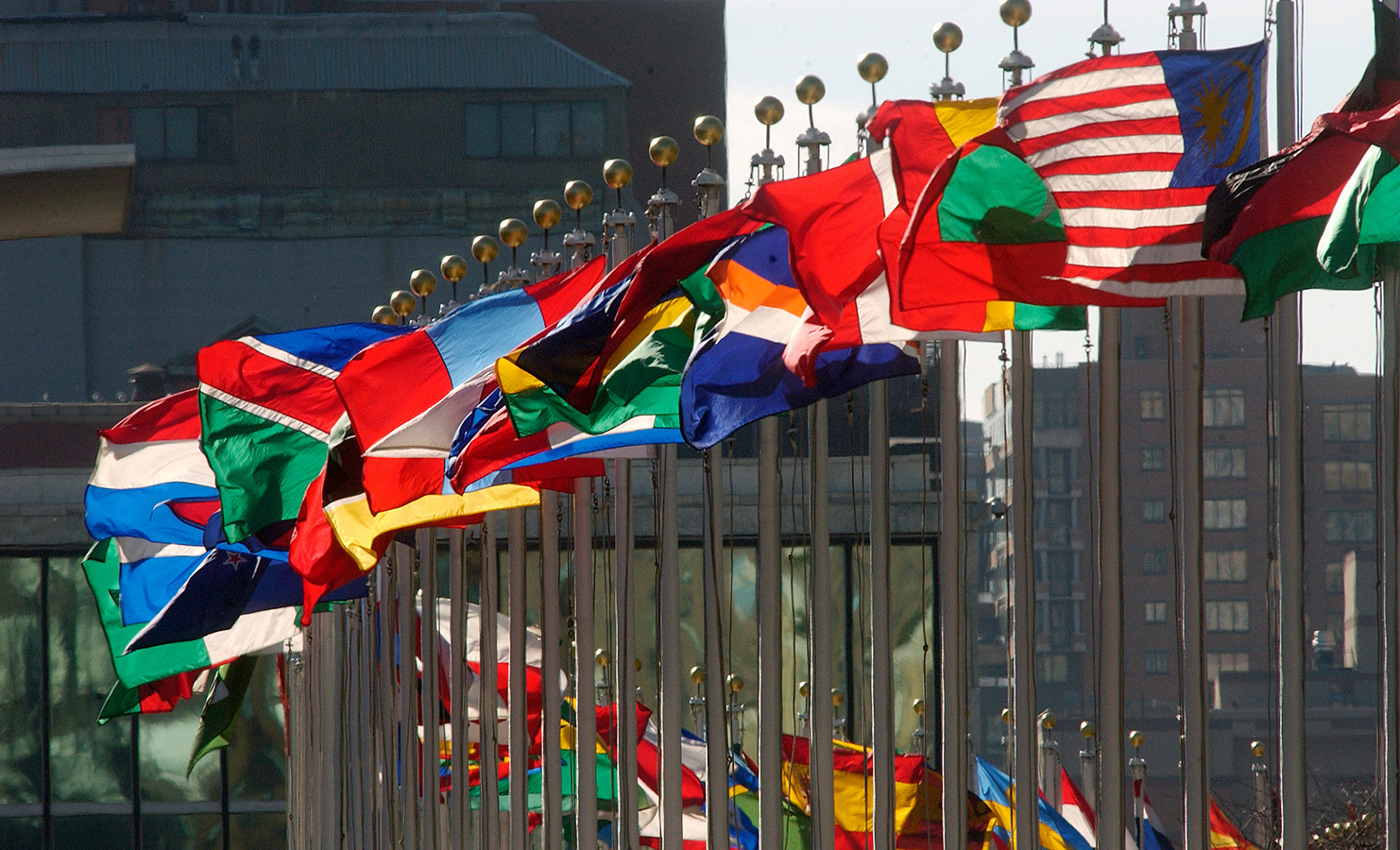
Flags of member nations flying at United Nations Headquarters.

The world order is broken. Yes, anyone can do anything now and justify it at the level unthinkable within a few months  after the fall of Saddam Hussein. Even Libya’s Gaddafi disarmed (a big mistake he would later posit) when he felt the splash of the Iraqi effervescence. As Azerbaijan reminds us that it has weapons to use, which part of the world is stable now? As you watch all these events, from emboldened coup plotters to imperialists, one thing is clear: a new global order is evolving, and all orders begin with military adjustments.

If you are a fund manager, model that by 2035, the probability of a major global war should be closer to 1. The question right now is where that war will begin. CNN just told us that Ukraine has used drones to bomb some targets in Sudan. Sure, it claimed they were Wagner (Russian) fighters in Sudan.

Ukrainian special services were likely behind a series of drone strikes and a ground operation directed against a Wagner-backed militia near Sudan’s capital, a CNN investigation has found, raising the prospect that the fallout from Russia’s invasion of Ukraine has spread far from the frontlines.

Speaking to CNN, a Ukrainian military source described the operation as the work of a “non-Sudanese military.” Pressed on whether Kyiv was behind the attacks, the source would only say that “Ukrainian special services were likely responsible.”

That is scary because if that principle applies, every part of the world is now a frontline. We hope some of these leaders wake up from slumber before really bad things happen on this planet earth!

Zimbabwe Government Makes U-turn on Starlink Approval, Reviews License Application

0

The Zimbabwe government has reportedly made a U-turn on Starlink’s approval in the country, following confirmation that the satellite internet provider license application is currently under review.

This was disclosed by the Zimbabwe Minister of Information, Publicity, and Broadcasting Services minister, Jenfan Muswere.

Muswere stated that the application is currently under review by the Postal & Telecommunications Regulatory Authority of Zimbabwe (POTRAZ). It is anticipated that the application will likely be approved.

The Minister made the remarks during a meeting with editorial executives of privately-owned media organizations.

In his words,

“What I remember is that they submitted their application for licensing and POTRAZ was still going through that application. Of course, we want to see it approved.

“It’s not possible to have fiber-optic cables across the country. It’s a reality that we need satellite technology for communication purposes. What we want as the government is a situation where every citizen from Binga to Chiredzi is also connected. That’s what the government wants, to leave no one behind”.

Recall that on the 1st of September, Zimbabwe’s Postal and Telecommunications Regulatory Authority (POTRAZ) cautioned the Elon Musk-owned Starlink users and dealers that they must have required licenses before being allowed to operate the internet service.

The regulators proposed two options for Starlink to either apply directly for a license or partner with local operators in the country to offer its services.

The Zimbabwean authorities also expressed concerns about companies distributing Starlink’s products nationwide. It cautioned local resellers to obtain a virtual network operator (VNO) before they could operate Starlink services in the country.

Reports reveal that Starlink is expected to launch its satellite internet services in Zimbabwe in the last quarter of 2023, as stated on its website.

However, the final approvals from the Postal & Telecommunications Regulatory Authority of Zimbabwe (POTRAZ) are taking longer than anticipated.

The Elon Musk-owned satellite internet has been poised as a potential solution to the limited internet, especially in remote areas of Zimbabwe where it is economically unfeasible for mobile phone companies to install towers due to sparse populations.

While Starlink offers faster internet speeds of up to 200Mbps, compared to the average internet speed in Zimbabwe, the service however comes at a higher price. Its affordability remains a concern, given that Zimbabwe is a low-income country faced with several development challenges.

Although, many Zimbabweans are hopeful that Starlink’s entry into the country will spur other internet service providers to reduce their prices.

Jodie and Mary: The Legal Principle of Killing One Twin to Save The Other

0

In the year 2000, the news about a conjoined twin spread around the world, the twins the media chose to name Mary and Jodie so as to protect their real identity.

Having seen the critical condition of the twins, the doctors advised that it would be better to kill one of the twins so as to save one. Jodie is the stronger twin and has a high chance of survival but Mary is the weaker one with a slim chance of survival. The dilemma being that if they are both left conjoined they will both die and it is the professional advice of the doctors that surgery should be carried out to save Jodie the stronger twin but Mary will likely die. 

The parents of the twins protested against this advice. The parents said that they could not allow any of the twins to be sacrificed for the other and that if the both twins cannot survive separation surgery the doctors should not carry it out. 

The matter was tabled before the court and the core issue for determination was can the court allow one person to be killed or sacrificed in order to save the other person. Can the court give an order permitting the doctors to carry out the surgery that will lead to the immediate death of Mary for the survival of Jodie? 

In delivering judgment, Lord Justice Brooke declared the situation as one of necessity and called for the allowance of a lesser evil. The court being the court of law and not the court of morality can make judgments out of necessity allowing the option of lesser evil for the greater good. The lesser evil being that it is better for the weaker twin to be sacrificed for the survival of the stronger twin instead of allowing both of the twins to die which will be the case if the surgery is not immediately carried out. 

One of the Justices also hinted that despite the wishes of the parents of letting their twins be instead of separating and killing one, the children’s interest is paramount and supersedes the wishes of the parents. 

The court therefore gave the go-ahead for the doctors to carry out the surgery. After the surgery, as anticipated, Mary, the weaker twin died but Jodie was saved.

This case gave rise to the philosophical debates that demonstrate the relationship between law and morality in today’s legal jurisprudence. 

Dangote Refinery to Begin Production in October, to Sell Refined Products in Dollars

0

Dangote Refinery is set to receive its initial shipment of crude oil within the next two weeks. Starting in October, the refinery is poised to commence production at a capacity of up to 370,000 barrels per day (bpd) of diesel and jet fuel, according to a senior company executive who spoke to S&P Global Commodity Insights.

This is coming after the company failed to meet an earlier production deadline, previously set for August. The deadline was set in May during the official inauguration of the refinery by former president Muhammadu Buhari.

In an exclusive interview with S&P Global, Devakumar Edwin, the Dangote Group Executive Director responsible for overseeing the $19.5 billion refinery project, provided insights into the project’s production timeline. He discussed the flow of crude oil and various petroleum products, shedding light on the challenges and delays that have plagued the project since its initial proposal in 2013.

“Right now I’m ready to receive crude,” said Edwin. “We are just waiting for the first vessel. And so as soon as it comes in we can start.”

Edwin, formerly in charge of Dangote Cement, revealed that the refinery’s launch will occur in stages. The initial phase will involve the production of 350,000-370,000 barrels per day (bpd) of diesel and jet fuel. This phase is expected to commence in October, coinciding with the completion and online operation of key units such as the crude distillation unit, sulfur block, and hydrogen plant.

Then on November 30, he said, the refinery will start the phased ramp-up to 650,000 bpd, around half of it petrol, the key area of Nigerian fuel demand.

Edwin said the delay is a result of some issues surrounding the refinery’s construction site. He explained that after buying 33 square km of land in Lagos state for $100 million, the team found more than 70% of the plot was swamp and spent a year clearing it.

“Then, faced with the possibility of rising sea water claiming the land in the next 70 years, Dangote spent $50 million elevating the land by 1.5 meters.
“We had to hire the world’s largest dredger, second largest dredger, and third largest dredger to… pump in about 65 million cubic meters of sand,” he said.

In June, Energy Times reported that the Dangote Refinery had reached an 88% completion stage. However, there were still some equipment deliveries pending from manufacturers, and the ones that had been installed had not yet undergone the necessary integrity tests for commissioning. The report also highlighted that various aspects of the production lines, including electrical work, were significantly delayed.

Since the August deadline elapsed, speculations have grown around the production commencement of Dangote Refinery, with a report that it has received a license to import petroleum products.

According to S&P Global analysts, the Dangote Refinery is not expected to reach its full operating capacity until around mid-2025, and there is a possibility of further delays. Despite these delays, forecasts from S&P Global indicate that Nigeria’s production of petrol is expected to surpass imports until the 2040s, largely due to the contributions of the refinery once it becomes fully operational.

Although the refinery was designed to process light sweet Nigerian crude, state-owned Nigerian National Petroleum Company (NNPC) Limited, which is a shareholder in the project, cannot supply the refinery until November, Edwin said, so Dangote is buying oil from trading houses. Vitol and Trafigura recently carried out inspections of the plant, he said.

“At the last minute [NNPC] said, ‘We have actually committed our crude on forward basis to someone else’, so immediately they don’t have the crude,” he said. This is a temporary issue, and the refinery should run on exclusively Nigerian crude by November, he said.

That Nigerian oil will be purchased in US dollars, not naira as some reports had suggested, because it is located in a free zone on the outskirts of Lagos, Edwin said. However, NNPC will supply some crude at knockdown prices due to its equity stake.

Edwin said the scale of the refinery meant being “solely dependent on Nigerian crude would not be advisable”, meaning the refinery can process most African crudes, apart from heavy Angolan grades, as well as Middle Eastern Arab Light and even US light tight oil.

“We can even take some of the Russian grades… if the global system opens up to allow us to receive [them],” he said.

Atiku, Obi File Appeals Challenging PEPC Judgment Upholding Tinubu’s Victory

0

The presidential candidate of the Labour Party, Mr. Peter Obi, has submitted a petition with 51 grounds of appeal to the Supreme Court, seeking the annulment of the judgment from the Presidential Election Petition Court, as well as the election victory of President Bola Tinubu.

Former Vice President and the presidential flagbearer of the Peoples Democratic Party (PDP), Atiku Abubakar, also filed an appeal on 35 grounds challenging the ruling of the court.

The appeals are coming nearly two weeks after the Presidential Election Petition Court (PEPC) quashed all the charges filed against Tinubu by Atiku, Obi, and the Allied Peoples Movement (APM).

In his notice of appeal, Mr. Peter Obi argued that the Presidential Election Petitions Court made legal errors and arrived at an incorrect conclusion when it dismissed his petition challenging the outcome of the presidential election.

He contends that the five-member tribunal, led by Justice Haruna Tsammani, committed a miscarriage of justice by asserting that he did not specify the polling units where irregularities occurred during the election.

Furthermore, Mr. Obi criticizes the Presidential Election Petitions Court for dismissing his case based on the premise that he did not provide specific figures for the votes or scores that were allegedly manipulated in favor of President Tinubu and the All Progressives Congress (APC).

Additionally, he accuses the panel of making a legal error by relying on paragraphs 4(1) (d) (2) and 54 of the First Schedule to the Electoral Act 2022 to strike out paragraphs of his petition.

Mr. Peter Obi has accused the lower court of violating his right to a fair hearing. He asserts that the evidence provided by his witnesses was wrongly dismissed as incompetent.

He argues that the panel unjustly rejected his claim that the Independent National Electoral Commission (INEC) uploaded 18,088 blurred results on its IReV portal.

Additionally, Mr. Obi alleges that the tribunal ignored his assertion that the Certified True Copies (CTC) of documents issued by INEC to his legal team contained 8,123 blurred results, which included blank A4 papers, pictures, and images of unknown individuals, falsely presented as the CTC of polling unit results from the presidential election.

Mr. Obi contends that the lower court mishandled his case by dismissing crucial evidence and not addressing his allegations of irregularities related to INEC’s actions and the authenticity of the documents provided.

Atiku’s Appeal

The Notice of Appeal filed by Atiku’s lead counsel, Chief Chris Uche, SAN is praying the apex court to set aside the whole findings and conclusions of the tribunal on the grounds that they did not represent the true picture of the grounds of his petition.

The former Vice President maintained that the tribunal erred in law when it failed to nullify the presidential election held on Feb. 25.

He wants the election nullified on the grounds of non-compliance with the Electoral Act, 2022, when by evidence before the tribunal; INEC conducted the election based on grave and gross misrepresentation contrary to the principles of the Electoral Act 2022, based on the “doctrine of legitimate expectation”.

Atiku alleged that the Presidential Election Petition Court (PEPC) erred in law by not taking into cognizance the Doctrine of Legitimate Expectation when the Independent National Electoral Commission (INEC) failed to conduct the election in accordance with its own guidelines and the Electoral Act 2022.

The doctrine of legitimate expectation, he said, was first developed in English law as a ground of judicial review in administrative law to protect a procedural or substantive interest when a public authority rescinds a representation made to a person.

He said in Nigeria, the doctrine of legitimate expectation demands that a public authority shall respect and apply its stated position or sustained practice in exercising its powers on members of the public.

Abubakar prayed the Supreme Court to declare him the authentic winner of the Feb. 25 presidential election based on lawful votes cast by Nigerians during the poll.

He said that in the alternative, the apex court should order a rerun election to be conducted for him and Tinubu being the 1st and 2nd runners-up in the last presidential election.

While challenging the entire judgment of the tribunal, Atiku claimed that the lower court erred in law when it failed to determine his case with respect to the mandatory verification and confirmation required before the announcement of the results of the presidential election, pursuant to Section 64(4) of the Electoral Act, 2022.

Atiku Abubakar’s Notice of Appeal, represented by Chief Chris Uche, SAN, seeks to challenge the findings and conclusions of the Presidential Election Petition Court (PEPC). He asserts that these findings did not accurately represent the grounds of his petition.

Atiku contends that the PEPC made a legal error by failing to annul the February 25 presidential election. He argues that the election should be nullified due to non-compliance with the Electoral Act 2022 and grave misrepresentation by INEC, based on the doctrine of legitimate expectation.

He asserts that the PEPC overlooked the Doctrine of Legitimate Expectation, which requires public authorities to honor their stated positions or sustained practices in exercising their powers.

Atiku calls upon the Supreme Court to declare him the rightful winner of the presidential election based on lawful votes or, alternatively, to order a rerun election for him and Bola Tinubu as the 1st and 2nd runners-up.

He challenges the entire judgment of the PEPC and argues that the lower court erred in failing to address the mandatory verification and confirmation required before announcing election results, as mandated by Section 64(4) of the Electoral Act 2022.

Furthermore, Atiku questions the PEPC’s interpretation of Section 134(2) of the 1999 Constitution, specifically concerning the requirement for Tinubu to secure 25% of lawful votes in the Federal Capital Territory (FCT).