DD
MM
YYYY

PAGES

DD
MM
YYYY

spot_img

PAGES

Home Blog Page 4336

The success of the cryptocurrencies of the future will depend on their ecosystem having a strong and diversified GDP

0

In a previous article on Tekedia, I laid the foundation for explaining why the Handshake Blockchain is one of the most resilient Blockchains in the world.

Why is that?

Because its got some of the things the Bitcoin ecosystem has which are great and something of what the Ethereum Ecosystem have that are great. It’s the best of both.

The Ethereum Ecosystem has a lot of activity going on. This is mostly on what are called Layer 2’s – such as Sidechains and EVMs (Ethereum Virtual Machines), but they are not hard forks.

What’s good about them?

They are fast. That’s it. They process transactions multiple orders faster than the eth core… and oh yeah… they are way cheaper. That is going to accelerate as a new technology on the system becomes available which is known as ‘sharding’.

The problem is, they are off chain. They are owned by commercial actors… those actors are now under the control of the US SEC (Securities and Exchange Commission) so…

Where have we seen this before? Ultimately, it could be argued they are not decentralized at all.. and that means, to be precise, they can’t even be called ‘Web 3’.

The Bitcoin core is more or less impenetrable. You can’t nuke it, you can’t hack it, you can’t litigate against it, you can’t reverse transactions on it. There is nobody to litigate. You might as well pass a bill that the movement of the tides can only happen by an order of Government, and it is only allowed to rain on Tuesdays and Thursdays late at night. – Notionally amazing, but practically useless.

Bitcoin Blockchain however becomes slow under load, and transaction prices can rise rapidly with demand.

The Handshake Blockchain is a smaller, lighter, ‘hard fork’ of Bitcoin. It has a market cap that is far too small for traders to be jumping in and out of at any volume that could be viable.

It has one big utility – ‘True’ Web 3 domains. These domains are minted to the blockchain core, as the way ENS is to the Ethereum core. They are not off any sidechain or scaling system. Unlike ENS however, which only permits ‘Second Level Domains’ (SLDs) off ‘.eth’ The attraction is that Handshake allows the minting of new TLDs (Top Level Domains).

This has proved hugely popular. There are now 9.7 million domains in existence, and 9ja Cosmos is a significant player, holding about 0.062% of the ecosystem, which is actually quite a lot for a single entity in the community.

I previously pointed out how the handshake token, HNS made multiple performance gains against Bitcoin from the period roughly start of November to end of last month.

But now, we need to move on and talk about a few other new things that happened since, rather than go into great detail about the topic I initially prepared to write about.

That is because three significant things have happened very recently.

  1. The Collapse of Silvergate.


The collapse of Silvergate came on the back of a lending spree with troubled businesses in the crypto world, such as FTX. Silvergate delayed its annual filing with the Securities and Exchange Commission, warning that it may go out of business. That news prompted the bank’s biggest crypto-industry clients, including Coinbase and Paxos, to pull their deposits.

Most of the cryptocurrencies fell sharply in empathy. This included both Bitcoin and HNS.


  1. The demise of SVB

Silicon Valley Bank (SVB) was a commercial bank headquartered in Santa Clara, California. SVB was one of the largest banks in the United States and a member of the S&P 500 index. On March 10, 2023, (yesterday) after a bank run on its deposits, it failed and was taken into receivership by the Federal Deposit Insurance Corporation in the second-largest bank failure in American financial history.

Now the thing about this is that the sentiment that followed in Cryptocurrency on SVB was very different to the reaction to Slivergate.

Yes, the public viewed Silvergate as a ‘Crypto Problem’ while it viewed SVB as a traditional centrepiece of a mature US Banking Problem

Both HNS and Bitcoin rallied sharply.

  1. Loss of Dollar Peg, and slide of the USDC

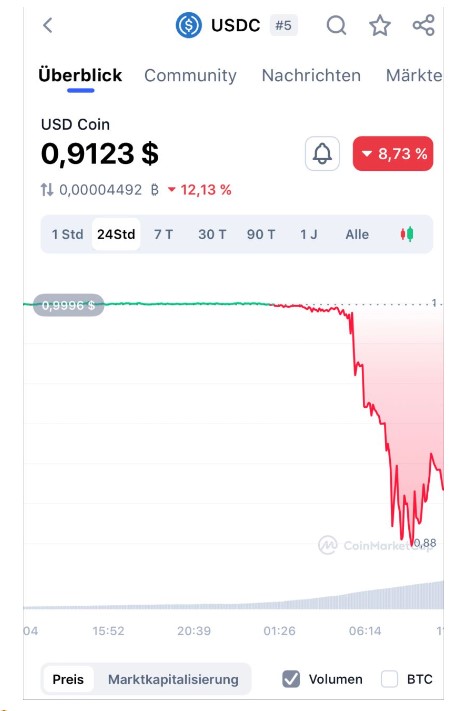
Today, the Stablecoin, USDC lost its peg to the US Dollar.

USDC is the second largest stablecoin and boasted a $43 billion market cap (at least before substantial outflows surrounding the SVB concern). Other stablecoins even have exposure to USDC, with both FRAX and DAI using USDC for significant portions of their collateral.

Circle is a peer-to-peer payments technology company that manages USDC, It was founded by Jeremy Allaire and Sean Neville in October 2013. Circle is headquartered in Boston, Massachusetts.

Silicon Valley Bank is one of six banking partners Circle uses for managing the ~25% portion of USDC reserves held in cash. While we await clarity on how the FDIC receivership of SVB will impact its depositors, Circle & USDC continue to operate normally.

Circle is currently protecting USDC from a black swan failure in the U.S. banking system.
SVB is a critical bank in the U.S. economy and its failure.
Stablecoins are effectively like the services of a CBDC contracted out into the public sector, They are extremely heavily regulated and are anchored in a sovereign currency.

When a stablecoin gets in trouble it has huge implications for CBDC’s, and other sovereign instruments as its more closely associated with traditional sovereign instruments than it is with cryptocurrencies.

There may be a cue to the e Naira here.

The Circle website says:

‘USDC is a digital dollar, also known as a stablecoin, that’s available 24/7 and moves at internet speed. USDC lives natively on the internet, running on many of the world’s most advanced blockchains. Billions of USDC change hands every day, and every digital dollar of USDC can always be exchanged 1:1 for cash…..’

Well, apparently, not today!

A verdict on a US Stablecoin is effectively a verdict on the Dollar.

I watched a video earlier today which explained the UK cumulative degradation of the Defence Budget over multiple governments since the end of the previous cold war and the collapse of the Soviet Union,

Suddenly thrust into a situation of needing to support Ukraine, and with a threat of direct action from Russia entirely possible, UK no longer has sufficient air assets to now successfully pull her weight on the Polish border assisting Ukraine, and simultaneously have sufficient Typhoon coverage to protect against air or sea launched Russian cruise missiles.

We are seeing potentially seismic shifts in international relations that have a strong potential to reposition the US Dollar from being a single dominant global currency.

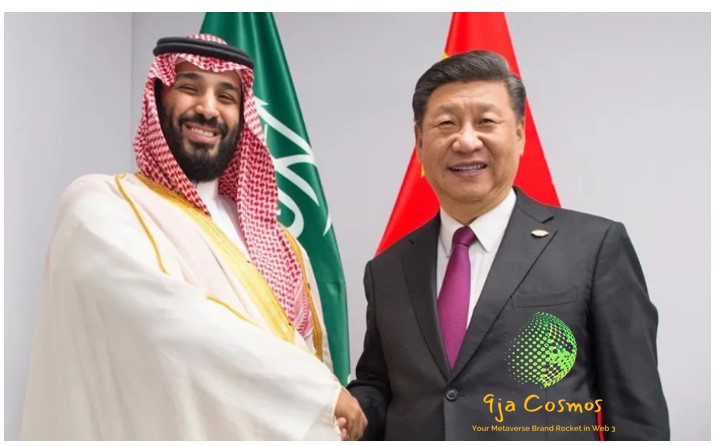
Most of these changes are happening in the Middle East, where firstly, last year, Chinas’ Xi  came away from Saudi Arabia from a much more successful visit than US’ Biden. China is doing an oil deal that won’t involve USD.  Recently Iran and Saudi Arabia met to agree re-establishment of diplomatic ties. Talks are underway for both countries to be admitted to BRICS.
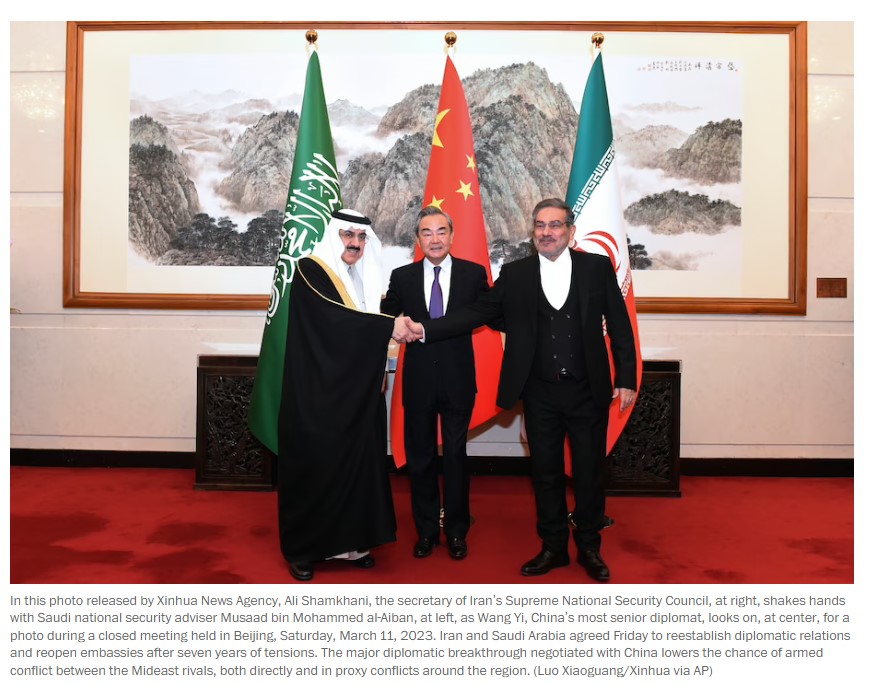
Meanwhile Israel is courting the establishment of ties with many Arab and Muslim nations.

With the US Debt/GDP running at 120.36%. USD position as the defacto international trade medium is critical to its stability, and the life of the US economy.

There is a fight the USD now feels it has to wage, not only against a diversification away from the dollar by sovereign actors, but also by increased interest in cryptocurrency payment media by global corporations and domestic individuals.

The US is increasingly seeing a world not transacting in dollars, and doesn’t like it.

Conclusions

Sovereign nations have military and economic deterrents both independently as a nation and through collective power built on agreements and treaties. Certain minimal levels of autonomy need to be preserved because the global political landscape can change. Today’s allies and partners can become tomorrow’s adversaries and competitors.

‘Crypto Nations’ (yes I call them that) cannot build physical defences and cannot build assault weapons and go on the offence. But what their makers can do is create them with imperviousness, immutability, self-propagating autonomy, and, post creation, no human with accountability retention. Nobody to be targeted by sovereign law, nobody to be targeted by statutory compliance. Nobody to be targeted with taxation.

The Ethereum ecosystem is very like the UK’s defensive dilemma. It’s lulled itself into a sense of false security, going 100% for speed and flexibility, bad at the core since PoS (proof of stake), and even worse at the EVMs and L2s/sidechains. Sharding will make it worse still.

With the US policy the way it is going, and with projects exhibiting problems more typical of non-blockchain solutions, I don’t see a good future for it.
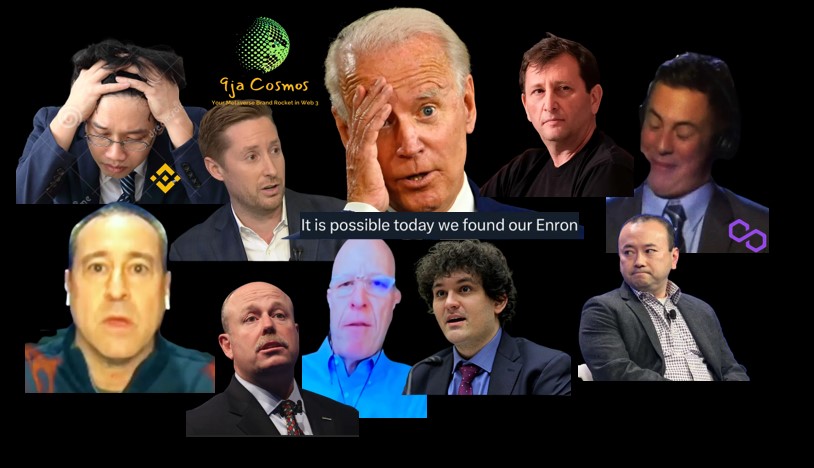
: (In no particular order) Alan Lane, Silvergate; Changpeng Zhao Binance; Alex Mashinsky, Celcius; Kevin Turner, Core Scientific; Michael Moro, Genesis Network; Zac Prince, Blockfi; Ryan Wyatt, Polygon; Sam Bankman-Fried, FTX; Steve Ehrlich, Voyager Digital President J Biden, US.

Outside the Ethereum ecosystem, where ‘design defence’ features are better, Crypto Nations’ need to build their own GDP profile.

The days of a blockchain just having a coin are gone. So are the days when a blockchain could be built around a series of collectibles. The blockchains of the future need to be dynamic, interactive, and drawing human beings into their system by amazing things and amazing ways to be involved as a creator, as a vendor, and as a consumer.

Yes, they need to exhibit all the properties of a real world nation with functions that create Gross Domestic Product (GDP)

You should be able to ‘go japa’ there, without even physically moving from where you are!

As we look back on the impact of both Silvergate and SVB how they pulled the whole cryptocurrency markets one way, and then another, this should not be possible.

In a new world where Blockchains evolve to have a combination of the right levels of secure autonomy, and (Blockchain Asset 3)   BCA 3 – unbound tokenized utility with self sustaining GDP, a coin will stand on its own, just as sovereign FIAT.

No more ‘pack’ performance. No more ‘group sentiment’ from investors!


9ja Cosmos is here…

Get your .9jacom and .9javerse Web 3 domains  for $2 at:

.9jacom Domains

.9javerse Domains


All reference sites accessed between 08-11/03/2003

linkedin.com/posts/john-mc-keown-nigeria-expert_how-9ja-cosmos-can-bring-bca-3-status-utility-activity-7026341390162776064-V97A?

linkedin.com/posts/john-mc-keown-nigeria-expert_the-value-trilemma-of-fiat-bitcoin-and-ethereum-activity-7038628934606811136-izqR?

bloomberg.com/news/articles/2023-02-15/brics-debates-expansion-as-iran-saudi-arabia-seek-entry

middleeastmonitor.com/20230216-brics-discussing-decision-on-saudi-arabia-iran-memberships-this-year/

nytimes.com/2023/03/11/us/politics/saudi-arabia-iran-china-biden.html

circle.com/en/usdc

edition.cnn.com/2023/03/08/business/silvergate-winds-down-crypto/index.html

en.wikipedia.org/wiki/Silicon_Valley_Bank

web3isgoinggreat.com/?id=usdc-loses-peg-to-the-dollar

reuters.com/world/chinas-xi-starts-epoch-making-saudi-visit-deepen-economic-strategic-ties-2022-12-07/

usdebtclock.org/

Roku Said $487m, 26% of its $1.9bn Cash is Trapped in Failed SVB

0

Roku has been caught in the Silicon Valley Bank collapse, where it has kept 26% of its cash. The streaming company said Friday that it had $487 million stashed in a lender that was shut down on by regulators.

The failure of Silicon Valley Bank exposed several tech companies to risk of losing their funds parked in the bank. In its disclosure to the US Securities and Exchange Commission (SEC), Roku said the $487 million held at SVB represents approximately 26% of the $1.9 billion in total cash and cash equivalents it has as of Friday.

Roku also said that most of its funds with the SVB are not insured, significantly minimizing its chances of recovering them. The Federal Deposit Insurance Corporation (FDIC) had said in a statement that when the bank opens on Monday, March 13, all insured depositors will have access to their insured deposits.

“At this time, the Company does not know to what extent the Company will be able to recover its cash on deposit at SVB,” Roku said in the filing. It added that its “existing cash and cash equivalents balance and cash flow from operations will be sufficient to meet its working capital, capital expenditures, and material cash requirements from known contractual obligations for the next twelve months and beyond.”

SVB’s shutdown marks the largest bank failure in the US since the 2008 recession. Roku said in the filing that its remaining $1.4 billion in cash and cash equivalents have been distributed across “multiple large financial institutions.”

However, the company told Insider via email that the trapped fund will not impact its operation. “As stated in our 8-K, we expect that Roku’s ability to operate and meet its contractual obligations will not be impacted and we continue to have access to $1.4 billion in cash and cash equivalents which are distributed across multiple, large financial institutions,” Roku’s spokesperson said.

SVB was shut down on Friday by the FDIC. The regulator then transferred the lender’s assets to a newly created bank, the Deposit Insurance National Bank of Santa Clara. The bank’s collapse became inevitable after it announced Wednesday it was trying to raise more capital, after selling part of its portfolio at a $1.8 billion loss.

The collapse of the bank, which lends heavily to venture-backed tech startups, has thrown the US banking industry into disarray – with many VC firms seeking secure financial institutions to lodge their money.

Reviewing the Utah DAO Act of 2023

0

On March 1, 2023, the Utah Legislature passed HB 357, the “Utah Decentralized Autonomous Organizations” Act (the “Utah DAO Act”). This was a combined effort of the Utah Legislature’s Blockchain and Digital Innovation Task Force, under the leadership of Co-Chairs, Senator Kirk Cullimore and Representative Jordan Teuscher.

Decentralized Autonomous Organizations (known as “DAOs”) are a priority for the State, and a priority for the Blockchain and Digital Innovation Task Force. Utah is a fast-rising technology hub, with a sophisticated and advanced approach toward on-chain, decentralized, Web3 software and financial platforms, making legislation giving legal recognition and limited liability to DAOs a priority for the Task Force. In short, technology innovators and leaders are demanding that legislation keeps pace.

We have been students, practitioners and admirers of the states that have used the “LLC wrapper” approach to grant DAOs limited liability protections and legal entity status. These states were the first through the gates and should be commended for their visionary leadership. There are, however, limitations to the “LLC wrapper” approach, which we sought to address in Utah’s approach.

The Utah DAO Act adopted a version of the COALA model law, which does more, goes further and achieves a level of “legal personality”, limited liability protections, and avenues for decentralization and anonymity than the simple “LLC wrapper” approach. More specifically, the Utah DAO Act, among other things:

– Defines the DAO ownership/participant base in the abstract consistent with the realities and ethos of a complex and vast DAO community.

– Incorporates a technology gatekeeping function to assure the DAO is indeed a DAO.

– Uses “Bylaws” (not an Operating Agreement) to protect the DAO ownership/participants with anonymity redactions and protections.

– Introduces quality assurance requirements for DAO protocols.

– Creates a clear and more nuanced tax treatment consistent with current DAO functionalities.

– Establishes that there are no implicit fiduciary duties owed by DAO participants unless those duties are explicitly stated to apply.

– In short, a limited liability company is not a DAO, and a DAO is not a limited liability company. The Utah DAO Act grants the DAO a form of legal recognition that is unique to DAOs.

The Utah DAO Act passed both the House and Senate committees (with narrow approval) and robust discussion. There were concerns –and compromises. The three major concerns were:

  1. Full “unaccountable” anonymity for the DAO base.
  2. (Original) tax language that was “LLC flow through” inconsistent with potential state and federal tax realities.
  3. Lack of ramp-up time to assure the Utah Division of Corporation is prepared to handle new applications.

Our approach to compromise was as follows:

  1. Accountability. Require each DAO to have a disclosed incorporator, while still allowing the DAO participant base to remain anonymous (and “redacted”).
  2. Tax Language. We solicited the participation of the Utah Tax Commissioners’ office to propose acceptable tax language, which is indeed more nuanced and consistent with the tax complexities of a DAO (that language can be reviewed under Section 48-5-406 of the Bill).
  3. Ramp-Up Time. We agreed to make the effective date of the bill 2024. We made that compromise so we would have another year to edit, adjust and assure the practical implementations can be made for a smooth adoption.

The Utah Department of Commerce, which oversees the Division of Corporations and the Division of Securities, both critical for the roll-out and adoption of the new legislation, has been hands-on, cooperative, and visionary in the eventual adoption of the new Utah DAO Act.

On March 1, with the amendments (and compromises stated above) the Utah DAO Act was passed unanimously by both the House and the Senate.

 What Now

The Task Force will continue to work closely with the Utah Department of Commerce for the 2024 implementation of the new Utah DAO Act. We will engage closely with relevant industries (technology, finance and legal) to assure the new law is efficacious to need and purpose.

We will spend the remainder of 2023 exploring any weaknesses in the legislation and working toward fixes, while at the same time preparing for administrative onboarding. The Task Force will also be looking for opportunities to build and eventually pass complementary DAO legislation.

 Challenges Remain

We understand the challenges of the current environment. We are not naive nor ignorant of many of the federal and judicial impediments of fractional sharing and tokenization, which are associated with DAOs. We also understand, however, that there is no going back, that the best technologies are being built in shared decentralized environments, and that law and policy should participate in and facilitate this movement.

The continued overreaching and (mis)application of isolated terms in Depression-era laws (and “intent”) to revolutionary technology poised to define the next generation of the internet needs to be reconsidered. It is like applying 1900 horse and buggy speed codes to the era of automobiles. There is a path out of the oversimplified dichotomy of securities versus non-securities “analysis”, and that path starts with bold legislation which leans into new technologies.

If the United States and other similar sovereign states don’t find that path they will get left behind — literally placed behind exclusionary firewalls where the best ideas and innovations are taking hold. The US’s failure to embrace these technological innovations has already resulted in a sharp decline in America’s share of blockchain developers as compared to the rest of the world.

So, starting in January 2024, a “Utah LLD” (a DAO designation under the new law) may be formed in Utah, and the State will become a welcoming environment for decentralization and on-chain innovation. We are excited about the possibilities.

LinkedIn News Features Our Piece on Banking 101 And Bank Failures

0

LinkedIn News featured our post on Banking 101 and why Silicon Valley Bank struggled and collapsed. As a former Lagos banker (a really good one; ask my supervisors, they rated me 5/5 continuously), that piece explained the systemic risks of the high interest rate regimes in the United States.

Now, the government has a choice: socialize losses after the millionaires had privatized their gains during the boom times. Indeed, now they are in trouble, the taxpayers will be needed to bail them out.

Read the feed here – thanks LinkedIn team for the assist; very appreciated.

Less than two weeks before Silicon Valley Bank had sold part of its portfolio at a $1.8 billion loss and was trying to raise more capital, CEO Greg Becker sold $3.6 million worth of company stock, Bloomberg reports. Regulators shut down Silicon Valley Bank on Friday amid liquidity worries and a run on deposits — the biggest bank failure since the 2008 financial crisis. The stunning collapse has at least one notable investor calling on the government to consider a “highly dilutive” bailout of the bank.

Here is the latest news on the collapse:

  • Circle Internet Financial, which operates USD Coin, a digital stablecoin, said it had $3.3 billion tied up in Silicon Valley Bank. As a result, the virtual currency fell below 87 cents on Saturday, according to CoinDesk.
  • Silicon Valley Bank has been put under the control of the US Federal Deposit Insurance Corporation, which is serving as the tech lender’s receiver.
  • According to the FDIC, insured depositors will have access to their deposits by Monday morning, at the latest.
  • Some analysts and investors are arguing that Silicon Valley Bank’s downfall is an indicator that interest rate hikes have been too aggressive, The Washington Post reports.

SVB’s Speedrun: A bankrun in the internet world

0
FILE PHOTO: SVB (Silicon Valley Bank) logo and decreasing stock graph are seen in this illustration taken March 10, 2023. REUTERS/Dado Ruvic/Illustration

How fast can you crumble a bank and an economy today? 48 hours. I write about the chilling story of Silicon Valley Bank’s collapse, what it means for all of us.

The last 24 hours have been all about the collapse of US bank ~ Silicon Valley Bank (SVB) but what really is SVB, how bad is it, and what should we expect from the second largest bank collapse in US history and the first bank run of the internet world?

SVB was the 16th largest bank in the US with $200B+ assets at the time of failure, banking 50% of the US tech, VC, healthcare & biotech ecosystem; which has now become its Achilles heel.

Made by internet-age businesses, SVB was also killed by the digital era. It took less than 72 hours of panic withdrawals enabled by transfer technology to bring the bank to its knees with $40B+ in withdrawal requests – “a speedrun”, as described by Slow’s General Partner, Sam Lessin.

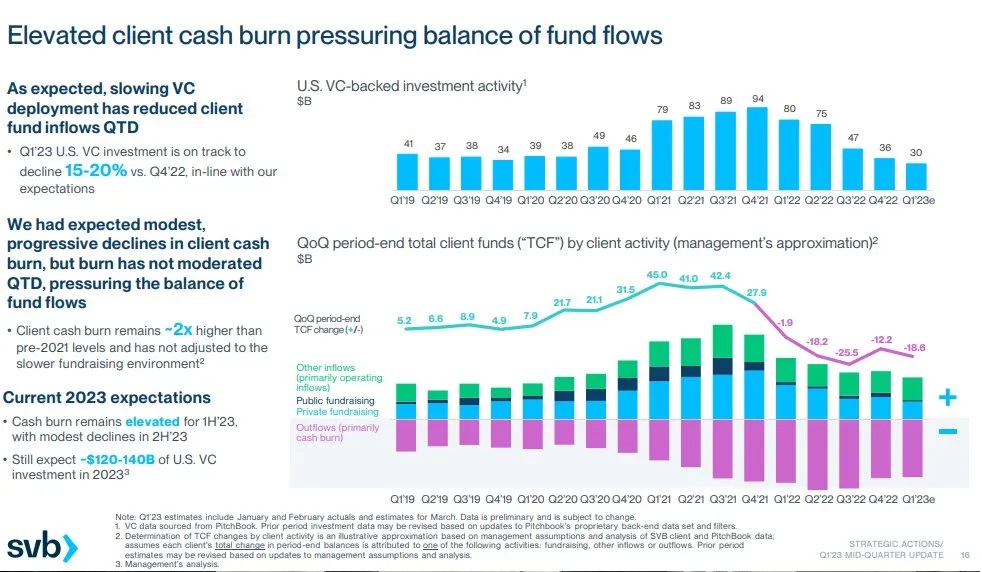
SVB customers are high-growth businesses and are products of a low-interest rate environment, where funding was awash. The chart below shows continued spend by SVB customers despite a slowdown in inflows.

To meet its growing liquidity needs, SVB bowed to duration risk, losing nearly $2B from selling $21B+ of medium to long-term securities. SVB quickly attempted to raise $3B in equity to cover its position. Once this became public, panic about the bank’s solvency spread like wildfire. SVB’s stock sunk by 60% on Thursday. Apparently, in the era of Twitter and Reddit, it’s much easier to crumble a bank and the economy.

Notable leaders like Peter Thiel, founder of Paypal & Founders Fund asked customers to withdraw their money from SVB, sparking what will be the end of SVB. You know the rest. If you short SVB and sparked a withdrawal frenzy, you should be smiling to the bank. That is now more of an irony in this case, as everyone will be affected directly or indirectly. In my opinion, it shouldn’t have been SVB, an agelong partner of the innovation ecosystem.

This is all so similar to the FTX situation last year, which the crypto market is still struggling to recover from, although FTX was a grossly criminal situation. Unlike crypto, there is a big brother in the fiat market – the regulators. At the time of writing, the FDIC has seized control of the bank and will be commencing the process of selling down its assets to pay SVB depositors. Let me add that 97% of SVB’s assets are uninsured deposits, exceeding FDIC’s $250,000 payout for insured accounts.

To be fair, another culprit is the Fed. After signaling lower interest rates, and rushing everyone into longer-dated securities, you make a dramatic u-turn and start an aggressive rate hike campaign, leading to significant mark-to-market losses from the fall in bond prices. Anyway, the Fed can mitigate this situation. By cutting rates and starting an aggressive bond purchase ~ QE program, the Fed might be able to save us from ourselves. This is particularly important because just like SVB, many institutions hold a similar investment strategy and are booking losses from falling bond prices.  However, the prisoner’s dilemma for the Fed, is sacrificing its fight to keep rising US inflation in check with rate hikes.

What should we expect?

  • If we give in to FUD, the immediate order effect will be a widespread test of bank solvency from mass withdrawals which may crumble the US financial system and cause a global economic meltdown just like 2008.
  • Mid-month payroll is next week and companies may struggle with salary payment, which is quite chaotic when you recall that 51% of Americans earning over $100,000 a year mostly tech workers, are living paycheck to paycheck. This implies a slowdown in consumer spending, except the US government, steps up with a cash transfer scheme.
  • What’s even scarier is the fact that VCs who are the lifeline of the technology market might have been affected by SVB’s collapse. That’s $200B worth of assets, so this is very possible.
  • We should be expecting a slower funding market, and steep cost-cutting measures like hiring freezes and layoffs.
  • Let me add that one concept I’ve been fascinated with of late, is remote work & global talent. Hiring cheaper and same quality talents from Africa or Asia may prove to be one of the cost-cutting measures, that will make businesses more resilient in a market like this.
  • Just to note, SVB’s assets are still very much alive. The authorities will just need some time to sell down the assets if SVB doesn’t find a buyer pretty soon, which is why the Fed should come in and stop falling bond prices.
  • This presents a good opportunity for other banks to cannibalize with a lending product backed by SVB deposits. Brex has already swung into action with this. Regardless, it’s a market for the taking, so other players can start their own lending products.
  • I’m not sure if crypto or “non-custodial wallets” will reap many gains from this. USDC’s de-pegging after Circle announced that it holds part of its treasury in SVB will likely not age well for web3. I’m actually rooting for Circle, as I am a big fan. Nonetheless, if you were stanning SVB just a few days ago and gave into hope, you’re definitely facing some challenges right now. On the flip side, liquidity line business models may thrive as web 2 & web 3 financial companies grapple with rising liquidity pressures during this period.
  • To suffice, holding cash as Bloomberg predicted, and keeping burn low while not compromising productivity will be a winning strategy. All roads do not lead to a good end, so I’d say for the umpteenth time that someone needs to step in and save us from ourselves.