Following Alfred Schutz’s phenomenological theories in the 1960s, the field of ethnomethodology was born. It could be suggested further that Erving Goffman, who was born in Alberta, Canada, on June 11, 1922, played an invaluable role in the establishment of the intellectual scheme. Owing to his stance on free thought, Goffman was regarded as a cult figure and an essential theorist in sociological theory (Williams, 1986).
In 1982, he passed away at the height of his popularity – as president-elect of the American Sociological Association. However, he was unable to deliver the Goffmanian presidential address due to his failing health. It is, indeed, challenging to fit Goffman’s theoretical perspective into a single sociological category because his distinctive orientation was derived from a variety of sources (Ritzer, 2011).
In spite being taught by Symbolic Interactionists, Collins (1986) and Williams (1986) linked Goffman more with the field of social anthropology in a bid to categorize him. To support their position, Collins studied an earlier paper done by Goffman and found that social anthropologists were cited more often than symbolic interactionists. Nevertheless, the Goffmanian perspective was inspired by the descriptive studies conducted at Chicago, which combined their point of view with that of social anthropological research to create his distinctive perspective.
A symbolic interactionist, for instance, might examine how people construct or negotiate their self-images, whereas Goffman was interested in how society compelled people to present themselves in a certain way, ultimately leading to their being inconsistent, untruthful, and dishonourable (Collins, 1986:107). Despite having a different viewpoint, Goffman had a significant impact on symbolic interactionism.
The phrase “civil inattention” was first used by Goffman, and it refers to an experience we all have on a daily basis. As an illustration, commuters regularly congregate at different time interval, every day, to go from the parking lot of the University of Ibadan (first gate) to various places on campus. When necessary, some people will nod, smile, or establish eye contact as a sign of mutual goodwill. However, some people will act differently than expected, disembarking when they arrive at their bus stops to begin their various tasks.
These activities, which Erving Goffman refers to as civil inattention, were of fundamental significance to the social life of the University system. The exchange of greetings and other small talk are largely unconscious. Like when someone briefly glances at another person before turning their gaze elsewhere. Giddens and Sutton (2013) contend that this civil inattention is distinct from ignoring another individual and should not be interpreted in the same way. However, why should sociologists be interested in such trivial aspects of behaviour? The practise of acknowledging others’ existence while avoiding overt gestures (Goffman, 1967; 1971). All of these tasks are done by us every day without a second thought. The fact that we do not have to take into account our everyday activities, however, does not mean that they are not subject to sociological analysis (Giddens & Sutton, 2013).
I believe, we can all relate to this concept of civil inattention; in fact, Alfred Schutz (1899–1959) saw it as the fundamental beginning point for phenomenology, the study of how people come to have that attitude of taking things for granted and how it is reflected in social interaction. The interaction between people is one of the most fascinating or absorbing topics in sociology, far from it being uninteresting. The majority of social experiences involve talk – casual verbal exchange – carried out in conversation with others, although we frequently use non-verbal cues in our own behaviour and in understanding the behaviour of others. Language has always been acknowledged by sociologists, particularly symbolic interactionists, as being essential to social life (Giddens & Sutton, 2013).
But in the latter half of the 1960s, a method was developed that pays close attention to how people use language in regular settings of daily life and how this usage generates social order. An ethnomethodologist investigates the social interaction mechanisms that give rise to this social order. According to Haralambos, Holborn, Chapman, and Moore (2013), social order is only an apparent order created by individuals of an ecosystem. Thus social life only seems organized to society’s members because they actively participated in making meaning of it.
Much like many other people who came of age during the Great Depression and later World War II, Harold Garfinkel had to go through a difficult process to join the field of sociology. He was born on October 29, 1917, to a small merchant in Newark, New Jersey. Even though his father advised him to seek a trade, Garfinkel wanted to go to college. Several different social theories were presented to Harold Garfinkel, but most notably the writings of phenomenologists (Ritzer, 2011). As one of Alfred Schutz’ student, Harold Garfinkel, was known to have coined the term “ethnomethodology” (Giddens & Sutton, 2013), ascribing its origin to his research on the jury’s members in 1954 (Garfinkel, 1974).
His intention was to outline the logical strategies jury members use to present themselves in a jury chamber as a jury. Garfinkel (1984) asserts that these methods support the social order of serving as a juror for the jury members as well as for academics, researchers, and other interested parties in that particular social context. It is interesting to note that Talcott Parsons also taught Garfinkel; as a result, this ostensibly novel body of knowledge was oriented in a way that combined Schutzian and Parsonsian ideas.
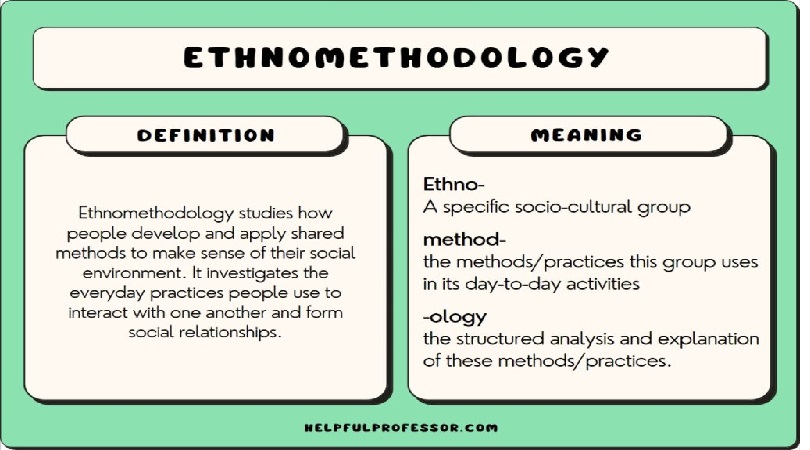
In its basic form, the word “ethnomethodology” refers to the cultural practices employed by locals (constituents of a specific society) to create their social universe. However, by reviewing the founders’ viewpoint, Garfinkel (1988; 1991), we can delve deeper into the essence of ethnomethodology. Garfinkel, like Emile Durkheim, views “social facts” as a crucial sociological occurrence (Hilbert, 2005). But Garfinkel’s sociological findings diverge significantly from Durkheim’s.
According to Durkheim, social facts are external to and coercive of individuals. To put it another way, social realities are imposed on people from without. People who embrace this focus frequently believe that actors are constrained or determined by societal structures and institutions and have little to no ability to make independent decisions. In the sarcastic language of ethnomethodologists, these sociologists frequently refer to actors or individuals as “judgmental dopes” or “cultural dopes” – the man in the sociologist’s society who merely enacts the prescribed behaviours dictated by their society’s culture. The objectivity of social facts, however, is treated by ethnomethodology as members’ achievements (Ritzer, 2011; Haralambos et al., 2013).
These members are not considered independently, but rather “strictly and solely, in their collective membership activities – the artistic processes by which they create what’s for them, which includes small-scale interpersonal or interactional structure and large-scale organisational structure” (Hilbert, 1992:193). The organisation of everyday life, or as Garfinkel (1988:104) puts it, “immortal, ordinary society,” is still a concern in ethnomethodology despite its primary micro orientation to actors and their action and behaviour. In conclusion, ethnomethodologists are more interested in the artistic practises that give rise to both macro and micro structures rather than either one being of particular interest to them.
In order to address the traditional concern of sociology with objective structures, both micro and macro, Garfinkel and the ethnomethodologists have looked for novel approaches (Maynard & Clayman, 1991). In light of this, ethnomethodology is the study of “the body of common knowledge and the variety of procedures and considerations [the techniques] by which the ordinary members of society make sense of, find their way around, and act on the circumstances in which they find themselves” (Heritage, 1984:4). A good example would be the common or casual approaches people use to interpret the actions and, more specifically, the speech, of others. But in order to understand what was said in a discussion, it is wise to be aware of the social context.
These implicit expectations include how a typical discussion is structured. For instance, understanding when to speak and when to remain silent, what to assume without explicitly saying it, and other situations (Giddens & Sutton, 2013). Our ability to continue existing depends heavily on our ability to pretend we are unaware of what is being said and why. In Garfinkel’s view, this sharing of unstated assumptions gives our daily lives stability and meaning. Meaningful dialogue would be very difficult if we were unable to accept these as givens. Any query or comment would have to be followed by a significant “search procedure” of a similar kind. Thus, what initially appeared to be unimportant conventions for talking right now reveal themselves to be essential to the very foundation of social life, which is why their violation is so severe.
REFERENCES
Collins, R. 1986. Is 1980s sociology in the doldrums? American Journal of Sociology 91: 1336-1355.
Garfinkel, H. 1974. The origins of the term ethnomethodology. In R. Turner (ed.). Ethnomethodology Harmondsworth: Penguin. 15-18
Garfinkel, H. 1984. Studies in ethnomethodology. Cambridge: Polity Press.
Garfinkel, H. 1988. “Evidence for locally produced, naturally accountable phenomena of order, logic, reason, meaning, method, etc., in and as of the essential quiddity of immortal ordinary society (I of IV): an announcement of studies.” Sociological Theory 6:103-109.
Garfinkel, H. 1991. “Respecification: evidence for locally produced, naturally accountable phenomena of order, logic, reason, meaning, method, etc., in and as of the essential haecceity of immortal ordinary society (I): an announcement of studies.” In G. Button (ed.). Ethnomethodology and the Human Sciences Cambridge, England: Cambridge University Press. 10-19
Giddens, A. & Sutton, P. W. 2013. Sociology. 7th ed. Hoboken, New Jersey: John Wiley & Sons, Inc. 317-319
Goffman, E. 1967. Interaction ritual. New York: Doubleday/Anchor.
Goffman, E. 1971. Relations in public: microstudies of the public order. London: Allen Lane.
Haralambos, M., Holborn, M., Chapman, S., & Moore, S. 2013. Sociology themes and perspectives. 8th ed. London: HarperCollinsPublishers Limited. 982
Heritage, J. 1984. Garfinkel and ethnomethodology. Cambridge, England: Polity Press.
Hilbert, R. A. 1992. The Classical Roots of Ethnomethodology: Durkheim, Weber and Garfinkel. Chapel Hill: University of North Carolina Press.
Hilbert, R. A. 2005. Ethnomethodology. In G. Ritzer (ed.). Encyclopedia of Social Theory Thousand Oaks, California: Sage. 252-257
Maynard, D. W. & Clayman, S. E. 1991. The Diversity of Ethnomethodology. Annual Review of Sociology 17: 385-418.
Ritzer, G. 2011. Sociology theory. 8th ed. New York: McGraw-Hill.
Williams, S. J. 1986. Appraising Goffman. British Journal of Sociology 37:348-369.
Like this:
Like Loading...