DD
MM
YYYY

PAGES

DD
MM
YYYY

spot_img

PAGES

Home Blog Page 434

How Startups Can Effectively Leverage Artificial Intelligence

0
Leveraging AI for Startups

Starting a business is exciting, but it’s a constant uphill battle. Most startups run on tight budgets and small teams. Yet, they’re faced with endless pressure to deliver results on time. In such an environment, every hour and every decision matters.

Thankfully, artificial intelligence can help do the heavy lifting and make the whole process a breeze. This innovation can help young companies do more with less. So, the era of wasting time on repetitive tasks is officially over. Founders can rely on AI to automate work and make smarter choices based on data.

Moreover, AI doesn’t just cut costs for startups. It also opens new opportunities for personalization and growth. View it as a practical ally that can help startups compete with the top dogs and build stronger businesses.

AI for Startups: Key Areas to Implement Artificial Intelligence

Gone are the days when the thought of AI was attributed to tech companies. However, many people are starting to realize the power of this innovation. AI is integrated into every sector, including music, gambling, and healthcare.

Despite this, many startups still think the idea of using AI is overwhelming. They feel like it’s only meant for big corporations with huge budgets. However, in reality, AI has become more accessible and practical than ever. The beauty of AI is that it’s not limited to one part of the business. It is useful in every key area:

Customer Service Operations

Businesses have folded because they lacked solid customer support services. The way you treat your customers greatly determines the success of your business. However, they may get caught up and forget to attend to customers’ needs and inquiries. And the reason might be due to the massive workload required to meet market trends.

However, startups can leverage AI to provide 24/7 customer service. This makes customers feel heard and valued, creating trust from the very first interaction.

Tasks and Process Automation

Startups no longer need to manually carry out certain operations that take up much time and resources. The reason is simple – AI can automate repetitive tasks and processes like scheduling, invoicing, data processing and analysis, customer service inquiries, and inventory management. By adopting AI to streamline these processes, startups can save time. This also allows them to channel human resources to manage other business operations.

Marketing and Sales Optimization

Manual operations don’t promise any certainty when it comes to marketing. Startups will only end up spending a lot of resources on ad campaigns that reach uninterested customers. Meanwhile, with AI, a customer’s behavioural pattern toward making purchases can be predicted. Startups can then use this to determine where to channel the resources.

These tools can also create personalized marketing campaigns and recommend products or services tailored to customers’ needs. It can also suggest the best time to reach out to them for improved conversion rates.

Product Development and Innovation

AI tools can highlight what features people actually want. These innovations can analyze market gaps and customer feedback, test prototypes, and track user behaviour. This gives startups a more competitive edge over bigger companies. The goal is to stay ahead of industry trends and improve products faster and efficiently.

Decision Making

Normally, startups have limited data to work with. Yet, AI can still help identify market opportunities. This makes it easier and faster for startups to make informed data-driven decisions. Everything might just start shooting up from there.

Risk Management and Cybersecurity

AI can also prevent fraud and protect the integrity of an organization. It can detect unusual patterns in real-time, preventing security breaches or financial fraud before they escalate. No wonder startups in tech and finance niches leverage this technology for additional security. The level of protection it offers is crucial for maintaining customer trust.

AI Tools for Startups

Top AI Tools for Startups to Maximize Operations

It is one thing to know that AI can transform a startup. The real thing is to figure out the tools that can make a difference. This is because with the right tools, even the smallest teams can work with the efficiency of a much larger company.

The good news is that many AI tools are now designed with startups in mind. The table below reveals the most practical AI tools that can help startups succeed from day one:

AI Tools Core Function Recommended Use
ChatGPT (OpenAI) Content creation, customer support automation and brainstorming For marketing, customer service and internal operations
Jasper AI Copywriting and content generation Creates blog posts, ad copy and SEO content
Drift Conversational AI chatbot for websites Customer service and lead generation
Zapier Automates workflow between various apps For streamlining operations
Grammarly AI writing assistant For professional communication and improved content quality
Hubspot AI Customer relationship management (CRM) and marketing automation Sales generation, lead management and creating targeted campaigns
Tableau Data visualization and predictive analytics Provides business insights on data analysis and reporting
Hootsuite Schedules social media posts and analyzes engagement For managing multiple social media accounts effectively

AI in Niche Industries: The Case of Online Casinos

The online gaming sector is the perfect testimony of how AI can help startups stand out among competitors. The industry thrives on personalization, security, and seamless user experience. And AI delivers incredible value in these areas.

Plenty of big-name gambling sites are already using this tech. It helps them suggest the right games, run smarter promos, and catch fraud on the spot. The idea is simple — keep things safe while making the experience more fun. Take Slotozilla Canada, for example: the platform provides players with clear information on casino bonuses, making it easier to spot the best deals and maximize their return on every session. That kind of personal touch is the same way other startups use AI to keep customers happy and coming back.

Conclusion

The real power of AI for startups doesn’t lie in using every tool available. It is actually in identifying where it creates the most impact. Another thing to note is that AI-powered tools are not exclusive to only the top dogs. Startups can also leverage it in their operations.

Note that AI cannot replace human creativity and vision. However, it can complement them. Utilize AI to automate what can be automated and analyze what can be analyzed. By doing this, founders can focus on strategy and innovation, rather than managing the details.

Ultimately, startups that embrace AI will adapt quicker and thrive in a digital-first world. The right AI tools can just be the game-changer.


How states are encouraging responsible gambling

0

The state of online gambling has changed a lot over the past few years, with many new sites being introduced, along with new rules and regulations that states have to abide by. So, how and why are states taking responsible gambling more seriously? And how does it affect the players?

The importance of understanding state-by-state regulations 

There are, of course, many states in America, and they can all have different rules and regulations that apply to online gambling. For example, responsible gaming in Pennsylvania may look completely different from another state; this is why it is important that you know the rules for the state you live in. 

The US crackdown on offshore sites 

In recent years, the US as a whole has been cracking down on the abundance of offshore online casinos that are being accessed from the US. These pose a threat to US player bases as they don’t follow the rules and regulations set in place by the US. They often lure players in by making above-average bonus offers that are too good to be true, but these sites cannot be trusted under any circumstances and can pose a threat to your cybersecurity. 

Accessible gambling help sites 

With the rise of the internet, resources for all kinds of products and services have become much more accessible. This includes help for problem gamblers being considerably more accessible than it once was. If a player recognizes that they may have some kind of problem, it has never been easier to hop on the internet and be presented with a plethora of different resources that could be helpful.

Incorporation of self-exclusion services 

In recent years, many more self-exclusion services have been implemented in online gambling services. What these do is allow players to exclude themselves from accessing all approved online casinos. This can be an incredible tool that can really help a problem gambler begin to recover. 

Increased security measures 

Cybersecurity is a more relevant topic than ever. With an increase in the number of cyberattacks, we’re seeing sites and governments taking them more seriously and implementing different ways in order to combat them. As well as this, there are some things you can do to protect yourself while online.

Something that you should do, and what most modern sites have in place, is check for an HTTPS connection. What this does is allow for data transmissions to and from the site to be encrypted, meaning that all data will be much harder to intercept, allowing for more secure browsing. This is a very simple check anyone can do; all you need to do is look for the HTTPS at the beginning of a site’s URL.

Something that can be useful for security is giving a platform’s terms and privacy policy a read – especially considering that all sites must have some form of one. It is vital that you understand how any particular site is using your data and how they are keeping it safe, before you decide to commit your time and money to that site.

A VPN, or virtual private network, can be a great tool, especially for those who access their personal data or make payments while connected to public Wi-Fi networks. What a VPN does is hide your true IP address and mask it with a virtual one. It will also encrypt your data, making it useless to anyone who does manage to intercept it, allowing for much safer browsing.

Lastly, it can be beneficial to turn on two-factor authentication (2FA) where and when possible. This will require you to verify every login attempt or payment, which can be through a third-party authentication app or a code sent via email or text message directly to your phone. This acts as a great last line of defense, because even if a hacker gets their hands on your login details, they will still not be able to get into your account.

With all of these safeguards, you will be much better protected from online cyberthreats. Although it is important to always stay vigilant when browsing online, as attacks can come from anywhere, you’ll be relatively safe when accessing most sites.

What comes next? 

Across the whole industry, we will continue to see developments in security in order to maintain a safe and secure environment for players and internet users in general. I believe we will also see the continued protection of players against anti-consumer business practices, and users generally being taken advantage of. This may be through better regulated marketing practices and improved transparency. 

Conclusion

Online gambling is as safe as it has ever been in the US, with rules and regulations that protect players to a greater extent than they did even just a few years ago. Overall, the industry has never looked better, and I expect it will only grow from here.

The Most Impactful Person in Abia State

0

Question: “Ndubuisi, who is the Richest Man in Abia?”

My Response: Your question is often asked in markets, chatrooms, clubs, etc, not just for Abia State, but for the Igbo Nation. So, I give it a trial. Here is the deal: in many Igbo communities, wealth is not only the number you can tally in your bank ledger. Instead, it is how many boys you turned into men, and how many girls you transformed into women. In fact, in some villages, before you are permitted to speak in the square, you must first point to lives you have touched; only then will the elders yield the floor. Simply, money without impact is vanity.

Take my community, Ovim. One of our “richest men” remains Dr. E. N. C. Ukpabi. He had a PhD in Geography from America before Nigeria’s independence and was the first indigenous students’ dean at the University of Nigeria, Nsukka. His home was an open house for all, and his generosity so shaped destinies that during church baptisms, when asked for their “Saviour,” some responded “Dr. Ukpabi.” The Bishop, of course, would redirect them back to catechism. Yet, that anecdote captured a truth: a man without a swollen bank account became the messiah of his people. That is wealth!

Scale that thinking across Igbo land. People built companies only to hand them to apprentices, who later became competitors. I shared this Igbo Apprenticeship System in the Harvard Business Review as a thesis for stakeholder capitalism. The global debate is still framed as shareholder versus stakeholder capitalism. But long before, our ancestors had codified a richer capitalism, where community thrived when individuals prospered. And in that worldview, the richest man is not he who has the tallest mansion, but he who has built the largest number of men and women.

“Nwaany? b? ?z? mmad? si enweta mmad? ?z?” – a woman is the road through which a man reaches another man. The proverb reminds us that wealth is validated only in the lives it connects and elevates. That is the Igbo way. That is the Abia way. And that is how we know who the richest man truly is.

So, change the question to: “Ndubuisi, who is the Most Impactful Person in Abia?” lol. Now,  you are talking. Nice day at work, Good People.

Halal Knowledge Series Set to Empower Nigerian Investors

0

Infoprations has announced the launch of a new educational initiative on halal finance through its SimplyHalal (Ethical) Investment Community, a specialized unit dedicated to promoting financial literacy and ethical investment. The series, called the Halal Investment Knowledge Sessions, will debut on Saturday, October 4, 2025, with the theme: “Principles of Overcoming Financial Challenges and Creating Halal Way to Wealth.” The first session, scheduled for 5:00 p.m. (WAT) on Zoom, will be delivered by Dr. Abdulrazaq Taiye Jimoh, ACA, Head of the Department of Finance at the University of Ilorin.

A Knowledge Series Rooted in Ethical Finance

Infoprations said the series will provide structured, practical insights into halal investment at a time when Nigerians are seeking sustainable, transparent, and inclusive financial options.

“The SimplyHalal community is our dedicated platform for guiding both Muslims and non-Muslims into ethical wealth creation,” Dr Adebiyi Rasheed, a Principal Consultant at Infoprations explained in a statement. “This knowledge series goes beyond technical finance, it emphasizes values, literacy, and practical tools for building financial resilience.”

Beyond Faith: Ethical Finance for All

Although grounded in Islamic principles, the series is designed to resonate broadly with audiences seeking alternatives to exploitative or speculative financial systems. Organizers point out that halal finance shares much in common with global movements for responsible, sustainable, and socially conscious investing.

 “Halal finance is about fairness, avoiding harmful practices, and promoting transparency. These values are universally relevant in today’s uncertain economy.”

Leveraging Digital Platforms

The event is being powered by Cowrywise, a Nigerian fintech platform that has become a leader in democratizing investment opportunities. By holding the session online, Infoprations is ensuring broad access for participants across Nigeria and beyond, regardless of location.

For Infoprations, “the collaboration with Cowrywise reflects its dual commitment to digital transformation and ethical finance. The organization has been active in research and capacity building across governance, digital infrastructure, and economic inclusion. The SimplyHalal unit extends this mission by applying those priorities to the field of faith-informed investment,” the statement adds.

Analysts suggest that Infoprations’ SimplyHalal approach is different. Rather than focusing narrowly on financial instruments, the new series promises to provide continuous education, connecting faith, ethics, and practical strategies for poverty reduction.

Relevance Amid Economic Struggles

With Nigeria grappling with inflation, high unemployment, and rising poverty levels, the timing of the series appears strategic. By positioning halal investment as a tool for both financial empowerment and ethical responsibility, Infoprations hopes to attract households, students, entrepreneurs, and small business owners.

Registration for the webinar is free, underscoring the organization’s commitment to accessibility. Participants will learn not just about investment products but also about the mindset and principles required for long-term financial independence.

With the backing of Infoprations, the expertise of Dr. Jimoh, and the technological support of Cowrywise, the SimplyHalal Knowledge Sessions may set a new standard for how Nigerians learn about and engage with halal finance.

“Ultimately, our goal is empowerment,” Infoprations noted. “When people align their values with their financial decisions, they not only build wealth—they build resilience and dignity.”

Power, People and Institutions in Osun LG Crisis

0
political structure of Osun government for administrative purposes

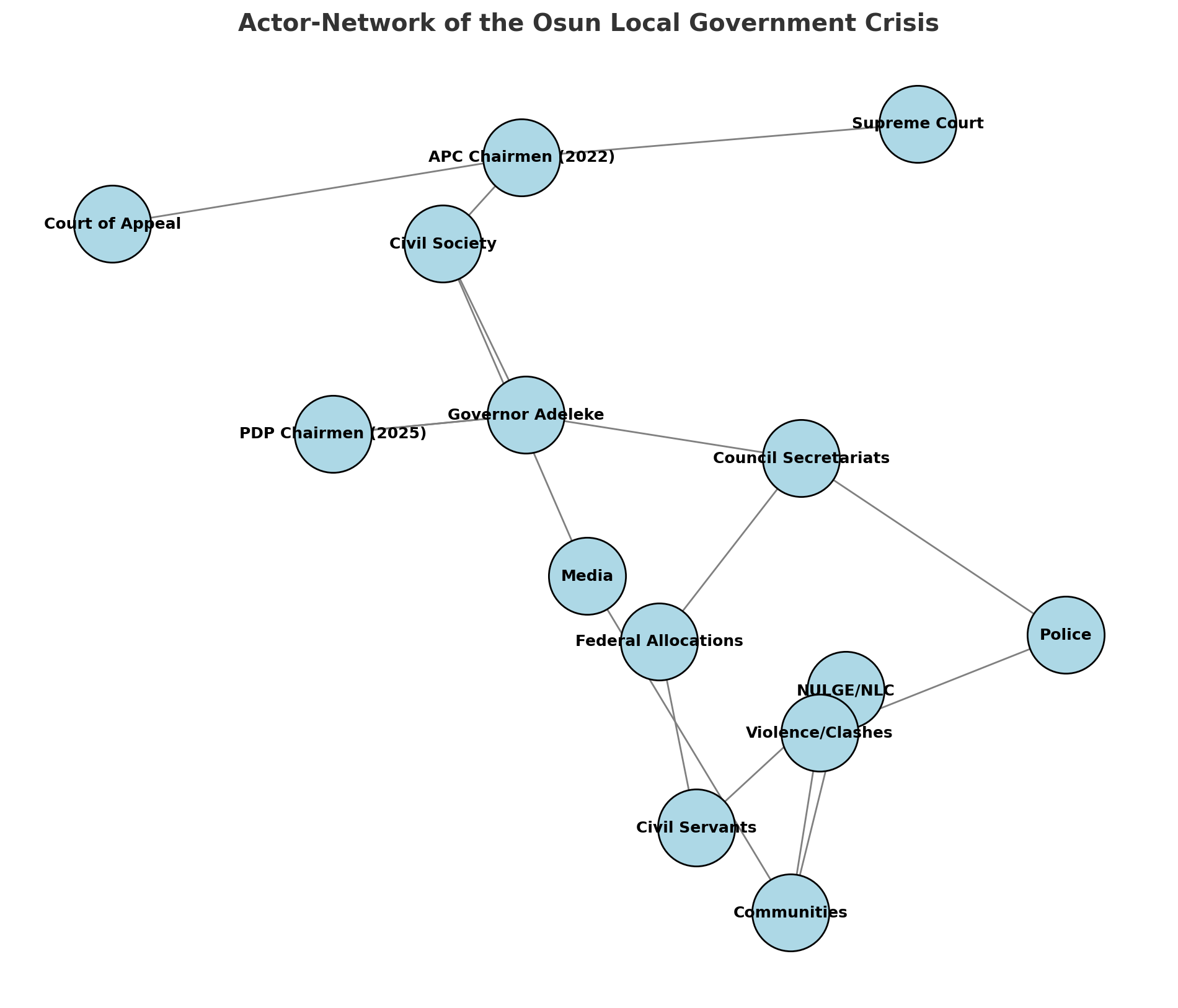
The local government crisis in Osun State has become one of the most troubling tests of grassroots democracy in Nigeria. Since February 2025, the state has been trapped in a web of legal disputes, political rivalry, violence, and uncertainty over who truly holds authority at the local level. The longer the stalemate lasts, the more it damages basic service delivery and the trust of citizens in government.

The roots of the crisis can be traced to two competing events. On 10 February 2025, the Court of Appeal gave a judgment that the opposition All Progressives Congress (APC) interpreted as restoring the tenure of local government chairmen elected in 2022. Less than two weeks later, on 22 February 2025, local government elections organised by the state government produced a new set of chairpersons and councillors who were largely from the Peoples Democratic Party (PDP). Governor Ademola Adeleke quickly swore them into office. The APC then directed its earlier chairmen to resume duty, arguing that the court had validated their positions. In that moment, Osun had two sets of officials laying claim to the same councils.

Source: Nigerian Newspapers, 2024-2025; Infoprations Analysis, 2025

From Clashes to Closures

Tension rose immediately. Across many local government areas, supporters of both sides clashed. Reports of killings and invasions of council secretariats filled the news. At least five people were feared dead, including a serving chairman, while others were injured. Governor Adeleke reacted by ordering all council secretariats shut and placing them under police guard. In one move, the buildings that symbolised power at the grassroots were locked away, leaving both camps unable to exercise full control.

With council buildings closed, the battle shifted to the courts, the media, and the flow of funds. The APC insisted that only the Supreme Court could overturn the appeal judgment and demanded that council allocations be released to its officials. The PDP government countered that the February elections were valid and that the swearing in of the new chairmen gave them legitimacy. Civil servants and local government workers found themselves caught in the middle. Their unions, NULGE and the NLC, refused to work under such uncertainty, citing security risks and lack of clarity on who had authority to pay salaries. Their decision effectively paralysed operations at the councils.

The Role of Money and Institutions

The crisis has also been shaped by the movement of money. Federal allocations are the lifeblood of local governments. In Osun, questions about who should receive the funds have become central. Workers have complained of not receiving alerts for months. Civil society groups accuse the state of diverting funds or withholding them unlawfully. The government maintains it is operating within the law and has called for patience. Each statement, each official letter, and each allocation alert or its absence has deepened the mistrust between the two sides.

Beyond money and courts, physical spaces matter. Council secretariats are not just buildings. They are symbols of authority. Whoever controls them is seen to control governance. By locking them, the governor removed that symbol from both sides, but also weakened the visibility of local government as an institution. Communities no longer see their local offices as open places where governance happens. Instead, they see padlocks and police guards. This absence of everyday administration is just as damaging as the violence that sparked the closures.

Finding a Path Forward

The crisis reveals how fragile grassroots democracy can be when legal processes, political competition, and state power collide. On one side, the APC clings to a favourable court judgment as its strongest weapon. On the other side, the PDP relies on the February election and the authority of the governor. Both have legitimate claims, yet neither can translate their claim into undisputed control. This deadlock leaves citizens confused, workers unpaid, and services stalled.

What can be done? the legal ambiguity must be resolved quickly. Only a clear ruling from the Supreme Court can settle whether the 2022 chairmen have any tenure left or whether the 2025 elections stand as final. The state should work with unions and civil society to create a transparent system for tracking and disbursing council funds. Publishing clear records of allocations and spending would rebuild trust. Secretariats must be reopened, at least for basic services, even if managed temporarily by joint committees that include neutral administrators. Dialogue should be prioritised. Political leaders, traditional rulers, and civil groups need to sit together to chart a path away from violence and towards stability.