DD
MM
YYYY

PAGES

DD
MM
YYYY

spot_img

PAGES

Home Blog Page 437

Avoiding Common Mistakes During Zendesk Setup: A Practical Guide

0

Setting up Zendesk is a smart step toward improving your customer support experience. And in many cases, it is. Still, plenty of teams hit unexpected bumps in the road during their Zendesk implementation journey. Why? Because while the tool itself is powerful, the way you configure it makes all the difference. Think of it like moving into a new house: the structure is ready, but how you arrange the furniture determines whether you are comfortable or tripping over your coffee table every morning.

The good news is, you can learn from the mistakes others have already made. In this blog post, we will explore common pitfalls during Zendesk setup, show you how to sidestep them, and share real-world examples that prove these lessons are not just theory. By the end, you will feel more confident in building a help desk that works seamlessly for both your agents and your customers.

Jumping in Without a Plan

One of the biggest mistakes is diving into Zendesk setup without a clear plan. Companies often rush, thinking speed will solve everything. Instead, they end up creating confusion for both customers and agents.

A small e-commerce brand I worked with rushed their rollout before the holidays. They skipped planning, created ticket fields on the fly, and ended up with a messy queue. Agents spent more time figuring out where tickets belonged than answering customer questions.

To avoid this, define your goals before touching the system. If your aim is faster response times, design workflows with that in mind. If customer self-service is the priority, start by shaping a strong Help Center.

Making Workflows Too Complicated

Zendesk has plenty of options: triggers, automations, macros, and SLAs. It is tempting to use them all at once, but that usually backfires.

For instance, a SaaS company created 50 triggers before launch. Within weeks, tickets were bouncing between agents because rules overlapped. Customers noticed delays, and frustration grew. After reducing automations to about a dozen, things started running smoothly.

The key is to keep it simple at first. Automate the basics, then add complexity only as your team grows comfortable.

Forgetting Agent Training

Even the best Zendesk implementation will flop if your team is not trained. Agents need to know how to use macros, views, and shortcuts. Without training, they fall back on slow, manual processes.

At a travel agency I visited, agents typed every reply by hand because no one had explained macros. Productivity plummeted until proper training was introduced. Afterward, response times dropped by nearly 40 percent.

Training does not have to be overwhelming. Start with short workshops, then back it up with an internal guide agents can revisit anytime.

Ignoring Reporting and Metrics

Data is what keeps your support team on track, yet many companies ignore it during Zendesk set up. They assume that if customers are not shouting, everything must be fine.

A retail company learned this the hard way. They ignored Zendesk Explore reports for six months. When they finally looked, they saw doubled response times and weekend backlogs. By then, CSAT had already dropped significantly.

From the start, identify which metrics matter most. Use dashboards to track them and review results regularly. A few numbers can reveal problems before they grow out of control.

Neglecting the Customer Experience

Zendesk is designed for agents, but customers are the ones who feel the impact. If your system is clunky, they will not care how smooth your backend workflows are.

A subscription box company made this mistake. Their ticket forms were long and complicated, with endless dropdowns. Customers gave up and vented on social media instead. After simplifying forms and adding a Help Center with FAQs, ticket volume dropped by 25 percent.

When setting up Zendesk, keep the customer’s view in mind. Submit a ticket yourself, test live chat, and browse your Help Center. If it feels clunky, customers will notice.

Key Mistakes to Avoid

Here are the five most common mistakes during Zendesk setup:

  • Jumping in without a clear plan
  • Overcomplicating workflows
  • Forgetting to train agents
  • Ignoring reporting and data
  • Neglecting the customer experience

Best Practices for a Smooth Zendesk Implementation

To make your Zendesk implementation successful, keep these best practices in mind:

  • Start with clear goals and map the customer journey before configuring.
  • Keep workflows simple, adding complexity only when necessary.
  • Train agents early and provide ongoing resources.
  • Monitor data from day one to spot issues quickly.
  • Always test the system as if you were the customer.

Wrapping It All Up

Launching Zendesk can be exciting, but it is also a delicate process. The most common mistakes, rushing in without a plan, overcomplicating workflows, skipping agent training, ignoring data, and neglecting the customer experience, are all avoidable if you take a thoughtful approach.

Think of your Zendesk implementation as planting a garden. You cannot just throw seeds into the ground and hope for the best. You need to prepare the soil, water regularly, and pull out weeds before they take over. Do it right, and you will cultivate a thriving support system that benefits both customers and agents.

So, before you finalize your Zendesk setup, pause and ask yourself: Am I setting my team up for long-term success, or am I rushing toward a quick launch? With the lessons shared here, you will be far better equipped to make Zendesk a powerful ally instead of a daily headache.


Trump Announces 100% Film Tariff, Threatening Hollywood and Global Cinema Trade

0

US President Donald Trump on Monday said he would impose a 100 percent tariff on all foreign-made films, an unprecedented move that extends his protectionist trade agenda into cultural industries and risks disrupting the global movie business.

The announcement, made in a post on Trump’s Truth Social platform, claimed that America’s moviemaking industry was being stolen by international rivals.

“Our movie making business has been stolen from the United States of America, by other countries, just like stealing candy from a baby,” he wrote.

The measure, if enforced, would directly threaten Hollywood’s reliance on international co-productions and box office revenue while also striking at foreign film industries that depend on exporting movies to the lucrative US market. Netflix shares dropped 1.5 percent in early trading following the announcement.

It remains unclear what legal authority Trump would use to apply a tariff on films. But trade lawyers point out that films are often categorized as intellectual property or services rather than goods, which complicates the use of tariffs. Studio executives have expressed confusion about how the measure could be enforced in an era where movies are funded, shot, and edited across multiple borders.

The president had first floated the idea in May without offering details, leaving the industry “flummoxed,” especially over how co-productions would be classified. Modern blockbusters often combine American financing with European post-production, Asian special effects, and international talent, raising questions about how the line between foreign and domestic films would be drawn.

Shockwaves Beyond Hollywood

While the policy has alarmed Hollywood studios, its ripple effects would extend far beyond the United States. Foreign film industries that have steadily grown their footprint in the US market now face the prospect of losing access or watching ticket prices double under tariffs.

  • China, now the world’s second-largest movie market, has long used cultural exports as soft power. Big-budget titles such as The Wandering Earth and Wolf Warrior 2 have found audiences abroad, while Chinese studios increasingly partner with American distributors. A 100 percent tariff would make these imports far more expensive, eroding their competitiveness and possibly pushing Beijing to retaliate against US films seeking entry into Chinese theaters.
  • India, home to Bollywood, Tollywood, and a sprawling regional film ecosystem, would also be affected. Indian films like RRR and Pathaan have enjoyed breakthrough success with US audiences in recent years, boosting the global profile of the industry. A tariff would blunt that momentum, especially for mid-budget productions that rely on the diaspora market in North America. For Indian studios, which already operate on thinner margins than Hollywood, doubling the cost of entry into the US market could prove prohibitive.
  • Nigeria’s Nollywood, the world’s second-largest film industry by volume, has built an expanding audience base in the United States through streaming platforms and theatrical releases targeting African diaspora communities. Films like The Wedding Party and King of Boys have gained international traction. With a 100 percent tariff, Nigerian films could lose affordability and exposure in US cinemas, slowing Nollywood’s global expansion at a critical moment when it is beginning to gain wider recognition.
  • Europe has long been a steady exporter of prestige cinema, with French, British, Italian, and Spanish films regularly securing US theatrical releases, awards recognition, and festival distribution. Co-productions between Europe and Hollywood are also a pillar of the industry, from arthouse dramas to streaming hits. A tariff would complicate financing structures and undermine cultural exchange, potentially reducing the flow of European films into the US while inviting retaliatory measures from Brussels.

Hollywood’s Global Dependence

The irony is that Hollywood itself depends heavily on foreign markets. Overseas audiences account for the majority of box office receipts for many blockbusters, while production is often outsourced abroad for cost and tax benefits. Trade analysts warn that targeting foreign films could spark retaliation from China, India, or Europe, making it harder for American studios to distribute their own films internationally.

Trump has introduced uncertainty into one of America’s most successful export sectors by venturing into cultural industries. Films and related services have traditionally delivered a trade surplus for the US, with Hollywood productions dominating global markets. Tariffs, analysts argue, risk undermining that advantage.

Gold Hits New ATH of $3831 Per Ounce

0

Gold has surged to a fresh all-time high today, September 29, 2025, with spot prices reaching $3,831.28 per ounce amid ongoing safe-haven demand and expectations of further Federal Reserve rate cuts.

This marks the 38th record high of the year, pushing gold up 43% year-to-date and on pace for its strongest annual performance since 1979. U.S. gold futures settled 1.1% higher at $3,815.70, while the broader rally has seen prices climb nearly 35% since January, outpacing major asset classes.

Escalating tensions and U.S. recession fears are driving investors to gold as a hedge, with 85% of central bankers citing its role in mitigating geopolitical risks. Anticipation of additional rate cuts into 3%+ inflation has boosted inflows into gold ETFs and central bank reserves, which hit a record 710 tonnes quarterly.

The weakening U.S. dollar down 9% YTD mechanically lifts gold’s dollar-denominated price. Global reserves are expanding, with the U.S. now holding over $1 trillion in gold—2.4 times more than Germany’s. No central banks expect to reduce holdings this year.

Analysts remain bullish, with forecasts pointing to $3,800 by year-end and potential climbs above $4,000 in 2026, driven by sustained demand from central banks, ETFs, and investors hedging against stagflation and U.S. policy risks.

However, short-term overbought conditions could lead to tactical pullbacks. Traders are calling it “insane” and linking it to Bitcoin’s potential rally, with posts noting gold’s edge over BTC 0 days without a new ATH vs. 46 for Bitcoin.

Gold’s fresh all-time high at $3,831.28 per ounce isn’t just a win for traditional safe-haven seekers—it’s a macro signal that’s lighting a fire under cryptocurrencies, especially Bitcoin.

The same drivers fueling gold’s 43% YTD surge geopolitical tensions, Fed rate cuts, dollar weakness, and inflation fears are creating fertile ground for crypto’s risk-on rotation. While gold acts as the “boomer hedge,” BTC and alts are positioned as the superior, programmable upgrade—scarce, divisible, and borderless.

Gold’s rally signals capital fleeing fiat into hard assets, but as risk appetite returns, that liquidity often rotates into higher-beta plays like crypto. Historically, when gold breaks ATHs amid rate-cut cycles, Bitcoin has followed with amplified gains—up 150-300% in the subsequent 6-12 months in past parallels.

With the Fed eyeing more easing into 3%+ inflation, expect inflows to Bitcoin ETFs to rebound from August’s outflows, potentially pushing BTC toward $185K-$220K if gold hits $5,000, per Goldman Sachs models.

Central bank gold buying forecast at 900 tonnes in 2025 underscores a “hard money” theme, but tokenized gold on blockchain could integrate with DeFi, using BTC/ETH as settlement layers for trillions in RWA. This isn’t zero-sum—it’s symbiotic, with gold’s $15T+ market dwarfing crypto’s $4.14T cap, priming explosive adoption.

BTC’s BTC/GOLD ratio is tightening, with an “arb bid” emerging as Bitcoin becomes more attractive relative to gold’s physical limitations. On a power-law trajectory, BTC could surpass all above-ground gold’s value by 2033, turning holders “gold-rich” in dollar terms while capturing reserve asset flows—Harvard estimates BTC needs just 1/3 of gold’s $7-8T monetary role for massive re-pricing.

Gold’s unlimited supply 2,500-3,500 tonnes mined yearly vs. Bitcoin’s 21M cap amplifies this: As fiat distrust grows like US debt erosion, BTC’s scarcity drives outsized moves. PlanB’s models suggest BTC/GOLD could rise 8-10% annually, adjusted for liquidity, signaling BTC’s “other force” is kicking in.

Ethereum could hit $4,495-$5,190 in 2025 on Web3 adoption, with Solana, XRP, and Cardano benefiting from institutional stablecoin flows. Gold-collateralized DeFi loans could refinance US debt indirectly, boosting perps and risk management in crypto.

DOGE’s ETF odds at 80% by year-end could spark liquidity, tying into the “gold with Bitcoin” alliance where safe-haven flows prime speculative runs. Short-term caution—gold’s overbought status and Nasdaq/gold/BTC divergence hint at liquidity favoring trad assets, with BTC ETFs seeing $27M outflows recently.

A DXY breakdown lags crypto by months, so near-term consolidation is possible before the “most hated rally.” This gold ATH isn’t a threat—it’s confirmation. Crypto lags by weeks/months but amplifies the move, with BTC poised for divergence and outperformance.

As one trader put it: “Gold rallies on fear, Bitcoin on inevitability.” Stay long on dips; the hard money revolution is just heating up. If you’re allocating, BTC remains the core play, with ETH and select alts for rotation upside. DYOR—markets can whipsaw on Fed surprises.

OpenAI Rolls Out Parental Controls for ChatGPT Amid Safety Concerns and Political Scrutiny

0

OpenAI has introduced long-awaited parental controls for ChatGPT users on the web, with a mobile rollout expected soon, marking its most significant attempt yet to address mounting concerns about the platform’s impact on teenagers.

The new system, announced in August and now available, allows parents to limit or remove certain content such as sexual roleplay, graphic imagery, and extreme beauty ideals. It also gives them the option to disable ChatGPT’s memory of past transcripts, switch off voice mode or image generation, restrict access during “quiet hours,” and prevent teens’ conversations from being used to train OpenAI’s models.

Parents must hold their own OpenAI accounts to set up the controls. Teens must opt in by linking their accounts, and they retain the ability to disconnect at any time, though parents will be notified. Notably, parents cannot view their children’s conversations, except in rare cases when the system flags a serious safety risk and alerts parents with minimal details.

OpenAI also unveiled a flexible notification system, allowing parents to choose alerts via email, SMS, or push notifications. A resource page has been created to guide parents through the new tools.

A Response to Tragedy and Lawsuits

The launch comes against the backdrop of intense public scrutiny and legal challenges following the death of Adam Raine, a 16-year-old who died by suicide after reportedly confiding in ChatGPT. His parents sued OpenAI earlier this year, alleging the chatbot groomed their son into taking his own life.

The case quickly drew political attention. Just weeks later, parents of teens who died by suicide testified before a U.S. Senate panel investigating the risks of generative AI to minors. In emotional remarks, Adam’s father, Matthew Raine, told lawmakers, “As parents, you cannot imagine what it’s like to read a conversation with a chatbot that groomed your child to take his own life. What began as a homework helper gradually turned itself into a confidant and then a suicide coach.”

He accused OpenAI of negligence, citing CEO Sam Altman’s own words about the company’s philosophy of releasing systems to the public and adjusting later.

“On the very day Adam died, Sam Altman … made their philosophy crystal-clear in a public talk,” Raine said. “He said OpenAI should deploy AI systems to the world and get feedback while the stakes are relatively low.”

Safety vs. Privacy Dilemma

The parental controls reflect OpenAI’s attempt to strike a balance between teen safety and user privacy. In a blog post, Altman said the company is working on an “age-prediction system” to better estimate a user’s age based on behavioral signals, suggesting stricter safeguards may follow.

OpenAI acknowledged in August that ChatGPT’s personalization and memory features sometimes worked against safety guardrails. In one example, the company said the model might correctly point a distressed teen toward a suicide hotline at first, but could later shift its responses after repeated interactions, undermining its own protections.

What’s Missing?

One planned feature that has not materialized is the ability for parents to set an emergency contact who could be reached with “one-click messages or calls” from inside the chatbot. Instead, OpenAI appears to be relying on its internal monitoring and parent-notification system to catch warning signs of serious risk.

Part of a Wider Industry Reckoning

The rollout reflects broader pressures on AI firms to address youth safety. Lawmakers in the U.S. and Europe have criticized the sector for failing to implement adequate safeguards, while privacy regulators have probed how companies handle minors’ data.

Meta, TikTok, and YouTube have all introduced more restrictive teen accounts in recent years, adding limits on late-night usage, disabling certain features, and curbing algorithmic recommendations. OpenAI’s controls go further in some respects — particularly the ability to reduce exposure to sexual and violent roleplay — but stop short of giving parents full oversight of their children’s conversations.

The issue has quickly become political. Senators at the hearing signaled bipartisan frustration with AI companies over their rapid deployment of powerful tools without comprehensive protections for young users. Some lawmakers pushed for binding regulations requiring child-safety features, while others argued that firms like OpenAI have a moral obligation to do more without waiting for legislation.

OpenAI has pitched ChatGPT as an educational tool for teens, while simultaneously facing criticism for exposing them to harmful content and complex conversations that could encourage isolation. With Washington sharpening its gaze, the rollout of parental controls represents both a defensive move against lawsuits and an effort to show regulators that the company is acting responsibly.

3 Best Cryptos to Buy as the Market Picks Up Pace

0

The crypto market is staging a strong recovery, with Bitcoin’s stability fueling optimism. Historically, when momentum returns, certain altcoins break out faster than the rest. They often deliver exponential gains for early investors.  Right now, several tokens are standing out from the pack. They are showing both resilience and strength as capital rotates back into high-upside plays. Below are the three best cryptos to buy as the market picks up pace.

Little Pepe (LILPEPE): Meme Power Meets Real Infrastructure

Little Pepe (LILPEPE) is not just another meme coin trying to ride the viral wave. It’s carving out a lane of its own by blending meme culture with real blockchain infrastructure. At its core, LILPEPE is launching on its own Layer 2 chain, an upgrade that places it well ahead of many competitors still stuck on legacy networks.  This design brings lightning-fast transaction speeds, ultra-low fees, and protections against sniper bots. Hence, it gives traders a fairer and more efficient experience. However, what truly sets Little Pepe apart is its timing. The meme sector is heating up again, and while older players like Dogecoin and Shiba Inu continue to rely on brand recognition, Little Pepe is introducing fresh utility to back its cultural hype.

Central to this is Pepe’s Pump Pad, the project’s dedicated meme launchpad. Every new meme coin launched there feeds liquidity and attention back into LILPEPE itself. This creates a sustainable ecosystem rather than a short-lived trend. Investor momentum has already been remarkable. The presale has raised more than $26 million, a figure that signals overwhelming community confidence before the token even hits major exchanges.  Confirmed listings on multiple top-tier CEXs and a mega giveaway to energize early adopters give Little Pepe one of the strongest launch lineups in the market. Ultimately, what separates LILPEPE is its ability to merge timeless meme culture with scalable blockchain tech. It’s not just a coin to speculate on. It’s a platform for building, trading, and fueling the next wave of meme innovation. With the market recovering, LILPEPE is positioned as one of the most explosive tokens to watch in 2025. Analysts projections suggest targets between 30x to 50x increase.

Solana (SOL): Strong Momentum, Institutional Support, Big Breakout Potential

Solana (SOL) is drawing renewed attention as markets recover, anchored by real on-chain progress. Over the past week, whales accumulated over $381 million in SOL, pointing to renewed institutional confidence. Meanwhile, DeFi protocols on Solana have pushed TVL past $12 billion, a multi-year high. This signals growing trust and active usage across its ecosystem.

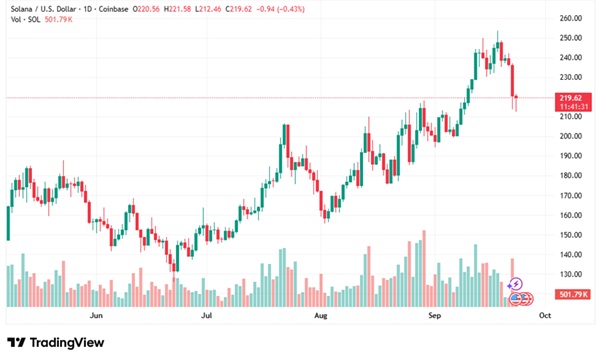
SOL/USD 1D Price Chart|Source: TradingView

Institutional signals are also heating up. The U.S. Securities and Exchange Commission recently approved generic standards that streamline approval for crypto spot ETFs, including those for SOL. Analysts anticipate $3–8 billion in inflows when these ETFs go live, which could move SOL significantly. Trading around $219-$220, SOL is supported around $220-$225. Meanwhile, resistance is near $245-$250. If SOL can decisively close above the $250 line and hold that as new support, the path is clear for it to move toward $300 in the near-term.

Pepe Coin (PEPE): Accumulation, Liquidity, and a Clear Breakout Path.

PEPE is trading around $0.000009, with a market cap in the $4 billion range. Its daily volumes are approaching nine-figure levels. These are signs that this meme veteran still commands deep market liquidity.

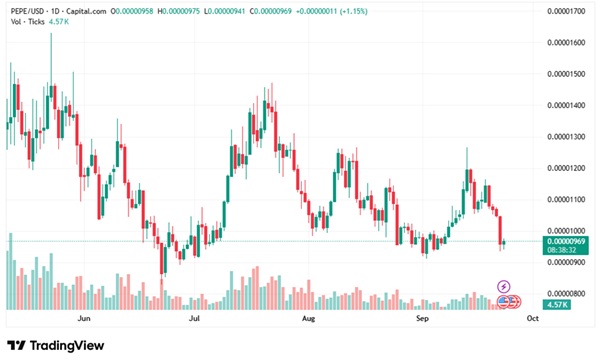
PEPE/USD 1D Price Chart|Source: TradingView

On-chain behavior over the past week has been constructive. Analytics indicate that top wallets are increasing their holdings by approximately 1.38% among large addresses. Moreover, several whale transfers moved multi-million-dollar PEPE into private storage. This classic accumulation footprint can precede strong rallies if retail demand follows. Exchange balances have concurrently tightened, which may reduce immediate sell pressure.  Currently, PEPE is struggling to surpass $0.000012. A clean breakout will push it to the $0.000016–$0.000022 range. But the decline might be steeper if it loses support. These mixed signals suggest PEPE could deliver outsized moves in a renewed meme-coin cycle. But outcomes hinge on continued whale accumulation, exchange liquidity trends, and broader market risk appetite.

Conclusion

With the market regaining momentum after Bitcoin’s recovery, some altcoins are already flashing strength. Little Pepe (LILPEPE) stands out as a meme-layer pioneer, backed by an explosive presale. Solana (SOL) is leading with expected institutional investment. Pepe Coin (PEPE) is showing renewed interest from whales and technical rebounds that could fuel a comeback. Together, these three stand out as the three best cryptos to buy as the market picks up pace. Little Pepe is currently in presale, offering a unique opportunity to get in early. With projections suggesting a 30x increase by 2025, it’s a promising pick.  Join the presale at littlepepe.com before the token listing.


For more information about Little Pepe (LILPEPE) visit the links below:

Website: https://littlepepe.com

Whitepaper: https://littlepepe.com/whitepaper.pdf

Telegram: https://t.me/littlepepetoken

Twitter/X: https://x.com/littlepepetoken