DD
MM
YYYY

PAGES

DD
MM
YYYY

spot_img

PAGES

Home Blog Page 4410

The Prices of Bitcoin and Ethereum Surge Amid FUD

0

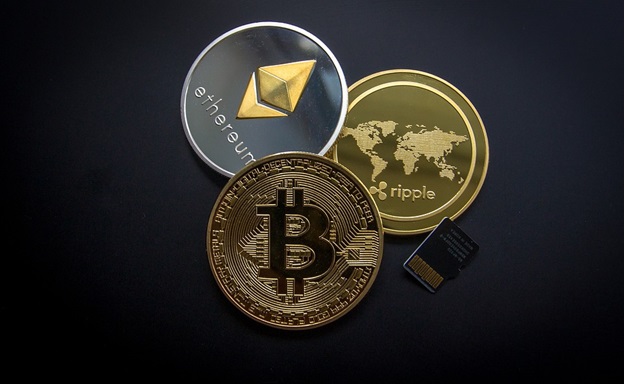
The Crypto market has witnessed a rejuvenating upward trend, the price of Bitcoin and Ethereum increased rapidly on Wednesday. At the start of this week, Bitcoin price fell around $22,000 and Ether was hovering around $1500 range owing to the CPI data which led to the decline on inflows of institutional funds and massive sell off as a result of SEC hammering Paxos— issuer of the Binance stablecoin [BUSD].

Currently Bitcoin and Ethereum is trading around $24,613 and $1685 respectively, with $BTC and $ETH witnessing a 10% and 8.3% increase on the 24 hours trade chart and a market capitalization of $474 billion, $202 billion respectively.

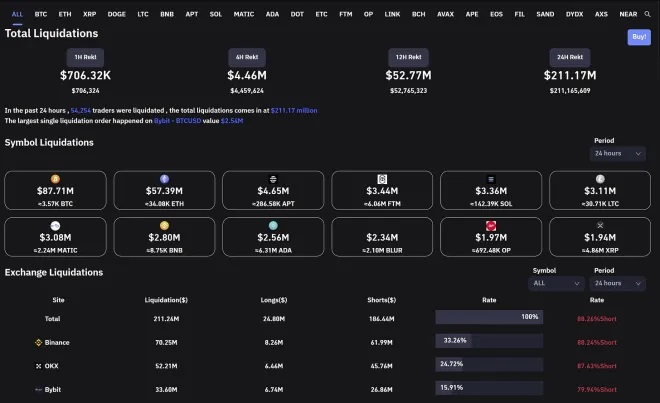
Apparently, following the surge in price of Bitcoin to the $24,000 zone, over 54,000 Crypto traders liquidated in the past 24 hours. The total liquidations are over $210 million, while short trades make up almost 90% of the liquidations majority happened on Bybit.
Willy Woo, Bitcoin analyst said “it took Bitcoin six months to get 1,000 users, 5 years to find 1 million users. Today, 14 years from inception, it has 300 million+ users, 4% of the world.
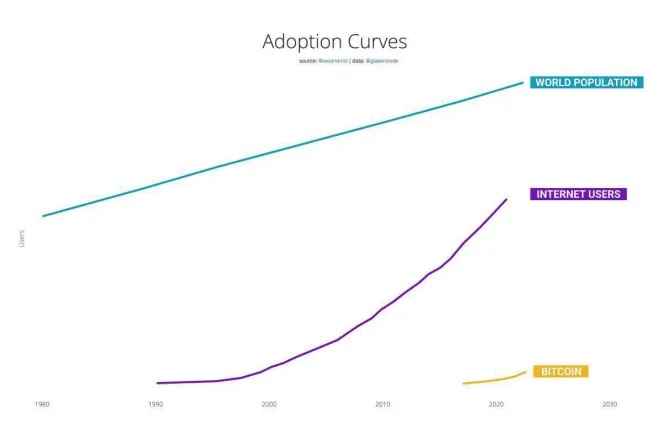
At current growth rates, one billion users will be hit in the next three years— that’s 12% of the world.” George1Trader, a Bitcoin Degen opines that the $27.7k area is the level everyone’s watching as key Bitcoin resistance. Would make more sense to slightly front run, then smash through and go straight for 33-35k’s imo. Weekly close will tell more about whether that’s coming soon or we see a retracement first.
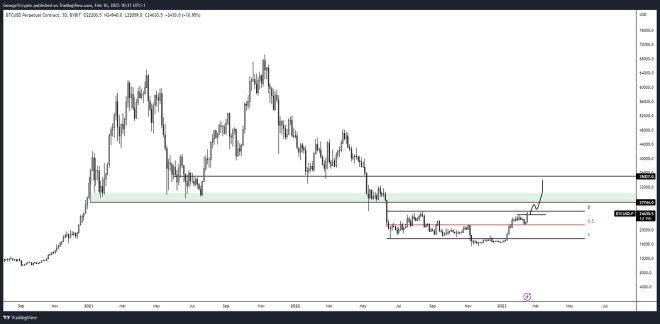
If BTC breaks the $25k resistance, there`s a high possibility of $28k Bitcoin in the next week or two. Interestingly, the recent Bitcoin pump was driven with stablecoin BTC futures.
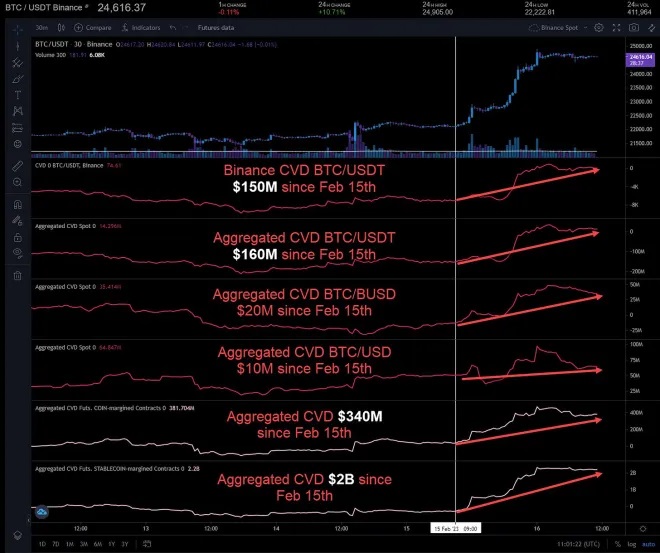
The aggregated CVD showing $2B, if we add the BTC margined CVD too, we see $2.34B in futures, while only $190M in spot aggregated CVD. While the price goes up— more institutional funds will flow into the crypto market.

Kismia: 3 Reasons to Try the Best Dating Site in Nigeria

0

Nigerian dating culture is still different from what we can see in American movies and on the internet. But just because you have great respect for your culture’s domestic values, that doesn’t mean that you can’t look for your significant other on online dating sites like Kismia.

In case you haven’t heard of it, Kismia is the greatest dating site in Nigeria.

Here’s why you should try Kismia, whether you’re looking for marriage or fun:

  1. Kismia Is Safe and Respectable

Kismia is one of the very few online dating sites in Nigeria that doesn’t compromise quality for quantity. Even though it has more than 15 million users, Kismia has no fake profiles. Every person you meet on this dating site has to go through a verification process and prove their identity.

You, too, will have to submit your photo so that your profile is approved.

Online dating safety is important for many reasons. You’re at your most relaxed and vulnerable when you’re dating, so it’s only natural that you’d want to meet people in a safe environment. Kismia is a respectable dating site with extensive privacy policies that protect its users.

1. Kismia Is Also Exciting and Fun

Of course, all that would be for nothing if dating on Kismia wasn’t fun.

Kismia is not just any dating site. It’s a loving community of people of all ages, sexual preferences, and even genders. If you’re romantically curious, this is a great place to experiment in private before you find a serious partner. Even if you get turned down, nobody will judge you.

Online dating gives us the freedom most of us don’t have in real life, but that’s why it is so important to choose a good online dating site. If you feel like social and cultural stigmas are standing in the way of true love, this is your opportunity to explore more daring dating cultures.

2. You Can Find Love on Kismia

The best of all is – you can find your true love right there, on Kismia.

According to the site’s statistics, around 6,000 couples fall in love on Kismia every day. That’s something, even when it comes to online dating. Kismia has a high success rate because it creates a relaxing setting where people can enjoy being themselves and talk to others with ease.

Kismia offers cool matchmaking features. The Dating Section shows your potential partner’s name, age, and photo, as well as their dating preference and your compatibility percentage. If you don’t like what you see, you can look for other people using Kismia’s search filters.

Conclusion

Whether you’re looking for a taste of true African flavor or something entirely different from Nigerian dating culture, there’s no doubt you’ll be able to find it on the best online dating site in Nigeria. Kismia is simply the best place on the internet for finding like-minded singles.

The Sociology and the Sustainability of the Naira Redesign Policy

0

The Naira redesign policy of the Federal Government and the Central Bank of Nigeria no doubt started out on a promising note, and not a few well-meaning Nigerians had ab initio been sentimentally attuned to the manifest objective of the policy which is to curb vote buying and electoral malpractices in the country.

However, issues that have emerged since the implementation of the policy have presented multidimensional cases for a critical reflection and interrogation of the logic of the policy and its general implications on the economy and distribution of wealth of the nation.

To start with, it is no brainer that a sustainable monetary policy must above all things be predicated on economic laws, specifically the relationship between demand and supply. However, where a monetary policy is politically driven or is anchored on issues outside the shores of economic relations, economic resistance is likely to erupt, leading to upheavals or what sociologists refer to as anomie or moral crisis within the economy. This is because the economy is the fulcrum of human survival, social order and nation’s wealth.

The forgoing was based on the thought of Karl Marx in his historical materialism where he propositioned that the economic infrastructure determines the superstructures of society. Superstructure as used by Karl Marx refers to all social institutions other than the economy. According to the German social philosopher and father of conflict (dialectic) sociology, the superstructure provides support systems through policies, values, morals and laws etc towards driving the economic relations and distribution of wealth within society.

In recent developments in Nigeria, we have seen how the implementation of the Naira redesign policy has adversely impacted economic activities and social order in the country due to misplaced priority or, better say, misdirection of purpose of the policy.

Orienting monetary policy towards gaining political points by all means has its economic cost which in the case of Nigeria has been a serious disturbance to the velocity of Naira. Moreover, for a nation that has yet to be technologically mature for cashless economy, whimsically mopping cash out of circulation has a strong likelihood to instigate social crisis and anomie.

In that light, many Nigerians have been hard pressed due to difficulty in accessing and delivering cash to enable them go about their normal economic lives. Consequently, that has degenerated into riots or chaos in many parts of the country.

Another way to interrogate the logic and potency of the naira redesign policy beyond its sociological and societal implications is its sustainability. Since the policy is chiefly anchored on curbing vote buying and electoral malpractices in the country, the question to be answered is this: Would the policy be replicated or be made into law to be effected at every four years of the elections period?

Nigeria’s New Empires Are Being Built and Tech Will Drive The New Wealth

1

The largest financial institution in Nigeria is not a bank. That startup can buy the two largest banks in Nigeria and still have change. The one which comes after it processes US$12 billion monthly. From financial services to logistics, Nigeria’s largest logistics startup can buy the top five traditional logistics firms conveniently. This redesign cuts across industrial sectors and domains. While it takes decades for some financial institutions to hit one million users, Tekedia Capital portfolio startup, Touch and Pay, did from 1,000 users to 3 million users in three years.

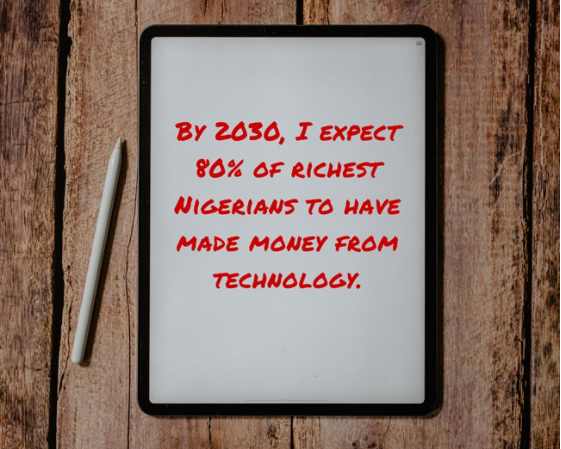
Good People, by 2030, I expect 80% of the richest Nigerians to have made money from technology. Nigeria is having its finest cambrian moment on the formation of enduring companies. The last time we were this bold, on entrepreneurial capitalism, was in the early 1990s when some of Nigeria’s current  leading banks were established. 

The 1990s gave us the new generation banks. The 2000s brought voice telephony. The 2010s ushered mobile internet. The 2020s would deliver the era of application utility across industry sectors and market territories.  

We will see software systems change the ordinance of markets by “eating” frictions along the way. From education to healthcare, from financial services to logistics, and beyond, it would be exciting. The empires of the future are being built. That was the reason I founded Tekedia Capital and today we hold positions in dozens of companies. 

As exits begin to happen from 2026 looking at the curve, a new generation of business leaders will emerge in Nigeria. In the next coming weeks, we will open the next cycle of Tekedia Capital Syndicate; I invite you to come and learn about the companies I am investing in. We invest $$millions yearly to seed and empower these builders, innovators and category-king agents.

We’re making it easier for citizens, groups, investment clubs, companies, organizations, etc to own a piece of early-stage, high-growth technology startups operating across Africa.

Our opportunity antenna and grassroot connections with innovators enable us to see patterns as they develop. We invite you to partner with us as we nurture and build category-king companies in Africa and beyond, and in the process advance citizens, communities and nations.

At Tekedia Capital, we fund the foundations of the NEXT African economy through entrepreneurial capitalism. A  membership fee which covers 4 investment cycles (we typically do 2-3 cyclers every 12 months)  of $1,000 or Naira equivalent IS REQUIRED; click and join today.

Meta CEO Mark Zuckerberg Increases Spending on Personal Security Amidst Cost Cuts

0

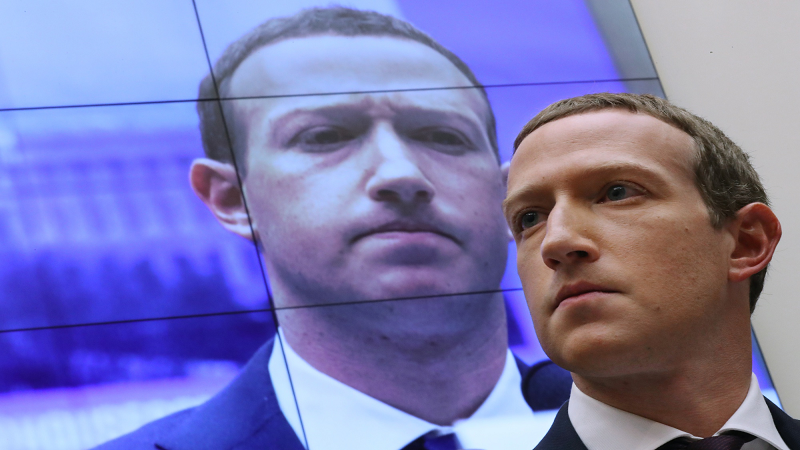
Meta CEO Mark Zuckerberg has increased spending on his personal security and that of his family to $14 million (S$18.7 million ) in 2023, up from US $10 million in the past few years, amid cost cuts at the company.

Meta stated in a recent filing that the increased allowance together with the costs of the CEO’s existing overall security programme was appropriate and necessary under the circumstances.

The move comes at a time when Meta has laid off thousands of its workforce as well as significant cost cuts at the company in what Zuckerberg dubbed 2023 as a “year of efficiency”.

With a $1 basic salary and no stock based rewards, the majority of Zuckerberg’s income was made up of security expenditures. While Meta disclosed the budget is $14 million, it stated that it will probably spend much more than that to provide security to Zuckerberg and his family.

In 2021, the company spent over $15 million on costs associated with the protection of its CEO while he was at home and on personal business. It is interesting to note that Zuckerberg in the past has been faced with scrutiny for spending more on security than comparable technology executives. In 2021, Meta spent over $26.8 million on security-related expenses. In a recent filing, the company revealed that its CEO, Mark Zuckerberg receives an annual salary of US$1 and does not receive any other compensation.

In it’s fourth quarter (Q4) result, Meta surpassed revenue expectations, bringing in $32.2 billion. Number of Facebook users also managed to inch up in the last quarter with the platform hitting 1.98 billion daily active users and 2.96 billion monthly active users as of September 2022.

Those gains combined with Meta’s aggressive cuts and its promise of an efficient 2023 drove stock prices up around 15% in trading after-hours. Meta took a notable beating in 2022’s market turndown, losing as much as 60% of its value over the course of the year.

In its Q4 earnings call, the company’s CEO Zuckerberg therefore revealed that Meta will be very proactive about cutting projects that aren’t performing or may no longer be as crucial. The tech giant is also reducing spending as it builds new data centers that are intended to be more efficient while still able to power the company’s various artificial intelligence technologies.

He therefore revealed that the management theme for 2023 is the ‘Year of Efficiency’, noting that the company will be focused on becoming a stronger and more nimble organization. Zuckerberg’s commitment to cost cuts and efficiency is a sign that increasing profitability is important to Meta, which was known as a growth machine prior to last year’s slump.

Meanwhile, recent reports reveal that Facebook’s parent company Meta has delayed finalizing the budgets of the teams at multiple levels, as it prepares for a fresh round of layoffs.