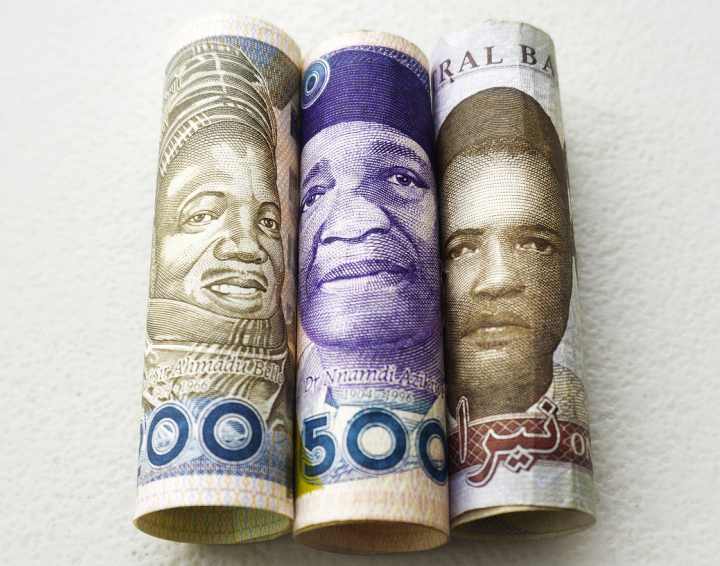
The International Monetary Fund (IMF) has called for a review of the Central Bank of Nigeria Act 2007 to enhance the bank’s autonomy and governance considering emerging problems and controversies around the Naira redesign policy of the Nigerian apex bank .
In a recent report of the IMF entitled ‘Nigeria: 2022 Article IV Consultation-Press Release; Staff Report; and Statement by the Executive Director for Nigeria released on its website, the CBN’s autonomy has been said to have been disputed due to the CBN’s naira redesign policy.
It is observed that the integrity and autonomy of the CBN needs to be reconsidered as some states’ governors challenge and issue counter-directives on the CBN’s pronouncement on the legal status of the old 1000, and 500 naira notes which is said to be in contrast with the subsisting ruling of the supreme court.
The IMF, in its article, stressed the importance of maintaining the CBN’s autonomy to make price stability its primary objective. The International financial institution also urged the CBN to abide by international standards by publishing its annual financial statements, and pruning government officials’ presence on its apex board and committees.
According to legit.ng, the IMF also recommended modernizing the CBN Act 2007, strengthening the CBN’s autonomy, safeguarding the independence and tenure of central bank officials, and phasing out some quasi-fiscal activities that may worsen financial repression and weaken the CBN’s price stability mandate.
The IMF article reads in part: “The CBN Act should be updated to make price stability the main goal, improve the bank’s independence by decreasing the number of government officials on the board and committees, and protecting the tenure of central bank officials. Legal changes should establish independent oversight, including a non-executive board and independent audit committee.
“Financial autonomy should be safeguarded through clear statutory limits on credit to government and prohibition of quasi-fiscal operations and developmental lending activities, which need to be phased out.”
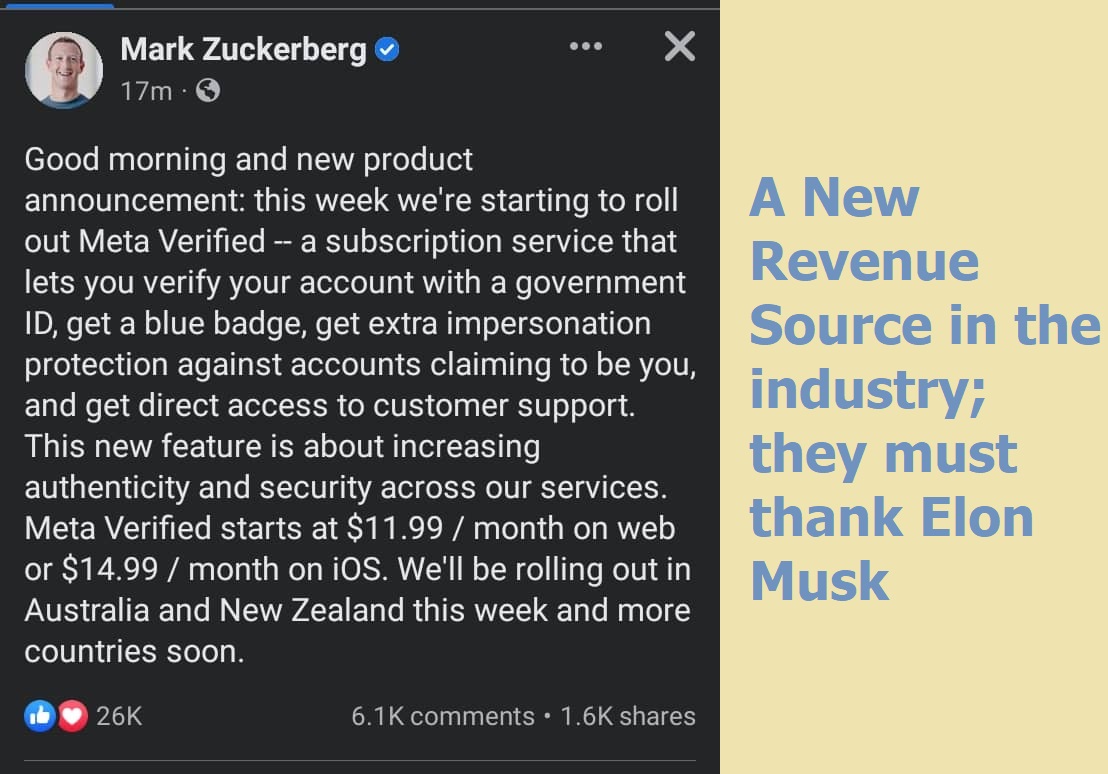
I wrote about this when Elon Musk pioneered it, noting that it would be a good feature for Meta (Facebook parent company) and LinkedIn. Today, it has been adopted: “‘Meta Verified’ will give you a blue badge along with several other benefits, including increased visibility, protection against impersonation, priority customer support, and more” for $12/month.
Meta’s testing paid verification for Instagram and Facebook for $11.99 per month on web and $14.99 per month on mobile. In an update on Instagram, CEO Mark Zuckerberg announced having a “Meta Verified” account will grant users a verified badge, increased visibility, prioritized customer support, and more. The feature’s rolling out to Australia and New Zealand this week and will arrive in more countries “soon.”
“This week we’re starting to roll out Meta Verified — a subscription service that lets you verify your account with a government ID, get a blue badge, get extra impersonation protection against accounts claiming to be you, and get direct access to customer support,” Zuckerberg writes. “This new feature is about increasing authenticity and security across our services.”
For years, nobody wanted to do this until the boldest entrepreneur in our generation, Elon Musk, did it, and it is going to become an industry standard henceforth. I am waiting for the LinkedIn one as that is the only one I will pay for; I will put it under business expense since LinkedIn is my CNN, NTA, BBC, NYTimes, Economist, etc combined for business and professional visibility.
Anything that will stop people writing “are you Ndubuisi Ekekwe” even though he/she is chatting with Ndubuisi Ekekwe right there. Hopefully, when LinkedIn does that, that question will disappear and we can build more trust to advance entrepreneurial capitalism.
This is a new revenue source for Meta. I can assure you that most times, we overestimate how customers will react. Those people paying at Twitter are still there because they get more than $20/month for that visibility.
Welcome to Internet Utility 2.0 where you will pay for the privilege of feeding aggregators with data and raw materials which they use to make money. Of course, you also get value in return.
Comment on Feed
Comment 1:Ndubuisi Ekekwe Prof.. Your prediction of business innovation is becoming so prevalent now, its getting to the point it is starting to look ‘ordinary’.
The normalization of showcasing this skill on LinkedIn has moved the bar for self declared ‘thought leaders’ ‘visionaries’ and ‘influencers’
Many of them have just taken an aggressive approach to network building on here, but their content is thin, unoriginal, formulaic, lacks a commitment of opinion, repetitive ( I could go on) and above all, uninspiring.
Show them the way, please. ?
Comment 2: Elon Musk is not just a technocrat but also a business mogul.
He’s currently considering a business model in which public influencers can earn from part of advert revenue.
Comment 3: Elon Musk is on a league of his own, those who taunt him obviously don’t fully understand what that guy embodies, he’s not just bold but also visionary. If Twitter gets 20 million people to pay for blue tick, $2 billion could be within reach per annum, yet for years Twitter was languishing in the hands of people who knew nothing about running a profitable enterprise, rather it was turned into an ideological battlefield, incapable of bringing meaningful returns.
For all the beatings Mark has taken over the last few years, finally the man Musk has shown him the light, a new revenue stream is here.
This verified badge model will also help aggregators negotiate better deals from advertisers, unlike before where anything goes, if a platform can boast of 30 million verified accounts, you atleast know that there are 30 million people capable of paying for something, it’s a better benchmark than what was previously obtainable.
Musk has transformed social media revenue model.
My Response: “This verified badge model will also help aggregators negotiate better deals from advertisers, unlike before where anything goes, if a platform can boast of 30 million verified accounts, you atleast know that there are 30 million people capable of paying for something, it’s a better benchmark than what was previously obtainable.” – very revealing. Amazon Prime number is an x-factor when it negotiates with vendors. Who do you deal with? The company where 100m+ pay to shop or the one that does not even know if people will come tomorrow.
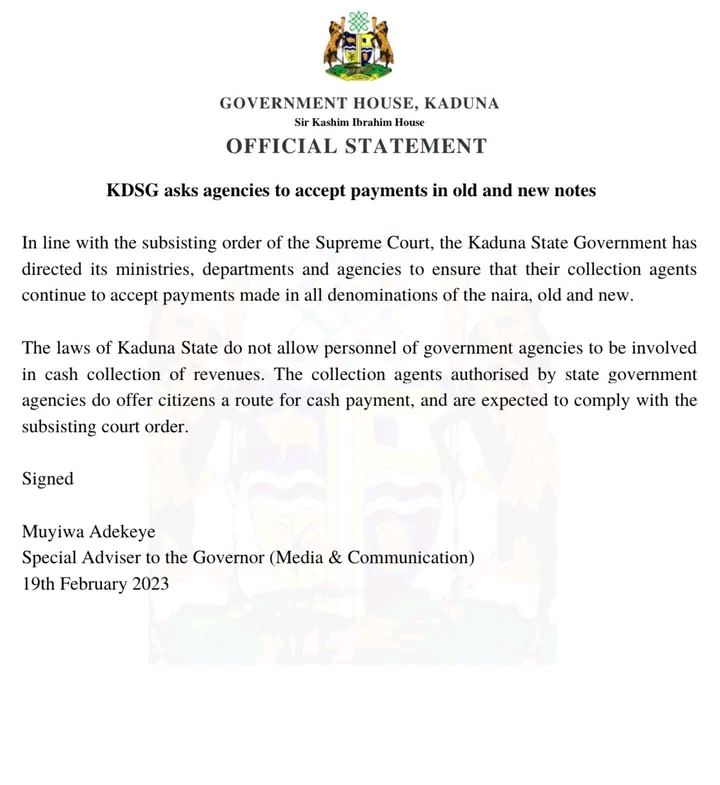
The Kaduna State Government has ordered all agencies, department and ministries within the state to ensure that their collection agents continue to accept payments made in all denominations of the naira, old and new congruent to the subsisting ruling of the Supreme Court on Wednesday that the old 200, 500 and 1000 Naira notes shall remain a legal tender pending the determination of the suit brought before it against the Federal Government and the CBN.
According to a statement by the State Government dated 19th February 2023 and signed by the Special Adviser to the Governor on Media and Communications, all the Government authorized collection agents within the state which offer the citizens a route for cash payment are expected to comply with the subsisting order of the supreme court. The Statement reads as follows:
“In line with the subsisting order of the supreme court, the Kaduna State Government has directed its ministries, departments and agencies to ensure that their collection agents continue to accept payments made in all denominations of the naira, old and new.
“The laws of Kaduna State do not allow personnel of government agencies to be involved in cash collection of revenues. The collection agents authorized by State government agencies do offer citizens a route for cash payment, and are expected to comply with subsisting court order.”
Recall that on February 16, the Governor of Kaduna State, Mallam Nasir El-Rufai, had in a media address implored Kaduna State citizens to continue to use their old naira notes along side the new notes without any fear while he assured that all the old and new notes shall remain in use as legal tender in Kaduna State until the Supreme Court determines otherwise. This is despite the declaration of the old 500 and 1000 Naira notes as obsolete by the President, Muhammadu Buhari .
Some of the citizens and residents of Kaduna State had also expressed pessimism and skepticism about the posture of the State Government, especially with the awareness that the CBN and the major Commercial banks in the state will not be collecting the old notes from them.
Several reports have shown that the number of populist leaders is both increasing and decreasing around the world. In the global north, the reports indicate that the political leadership style has “fallen to a 20-year low after a series of victories for progressives and centrists over the past year,” according to analysis from the Tony Blair Institute. The Institute, as quoted by the UK newspaper The Guardian, reports that the number of people living under populist rule has fallen by 800 million in two years. Politicians like Donald Trump in the United States of America, Jair Bolsonaro in Brazil, and Rodrigo Duterte in the Philippines gained power through populism, an ideology, political programme or movement that champions, or claims to champion, the common person. In other words, it “promotes the idea that its leaders alone represent the people in their struggle against the elite.”
In the global south, where we have Africa, Latin America and Asia, the political movement is also on the rise. These continents had populist leaders who fought the elite and eventually were elected as presidents and prime ministers. Burundi, Cameroon, Egypt, Gabon, The Gambia, South Africa and other countries on the continent have had populist leaders who eventually became presidents. A populist leader who eventually became president could only have happened in Nigeria, when President Muhammadu Buhari was elected in 2015 after “public acceptance” of his rhetoric and promises of changing poor socioeconomic and political indices. Citizens and members of the international community have described his seven years as president as having both negative and positive consequences.
As his tenure draws to an end, some of his economic policies and political decisions are having severe impacts on people and businesses. As a result, there is a need to elect a populist leader. However, our analyst observes that, for the first time since the country’s return to democratic governance in 1999, voters are undecided about which of the three leading presidential candidates to support. They are in a serious dilemma because Senator Bola Ahmed Tinubu, Alhaji Atiku Abubakar and Mr. Peter Obi have been campaigning using populism since September 28, 2022. Across mainstream news media, digital platforms, and community mobilisation strategies, the trio has used and continues to use various rhetorical appeals and ethos that align with populism. This is not a new phenomenon in the history of populist movements; Hugo Chavez famously used emotionally charged populist rhetoric to appeal to a broad base of Venezuelans from the poor and working classes.
However, when a populist leader fails to win a presidential election, their followers can be left feeling deflated and disappointed. In order to manage their mental health during such a time, it is important for followers of a populist leader to practice self-care and focus on the positives in any situation. After reviewing several sources regarding the psychological state of followers of populist leaders during electoral cycles in the global north and some countries in the global south, our analyst briefly discusses some fundamental tips for mental health management in the case of electoral loss.
Firstly, it is important for followers of the three candidates to avoid engaging in negative self-talk. It can be easy to get caught up in the disappointment and frustration of the failed election and to start thinking negatively about oneself and the situation. Instead, followers should focus on reframing these negative thoughts into something positive and productive. For example, if they are feeling down about the election result, they could think of ways that they can use this experience to better themselves and their communities.
Secondly, followers should practice self-care and self-compassion. This can be done through activities such as mindfulness, yoga, or journaling. Taking time to relax and focus on themselves can help followers reframe their thoughts in a more positive light and find contentment in their current situation.
Nigerian naira banknotes are seen in this picture illustration, September 10, 2018. REUTERS/Afolabi Sotunde/File Photo
The Nigerian economy faced complex challenges in 2022. One of the most significant of these challenges is the prolonged fuel scarcity, which appears to be slowing down economic activity, increasing inflationary pressure, eroding the purchasing power of the Naira, and pushing more Nigerians into poverty.
While ordinary Nigerians and many businesses were devising strategies to mitigate the effects of fuel scarcity and rising inflation, the Central Bank of Nigeria (CBN) announced plans to redesign the country’s currency, specifically the higher denominations, on October 26th, 2022. The announcement came with a tight deadline of January 31st, 2023, to phase out the old N200, N500 and N1,000 notes – which account for 95.6 percent of the total value of the currency in circulation.
The decision by the CBN to redesign some Naira denominations is not unprecedented in Nigeria, given the history of currency redesigns as obtained in 2007 and 2009 with the lower denomination banknotes. The Naira redesign policy is authorised by Sections 18 (a) and (b) of Nigeria’s Central Bank of Nigeria Act of 2007. According to the Act, the CBN shall (a) arrange for the printing of currency notes and coin minting; and (b) issue, re-issue, and exchange currency notes and coins at the Bank’s offices and such agencies as it may establish or appoint from time to time.
Both the reasons for the redesign of the Naira and the timing are important factors in examining the policy and the merits of the decision to redesign the currency notes. The CBN highlighted five (5) main reasons for its decision [1].
Apart from promoting economic activity, the Naira currency represents Nigeria’s pride and heritage, far more valuable than its face value and purchasing power – what it can buy. Cash is still central to economic activity in Nigeria, where about 90 percent of transactions occur using money. Therefore, chronic shortages, such as the Naira scarcity experienced since the fourth week of January 2023, due to limited Naira notes printed by the CBN, hoarding by financial institutions and digital financial platform breakdown/malfunction, have economic and sociocultural consequences for the Nigerian economy and the general populace.
At a broader level, the Nigerian economy is facing continued exchange rate volatility, increased inflationary pressure, and other macroeconomic challenges. These issues have deteriorated socio-economic conditions, increasing insecurity, food shortages, and crime. While this is due to various structural problems, the effects of the pitiable execution of the redesign policy are exacerbating the economy’s situation, mainly because of the prominent role of “cash-in-hand” to economic activities and the unpreparedness of economic actors for the rapid changes which have taken place. This report details an analysis of the CBN’s Naira redesign policy to provide a critical way forward toward addressing the unintended realities emanating from policy implementation.