DD
MM
YYYY

PAGES

DD
MM
YYYY

spot_img

PAGES

Home Blog Page 4424

Google Employees Criticize Leadership Over “Rushed” Bard Release

0

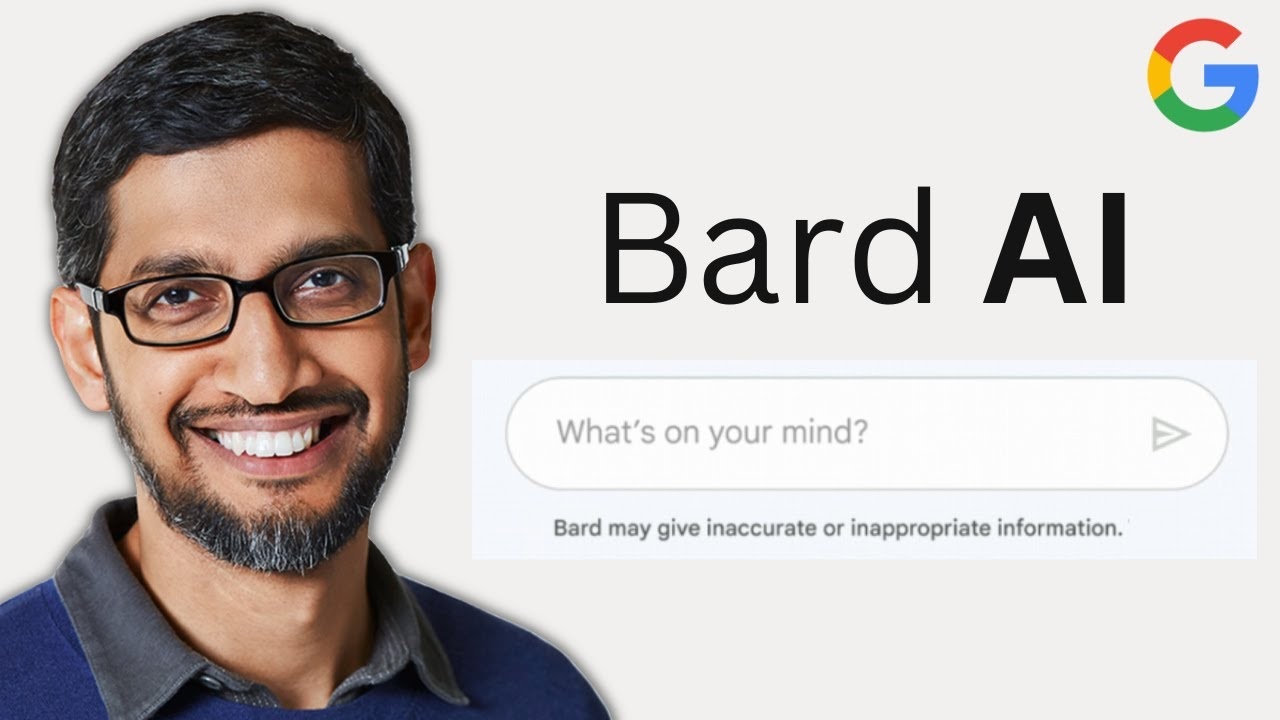
Employees at giant tech company Google have recently criticized the leadership following the release of its AI chatbot Bard, which they described as rushed.

These employees took to memengen, Google’s Internal Meme Generator to call out the company’s CEO Sundar Pichai, and the leadership, over the lackluster release of Bard.

They referred to the release of Bard as “rushed,” “botched” and “un-Googley,”. Also, they faulted the company’s layoff of 12,000 workers which is about 6% of the workforce, that affected the company’s stock price.

A meme read, “Dear Sundar, the Bard launch and the layoffs were rushed, botched, and myopic. Please return to taking a long-term outlook.”

Another meme which was accompanied by a photo of a bird doing a facepalm, read “Rushing Bard to market in a panic validated the market’s fear about us”.

Recall that shares of giant tech company Google plunged by 8% which is reported to have wiped out $100 million from the company’s valuation after its AI chatbot “Bard” answered a question incorrectly.

According to reports, Google’s AI chatbot claimed that NASA’s James Webb space telescope took the first image of an exoplanet but was wildly wrong. The first image was reported to be taken in 2003, by the European Southern observer’s very large telescope.

Google used the question and incorrect answer Bard generated via a video GIF on Twitter to showcase how the AI chatbot Bard works.

The company wrote, “Bard is an experimental conversational AI service powered by LaMDA, built using our large language models and drawing on information from the web. It is a launchpad for curiosity and can help simplify complex topics.”

However, the incorrect response given by Google’s chatbot Bard has stirred mixed reactions.

In comparison to what Microsoft unveiled at its AI presentation, some investors feel that Google’s AI presentation was shambolic, noting that it didn’t offer any insight into how the company would compete against Microsoft’s exceptional offerings.

Bard’s blunder highlights the challenge for Google as it races to integrate the same AI technology that underpins Microsoft-backed ChatGPT into its core search engine. In trying to keep pace with what some think could be a radical change spurred by conversational AI in how people search online, Google now risks upending its search engine’s reputation for surfacing reliable information.

Like ChatGPT, Bard is built on a large language model, which is trained on vast troves of data online in order to generate compelling responses to user prompts. Experts have long warned that these tools have the potential to spread inaccurate information.

In an apparent attempt to address that concern, Google previously said Bard would first be opened up to “trusted testers” this week, with plans to make it available to the public in the coming weeks.

CBN’s Naira Swap Policy May Cut Nigeria’s GDP by 5% in Q12023 – Bismarck Rewane

0

The economic implications of the naira redesign policy of the Central Bank of Nigeria (CBN) are likely going to cut into Nigeria’s gross domestic product (GDP) by three to five percent in the first quarter of 2023, according to Bismarck Rewane, an economic expert.

The circulation of the redesigned N200, N500 and N1,000 notes, which were unveiled late last year by President Muhammadu Buhari, have been marred by chaos across the country. This is due to the insufficiency of the new naira notes that has forced the CBN to extend its January 31 original deadline for the old naira notes to be returned to the banks.

The deadline was extended to February 10. But it was not enough to quell the scarcity of the new naira notes that is increasingly crippling the informal sector.

With businesses and people across the country reeling on the impact of the policy, no less than five states in Nigeria have dragged the federal government to the Supreme Court, praying the apex court to order the CBN to allow both the old and new naira notes to coexist.  The Supreme Court restrained the federal government from enforcing the February 10 deadline until February 15 when the matter will be determined.

Based on the growing economic consequences resulting in chaotic responses from the public, including attacks on banks believed to be hoarding the new notes, Rewane said the policy will bear a negative effect on Nigeria’s GDP in the first quarter of the year.

He said this during his appearance on the 2023 Verdict, Channels Television’s special election programme. The CEO of Financial Derivatives Company Limited said the growing number of hours spent on queues to withdraw money owing to the scarcity of the new notes, will affect the economy negatively in the short term if it is not hastily addressed.

“The impact at the end of the day is that it will affect GDP this quarter, conservatively, by three percent, and aggressively it could reduce GDP in this quarter by five percent, if nothing is done in a hurry,” he stated.

Rewane noted that due to the policy, the number of ATM users in Lagos has grown significantly. He said the number of ATM users in downtown Lagos (Ikoyi, Victoria Island, Lekki) used to be three to four. Midtown (Ebute Meta), the number of ATM users at average times was eight, while one uptown (Alimosho) typically had 15.

He added that this has increased the downtime to get one’s money out of the ATM, which used to be five minutes in Ikoyi, seven minutes in Ebute Meta, and 10 minutes in Alimosho.

“Fast-forward to now. The average number of people in front of an ATM in Ikoyi and Victoria Island is now 40. In midtown Ebute Meta, it’s about 100 people. And in Alimosho, it’s about 600 people.

“The consequences are that flour sales in Lagos are down 30 percent. The rams in Kano are down 70 percent. And cement in Kogi is down 40 percent of sales,” he said.

Proffering solution, Rewane said the federal government needs to do damage control to ensure improved supply of the naira. He said there is a need for the government to print more notes to meet supply demand and rebuild citizens’ confidence.

“We can talk from now to tomorrow. It doesn’t change. We are on the ground. What we need to do is damage control. Damage control means that two aspects: print more money – the mint or whatever it is – overseas to give us all of this supply and instill confidence,” he said.

But the CBN governor Godwin Emefiele had on Friday told the National Council of State (NCS) that the Nigerian Security Printing and Minting Plc (The Mint), is currently under capacity constraints, which means it cannot print adequate new notes to replace the old naira notes.

“The Mint has run out of papers to print N500 and 1,000 notes. They have placed orders with a German firm and De La Rue of the UK (for papers) but they have been placed on a long waiting list, so their orders cannot be met now,” he said after the Council asked the CBN to print more money to meet the supply needs of the new notes.

SEC Bans Crypto Staking Service on Retail Institutions

0

The Security and Exchange Commission [SEC] has banned Crypto Staking in the USA for retail institutions. SEC also charged Kraken Exchange for running Crypto staking program as a service not as a security. According to SEC, the problem with the Kraken staking is “When crypto investors provide tokens to staking-as-a-service providers, they lose control of those tokens and take on risks associated with those platforms”. This sounds like the Celsius earn program where you don’t own your coins in actual facet.

it’s a concerning development for the crypto industry in the USA. The idea of limiting staking opportunities to only big players goes against the decentralized spirit of the sector. Let’s hope for clarity and fair regulations from the SEC.

If you want to pledge on a centralized platform, you must accept supervision, but you can also choose a decentralized platform, which seems to make the decentralized platform stronger.

Gary Gensler and the SEC aren’t looking to ban all staking, but rather want to increase the fiduciary responsibility of centralized entities offering staking as a service. The rationale here is that end customers should know where their money is going. Is the institution actually putting those funds to staking? Are they commingling them with another business? Where does the APR come from?

The ruling is actually bullish because this would protect people using these staking as a service provider. It does not mean Ethereum itself would be a security, but rather the derivative tokens these providers are offering. It also likely means that decentralized staking protocols like LidoFinance and Rocketpool are in the clear as the funds transfers are transparent and onchain. You can see directly where your money is going.

It also means self stakers are well in the clear and have nothing to worry about. Sometimes regulation can be good because it legitimizes the investment options we have. It makes them safer and thus more people are likely to invest more in them because they feel protected.

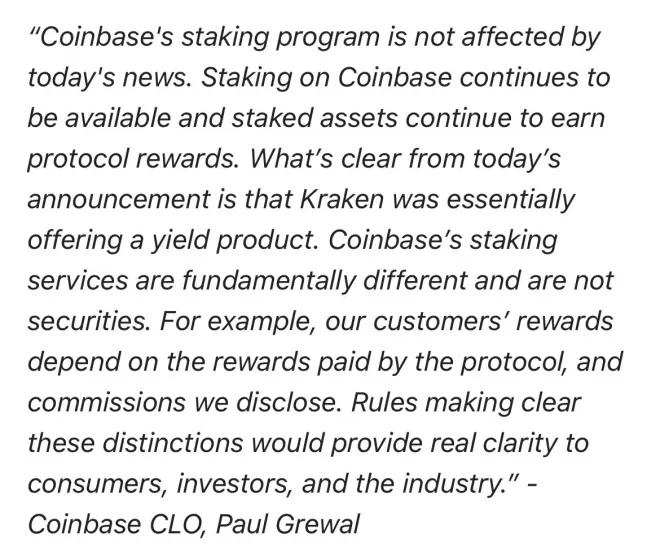
Coinbase says Kraken news will not affect their staking program, Coinbase CLO, Paul Grewal said they’re willing to fight SEC on this issue.

If SEC bans staking on retail, there will be big ripple effects through the multi-billion dollar staking industry including exchanges, infra firms, protocols, derivative tokens, devs, the big VCs, and all is happening a month before withdrawal is enabled.

Adam Carver, CEO at Bitgreen stated on microblogging platform Twitter;

A ban on staking crypto would do irreparable harm to centralized exchanges who are the only ones attentively trying to behave compliantly with US regulation, and move token flow to decentralized platforms that are offshore and hostile to regulation. Not to mention it would suck the wind out of innovation in the US. The only people who like the idea to prohibit staking are Bitcoin maxis because innovation in blockchain happens on chains that aren’t Bitcoin

Crypto exchange Kraken winding off staking services on its platform following SEC charges will encourage stakers to move from CEXs to DEXs and use decentralized staking protocols. Seems SEC thinks they can ban staking in the United States of America but I think they forgot there’s something called VPN.

Big exchanges like Coinbase wouldnt be able to accumulate large token allocations, decentralizing pools as 11% of coinbase’s stock is staking, this can be the momentum shift for the last leg down on Crypto regulations which proves decentralization will spur widespread crypto adoption.

Staking tends to get misconstrued with unrelated activities like lending, but staking is fundamentally a way for anyone to join in providing security for proof of stake networks. The SEC didn’t “ban staking.” The SEC enforced action on financial intermediaries offering, in this case, staking-as-a-service (or: custodial staking) programs, which has nothing to do with non-custodial staking or protocols themselves, Antoni Zolciak Cofounder Aleph Zero noted.

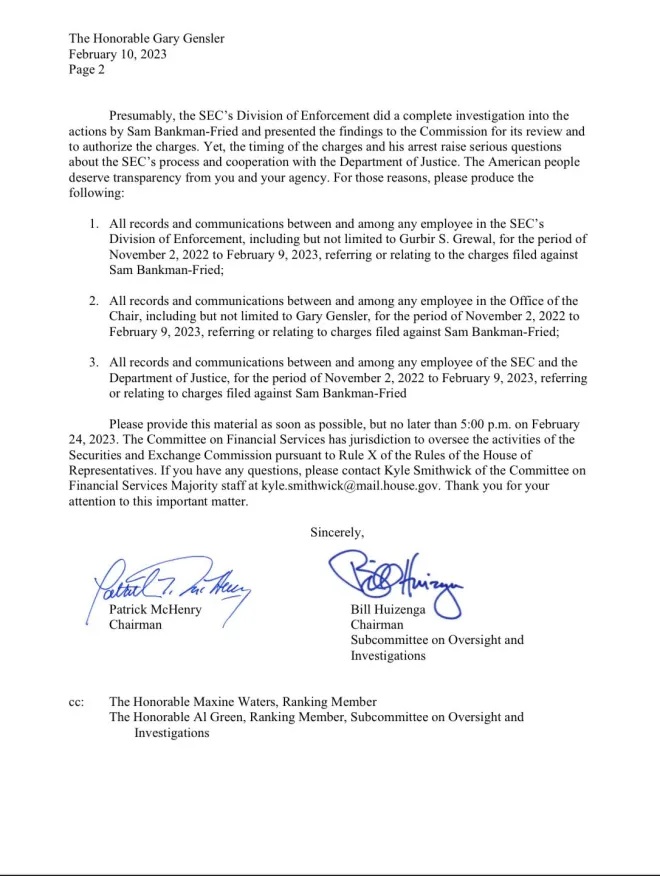
Interestingly, U.S. Rep. Bill Huizenga stated that “since Gary Gensler won’t abide by his own polices to “come in and talk”, the House GOP will hold him accountable.

I’d bet if the SEC got off their asses and defined clear regulation for centralized exchanges, they’d comply. How can the IRS define crypto as property, and SEC call them securities. Stocks aren’t property.

The SEC have allowed so much to continue to happen. Don’t look into Darkpools, Naked Shorting, All Citadel’s businesses are basically monopolizing the stock market and astronomical conflicts of interests. Gary Gensler is legislating through enforcement. He ignores bad actors and shuts down honorable crypto businesses to grab headlines.

Coinbase Explains Why Crypto Staking Service should not be Classified as Security

0

Crypto Staking Service is not a Security under the US Securities Act, nor under the Howey Test. Trying to superimpose securities law onto a process like staking doesn’t help consumers at all and instead imposes unnecessarily aggressive mandates that will prevent US crypto consumers from accessing basic crypto services which tends to push U.S. crypto Users to offshore and on unregulated platforms.

Paul Grewal, Chief Legal Officer at Coinbase opined recently on CoinBase’s blog that;

At Coinbase, we’ve been committed to providing our users with a secure, compliant platform to access the cryptoeconomy since day one, and our staking products are not securities.

But there are a lot of products in the market called staking and many of them work very differently. Today I’ll focus on core staking services (protocol-based, on-chain staking), like the ones Coinbase offers, which are a vital aspect of crypto and blockchain technologies.

Staking allows anyone, anywhere, to contribute to the security of a blockchain and to be rewarded for their efforts. But while anyone can participate in staking activities, the average crypto user will generally use a service provider like Coinbase to keep the servers running and software up to date. However a crypto owner chooses to stake, they provide a critical service to the crypto ecosystem, allowing proof of stake blockchains to operate seamlessly.

The reason your crypto earns rewards while staking assets is that you are putting your crypto to work in exchange for a payment from the blockchain itself. Cryptocurrencies that allow staking use a “consensus mechanism” called Proof of Stake, to ensure that all transactions are verified and secured without a bank or payment processor intermediary. If you choose to stake your crypto, it becomes part of that process, but it remains your crypto at all times.

Press Statement from Coinbase Exchange on the recent SEC Legislation on Crypto Staking Service

To put it simply, no. Staking is not a security under the US Securities Act, nor under the Howey test, which the SEC uses to determine whether an investment contract is a security. The Howey test comes from a 1946 Supreme Court case and there is a separate discussion to be had about whether that test makes sense for modern assets like crypto. Regardless, staking fails to meet the four elements of the Howey test: investment of money, common enterprise, reasonable expectation of profits, and efforts of others.

First, staking services do not constitute an investment of money, even under an expanded definition that includes any “specific consideration” that is given up “in return for a separable financial interest.” When a customer asks us to stake some of their crypto, they aren’t giving up one thing to get something else – they own exactly the same thing they did before. Staking customers retain full ownership of their assets at all times, as well as the right to “unstake” those assets consistent with the underlying protocol.

Second, staking services do not meet the “common enterprise” prong of Howey because assets are staked on decentralized networks. Stakers are only connected by blockchain technology and they validate transactions through a community of users, not a common enterprise. The fortunes of users are not tied to those of Coinbase because staking rewards are determined by the protocol—not by anything that Coinbase does. Therefore, this does not meet the case law definition of common enterprise.

Third, staking services fail to meet Howey’s “reasonable expectation of profits” element. To determine this, courts look at whether a customer is attracted to an asset based on the prospects of a return on investment or a desire to use or consume the item purchased. Staking rewards are simply payments for validation services provided to the blockchain, not a return on investment. They are set by the blockchain protocol and are the same whether the customer stakes on their own or through an intermediary like Coinbase. The only difference is that a user who stakes on their own may need to buy a dedicated computer and pay to keep it running, while the customer who stakes through Coinbase, pays us a fee to do those things on their behalf.

Finally, staking services do not pay rewards based on the “efforts of others.” Service providers’ staking services are not entrepreneurial, managerial, or a significant factor in whether customers receive staking rewards or the amount of rewards received. The relevant blockchain protocol governs which validator nodes receive rewards and the amount of rewards paid for each token staked by that node. Service providers simply use publicly-available software and basic computer equipment to perform validation services and do not perform any managerial efforts. These are IT services, not investment services.

Why this matters

The purpose of securities law is to correct for imbalances in information. But there is no imbalance of information in staking, as all participants are connected on the blockchain and are able to validate transactions through a community of users with equal access to the same information. Trying to superimpose securities law onto a process like staking doesn’t help consumers at all. Instead, unnecessarily aggressive mandates will prevent US consumers from accessing basic crypto services in the US and push users to offshore, unregulated platforms.

Blockchain technology can spur significant economic growth in the US and staking is a safe and critical aspect of that technology. Coinbase supports sensible regulation in our industry. But regulation by enforcement that does nothing to help consumers and drives innovation offshore is not the answer. Getting it right on staking matters.

However, Kraken’s settlement with the U.S. Securities and Exchange Commission to end its crypto-staking activities has pushed bitcoin below $22,000 range amid high-selling pressures, the development also caused Coinbase’s shares to drop to its lowest point. Apparently, Coinbase has insisted that it won’t be ending crypto staking services on its platform and that it’s prepared to fight the US securities regulator on this issue. Coinbase is likely to win if they take on SEC on staking, SEC has only defined staking on CEX but kept  mute on staking on DEXs— they are pushing everyone to self custody.

MATIC Price Prediction: MATIC and RENQ Are Primed to Pump in 2023

0

The cryptocurrency market as a whole has seen a downturn over the past year, largely due to the prolonged period of decreased activity and investor interest referred to as the “Bear Market.” Additionally, the recent collapse of the cryptocurrency exchange FTX further exacerbated the situation. With these events in mind, many people in the crypto community are wondering whether this trend of decreased market performance will continue in 2023.

Considering that, we’ll look at Polygon (MATIC) today to see how it’s doing, analysts and experts in the crypto space are closely monitoring Polygon and its performance, trying to determine whether it is a wise investment choice or if investors should consider alternative popular cryptocurrencies options like RenQ Finance (RENQ) instead.

Polygon (MATIC): A Brief Overview

Polygon is a layer-2 scaling solution built on Ethereum that aims to make creating decentralized apps, games, and other Ethereum-based services simpler and more accessible. With Polygon, developers can create dApps with increased capability. MATIC is the token used on the Polygon network, which was introduced in 2017. It uses a Proof-of-Stake consensus mechanism, making it more energy-efficient than some other networks.

Polygon (MATIC): Technical Analysis

Polygon, a layer-2 scaling solution for the Ethereum network, has seen fluctuations in its token’s price, MATIC, over the past year. In early 2022, the price of MATIC was over $2, but it quickly fell to $1.50. It managed to briefly recover to $2 in February, but then dropped to $1.40 and traded in the range of $1.4 to $1.6. In April, the price dropped steeply again to $0.6009, which was a 44% decrease from its previous level. From May to June, the price was less volatile but still declined to its lowest point of the year, $0.34, by the end of June.

Over the following months, the price of MATIC gained stability and was trading in the range of $0.8 to $0.9. There was a short-lived increase to $1.25 in October, but it quickly returned to the $0.8 to $0.9 range. In the start of 2023, MATIC saw an upward trend in prices, reaching $1.35 before settling at its current level of $1.2.

Polygon (MATIC) Price Prediction: Expert’s Opinion

Though Polygon showed some improvement in the start of 2023, As it recouped the $1 mark. Touching $1.34 as local high in January. Let’s take a look at what experts have to say about it for the rest of 2023.

CoinCodex predicted a mixedshort-term price performance for MATIC coin. The price of Polygon will increase by 19.98% over the next week and reach $?1.510317 by February 15, 2023. And decrease over the next month and reach $?0.779204 by March 12, 2023. Indicators on the site were bearish, 24 of them giving downbeat signals, while six gave bullish signals.

PricePrediction predicted Polygon would hit $1.86 by 2024. Further, DigitalCoinPrice also predicted positively, even though it was more cautious with its polygon crypto price prediction. As per the website, in 2023, the coin could be worth $1.87.

Slowly, Polygon is recovering and getting back on track. Meanwhile, there are a couple of coins that are predicted to go up in value. Let’s see what they’re about.

RenQ Finance (RENQ): The Future of DeFi

RenQ Finance is a decentralized finance platform that offers a one-stop solution for users looking to trade multi-chain digital assets in a secure and efficient manner. The platform is built on the Ethereum blockchain and operates in a decentralized, trustless manner, relying on smart contracts for security and transparency. It provides users with a comprehensive set of tools and features, including a market maker, automated trading, order matching, advanced liquidity solutions, analytical tools, and market insights.

RenQ also places a strong emphasis on community involvement, allowing active members to contribute to the platform’s governance and decision-making. The RENQ token is the operational currency of the platform, allowing users to participate in governance, stake and earn rewards. With its focus on security, ease of use, and advanced features, RenQ Finance is poised to become a leading player in the DeFi space.

RenQ Finance (RENQ) Price Prediction

The potential for growth of the RENQ token is seen as substantial by experts. They believe that the token’s value could reach up to $10 by 2025, with a potential 500x growth. For 2023, RenQ Finance is touted as a prime investment opportunity in the crypto world due to its useful application and low price during the presale phase. During the presale, investors can purchase the RENQ token at a reduced rate prior to its official release. Predictions for the long-term suggest that RENQ could become one of the top DeFi projects, with the aim to reach $1 in 2023 and $10 by 2025. In conclusion, RenQ Finance is viewed as a promising investment with the possibility for substantial growth.

RenQ Finance (RENQ): Great Potential In The Future

The future of RenQ Finance (RENQ) looks bright with strong potential for growth. Crypto experts believe the token could see a huge increase in value, possibly reaching $10 and experiencing a 500x growth by 2025. The presale has garnered attention from investors and is expected to be a major player in the DeFi space. Investing in RENQ during the presale at its discounted rate is considered a lucrative opportunity. The long-term outlook for RENQ is positive, with the goal of reaching $1 by the end of 2023 and $4 by 2024 with planned upgrades.

Thus, RenQ Finance is viewed as a great investment opportunity at its current presale stage 1 price of $0.02, which will increase to $0.055 by the end of the presale, a 175% gain.

User’s can take advantage of these low prices on RENQ and buy presale here.

Website: https://renq.io

Whitepaper: https://renq.io/whitepaper.pdf
Telegram: https://t.me/renqfinance