DD
MM
YYYY

PAGES

DD
MM
YYYY

spot_img

PAGES

Home Blog Page 4456

[New Course] ChatGPT, DALL-E 2 and Emerging AI Innovations: Business Opportunities in Africa

0

Our faculty is Zion Pibowei, a first-class graduate of Physics, with postgraduate degree distinction in applied mathematics, specializing in decision theory and optimization. He heads data science at Periculum, a Canadian data infrastructure company that empowers organizations in underserved markets to integrate their data, decisions and operations effectively through smart analytics and machine learning.

Zion, a mathematical prodigy, will teach a new course at Tekedia Mini-MBA titled “ChatGPT, DALL-E 2 and Emerging AI Innovations: Business Opportunities in Africa”.

Tekedia Institute Mini-MBA >> learn from the best. Please register and join.


Meta to Reinstate Trump Facebook And Instagram Accounts

0

After two years of ban, Facebook parent company Meta has disclosed plan to reinstate the Instagram and Facebook account of former U.S President Donald Trump.

The social media company revealed that it intends to do so in the coming weeks, however they are doing so with new guardrails in place to deter repeat of such offenses.

It further stated that when Trump’s suspension is eventually lifted, there will be a strict set of rapidly escalating sanctions that will be triggered if he commits further violations in future, up to and including permanent removal of his pages.

The company’s president of Global Affairs Nick Clegg in a Twitter post, disclosed that People should be able to hear what politicians are saying, good, bad & ugly, as such following the elapse of Trump 2 year suspension ban, they have decided to reinstate him back on the platform.

See what he wrote,

As a general rule, we don’t want to get in the way of open debate on our platforms, esp in context of democratic elections. People should be able to hear what politicians are saying – good, bad & ugly – to make informed choices at the ballot box.

“Now Trump’s 2-year suspension has elapsed, the question is whether the serious risk to public safety that existed in January 2021 has receded enough to allow the suspension to expire.

“To assess the risk, we evaluated current circumstances according to our Crisis Policy Protocol, established in response to @oversightboard’s guidance, inc looking at conduct of 2022 midterms & expert assessment of security environment.

“We know any decision we make on this will be fiercely criticised. We tried to make it as best we can consistent with our values and the process established in response to @oversightboard’s guidance.

Meanwhile, following the ban of Donald Trump on Facebook and other social media platforms, he went ahead to launch his own social media platform known as “Truth” which is available to invited guests only.

Before Facebook decided to lift the ban on Trump’s account, Republicans have been pressing for him to be allowed back on the platform as he prepares to run for the US presidency again next year.

However, news of Mr Trump’s reinstatement was quickly criticised by Democrats and some activist organisations who expressed concern that he could again use the platforms to repeat false claims that he won the 2020 election.

California Democratic representative Adam Schiff wrote on Twitter, “Trump incited an insurrection, giving him back access to a social media platform to spread his lies and demagoguery is dangerous.”

Nigeria Unveils A National Domestic Card Scheme, “Ways and Means” Loan, Stamp Duty

0

A few days ago, I wrote how US banks are trying to take it to the likes of PayPal and Apple Pay by coming together to build financial products which could move them from the center of the smiling curve to the edges where more value could be captured:

The companies which are at the center capture least value, and most times, there are the ones which support the ecosystem the most.  But those at the edges capture the most value even though they do not provide a lot of catalytic support in the ecosystem. PayPal and Apple Pay operate at the edges and extract tons of value while the US banks remain lost in the center capturing just a small value.”

People, it seems like Nigerian banks have the same plan: build a card network to ensure Visa, Mastercard, etc do not eat all the nice stuffs: “The Central Bank of Nigeria (CBN) on Thursday, in conjunction with the Nigeria Inter Bank Settlement Systems (NIBSS) Plc, the Bankers Committee and other financial ecosystem stakeholders, launched the National Domestic Card Scheme in a virtual event.”

“The launch of this historic Scheme presents a new dawn in the Nigerian payment ecosystem and unveils the unique opportunities presented by the Nigerian retail landscape. It is indeed the beginning of a new era, charting the future of the payment landscape as the first Domestic Card Scheme to be launched on the African continent,” the statement said.

What can I write? I wish Interswitch Verve good luck as an asymmetric attack comes to disintermediate it at scale if indeed this new system is not being powered by it [it is likely this is a logo matter with Verve still running all]. In this payment universe, it is all frenemies; no enemy, no friend, it is all about interest. Yes, who keeps the most transaction fees as those cards are used! Nigeria – a transaction-economy and everyone is looking for his or her cuts, including yours truly!
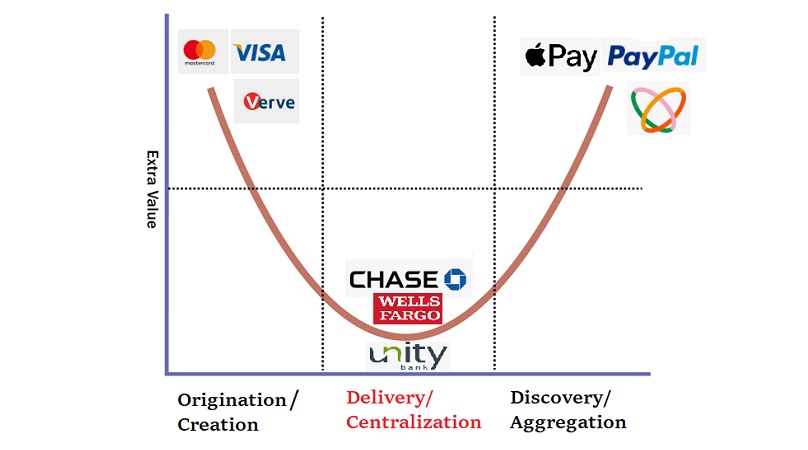
Banking, Fintech and Smiling Curve: Why Where You Operate Is More Important Than Efforts You Put In

CBN, Nigerian Banks, NIBSS Launch AfriGo, Nigeria’s National Payment Card

Press Release by CBN

The Central Bank of Nigeria announced in 2022 that it will be launching a National Domestic Card Scheme in conjunction with the Nigeria Inter-Bank Settlement Systems (NIBSS) Plc, the Bankers Committee and other financial ecosystem stakeholders.

The new Domestic Card Scheme is a robust in-country Scheme tailored to address the specific requirements of Nigeria’s payment industry and provide innovative offerings tailored to the Nigerian market and beyond. The Scheme will transform the domestic and African payment landscape through the promotion of innovation in payment, enhancement of interoperability domestically and internationally and improvement in the suite of products and solutions offerings by banks and other financial institutions such as debit, credit, virtual, loyalty and tokenized cards.

The National Domestic Card set to be delivered to over 200 million Nigerians offers unique value propositions through enhanced data sovereignty and transaction security, better pricing opportunities, reduced demand for FX, enhanced financial access and support of the growth of a robust and inclusive digital economy, amongst others.

The brand unveils of the new Domestic Card Scheme by CBN and NIBSS will take place on Thursday 26th January at a virtual event that will be graced by critical stakeholders in the financial ecosystem such as the Governor of the CBN, Deputy Governors of the CBN, the Director General Securities and Exchange Commission and Managing Director of the Nigeria Deposit Insurance Corporation. Also expected at the event are representatives of multilateral agencies, Switches and Processors, Payment Service Banks, Mobile Money Operators, Payment Terminal Service Providers, Payment Solutions Service Providers, card manufacturers and industry associations.

The launch of this historic Scheme presents a new dawn in the Nigerian payment ecosystem and unveils the unique opportunities presented by the Nigerian retail landscape. It is indeed the beginning of a new era, charting the future of the payment landscape as the first Domestic Card Scheme to be launched on the African continent.

CBN Lending N22.8 trillion in “Ways and Means” to Federal Government

Meanwhile, the apex bank has explained why it lent  N22.8 trillion in Ways and Means to the federal government. The bank governor, Godwin Emefiele, explained that “the central bank is a banker to the government and also a lender of last resort to the government”. This implies that it has the constitutional authority to do the lending.

  • “because we are lender of last resort, it will be irresponsible for us to sit idle, it will be a dereliction of our duty as the lender of last resort to ignore the government and allow the economy and Nigerians to suffer.”
  • “What we did by lending to the government as lender and banker of last resort is normal in any part of the world particularly when countries face crises. Any central bank, any FED will do what we have done.”
  • “So that we appeal to those who are exaggerating the purpose behind ways and means to take it easy with us and believe that by the special grace of God that since the president has written to the national assembly, we will eventually give the approval to allow CBN to securitize” the loans.

According to Nairametrics, “The ways and means provision allows the government to borrow from the Apex Bank if it needs short-term or emergency finance to fund delayed government expected cash receipts of fiscal deficits.”

Stamp Duty Amount

More so, Godwin Emefiele, has noted that the total revenue collected as stamp duty on behalf of the Federal Government in 6 years, between 2016 and 2022, is N370.686 billion. There has been speculation that this was well higher (N89 trillion). Nonetheless, auditors will check if they are unremitted funds on stamp duty, even as the apex bank governor made a promise: “If there is any uncollected stamp duty, the banks will pay to the last kobo.’’

  •  “Total assets of all banks are N71 trillion; total deposit in banks is N44 trillion.
  • “From 2016 till date, stamp duty collection has amounted to N370,686 billion.
  • “The Federal Inland Revenue Service has disbursed N226.451 billion of the money to the Federation Account Allocation Committee, while the balance of N144,235 is in the CBN.
  • “The highest collection of the stamp is N71 billion, collected by First Bank.’’

CBN, Nigerian Banks, NIBSS Launch AfriGo, Nigeria’s National Payment Card

0

The Central Bank of Nigeria (CBN) on Thursday, in conjunction with the Nigeria Inter Bank Settlement Systems (NIBSS) Plc, the Bankers Committee and other financial ecosystem stakeholders, launched the National Domestic Card Scheme in a virtual event.

The move comes amid Nigeria’s forex crisis that has seen banks suspending international POS and ATM services. It is also in the era of fintech boom, which has birthed a plethora of cross-border payment systems that have become preferred payment options over the traditional banking system. Those have put the central bank on its toes to find innovative ways of preserving the nation’s conventional payment system and to tame the raging forex crisis.

The new domestic card scheme, dubbed AfriGo, is said to have a robust in-country system tailored to address the specific requirements of Nigeria’s payment industry. It is also built with innovative offerings designed for the Nigerian market and others.

Gracing the event were representatives of multilateral agencies, Switches and Processors, Payment Service Banks, Mobile Money Operators, Payment Terminal Service Providers, Payment Solutions Service Providers, card manufacturers and industry associations.

A statement about the scheme said it would transform the domestic and African payment landscape through the promotion of innovation in payment and enhancement of interoperability domestically and internationally. It will also improve the suite of products and solutions offerings by banks and other financial institutions such as debit, credit, virtual, loyalty and tokenized cards.

The statement added that the National Domestic Card, which is set to be delivered to over 200 million Nigerians, offers unique value propositions through enhanced data sovereignty and transaction security, better pricing opportunities, reduced demand for forex, enhanced financial access and support of the growth of a robust and inclusive digital economy, amongst others.

“The launch of this historic Scheme presents a new dawn in the Nigerian payment ecosystem and unveils the unique opportunities presented by the Nigerian retail landscape. It is indeed the beginning of a new era, charting the future of the payment landscape as the first Domestic Card Scheme to be launched on the African continent,” the statement said.

Following the launch, the CBN said existing card schemes in the country will be nullified in due time. The apex bank said it will set a deadline that will make other card schemes invalid for domestic transactions.

“With the implementation of the National Domestic Card Scheme, the industry will reap potential benefits which include improved transaction security, better pricing opportunities, reduced demand for FX and less pressure on the Naira, locally relevant partnerships and offerings developing local skills in card and payment space,” the Deputy Governor of CBN and Chairman of NIBSS, Aisha Ahmad, said.

“Other advantages include a boost to financial inclusion, value retention, flexible and innovative scale, source of national pride,” she added.

The CBN governor Godwin Emefiele said after the launch; “all domestic transactions that are going to be conducted in Nigeria will have to be through the Nigerian domestic cards.”

The card scheme is expected to ease Nigeria’s reliance on foreign exchange for international transactions.

“At some point in the next few weeks, I’m sure that the CBN will come up with the cut-off,” Emefiele said, talking about deadline for existing card schemes. “We will no longer pay dollars for those cards, for the charges on those cards.”

He said with the AfriGo card, Nigeria has joined countries like China, Russia, Turkey, and India which have their local cards.


Empty Banks’ ATMs and CBN’s Push for Redesigned Naira Notes Circulation

0

Nigerians are facing difficulty accessing the new naira notes as Automated Teller Machines (ATMs) across the country remain empty, even as the deadline given by the Central Bank of Nigeria (CBN) for the old naira notes to cease to be legal tender nears.

This is coming on the heels of the CBN’s reaffirmation that the January 31 deadline will not be extended. The central bank had issued ATM-only withdrawal ultimatum to the banks, among other measures, as a way of ensuring adequate circulation of the new naira notes across the country.

However, the ultimatum has failed to curtail the scarcity of the redesigned naira notes. Some bankers said there is not enough supply of the new N200, N500 and N1,000 naira notes, leaving them with to either issue the old naira notes or leave the ATMs empty. With the latter becoming their choice, the circulation of the new naira notes has been significantly undermined.

This is despite the CBN’s claim that there is enough of the redesigned naira notes to go round, threatening to sanction any bank caught hoarding the new notes.

”The CBN has massively supplied the new notes to commercial banks to dispense both at counters and ATMs.

”This is to enable quick circulation and we want to advise commercial banks to desist from keeping the cash away from the public or face the stiffer sanction,” Musa Jimoh, Director of the Payment System Management Department of the CBN, said in Jos.

Against the backdrop of the new naira notes scarcity, there is a growing belief that the CBN is deliberately creating artificial scarcity as a mechanism to tame Nigeria’s wild inflation.

The CBN governor Godwin Emefiele had decried the amount of naira in circulation in the country. He said after the Monetary Policy Committee held on Tuesday, where interest rate was once again reviewed upward to 17.5%, that some persons have been hoarding the naira, causing the circulation to rise from N1.4 trillion to N3.2 trillion in seven years.

The scarcity of the new naira notes despite assurances by the apex bank that there is enough to satisfy the need, is thus seen as part of efforts to limit the amount of cash in circulation while mopping up the excess old naira notes already in circulation.

However, the situation is creating a fresh facet of hardship that is poised to add further misery to the lives of the Nigerian public.

“It is a fact that you can do the right thing in the wrong way. How else do you explain the stubbornness of the CBN Governor. If this arbitrary deadline is not extended; there will be so much hardship and pain the people will revolt. Why is it so hard to apply common sense,” Dr Charles Omole, a security expert lamented.

With Nigeria’s push for a cashless economy still in cradle, Nigerians rely mostly on cash transactions. This backdrop means that the informal sector will likely see the impact of the redesigned naira notes doubled. Commuters are lamenting that lack of cash in ATMs is keeping them stranded. In addition, people who have deposited their old naira notes don’t have cash to buy the things they need.

It is not clear who, between the banks and the CBN, is telling the truth about the scarcity of the new naira notes. But the central bank is yet to sanction any bank for not making the new naira notes available in ATMs, a development many have pointed at as a sign of culpability.