DD
MM
YYYY

PAGES

DD
MM
YYYY

spot_img

PAGES

Home Blog Page 4480

Avalanche (AVAX) and Gala Token (GALA) Investors Are Quickly Flocking to Snowfall Protocol (SNW)

0

Despite Avalanche (AVAX) and Gala Token (GALA) securing interesting partnerships with Amazon Web Services (AWS) and A-list actors Dwayne Johnson and Mark Wahlberg, respectively, investors on these blockchains (Avalanche and Gala Token) are tilting towards Snowfall Protocol (SNW). That has further sparked the curiosity of the crypto community as to what makes Snowfall Protocol (SNW) special. Read on to see what makes Snowfall Protocol (SNW) special and why Avalanche (AVAX) and Gala Token (GALA) are jumping ship.

Avalanche (AVAX)

Avalanche (AVAX) is considered one of the best blockchains for decentralized applications (dApps). Avalanche’s (AVAX) features make it one of Ethereum’s primary competitors. Avalanche (AVAX) can power several Web3 applications ranging from DeFi protocols to NFT Finance applications (NFTfi) and others. Avalanche (AVAX) also works with Solidity, a programming language that Ethereum deploys. It is undoubtedly the go-to alternative for developers scared of Ethereum’s high gas fees. Despite being a big player in the crypto space, Avalanche (AVAX) is losing investors to a more decentralized protocol in Snowfall Protocol (SNW). AVAX’s investors have centralization concerns about the blockchain and are cautious of investing in a protocol that could fall or become less decentralized as new crypto regulations emerge.

Gala Token (GALA)

Gala Token’s (GALA) price surged immensely following the announcement by Gala Games that it was partnering with actors Dwayne Johnson and Mark Wahlberg. The news sparked excitement in the crypto community, with many crypto investors aping into the Gala Token (GALA). However, Gala games quickly took down the announcement, which caused a u-turn for the Gala Token (GALA), with the token declining massively after Gala games took down the announcement. For context, the Gala Token (GALA) is the utility token for Gala games, and as such, every news from the gaming company automatically affects the Gala Token (GALA). Following the deleted announcement, crypto investors quickly moved on from the losses accrued from the Gala Token (GALA) and are looking to invest in more reliable companies like Snowfall Protocol (SNW).

Snowfall Protocol (SNW)

Why are Avalanche’s (AVAX) and Gala Token’s (GALA) investors moving to Snowfall Protocol (SNW)? That is the question on the lips of many in the crypto community. However, the reason isn’t far-fetched. Snowfall Protocol (SNW) has caught the eye of many crypto investors with its utility. The decentralized protocol is committed to solving the issue of blockchain interoperability with its cross-chain bridge. Snowfall Protocol (SNW) allows users to swap their fungible and non-fungible assets across EVM and non-EVM compatible chains.

Furthermore, Snowfall Protocol’s (SNW) token is doing insane numbers, and it hasn’t officially launched. The SNW token already gained about 100% across the first three presale phases. With an increased demand for the token, experts project that it will make crypto investors 5000x of their capital once it launches in February. The fourth and final phase of the presale stage is ongoing, and crypto investors have one last chance to get in on Snowfall Protocol (SNW) before it gets sold out. Sign up here to purchase some SNW tokens.


Presale: https://presale.snowfallprotocol.io

Website: https://snowfallprotocol.io

Telegram: https://t.me/snowfallcoin

Twitter: https://twitter.com/snowfallcoin
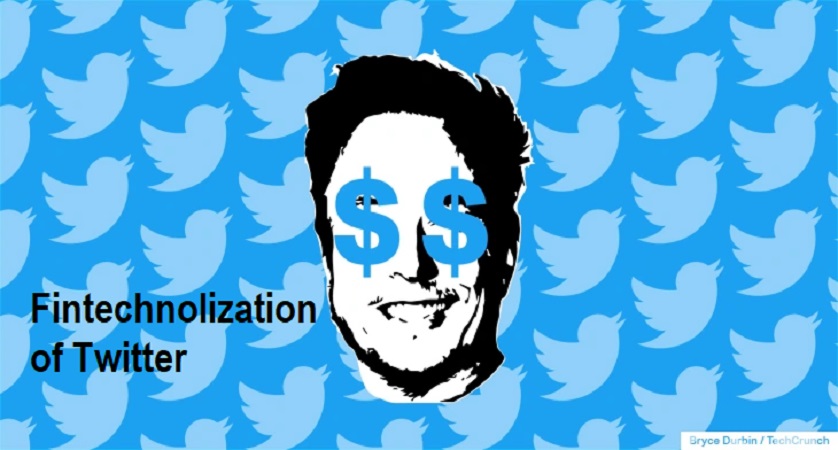
Elon Musk to Introduce Higher Priced Twitter Blue Subscription in a Bid to REMOVE Ads on the App

0

Elon Musk, CEO of Automobile giant ‘Tesla ’ tweeted that his recently acquired social media app Twitter would provide a new but “higher priced” Blue subscription that will remove advertisements from the micro-blogging platform.

Although this functionality hasn’t yet been made available, the existing $7.99 per month Twitter Blue subscription offers 50% fewer advertisements when compared to “non-verified persons.”

Twitter Blue Subscription was first launched on 5 November 2022, and had stopped accepting subscriptions by 11 November. The Washington Post reported the following week that “about 150,000 users” had subscribed to the new Twitter Blue during those initial few days, based on information from an internal source.

Imagine if every Twitter account holder has a wallet that is accruing balance all the time for the Users’ Attention; Engagement; Contribution; Interactions stored permanently on-chain via Block scripts.

It’s possible that Elon’s solution to Blue’s poor membership numbers and the 40% decrease in ad revenue — is to provide a subscription that is more expensive but does not include ads. Musk claims Twitter is also working on a mechanism to minimize the frequency and size of the adverts showcased on Twitter.

Matt Wallace, a close ally to Elon Musk announced they [Twitter] are making a creator fund to pay you for using the platform. Content is king, If Elon gets creators motivated enough to prioritize Twitter then it’s lights off for Instagram and the likes.

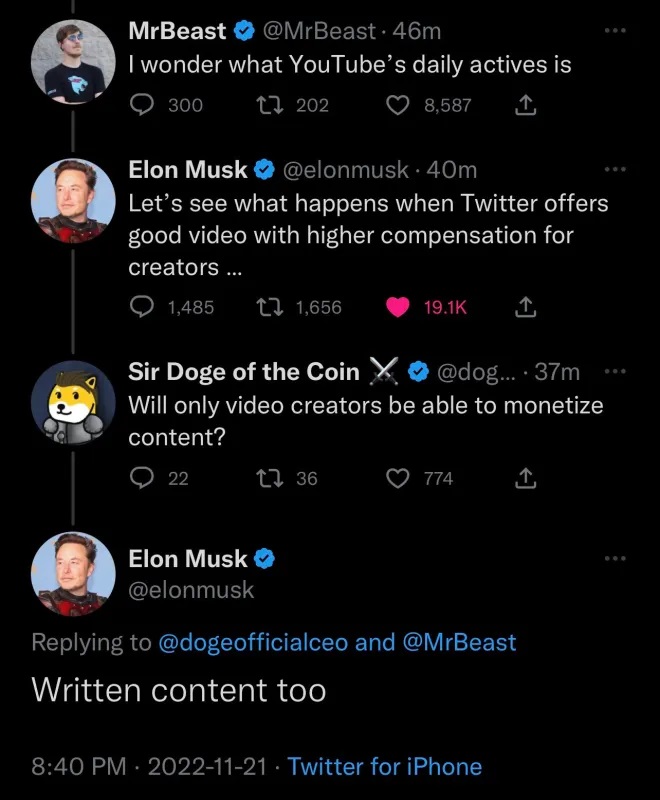
Apparently, Elon Musk said in the coming months, Twitter will translate and recommend amazing tweets from people in other countries and cultures. In November, Elon Musk replied to a tweet from Mr Beast— a prolific YouTuber signaling a call on Monetization of Contents on the bird App.

Twitter already has written content monetization through their acquiring of Revue, but I’d be HAPPY to see them innovate to Twitter-based deliverables.

Nick Flor, AI-ML-Algorithm VIZ Analyst consequently opined that;

Old Twitter was focused on brainwashing the public and serving the Woke Mind Virus.

New Twitter is a real company that focuses on providing a rich and entertaining customer experience.

On GitHub, Twitter Blue Repository record shows that as of 22 January 2023, there are just over 250k accounts listed on the Twitter Blue Subscription, but this does not mean that there are only 250k Twitter Blue subscribers. 150,000 Twitter Blue subscribers signed up between November 5-11, since it relaunched in December, 2022 only 75,000 additional users have signed up.

Child labour in Nigeria

0

Child labour refers to the act of exploitation of children or the economic and commercial exploitation of a person who is below the age of eighteen through any form of work that deprives the person of his or her childhood development and interferes with his or her education.

It is the employment of children under the age of twelve (in some jurisdictions) or eighteen (in some other jurisdictions) in a manner that restricts or prevents them from basic education and regular childhood formation and development.

Any form of labour that a child is subjected to; be it paid or unpaid, depriving that child of his or her education is child labour and it is a crime. 

Parents who send their children to hawk or engage in a different form of commercial/economic activities for the purpose of making money for the sustenance of the family are engaging their children in child labour. The child is deprived of education and he or she is exploited for economic purposes. Also, employing or engaging a child who is below the age of eighteen as domestic help or as a maid is a form of child labour. This is an example of child labour that is most prevalent in Nigerian society today; especially in the urban society of Nigeria. 

Children around the world are subjected to the worst forms of child labour, like slavery, child trafficking, debt bondage, forced labour, commercial sexual exploitation, domestic staff and as well used in armed conflict (infantry soldiers)  in war-prone countries, especially in Africa. 

Africa is the continent with the highest rate of child labour in the world, followed closely by Asia according to a recent study. It had been estimated that child labour accounted for 32% of the workforce in Africa and 22% of the workforce in Asia.

In Nigeria alone, a study carried out in 2006 has shown that the number of child workers was estimated at about 15 million and over a decade later, we can only assume that this figure has doubled. This is to say that out of the 65 million labour force in Nigeria (according to the world bank 2021 statistics), over 20 million of them are children. 

It has been a dispute amongst nations of the world as to the right age to peg child labour. In some jurisdictions around the world, legislation has been made that the minimum age for employment of a person is 12 years, any employment or form of labour engaged with a child below 12 years will be held to be child labour. Therefore, in those jurisdictions, a child (under 12 years) cannot be employed to work in any capacity except in government-approved ventures otherwise it will be a crime but the general accepted world standard is that a person below eighteen is still legally regarded as a child and any form of labour that the person is subjected to for the purpose of economic or commercial exploitation will be held as child labour. 

Fiat-Crypto Transactions below $100k won’t be Supported on SWIFT from Feb 1, 2023

1

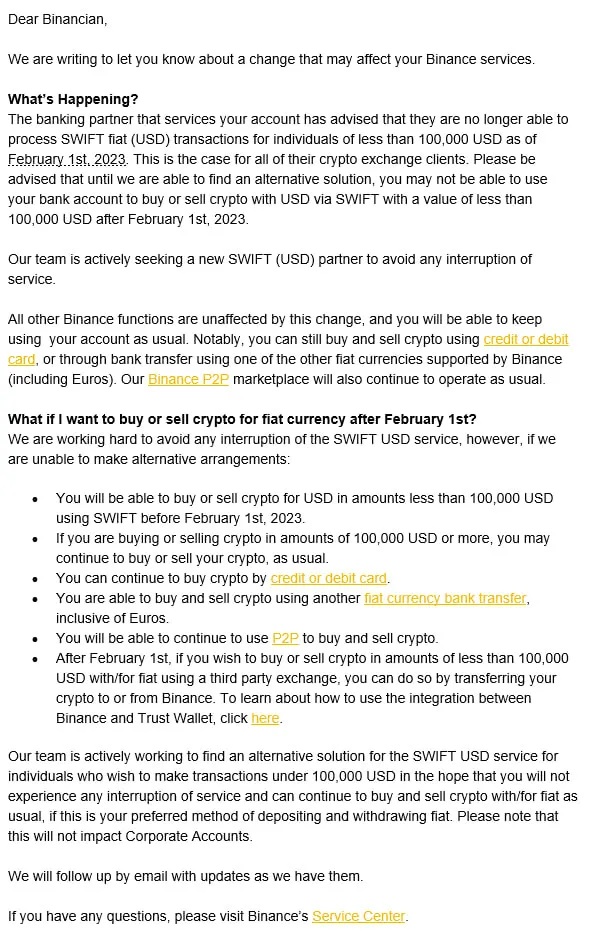
Effective February 1, 2023, some banks particularly New York’s Signature Bank will no longer process fiat currency transfers to Crypto Exchanges with a value less than $100,000 via the SWIFT Network.

SWIFT [an acronym for the Society for Worldwide Interbank Financial Telecommunication] is the world’s most critical financial network – facilitating trillions worth of international money settlements daily – it is a somewhat secretive Belgian-based cooperative.

New-York’s Signature Bank through the ‘Swift Network’ provides banking services to prominent CEXs and DEXs including Binance — the World’s leading Cryptocurrency Exchange prompting an announcement to Binancians that it will no longer process transfer payment below $100,000 citing new rules instituted by its banking partners — operating on the Swift Network.

One of our fiat banking partners, Signature Bank, has advised that it will no longer support any of its crypto exchange customers with buying and selling amounts of less than $100,000 USD as of February 1, 2023. This is the case for all of their crypto exchange clients.

As a result, some individual users many not be able to use SWIFT bank transfers to buy or sell crypto with/for USD for amounts less than 100,000 USD.

FinanceLot on Twitter said, the Crypto Market pump was perfectly timed to suck retail back in before they passed the new SWIFT rules. 90% of retails in the Crypto Industry are below the $100k threshold which means their funds is trapped on Feb 1st. This is why the average person should learn about using Tether in trading and commerce.

SWIFT Network is a protocol used by banks for cross boarder transactions. This will affect Crypto Exchanges, but Cryptocurrency Users can still buy and sell crypto on exchanges and send crypto anywhere in the world on their respective Blockchains.

As Bank payment channels get more restricted, merchant and individual Bitcoin and stablecoin adoption is likely to increase significantly. Banks continue to fail serving billions of people and tens of thousands of companies around the world for no good reason.

Presumably, that decisions to restrict commerce pushed by the Supranational groups may be the reason why dollar usage is declining globally. Getting dollars in the hands of everyday people and businesses is a key part of the U.S. national interest. Tether helps solving this problem.

Patterns, Numbers and Investing in Technology Startups

1

Patterns drive how investors take risks on tech startups. As I noted during Tekedia Capital OPEN presentation yesterday, we’re yet to see a “successful” gaming company out of Nigeria, and because of that construct, we have no appetite to invest in gaming, unless the founders can demonstrate a business model that taps one oasis and double play strategy as I have articulated in Harvard Business Review.

As we watch gaming, we’re also careful on B2C ecommerce due to marginal cost inefficiency and inability to attain a virtuous circle of leverageable and compounding assets during expansion in places with largely inadequate logistics and national postal services. So, we have not been bold enough to take risk on any B2C ecommerce; we like the B2C model pioneered by Kenya’s Copia and the hybrid model of the new Konga. Of course, the Copia model requires uncommon trust in communities while Konga needs bigger cheque books to execute; those things are not in abundance in all places.

As those happen, we have also been skeptical when businesses are built on transient frictions (yes, customer problems which are not durable or permanent  and can disappear quickly). Many wasted money on pandemic-driven opportunities even though the pandemic, thank goodness, will vanish over time – and when it actually did, those business models collapsed. 

One African startup was growing rapidly, powered mainly by people in sub-Saharan Africa not having the means to pay for items in many stores in Europe and America. That company became a connector and an intermediary, solving that payment problem. I did not like the business even though it raised tens of millions of dollars and scaled. My concern was clear: one day, someone will fix that payment problem, and magically, that business model would be disintermediated.  And that was what happened: when payment improved with virtual dollar cards across Africa, customers cut-off that company and bought directly from those stores. That company has since gone bankrupt.

And the latest is training African techies to feed into American big techs. A great idea. But most times, even the destination will struggle with carry-capacity. From Brazil to India, Nigeria to Vietnam, and beyond, everyone was training techies to supply Europe and the US. Many businesses were built on that model with absolute focus on the global market without any consideration of the development of their local markets. But now that the US is laying off thousands, some of these firms will have challenges. Yes, for Google to fire 12,000 workers, it must have reduced some of those external contractors.

Patterns. Patterns. And those are the numbers when Pythagoras said that “everything is numbers” as explained in my presentation.

Comment on Feed

Comment 1: Following patterns is conventional, but for anything profound to emerge, one will also need to be unconventional. We deny some sectors funds, because no one has ‘proven’ that sustainable value capturing is possible there, but without that much needed funding, how do we test what is possible on the other side?

If we keep sending more to only established sectors, they will become over saturated and then start eroding value, while some neglected ones that could turn out bigger never get a look in. More prodding and probing are needed beyond what is already known…

My Response: Accepted as accused since business is not charity. Until it becomes charity, your point will not fly. The conclusion is that nations need smart leaders who can invest in those sectors people run away to make them attractive. If you fix NIPOST in Nigeria, everyone will see opportunities in ecommerce. But without that. I think it is a waste of time. If the government fixes electricity, light manufacturing becomes attractive since the startup will not need to budget for a generator.

I do not think it is really about not being conventional. The issue is that  funds do not like scoring own-goals where you put money in areas no one cares to follow-up with more funds.

“Following patterns is conventional, but for anything profound to emerge, one will also need to be unconventional. ” Policymakers have huge roles to make such happen by providing catalytic infrastructures and enablers.

Comment 1R: Ndubuisi, plenty stars will still have to align, if some sectors will ever go beyond gestation stage; without funding, dreams quickly become nightmares.

Comment 2: You have a point but the problem is that gaming was never a business. It’s simply first and foremost entertainment fueled by its players. Investors treat everything like business, looking for margins, market share, and returns.

It’s taken me over 6 years to understand how to convert gaming into a business with actual customers we can service and not just players, and that’s only because I have experience in telecommunications, tech, and music all which I can combine to see the business of it all. It really ain’t that easy, hence why no one has done it yet.

P.S I only saw the business of music in gaming because it was a pain point of mine performing in cities across Belarus and Russia, having my music played in streaming apps but not making back the money I was investing into it. That’s where the business comes in, the enjoyable elements within the game monetised by the creators to service other creators, e.g musicians, fashion entrepreneurs, inventors, advertisers, and other businesses. Gaming is easily the most profitable business on earth if implemented properly.

My Response: “You have a point but the problem is that gaming was never a business” – indeed. Investors like to invest in businesses because they have fiduciary responsibilities. When that is not possible, they cannot write that cheque.

Comment 3: Sometimes predicting the future when it comes to investing boils down to being very good at guessing and placing the right bet on the right horse.

In 2008, I was in a Credit Risk Management class, and one take away from that class that I cannot forget is what the trainer called “Credit Intuition” .

You have dotted all the “T”s and crossed all the “I”s and everything is in order. But before you recommend a credit for approval, you try to listen to what your gut has to say.

I believe great investors who always make the right investment calls relay on something other than facts and great pitches that are always optimistic about being successful.