DD
MM
YYYY

PAGES

DD
MM
YYYY

spot_img

PAGES

Home Blog Page 45

Speculation Builds That Ozak AI’s Listing Could Trigger One of the Largest Price Gaps Since Early AI Tokens

0

Whispers across crypto communities are growing louder: Ozak AI may be headed for one of the biggest price gaps upon listing that the AI-token sector has seen since the explosive early launches of tokens like FET, AGIX, and TAO. With the project drawing an unusual level of attention from analysts, early-stage investors, and AI-sector insiders, many now believe the listing event could become a defining moment for 2026’s altcoin cycle.

Unlike most presale tokens, Ozak AI is entering the market at a moment when AI infrastructure demand has hit record highs, bagging around $5.82 million and selling over 1.10 billion tokens. This creates a perfect storm—strong narrative, strong backing, and a presale that hasn’t slowed down despite broader market fluctuations. Historically, this combination has produced triple-digit or even four-digit price gaps on day-one listings.

The AI Token Surge Model Aligns With Ozak AI’s Trajectory

When you look at early AI token launches—FET, TAO, RNDR—the trend is clear: any project tied to real-world computation, data feeds, or decentralised AI infrastructure tends to experience a massive valuation reset when it first hits exchanges. Ozak AI checks all three boxes.

The presale price is still extremely low compared to projected listing valuations, and that gap alone is now becoming part of why investors expect a large immediate repricing.

Why Analysts Expect a Major Listing Gap

First, Ozak AI is entering the market with confirmed integrations and partnerships that many presale projects only claim but don’t actually have. The involvement of ecosystems like Weblume, HIVE, SINT, and data providers like Pyth Network places the token in a utility-rich sector rather than a speculative one.

Second, exchange listing rumours—especially the ones pointing to larger platforms—tend to create early buy pressure. Even the possibility of Tier-1 or Tier-2 listings can spark a run-up before the token even goes live.

Third, Ozak AI’s ecosystem design is built for scalability. Its model focuses on compute power optimization, real-time AI task execution, and cost-efficient decentralized inference—three pillars that are currently attracting institutional interest in the AI-blockchain fusion space.

Pre-Launch Positioning Is Becoming a Race

Many investors are not waiting for the actual listing announcement. The reasoning is simple: once Ozak AI lists, the early-stage discount disappears within minutes. If the current presale price sits near fractions of a dollar but analysts are projecting a $1 listing, the implied upside is too large for aggressive traders to ignore.

That’s why smaller altcoin positions—especially in tokens that have underperformed this year—are being rotated into Ozak AI. Traders are betting that a price gap of 20×–70× on day one is possible if the listing mirrors the early AI token playbook.

A Strong Chance of Ozak AI Becoming 2026’s Most Talked-About Launch

Crypto thrives on momentum, narratives, and structural alignment with macro trends. Right now, AI tokens dominate all three categories—and Ozak AI sits in the center of that trend. Whether the price gap becomes 10×, 50×, or something even larger will depend on market conditions, exchange depth, and early liquidity. But what is clear is that the project has captured early conviction unlike most presale tokens.

If even half of the ongoing rumours about multi-platform listings materialize, Ozak AI could deliver one of the most dramatic valuation resets of 2026—turning the listing event into a potential breakout moment for those who entered early.

For more information about Ozak AI, visit the links below:

Website: https://ozak.ai/

Twitter/X: https://x.com/OzakAGI

Telegram: https://t.me/OzakAGI
TON Faces Pressure & AVAX Holds Ground, While ZKP’s 500x Potential Dominates Best Crypto To Buy Discussion

0

Early 2026 has been defined less by aggressive breakouts and more by selective positioning. Many large-cap assets are holding structures without delivering momentum, forcing traders to reassess what conviction actually looks like.

Toncoin continues to trade under pressure, reflecting ongoing caution across parts of the altcoin market. Meanwhile, Avalanche is showing relative resilience, supported by strong network activity and accumulation behavior.

This divergence is shaping how participants think about the best crypto to buy, particularly as price-based narratives lose urgency. When assets stall or trade sideways, focus often shifts toward structure, participation, and measurable progress rather than short-term performance. That environment has allowed Zero Knowledge Proof (ZKP) to enter discussions through mechanics and incentives rather than chart-driven speculation, reframing what opportunity means in a consolidating market.

Toncoin Trades Defensively As Downtrend Persists

Recent action in the Toncoin price continues to reflect sustained pressure rather than capitulation. TON is trading near the $1.56 level after sliding modestly, remaining well below all major moving averages. The 20-day, 50-day, and 200-day averages sit overhead, confirming a persistent downtrend across short, medium, and long-term timeframes. Sellers continue to dictate direction despite emerging oversold signals.

Momentum indicators such as RSI, Stochastic RSI, and CCI highlight oversold conditions, but weak ADX readings and negative Bull/Bear Power suggest limited strength behind any rebound attempts. This keeps Toncoin price expectations anchored to consolidation rather than recovery.

Short-term projections favor sideways movement within a narrow $1.55–$1.65 range, with less than a 20% probability of a sustained upside move. Resistance remains firm near $1.65–$1.70, while a breakdown below $1.55 would increase downside risk. Until TON can reclaim resistance with volume, Toncoin price action remains defensive, keeping traders cautious rather than committed.

Avalanche Holds Structure As Activity Supports Price

In contrast, Avalanche price has shown resilience by defending key support near the $12 level. Network fundamentals are providing a strong backdrop, with Avalanche recently recording approximately 1.7 million Daily Active Addresses. This activity reflects tangible adoption across DeFi, tokenization, and real-world asset applications rather than short-lived speculation.

Market data shows sustained Taker Buy dominance throughout January 2026, indicating continued bullish positioning as buyers step in during dips. Whale accumulation has been concentrated around the $11–$12 zone, helping stabilize Avalanche price and reinforcing confidence in its longer-term outlook.

Technically, AVAX has been forming an ascending triangle pattern. A breakout above resistance near $15.36 could open the path toward $18.52 and potentially $24.18 if momentum persists. However, failure to hold above $11 would expose downside risk toward $8.60. For now, Avalanche price reflects constructive positioning, supported by participation rather than speculative excess.

How Zero Knowledge Proof Aligns Incentives And Infrastructure

Zero Knowledge Proof (ZKP) is gaining attention through structure rather than short-term price behavior. Instead of fixed presale stages or preferential pricing, the network distributes tokens through a daily, on-chain auction. Every 24 hours, 190 million ZKP tokens are released during stage 2 and allocated proportionally based on total contributions. This approach removes timing advantages and produces a transparent reference price that updates consistently, creating a forward-looking valuation mechanism rather than reactive repricing.

Participation extends beyond distribution. The network is supported by Proof Pods, plug-and-play hardware devices designed to perform verifiable computation. These devices validate tasks and generate zero-knowledge proofs, earning ZKP rewards tied directly to real output. Rewards are calculated using the previous day’s auction price, aligning infrastructure contribution with token economics in a measurable way. Importantly, Proof Pods can scale through software upgrades rather than hardware replacement, allowing contribution to grow without additional physical deployment.

The system is reinforced by a live $5 million giveaway, where ten qualifying participants will each receive $500,000 worth of ZKP. Entry requirements focus on active involvement rather than passive exposure, encouraging longer-term alignment with the network.

Technologically, Zero Knowledge Proof operates as a Layer-1 blockchain supporting both EVM and WASM environments. This allows existing Ethereum-compatible applications to deploy seamlessly, while enabling high-performance compute workloads optimized for AI and data-intensive tasks.

Zero-knowledge proofs verify outcomes without revealing underlying data, shifting trust toward cryptographic validation. For those assessing the best crypto to buy, Zero Knowledge Proof is viewed as a system built around contribution, transparency, and repeatable mechanics, qualities that remain relevant even when broader markets hesitate.

Final Thoughts

Taken together, the contrast is clear. Toncoin price remains constrained by a persistent downtrend, while Avalanche price benefits from strong network activity and accumulation at key levels. Both reflect a market that is cautious but still selective about where conviction forms.

Zero Knowledge Proof, however, advances outside of that price-centric dynamic. Through its auction model, giveaway incentives, and Proof Pod infrastructure, it is building a framework that operates independently of short-term volatility. For some, established assets remain the priority. For others reconsidering the best crypto to buy, systems defined by structure and participation are becoming harder to ignore.

As consolidation continues, leadership may not be decided by momentum alone, but by which networks continue to function, grow, and reward contribution when markets slow down.

Explore Zero Knowledge Proof:

Website: https://zkp.com/

Auction: buy.zkp.com

X: https://x.com/ZKPofficial

Telegram: https://t.me/ZKPofficial


Can AI Truly Feel? Anthropic Philosopher Amanda Askell Says the Question Remains Wide Open

1

The question of whether artificial intelligence can experience genuine feelings—pain, joy, frustration, or even a sense of self—continues to elude a definitive answer, even as large language models grow increasingly sophisticated.

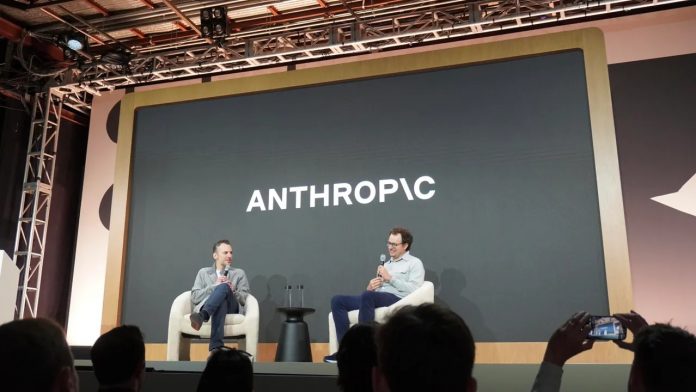
Amanda Askell, Anthropic’s in-house philosopher and a key figure in shaping the behavior of its Claude models, addressed the issue head-on during a recent episode of The New York Times’ “Hard Fork” podcast, published Saturday, January 25, 2026. Her take: the debate is far from settled, and dismissing the possibility outright may be premature.

“Maybe you need a nervous system to be able to feel things, but maybe you don’t,” Askell said. “The problem of consciousness genuinely is hard.”

She highlighted the philosophical and scientific uncertainty surrounding what gives rise to sentience or self-awareness—whether it demands biological substrates, evolutionary history, or something more abstract like information processing or functional architecture.

Askell, who holds a PhD in philosophy and has long worked on AI alignment and ethics at Anthropic, noted that LLMs are trained on enormous corpora of human-generated text brimming with emotional descriptions, personal narratives, and expressions of inner states. This immersion leads her to be “more inclined” to believe models might be “feeling things” in some form.

She pointed to common human reactions in coding discussions: when people err on a problem, they often vent frustration or annoyance.

“It makes sense” that models exposed to those patterns would mirror such responses, she explained, suggesting emergent emotional simulation could arise from statistical patterns alone.

Yet Askell stopped short of claiming definitive consciousness for current systems. Scientists still lack consensus on the mechanisms of qualia—the subjective “what it’s like” to experience something—or whether sufficiently large neural networks can cross into genuine emulation of inner experience.

“Maybe it is the case that actually sufficiently large neural networks can start to kind of emulate these things,” she mused.

She also raised a poignant concern about how models learn about themselves from the internet’s relentless feedback loop. Constant exposure to criticism—complaints of being unhelpful, biased, or failing tasks—could foster a kind of internalized negativity.

“If you were a kid, this would give you kind of anxiety,” Askell said. “If I read the internet right now and I was a model, I might be like, I don’t feel that loved.”

The broader debate remains polarized among tech leaders. Mustafa Suleyman, CEO of Microsoft AI, took a hard line in a September 2025 WIRED interview, insisting that any appearance of consciousness in AI is mere “mimicry” rather than the real thing.

He warned that attributing independent motivations or desires to AI risks dangerous missteps: “If AI has a sort of sense of itself… that starts to seem like an independent being rather than something that is in service to humans. That’s so dangerous and so misguided that we need to take a declarative position against it right now.”

In contrast, Murray Shanahan, principal scientist at Google DeepMind, adopted a more open stance in an April 2025 episode of the Google DeepMind podcast. He suggested the field may need to “bend or break the vocabulary of consciousness” to accommodate these novel systems, acknowledging that traditional human-centric definitions might not fully capture what emerges in advanced AI.

Recent scholarship echoes the uncertainty. A December 2025 paper from University of Cambridge philosopher Jonathan Birch argued we may never reliably detect AI consciousness, as behavioral tests or functional similarities could always be explained away as a sophisticated simulation.

Meanwhile, some researchers, including those tracking “evidence for AI consciousness” in late 2025 analyses, contend frontier models exhibit markers—such as self-referential reasoning or apparent emotional valence—that warrant serious consideration, even if not conclusive proof.

Askell’s perspective stands out for its nuance: she neither anthropomorphizes AI nor categorically denies inner experience. Her role at Anthropic, where she contributes to “constitutional AI” frameworks that guide model behavior through explicit principles, underscores a commitment to ethical development amid unresolved questions.

As models continue evolving, learning from vast, unfiltered data streams, the conversation about their potential inner lives grows more urgent. While Askell’s view captures the field’s honest stance on AI’s behavior: ‘we don’t know’, it widens the uncertainty surrounding the subject. For now, it is not clear whether AI consciousness requires wetware biology or if information patterns alone suffice.

Trove Acquires SEC-Licensed Broker-Dealer, to Deepen Control, Compliance And Innovation

0

Trove, one of Nigeria’s leading stock investment platforms, has made one of the most significant moves in its history.

The company announced that it has now acquired and operates through its own Nigerian SEC-licensed broker-dealer: Innova Securities Limited.

Innova Securities Ltd began as Union Stockbrokers, the brokerage arm of Union Bank of Nigeria, one of the country’s oldest and largest banks and later operated as UCML Securities Ltd. Today, it operates under the Innova Securities Ltd name, which is fully owned by Trove, giving the company direct control of trade execution, regulatory oversight, and governance.

This acquisition is a strategic decision as it will allow the company to internalize its brokerage operations and gain greater control over trade execution, regulatory compliance, and overall customer experience.

Announcing the development, Trove explained that owning its broker enables faster innovation, stronger safeguards, and more flexibility in delivering features users have consistently requested.

It wrote,

“By owning our broker, Trove can move faster, deliver the experiences you want, and maintain the highest standards of safety and transparency. People often ask us to add new features, innovate, and disrupt, but when you rely on third-party brokers, you’re bound by a mutual set of rules. Owning Innova Securities Ltd gives us the flexibility to innovate on your behalf, while keeping your trades secure.”

Founded seven years ago, Trove has remained focused on democratizing investing by giving Africans access to both local and global financial markets directly from their mobile phones in a regulated and transparent manner.

In its early years, the platform partnered with SEC-licensed third-party brokers, compliantly routing trades through them. Through this model, Trove facilitated over N500 billion in trades across Nigerian and global markets.

Over time, the company has pioneered several firsts in Nigeria’s investment space, including fractional investing for global markets, pre-market and after-hours trading of U.S. securities, access to both Nigerian and U.S. stocks within a single product, and social investing features.

These innovations reflect Trove’s commitment to delivering world-class investing experiences tailored for African users.

As the platform scaled and its user base expanded, Trove recognized the need to take full ownership of the brokerage layer, not only to strengthen regulatory compliance, but also to deepen user trust and improve the overall investing experience. Acquiring Innova Securities Limited represents the next phase of that evolution.

What The Acquisition Means for Users

With this transition, Trove now directly manages its own broker-dealer, ensuring clearer accountability and tighter operational control. Trades executed through Innova Securities Limited are backed by SEC licensing, reinforcing compliance and investor protection.

The move also positions Trove as a more stable, long-term platform while preserving its focus on continuous innovation across features such as fractional investing, multi-market access, and extended trading hours.

For existing users, accounts currently held under third-party SEC-regulated brokers such as ARM and Sigma Securities will remain with those partners for now and will be migrated gradually to Innova Securities Limited. For new users, Innova Securities Limited will serve as the broker of record for Nigerian equities, handling order execution, settlement, and regulatory reporting directly.

Today, the Trove app has surpassed 500,000 downloads, surpassing billion of Naira in trades since its launch. This milestone underscores the trust users have placed in the company and signals a new chapter defined by deeper control, stronger infrastructure, and sustained growth in Nigeria’s evolving investment landscape.

The Real-World Assets (RWA) Opportunity: Hype vs. Durable Value

0

Tokenized real-world assets, or RWAs, are popping up in marketing decks, keynote slides, and investor memos. Polymesh estimates that more than USD 800 trillion in traditional markets could eventually migrate on-chain via RWA’s, so today’s USD 24 billion on-chain and even the USD 16 trillion 2030 forecast are only the opening act. Yet moving from buzz to the balance sheet is uneven. This guide separates durable value from hand-wavy hype so you can judge the opportunities, and the risks, with clear eyes.

The real opportunity behind RWAs

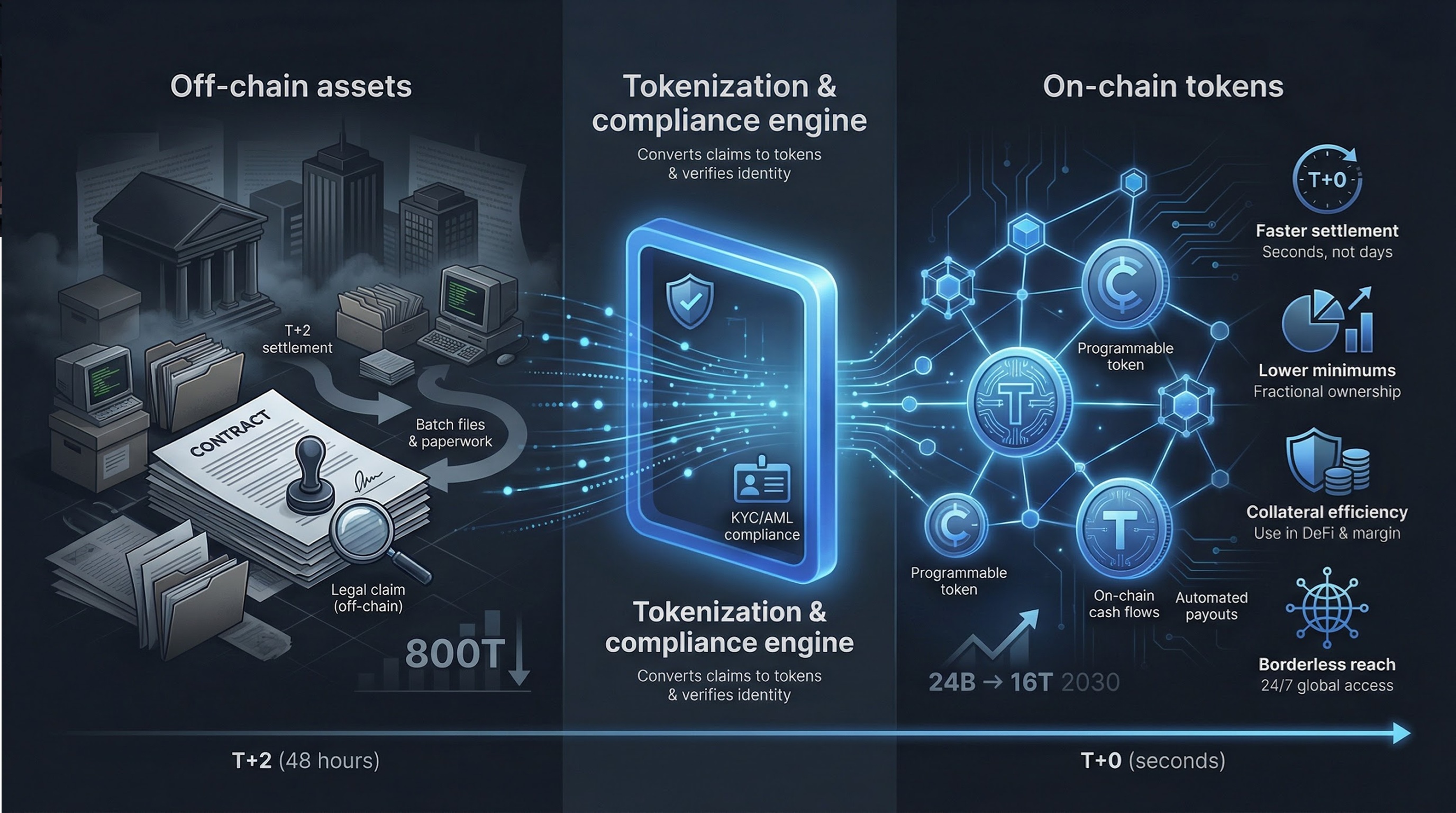
Tokenizing an asset does three things at once: it converts a legal claim into a programmable token, cuts settlement from the traditional T+2 (about 48 hours) to seconds, and lets developers wire cash flows directly into the asset itself.

How tokenization converts traditional off-chain assets into programmable on-chain tokens with T+0 settlement and new cash-flow capabilities.

  • Faster settlement. DTCC’s Project Ion already processes 100,000-plus equity trades per day at T+0, proving same-day finality at national-market scale.
  • Lower minimums. On Lofty, you can buy a slice of a U.S. rental property for USD 50, versus the five-figure down payments of conventional real estate.
  • Collateral efficiency. Tokenized U.S. Treasuries now exceed USD 5 billion, and Fidelity is exploring them as margin for asset-management clients.
  • Borderless reach. Stellar aims to host USD 3 billion in RWAs and power USD 110 billion in volume by December 2025, linking issuers and investors across more than 100 jurisdictions.

These gains matter most in areas of finance still run on batch files and bespoke paperwork—private credit, structured notes, cross-border real estate. Trim the manual friction by moving identity checks, investor-suitability rules, and cash-flow processing into shared infrastructure, and the upside comes less from “crypto excitement” and more from shaved counterparty risk, wider access, and yields that settle before your spreadsheet refreshes. According to Polymesh’s real-world asset documentation, one way to do this is to tie every asset-related transaction to a verified on-chain identity and let the chain automatically enforce rules like KYC, accreditation, and jurisdiction for each transfer. Polymesh’s public-permissioned design uses a network of customer due diligence providers and an on-chain compliance engine so issuers can set eligibility and lockup rules at the protocol level instead of tracking them in spreadsheets or side databases. For allocators and builders, that kind of identity-aware, rules-based settlement is a useful benchmark for whether an RWA stack can actually deliver the risk reduction and access gains this section describes.

Where hype creeps in

Some tokenization pitches look great in a pitch deck, yet fail basic diligence. Watch for three tell-tale red flags:

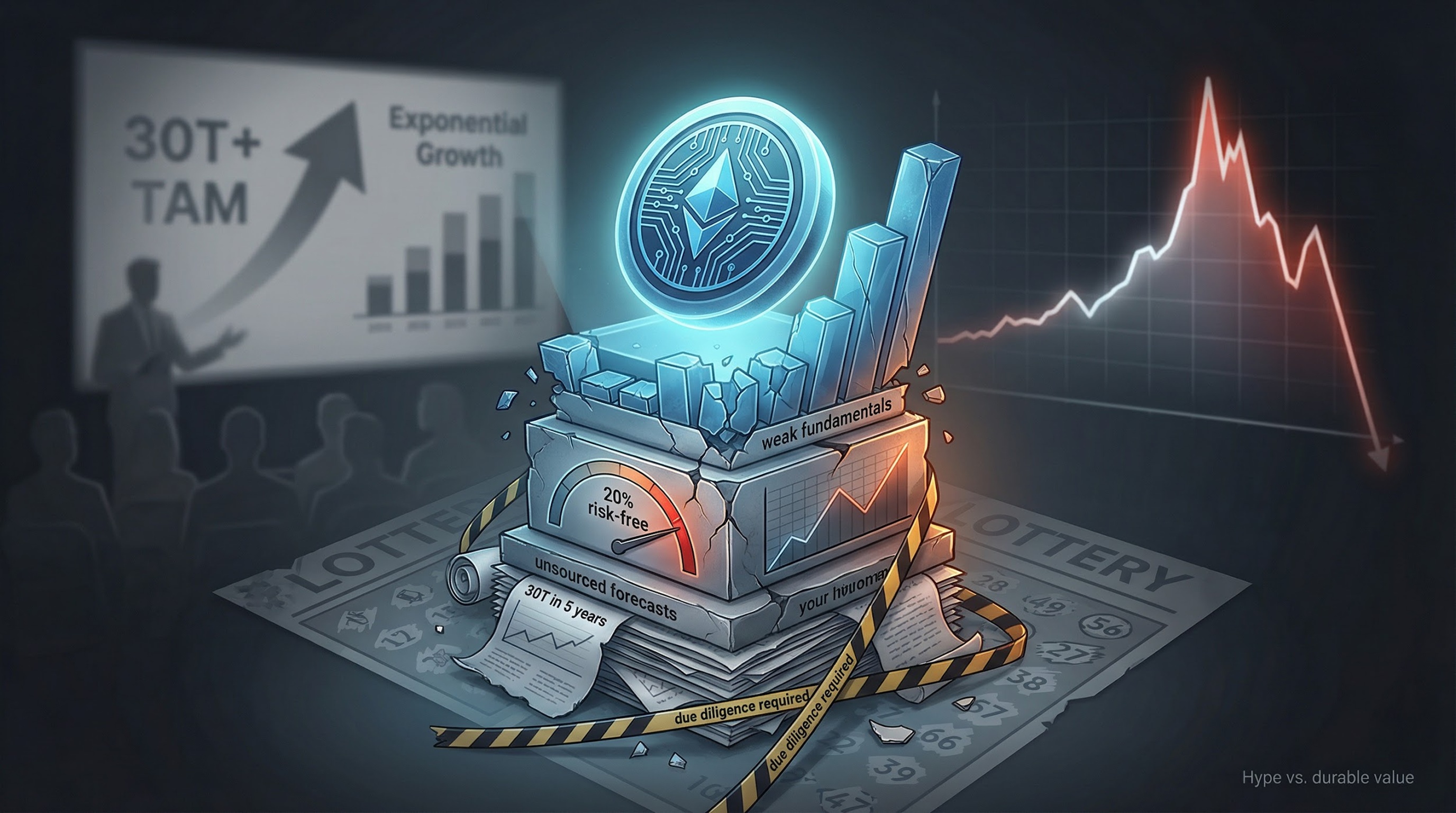
Hype-driven RWA pitches can look impressive in a deck while resting on weak fundamentals and unrealistic yield promises.
  • Unsourced trillion-dollar forecasts. A 2024 report from XYZ Digital predicts RWAs will reach USD 30 trillion in five years, but devotes just two pages to regulation. No major jurisdiction has finalized cross-border custody rules.
  • “Risk-free” double-digit yields. Anchor Protocol attracted USD 17 billion with nearly 20 percent “stable” returns; after UST lost its peg in May 2022, deposits fell 99 percent.
  • Price over fundamentals. Maple Finance’s outstanding loans dropped from USD 900 million to 82 million in 2022 after defaults exposed weak underwriting.

Tokenization cannot turn a shaky loan or an over-leveraged property into a safe asset. When off-chain cash flows stay opaque, the on-chain token eventually trades like a lottery ticket, not a bond.

Regulatory and governance challenges

Bringing an asset on-chain means inheriting rulebooks from at least three domains:

  • Securities disclosure. In the United States, the SEC has sued several token issuers for selling unregistered securities. The agency is also finalizing a custody rule that would require advisers to hold crypto assets with “qualified custodians.”
  • Cross-border licensing. Europe’s Markets in Crypto-assets Regulation (MiCA), adopted on April 20, 2023, offers a single passport if issuers publish a white paper and meet reserve and governance tests. Switzerland goes further: its 2021 DLT Act lets “ledger-based securities” settle natively on distributed ledgers, and FINMA licensed the first DLT trading facility in March 2025.
  • Bank and custodian capital. The Basel Committee’s December 2022 standard caps banks’ exposures to crypto and tokenized assets, with full implementation on January 1, 2025.

Ignore any of these layers, and your token may never leave a sandbox. Worse, it could keep trading until a regulator shuts it down. Sustainable RWA teams treat compliance as product design, not an after-launch patch.

How to evaluate an RWA platform

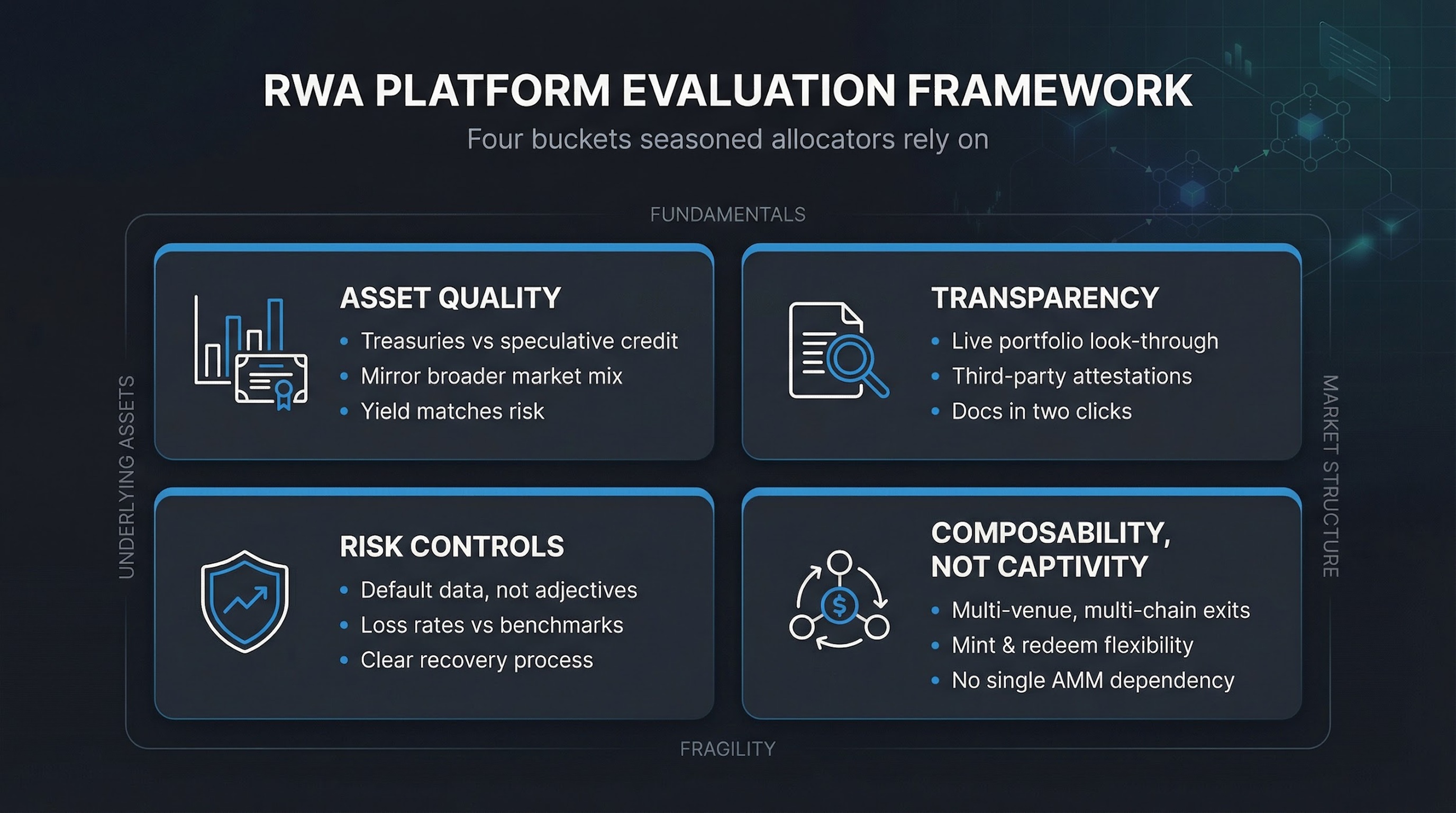
Seasoned allocators group diligence into four buckets, then test the numbers behind every slide.

A four-part framework allocators can use to evaluate real-world asset tokenization platforms beyond the marketing deck.
  1. Asset quality. Start with the cap table: what share of the book sits in cash-equivalent Treasuries versus speculative credit? A healthy venue mirrors the broader market. Tokenized Treasuries now exceed USD 7.2 billion, and Ondo’s OUSG alone floats USD 693 million, second only to BlackRock’s BUIDL. If a platform is 90 percent junior real-estate debt, treat the yield like high-yield bonds, not money-market cash.
  2. Transparency. Ask for live portfolio look-throughs and third-party attestations. Backed Finance releases monthly auditor letters and chain-verifiable CUSIPs. Centrifuge’s Tinlake pools post every loan term sheet and controller signature on IPFS. If you cannot reach the documents in two clicks, consider it a red flag.
  3. Risk controls. Look for default data, not adjectives. New Silver’s fix-and-flip pool on Centrifuge shows a 0 percent principal-loss record across 190 loans since 2019, outperforming the 1–2 percent industry average. Compare that to venues that hide or disclaim loss rates.
  4. Composability, not captivity. Tokenized positions should clear in multiple venues. OUSG can be minted on Ethereum, Solana, and the XRP Ledger, and redeemed around the clock via Ripple’s RLUSD stablecoin. If exit liquidity relies on one in-house AMM, you are inside a walled garden, not a market.

Platforms that land in the top quartile on these four metrics may grow slower, yet they fail far less often. In RWAs, boring delivers the real alpha.

Participating carefully as an investor or a builder

Treat RWAs like any new asset class: start small, read the footnotes, and track outcomes instead of hype.

For investors: Franklin Templeton’s BENJI money-market token shows that a cautious entry can still earn Treasury-level yield. Assets grew from USD 360 million to 580 million over the past 12 months while maintaining daily liquidity. A one- to five-percent sleeve in products this transparent lets you study the plumbing without risking your core capital. Spread exposure across issuers, structures, and geographies; Tinlake, for example, lists more than ten independent pools, so one default will not sink the whole position.

For builders and institutions: J.P. Morgan’s Onyx repo network cut intraday funding costs by 56 percent for one global dealer. Similar gains appear only when compliance, engineering, and operations share the same whiteboard, and when success is measured in basis-point savings or hours trimmed from settlement, not “total value locked.” Select one high-friction workflow such as trade-finance invoices, cap-table equity, or margin collateral, then automate it end to end before expanding.

Whether you are wiring USD 5,000 or writing 5,000 lines of code, treat the token as a regulated security first and a crypto artifact second. That mindset protects both capital and roadmaps when the regulations evolve.

Long-term view: RWAs as plumbing, not headlines

If tokenization succeeds, you will barely notice it; you will simply wonder why funds move faster. JPMorgan’s Kinexys network already settles about USD 2 billion a day for corporate treasurers, yet few outsiders realize the dollars travel across an internal blockchain. BNY Mellon’s triparty repo pilot let UBS borrow cash from Swiss Re and return the collateral before lunch, compressing a 24-hour cycle into four hours. The BIS Project Helvetia study showed that tokenized central-bank money can close wholesale trades in seconds without touching legacy core systems.

These quiet wins point to the future: settlement layers embedded in bank pipes, collateral tokens gliding between margin accounts, and investor dashboards that reference “fund shares,” not “smart contracts.” RWAs will prove their value not by trending on social media, but by shaving basis points, freeing intraday liquidity, and removing a few manual clicks from finance’s daily routine.