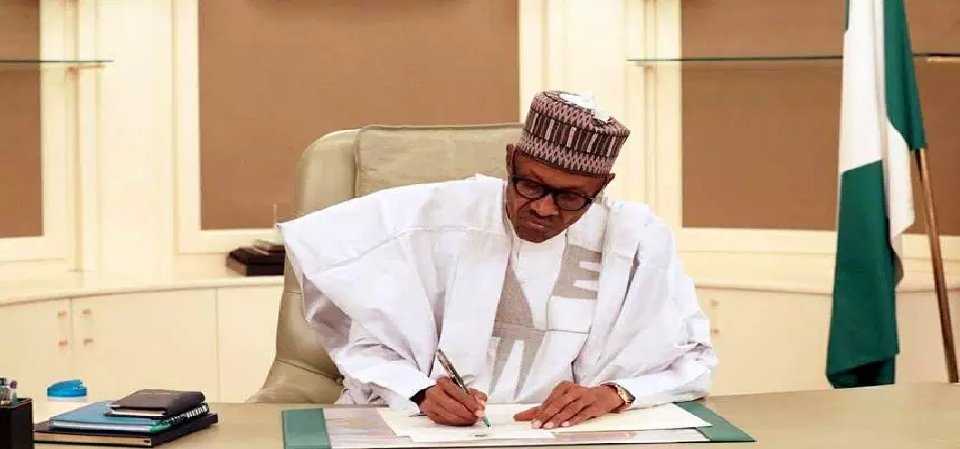
Criticism has continued to trail the N21,827.19 trillion 2023 Appropriation Act that was signed into law by president Muhammadu Buhari on Jan 3, due to how unrealistic it is seen to be.
The federal government said there is only about N10.49 trillion available to fund the budget, leaving a wide deficit of about N11 trillion. Based on this and other inconsistencies, the budget, which is the biggest in Nigeria’s history, has instigated a wave of criticism from experts.
A development economist and financial expert, Dr. Chiwuike Uba, is the latest economic big wig to condemn the budget. Describing it as “unrealistic”, Uba said the figures in the Appropriation Act is inconsistent with the budget’s policy direction contained in the President’s speech during the budget presentation.
While lamenting the inconsistencies of the revenue and expenditure projections in the budget, Uba, in a statement released to media, said the budget cannot “maintain fiscal viability and ensure a smooth transition to the incoming administration.”
He said Nigeria’s economy is currently sustained with a growing budget deficit funded by public debt, which means, that “there is no concrete strategy to jumpstart the economy.”
Uba, who is also the Board Chairman of Amaka Chiwuike Uba Foundation (ACUF), said the federal government has continued to violate paragraphs (a) and (b) of section 41 of the Fiscal Responsibility Act, 2007, which he described as “worrisome.” The section states that “government at all tiers shall only borrow for capital expenditure and human development”.
Uba advised federal and state governments to reduce the propensity to accumulate public debt under the pretext of financing capital projects, by actively seeking alternative project financing options, especially through the public-private community partnership arrangement (PPCP).
He said on average, approximately 48% of all debts incurred between 2015 and 2022 were used to finance recurrent expenses, contrary to applicable legislation.
Read his statement below:
“The N21,827.19 trillion 2023 FGN Budget, passed into law by the National Assembly and assented by the President on January 3, 2023, is worthy of commendation by Nigerians. First, the timely presentation of the budget to the National Assembly offered the minimum time required for an adequate and detailed legislative review of the budget documents. The revenue and expenditure projections in the FGN 2023 budget, known as the “Budget of Fiscal Consolidation and Transition”, appear to be inconsistent with the budget’s policy direction contained in the President’s Budget Speech. While the strategic objective of the budget is to “maintain fiscal viability and ensure a smooth transition to the incoming administration”, the budget figures are not in agreement and are incapable of achieving the budget objectives.
“First, fiscal viability cannot be created and sustained with a growing budget deficit funded by public debt and no concrete strategy to jumpstart the economy. In particular, where more of the public debt is allocated to the financing of recurrent expenses. The average budgeted deficit and the actual deficit between 2015 and 2022 are 56% and 111% respectively.
“In 2016, it was 47%, and 45% for deficit budget and actual deficit, 57% and 74% in 2016; 46% and 143% in 2017; 27% and 94% in 2018; 27% and 101% in 2019. In 2020 and 2021, the budget deficit and the actual deficit were 86% and 193%, and 74% and 139% respectively. In 2022, the budget deficit is 82% and the actual deficit as of November 2022 is 98%. Sadly, instead of reducing the budget deficit, the government has increased the budget deficit to 108% in 2023. The average budget deficit between 2015 and 2023 is 62% and this deficit is funded by public debt.
“The projected debt service to revenue ratio of 60% in 2023 does not have the capacity to support fiscal viability. Especially with the financing of recurrent expenditures with more than 48% of the proposed new debts. More worrisome is the continued violation of paragraphs (a) and (b) of section 41 of the Fiscal Responsibility Act, 2007. The section states that “government at all tiers shall only borrow for capital expenditure and human development”. “The debt service to revenue ratio for the years 2015, 2016, 2017 and 2018 is 32.7%, 44.6%, 61.6% and 54.1%, respectively. The ratio increased in 2020 and 2021 to 97.8% and 90.9%, respectively. As of November 2022, the debt service to actual revenue ratio was 80.7%.
“On average, approximately 48% of all debts incurred between 2015 and 2022 were used to finance recurrent expenses, contrary to applicable legislation. In addition, the average actual capital expenditures as a percentage of total actual expenditures from 2015 to 2022 are 15.3 per cent. The report indicates that, on average, only 15% of total expenditures since 2015 have been devoted to capital projects. Specifically, the share of capital spending relative to total actual spending in 2015, 2016, 2017 and 2018 was 12.8%, 3.4%, 22.3% and 22.0%, respectively. In 2019, it was 14.0%, 16.0% in 2020, 17.2% in 2021 and 14.6% as of November 2022.
“In November 2022, compared to 2015, debt service increased by 329%, actual revenues increased by 100% and actual total aggregate expenses increased by 173% (capital spending accounts for just 16% of total expenditure growth). The implication is that Nigeria has accumulated more debt for consumption instead of building the infrastructure needed to create wealth, fiscal viability and sustainable development. Unfortunately, the N6.3 trillion provision for debt servicing in 2023 will be inadequate because the government is likely to accumulate more debt to fund the budget in view of the unrealistic revenue projections. In fact, over the last five years, on the average, the government has consistently spent more than what was budgeted to service the debt.”
Speaking further, he said: “To reverse this trend, Nigeria needs to put in place a credible budget parameters and deficit reduction plan to cope with the negative impact of high deficits and debt on the economy. Unfortunately, there appears to be no clear exit strategy for transitioning from current levels of fiscal imbalances to more sustainable levels in the 2023 budget. Where’s the plan or strategy to reduce borrowing and debt service? To what extent is the strategy achievable when our deficit exceeds 108% of projected revenues and the larger portion of the proposed additional debt purposed to fund recurrent expenditures?
“I’m not sure the government is focusing on program evaluations, value for money, and cost-benefit analysis during the budget process. Incidentally, section 44 (1) of the Fiscal Responsibility Act 2007 mandates “any Government in the Federation or its agencies and corporations desirous of borrowing to specify the purpose for which the borrowing is intended and present a cost-benefit analysis, detailing the economic and social benefits of the purpose to which the intended borrowing is to be applied. In fact, subsection 2 of section 44 further states that “the proceeds of such borrowing shall solely be applied towards long-term capital expenditures.”
“Evidently, as a country, laws meant to promote fiscal responsibility and sustainability are flagrantly contravened by the government. Whereas Section 35 (5) of the Fiscal Responsibility Act 2007 states that “no Government in the federation shall have access to the savings made in pursuance to subsection (2) of this section, unless the reference commodity price falls below the predetermined level for a period of three consecutive months”, the savings from excess amount of the budgetary benchmark from the sale of crude oil is massively depleted. It is very difficult to maintain fiscal viability with the continued depletion of the Excess Crude Account during period of oil windfall. The Excess crude account dropped by about 10,000% in one month from $35.7 million in June 2022 to $376,655 in July 2022, despite the $38 profit per barrel designated to be paid into the Excess Crude Account”.
“Most of the 2023 FGN budget parameters are also very ambitious, unrealistic and do not appear to be based on evidence/reality. First, evidence and revenue trends suggest that the 2023 revenue projection is unrealistic. The average revenue performance from 2015 to 2022 is 66.8%. The highest revenue performance was in 2015, with a revenue performance of over 90%. The revenue of N6.5trillion as of November 2022 is the highest revenue since 2015.
“The 2023 revenue budget, which is N10.49 trillion, is 61.5% higher than the actual revenue as of November 2022. It would be important to know the government’s strategy to raise revenues beyond the budget numbers. Data has shown that actual revenue weighted average growth rate from 2015 to 2022 is 13%. The highest actual revenue growth rate of 45% was recorded in 2018. What is the result-based strategy to increase oil revenue from N586 billion as of November 2022 to N2.2 trillion in 2023? What are the real plans to stop oil theft, attract new investment and bring Nigerian divestitures back beyond the inauguration of the Committees? The projected increase in oil production from an average of 1.21 mbpd in 2022 to 1.69 mbpd in 2023 is overly ambitious. Other ambitious and unrealizable revenue projections are the 202.1% increase on federation account levies, a 290% increase on Domestic Recoveries + Assets + Fines, and the 280% increase on GOEs Retained Revenue, among many others.
“The exchange rate parameter of N435.57/$ is too ambitious and unrealistic. On January 9, 2023, the official exchange rate was N450.58/$, whereas the parallel market rate was N741.25/$. Given the above, the realistic exchange rate lies between N500/$ and N600/$. The growing decline in exports will further affect USD supply, which in turn will lead to a further depreciation of the Naira. In addition, the pressure on external reserves from external debt service demand and additional debt to finance the 2023 budget deficit will also impact the value of Naira. The truth is that the real exchange rate is the parallel market exchange rate because that is why most individuals and businesses access their foreign exchange needs.
“The projected inflation rate of 17.1% is unrealistic as well. Clearly, inflation will continue to rise in 2023 because the drivers of inflation have not yet been adequately addressed. Over 70% of inflation is due to the exchange rate (depreciation of the naira), diesel and aviation accounting for over 11% and around 7% to other exogenous shocks. The CBN is expected to increase its contribution to the funding of the federal government’s budget deficit through ways and means, which currently represents about 40% of the total money supply. This free money from the CBN will further exacerbate inflation rate in 2023.
“Prices of goods and services are expected to rise with the increase in electricity tariff, the ongoing scarcity and increase in PMS price, the 2022 flood which affected food production, and the proposed removal of petroleum subsidy. The high MPR has led to the closure of some manufacturing companies and existing companies are faced with an increase in manufacturing/production costs of inputs. This increase in input costs will naturally translate into higher inflation due to higher prices for goods, reduced production in the economy and unemployment.”
He added: “Fiscal viability/consolidation should be directed towards expenditure cuts, especially on government consumption and transfers rather than tax increases. The use of higher taxes while most businesses are closing and Nigerians are falling into abject poverty is not the best way to maintain fiscal viability/sustainability. The federal government must co-ordinate its efforts with sub-national governments to ensure consistent deficit reductions. The use of debt accumulation and fiscal recklessness by state governments has done more damage to the nation’s economy. Unfortunately, the emphasis is always on the national government and nobody is trying to hold state governments accountable.
“Maintaining financial sustainability calls for fostering entrepreneurship, innovation and competitiveness through the active participation of the private sector in the economy. Innovation and entrepreneurs create the greatest number of jobs for economic growth. Furthermore, to promote fiscal sustainability, it is very important to shift private sector participation from the current dominant capitalist model to a collective and democratically governed business model.
“To ensure their growth and sustainability, such businesses should benefit from free or low-interest loans. In addition, the government can establish a credit guarantee institution to facilitate credit guarantees for SMEs and co-operatives. A national policy on local and social procurement must also be put in place. It has been proven that for every naira spent in local businesses, more jobs are created than an outside business. A national policy making it mandatory to use locally produced vehicles, textiles and other equipment in all MDAs and other reference institutions should be in place.
“These initiatives will not only encourage local companies, revitalize dead (dying) companies, but they will attract foreign companies to set up manufacturing plants in Nigeria. It would also ensure long-term, stable and ongoing demand for goods and services, while contributing to job creation, national productivity and incomes. Furthermore, any company awarded a public contract must undertake to improve the social, environmental and economic well-being of the area in which it operates.
“Finally, to reduce the propensity to accumulate public debt under the pretext of financing capital projects, governments must actively seek alternative project financing options, in particular the public-private community partnership arrangement (PPCP). Under this platform, the private sector will not only contribute investment capital, but also its technical expertise, time and human resources.”
Like this:
Like Loading...