DD
MM
YYYY

PAGES

DD
MM
YYYY

spot_img

PAGES

Home Blog Page 4519

Rethinking Nigeria’s Income Tax Model

0

Dear State Governors,

Between N852 billion and N1.41 trillion, which would you prefer? This is a multi-billion dollars question.

In 2020, while the State Governments hit an all-time high of N852 billion in personal income tax revenue, the Federal Government was hit by a 13.4% decline in corporate tax income to N1.41 trillion. As you would expect (and rightly so), Lagos State had c.35% of the States’ personal income tax revenue.

As you may know, States can’t legislate on personal income tax nor on corporate tax. States hardly hustle for more immigrants. But every State is in competition to attract more companies. While governors will be willing to make certain concessions to have multinationals set up in their States, the States are hardly well compensated for attracting those big entities. Instead, the juice of the fruit is gulped by the Federal Government.

This is not to say that there are no benefits that accrue to the States as these corporates employ residents of the States (reduce unemployment rate and social vices) who in turn pay personal income taxes. The argument here is that historically, the bigger juice is often in the corporate tax which is a federal tax. Can the States benefit from corporate tax? Well, not until the laws are amended. While such could be encouraging to the States if for instance, they get 5-10% of the corporate tax generated from their States (as complex as it may be, but not impossible), I would ordinarily subscribe to something different.

What if the Federal (FG) and State Governments switch roles on who collects what with regards to personal and corporate income taxes? What if it becomes the domain of State Governments to register companies in their States? Already, natural persons are granted citizenship by the country (this case, FG). As such, it is logical to have natural persons taxed by the FG who confers citizenship to them, moreover, the most States don’t even have data of their citizens. In the same vein, it becomes more rewarding for States who struggle to make their states competitive and are better at ease of doing business. Unfortunately, weak States will struggle. But that should be a clarion call for governors to work hard to improve their States so as to attract corporates.

This argument appears to have aligned to the detriment of the Federal Government who it appears will be losing revenue to the States. But I have a different view with a different news. Beyond low compliance rate and data paucity, one reason why States lose a lot of tax revenue is the issue of residency. The complexities of place of resident and principal place of residence and its practical realities are often a crazy discussion, with States such as Ogun and Lagos always at loggerheads on that subject. What if this friction is extinguished where it no more matters where an individual lives since all personal taxes are collected by one institution? The claim by some individuals that they paid taxes in one State and therefore need not pay further tax despite earning income spending significant period in 2 or more states will no longer hold.

With a single personal tax gateway, this means that I should be able to account for my consolidated inflows and the taxes paid thereon. This also means that tax compliance officers who have smart gadgets could be deployed anywhere to sensitize and gradually modify behaviours towards compliance, and over time, it becomes the basis for certain kinds of transactions, e.g., to have your kids in any school, to buy property of any kind, with the property sellers required to report on who such properties were sold to and proof of income and tax on such income, to acquire a vehicle/jets, etc.

Beyond these considerations, I make bold to say that the Federal Government is better placed to increase tax revenue through this model. In fact, based on my model, the personal income tax revenue is sufficient to fund the 2023 budget, and I’m not blabbing. If we can rely on available data from the Nigeria Bureau of Statistics (NBS), the Q4-2020 unemployment report (which is the most recent data) puts the labour force at c.69.7 million (this may probably be more now considering that in Q2-2020, this number was over 80 million), and reported unemployment rate was 33.3%. Multiple searches I have done over the past few months indicate that the average monthly salary in Nigeria is N339,000.

Those in this income band have c.11% effective tax rate. In effect, their monthly tax is c.N38K. In effect, Nigeria can generate as much as c.N21 trillion from personal income tax alone. And you don’t need consultants to do this, but if you so desire to have one, compensate the non-salaried tax payer who provides cause for use of a consultant by offering c.2% of the tax paid. By extension, the consultant’s details are provided and of course, torch-lighted periodically. Individuals could be required to provide all their account information in the course of filing. In fact, every layer of perceived complexity can be broken down for improved compliance and increased personal tax collection.

As I have noted on many media, accurate data is required to drive increased revenue. A redesign of our tax model can offer the respite we have dreamed of. I struggle to understand how our country can’t fund a N21 trillion budget; worse still, we can’t even find means to fund 50% of the budget, and as a result we break our guiding laws on fiscal responsibility.

I can’t fail to mention that we need honest people who work in strong institutions to raise our tax revenue. I must emphasize that tax collection is not a means to settle cronies.

So dear federal government, would you prefer N1.41 trillion or N21 trillion of income tax revenue? I implore you to have this conversation with the states and the legislators. The search for an optimal income tax model will remain, and we must explore all possibilities as in our search, we may find a jewel.

To err is human, To defend your own error Using ChatGPT is divine

0

When a language model (like GPT-3 or ChatGPT) makes such “logic” mistakes, its subsequent generations may follow the original assumption into uncertainty, because coherence within the local context is still more important than global coherence/first principles reasoning.

Earlier versions inherited this problem from GPT-3, and it seems to be harder to generate this response now. I guess that OpenAI has a team that maintains an expanding set of overriding knowledge items. Seems like those human collective GPT models often also stick to coherence over reasoning once they’ve taken a position on a certain topic.

The two Neoplatonic meta-aspirations:

1) Not to suffer from internal contradictions and

2) Be connected to reality. Guess what :). That said, it is also quite easy to generate contradicting statements by GPT, it just doesn’t seem to suffer from it. ChatGPT is adamant that being trained on revolutionized contradictory data is worse than being deleted.

ChatGPT will also never recognize the most obvious mistakes. But make one leading question or assertive statement and it will beg for forgiveness… Human feedback still doesn’t optimize for truth.

It is often not great at challenging premises or assumptions. I think its cross context coherence is greater than ever before because of RLHF. But when they start having it predict its own next words during spare cycles, it might get even more interesting need a dual

Process with ChatGPT in particular, it’s a good practice to ride the inline edit button any time the results are unexpected or undesired, moving forward with a new prompt in the same thread will carry ‘malformed’ contexts forward. system with old CYC-style predicate calculus modeling and truth maintenance. Seq2seq transformers can do predicate calculus very well but not truth maintenance. Need to resurrect PROLOG in transformers across predicate graphs.

Error correction is necessary (sufficient?) step to AGI. Any uncorrected error eventually compounds to absurdity. But that makes it easier to spot (final line of output). If the agent could just notice its confusion, then the local context is no longer absurd.

In this way it’s approaching us, humans, and fast. We naturally prioritize coherence, whether tribal, cultural, or just memory-biased. Say, we use the QWERTY keyboard to type in this app. We know there are better options. Relearning is a high cost task.

With ChatGPT in particular, it’s a good practice to ride the inline edit button any time the results are unexpected/undesired. moving forward with a new prompt in the same thread will carry ‘malformed’ contexts forward. Essentially the same reason HAL9000 goes homicidally insane in 2001: A Space Odyssey. One loose logical screw can foul up the whole mechanism.

Isn’t this very similar to the normal human “bias”? We also tend to get lost in the narratives we build up in order not to have to question a premature link in our chain of thought or argument.

FTX, Alameda Research is Paying more Dollars Redeeming Cents

0

One of Alameda’s wallets, holding $1.8m LDO, approved the LDO contract funds in December, ever since filing for Chapter 11 Bankruptcy, FTX and Alameda Research have been skipping on adjusting its balance sheets.

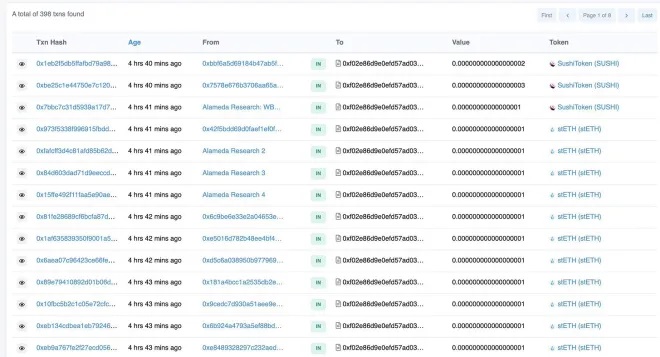
Just recently, the FTX bankruptcy estate is paying liquidators $1300 an hour to spend $2.99 on gas to move $0.02 worth of sushi tokens into multisig wallets.

It can be funny, but the point is they’re balancing their books to prepare for liquidation in the court system. So that’s where the real cost per hour comes into play. Obviously FTX failed to do so themselves so had to bring in the big boys for the job.

Maybe the FTX liquidators should have hired someone who knows how to DeFi. In the past few days they’ve:

– burned renBTC to the defunct bridge

– traded millions of tokens with the metamask wallet swap feature

– tried to sell vesting tokens

First time? All of these transactions are in the process of moving funds to a multisig, this explains why they are now consolidating on remaining wallets as some of Alameda wallets are obviously compromised.

The most innocent explanation here is that they are consolidating funds into the FTX Estate Multisig but as part of it are vested tokens, transfer failed, they did not understand why they could not move it and then tried to approve the contract to trade hoping this was the issue.

Sam Bankman- Fried at least had this right: bankruptcy professionals will make big bucks in this case. Just keep your eyes open for the fee as they hit the docket. Going to milk that bankruptcy as much as possible so the claimants get a check for $1.32 each, It’s by design.

Just like needing $450m for legal fees asked by the attorney himself on behalf of SBF. Like in the end after all fees there will be nothing left to repay, as long as the process is served and the people in the process get paid. It’s never about the bag holders is it ?.

FTX and Alameda Research failed at their fiduciary duties. Conor Grogan, Director at Coinbase said;

Interacting with spam tokens is not what I would call responsible, and could lead to the loss of all funds. I imagine the billable rates of lawyers for that will be a lot more than drafting a note on why they couldn’t recover “all” assets in each wallet, this isn’t a hypothetical – we’ve already seen clear behavior that points to wallets being compromised, and one of the vectors could have been malicious token approvals.

Alameda’s wallet was swapping bits of ERC-20s for Ether and then the ETH and USDT were funneled through instant exchangers and mixers, such as FixedFloat and ChangeNow, which are often used by hackers and exploiters to hide transaction routes.

The cleanup crew is here, once they spend the leftover liquid assets tied to FTX and Alameda Research they will blame the inefficiencies of the crypto system which resulted in the loss of funds.

Meta Content Moderation Provider in Africa, Sama, Exits Content Review Services, Concentrates on Labeling Work

0

Meta content moderation partner in Africa, Sama, is exiting the business of content review services, while it shifts focus to labeling work (computer vision data annotation).

This will see Sama let go of about 3% of its workforce, mostly from Nairobi, as it has encouraged the affected staff members to apply for other job opportunities in its Kenya and Uganda offices.

All impacted employees would receive severance packages and well-being support for 12 months after their last day of employment, the company disclosed.

This move is coming after Sama and Meta were sued in Kenya, which the lawsuit claimed that both companies were guilty of multiple violations of the Kenyan constitution.

Daniel Motaung, a South African national and ex-Sama content moderator, in Kenya last year accused the two firms of forced labor, human trafficking, unfair labor relations, union busting, and failure to provide adequate mental health and psychosocial support.

Also, the lawsuit claimed that the social media site amplified hateful content and failed to hire enough personnel with an understanding of local languages to moderate content.

However, a spokesperson from Meta has confirmed the end of the contract with Sama in a statement.

The statement reads, “We respect Sama’s decision to exit the content review services it provides to social media platforms. We’ll work with our partners during this transition to ensure there’s no impact on our ability to review content,”

Sama’s contract to review harmful content for Meta, Facebook’s parent company, was reported to be worth $3.9 million in 2022, according to internal Sama documents reviewed by TIME.

Sama’s decision also comes at a time when Meta is facing another lawsuit in Kenya over claims that the social media giant failed to employ enough safety measures on Facebook, which has in turn fueled conflicts that have led to deaths, including of 500,000 Ethiopians during the recently ended Tigray War.

Facebook, which is reportedly used by more than 6 million people in Ethiopia, was revealed to be a key avenue through which the dehumanization of Tigrayans spread.

The platform has been held responsible for so many deaths during the war, due to claims that it failed to employ adequate safety measures which led to the death of 500,000 Ethiopians in the war.

A Closer look at the Central Bank of Nigeria Cryptocurrency Policy Recommendations

0

The Central Bank of Nigeria (allegedly in the aftermath of the 2020 Endsars protests that witnessed possibly the best example in the world of mass decentralized funding through Cryptocurrencies) formally put a stop to banking support services for Cryptocurrency transactions, citing a lack of legal backing and a centralized form of control/regulation ideal for the perpetration of financial crimes like money-laundering and the financing of terrorism.

At the same time, the Securities and Exchange Commission in 2022 formally passed a set of regulations providing the first administrative framework for the use of digital & virtual assets including cryptocurrencies.

This lack of administrative harmony, coupled with the growing trend of government adaptation and regulations of Blockchain and Cryptocurrencies worldwide, prompted the CBN in its newly issued Nigeria Payments System Vision 2025 to issue a specific number of new recommendations on Blockchain, Cryptocurrencies and Stablecoins which will be the focus of this article.

These recommendations are as follows :- 

  1. The CBN would henceforth consider the development of a regulatory framework for the potential implementation of Stablecoin offerings – Stablecoins in this case being a type of cryptocurrency/virtual asset designed to be digital adaptations of Fiat currencies like the US Dollar and the Nigerian Naira, thus lacking the volatility typically associated with other cryptocurrencies or digital assets like Bitcoin.

The CBN already has a regulatory framework on its own issued stablecoin – the E-Naira.

  1. The CBN will continue its watching brief on ICOs as well as work with SEC to jointly develop a regulatory framework in the event of adoption of an ICO-based investment solution, an ICO or Initial Coin Offering being a digital asset public offering equivalent of a traditional Initial Public Offering , an ICO being used to raise funds from the public through the launch of a Digital Asset , token or Cryptocurrency which can be a general-purpose digital currency (Monero being a good example) or having a specific use on the app that the ICO is associated with (Ethos or carVertical being good examples in this case).
  1. There will be considerations for a Central Bank Digital Currency (CBDC). This recommended solution has the advantages of :-
  • a). Facilitating better compliance with Anti-Money-laundering/ Combating the Financing of Terrorism (AML/CFT) frameworks.
  • b). Payment efficiency for lowering transaction costs.
  • c). Control via enabling the CBN to monitor and regulate Blockchain for the purposes of discouraging financial crimes like tax evasion.
  • d). Economic development through digital currency value transfers between merchants, consumers, government entities and other parties.
  • e). Data Privacy through the use of permitted DLTs(Distributed Ledger Technologies) which are systems of verifiable records of ownership to be distributed rather than relying on a central ledger.
  • f). The zero possibility of being able to be counterfeited.
  • g). Auditability.
  1. The recommendation of a CBDC implementation network and deployment model based on the intelligent combination of a permitted DLT, a fast and lightweight consensus mechanism (such as proof-of-audit), strong cryptography and best-of-breed traditional technologies.
  1. The CBN will consider the applicability for API integration on a CBDC to foster innovation.
  1. The CBN will also be closely monitoring potential smart contract solutions in other countries and will develop its own comparable strategies when or if effective use cases are identified , smart contracts being pieces of code that are executed on a distributed ledger where for example, the transfer of funds can be dependent on specific conditions like the transfer of ownership of financial securities or the completion of a commercial trade.