DD
MM
YYYY

PAGES

DD
MM
YYYY

spot_img

PAGES

Home Blog Page 453

How Ozak AI ($OZ) Could Become the Next AI-Powered Token to Rival XRP, SOL, and BNB in Market Cap by 2026

0

Ozak AI ($OZ) is emerging as a formidable contender in the AI-powered token market, positioning itself to rival established cryptocurrencies like XRP, Solana (SOL), and Binance Coin (BNB) by 2026. Having sophisticated predictive AI and decentralized infrastructure coupled with cooperative initiatives, Ozak AI has a distinct solution that is not just hypothetical but is supported by practical implementation. This is a combination of AI and blockchain technology, which will distinguish Ozak AI, which has the potential to make significant increases in the competitive crypto market.

Ozak AI ($OZ): current Presale Price.

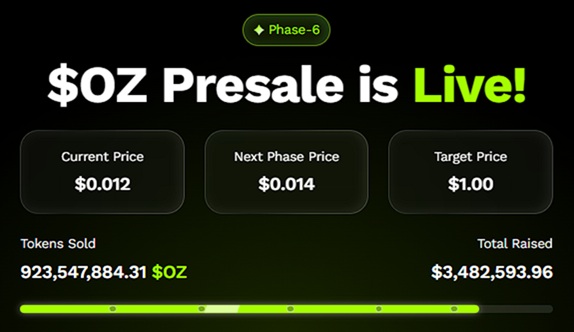
Phase 6 of the presale is ongoing, and the price of the token of Ozak AI token is currently priced at $0.012. The project has also raised an excess of $3.4 million with the sale of over 924 million tokens. The next phase will boost the price of the token to $0.014, which will be a 1300% increment of the initial presale price of $0.001. Analysts believe that the token may be valued at $1.00 upon launch, and this may be an 83x gain to early investors.

XRP: Current Market Overview

The native token of Ripple, XRP, is currently trading at around $2.77, and it rose 0.44% over the past 24 hours. In spite of this current decline, XRP is currently valued at approximately 166.14 billion dollars with a 24-hour trade volume of over 6 billion. Analysts are finding falling wedge formations in the price chart of XRP, and the falling wedge pattern in the past has shown bullish breakouts. And with this trend, there may be a possibility that XRP would be aiming at a price of between $2.95 and $3.60, provided that the currency persists in an uptrending move and the market situation is also favorable.

Solana (SOL): Up-to-date Market Analysis.

The present price of Solana (SOL) is about $201.84, which rose 2.83% in the last 24 hours. The network has encountered several issues, such as a reduction in the number of daily active addresses and the issue of scalability, which have added to its current price fluctuations. In spite of such challenges, Solana has a strong market capitalization, and the platform is still known as one with high-speed transaction speeds and a developer-friendly ecosystem. The future could see more decisions made, including the possible passing of an ETF based on Solana, and this would affect investors and the price of SOL.

Binance Coin (BNB): Overview of the Current Market.

Binance Coin (BNB) is currently trading at an average of $970.27, which comes at a gain of 2.19% in the past 24 hours. There have been wide fluctuations in the token, and the high point of its price was the all-time high of $1,079.07, which was followed by a downtrend. The value proposition of Binance is backed by the utility of BNB in the Binance ecosystem, such as offering discounts on transaction fees and participating in token sales. But as market forces have changed recently and regulatory issues have come into play, investors are looking over their shoulders.

Ozak AI ($OZ): Competitive Advantage and Market Share.

The predictive AI, the real-time data analytics, and the decentralized infrastructure are unique features of Ozak AI, which uses the Ozak Stream Network (OSN) as the source of power. With this architecture, large data can be processed over several nodes, which increases the integrity and security of the data. The partnerships with such giants of the industry as Pyth Network, SINT, Hive Intel, and Weblume additionally enhance the potential of Ozak AI, offering the ability to access high-frequency, tamper-resistant market data. The monetized data insights and the staking rewards of the platform are added benefits to the token holders, making Ozak AI a potentially successful player in the sphere of AI and blockchain.

Conclusion

XRP, Solana (SOL), and Binance Coin (BNB) remain a strong force in the cryptocurrency market, but the innovative approach and strategic alliances of Ozak AI indicate that it may become a very dangerous competitor by 2026. The combination of AI-based market prediction, decentralized infrastructure, and community involvement gives it a strong base for possible development and implementation in the changing crypto world.

For more information about Ozak AI, visit the links below:


Website: https://ozak.ai/

Twitter/X: https://x.com/OzakAGI

Telegram: https://t.me/OzakAGI

Ozak AI Presale Nears $3.5M as Stage 6 FOMO Intensifies

0

Crypto markets in 2025 are complete of opportunities, but few presales are producing as lots buzz as Ozak AI. Currently in its 6th presale level at $0.012 per token, Ozak AI has already raised greater than $3.4 million and is quickly closing in at the $3.5 million milestone. With over 920 million tokens offered to this point, the project is gaining momentum at a speedy tempo, sparking FOMO amongst each retail investors and whales.

Ozak AI Presale Gaining Unstoppable Traction

The appeal of Ozak AI lies in its perfect timing. The crypto market is already leaning closely into narratives like artificial intelligence, scalability, and cross-chain solutions, and Ozak AI sits at the intersection of all 3. By combining blockchain with AI-powered prediction marketers, the project gives investors more than just a token—it’s building equipment designed to supply real-time insights, actionable facts, and predictive analytics for crypto users and enterprises.

Stage 6 of the OZ presale has seen accelerating demand, with tokens moving quickly as investors recognize the opportunity to lock in early positions before exchange listings. FOMO has intensified in recent weeks, especially as Ozak AI continues to expand its partnerships and strengthen its ecosystem.

Why Ozak AI’s AI Twist Matters

Unlike many projects that use “AI” purely as a buzzword, Ozak AI is actively developing technology with tangible utility. Its prediction agents are designed to process massive data flows and provide instant market signals, helping users make smarter, faster, and more accurate decisions.

This practical application is backed by partnerships with some of the strongest names in the AI-crypto space. Perceptron Network, with its 700,000+ active nodes, gives Ozak AI access to a robust foundation of verified data. Collaboration with HIVE adds ultra-fast 30ms market signals, while SINT brings in cross-chain bridges, SDK development tools, and even voice-driven AI interfaces. Together, these integrations create a unique flywheel of speed, trust, and autonomy, giving Ozak AI a serious edge over other presales.

FOMO Builds on 100x Predictions

What’s driving much of the urgency is the bold prediction that Ozak AI could deliver 100x ROI by 2026. At just $0.012 per token, Ozak AI offers investors an asymmetric opportunity that established cryptos can no longer provide. Analysts suggest that if Ozak AI reaches $1 within the next two years, early investors could see life-changing gains.

This narrative has resonated strongly, especially when compared to blue chips like Ethereum and Solana. While those coins are strong long-term plays, their upside is measured in multiples rather than exponential jumps. Ozak AI’s small market cap and unique positioning in AI-driven crypto make it a candidate for the kind of breakout run that early investors dream about.

OZ’s Building Trust and Global Recognition

Presales often struggle with credibility, but Ozak AI has worked to establish itself as a serious player. The project has undergone a CertiK audit and completed an internal audit, giving investors added peace of mind. It is also listed on CoinMarketCap and CoinGecko, two essential platforms for transparency and visibility.

On the events front, Ozak AI showcased itself at Coinfest Asia 2025 in Bali, participating in invite-only sessions and collaborating with partners like Manta Network, Coin Kami, Block Bali Com, Forum Crypto Indonesia, and Bitcoin Addict Thailand. These global appearances signal a commitment to long-term growth rather than short-term speculation.

With its presale already surpassing $3.4 million and rapidly approaching $3.5 million, Ozak AI is one of the fastest-growing stories in crypto this year. Stage 6 has unleashed a wave of FOMO as investors scramble to secure tokens at $0.012 before the next stage pushes the price higher.

Backed by strategic partnerships, audited credibility, and a vision that fuses artificial intelligence with blockchain, Ozak AI offers both utility and the potential for explosive gains. If analysts’ predictions hold true, the 100x ROI potential by 2026 could turn today’s presale buyers into the next wave of crypto success stories. 

About Ozak AI

Ozak AI is a blockchain-based crypto project that provides a technology platform that specializes in predictive AI and advanced data analytics for financial markets. Through machine learning algorithms and decentralized network technologies, Ozak AI enables real-time, accurate, and actionable insights to help crypto enthusiasts and businesses make the correct decisions.


For more, visit:

Website: https://ozak.ai/

Telegram: https://t.me/OzakAGI

Twitter : https://x.com/ozakagi


Adobe Faces Morgan Stanley Downgrade as AI Adoption Outpaces Monetization

0

The race to turn artificial intelligence into business growth is no longer confined to Big Tech. Design platforms like Canva and Figma have embedded AI into their core products, while enterprise users are experimenting with generative tools at scale. Against this backdrop, Adobe finds itself under mounting pressure to prove that its AI bets will deliver more than headlines.

ChatGPT alone has amassed roughly 700 million weekly users, a number that has redefined expectations across industries. Canva, with its “Magic” AI suite, has surged to 220 million monthly users, adding enterprise clients at a rapid clip. Figma has pushed further with agent integrations and code-aware workflows, repositioning its collaborative canvas as an AI-enabled platform.

These competitors have set a high bar for Adobe, which has rolled out Firefly inside Creative Cloud, introduced Acrobat AI Assistant, and launched GenStudio to help marketers scale content production.

The adoption numbers are undeniably strong. Adobe says 99% of the Fortune 100 now use AI features in at least one of its apps, with about 90% of its top 50 accounts tied to AI-first products. But the financial story has been less convincing. Adobe shares are down 20.6% year-to-date and more than 11% over the past six months, reflecting Wall Street’s doubts that AI will meaningfully re-accelerate growth.

Morgan Stanley added fuel to those doubts this week, downgrading Adobe to equal-weight from overweight and cutting its price target to $450 from $520. Analyst Keith Weiss argued that Adobe’s Digital Media annual recurring revenue (ARR) isn’t reflecting the pace of innovation.

“Since that upgrade, we have seen the Digital Media ARR growth directionality diverge from the pace and quality of innovation being embedded within the product portfolio,” he said.

The bank’s call emphasized three concerns: monetization is lagging adoption, rivals like Canva, Figma, and Big Tech platforms are intensifying competition, and the reduced price target—nearly 15% lower—signals lower near-term upside. Shares dropped 2.35% to $353.27 on September 24 and edged down further after hours.

Adobe executives insist the momentum is there. CEO Shantanu Narayen said this month that “AI-influenced ARR has now surpassed $5 billion, and we have already surpassed our full-year AI-first ending ARR target.” CFO Dan Durn echoed that optimism, saying AI-first products have already generated $250 million in ARR, a full quarter ahead of expectations. Yet, the aggregate numbers tell another story.

In Q2 fiscal 2025, Adobe’s Digital Media ARR climbed 12.1% year-over-year to $18.09 billion. By Q3, it reached $18.59 billion, but growth slowed to 11.7%. That deceleration has raised doubts about whether AI features are boosting upsell revenue and seat expansion enough to materially change Adobe’s growth trajectory.

The comparison with rivals underscores the tension. Canva has built an AI-powered ecosystem that is attracting enterprise teams en masse, while Figma’s integrations with coding workflows put it at the intersection of design and development. Big Tech, meanwhile, has the luxury of bundling AI into existing cloud and productivity suites, lowering customer acquisition costs. Adobe, by contrast, is trying to monetize AI primarily within its existing Creative Cloud framework, which could limit how fast the revenue needle moves.
Adobe Faces Morgan Stanley Downgrade as AI Adoption Outpaces Monetization

Adobe’s $5 billion in AI-influenced ARR shows the early promise of its strategy for bullish investors. But for skeptics, the slowdown in overall ARR growth suggests AI may prove more of a defensive tool—helping Adobe keep existing users—rather than the disruptive growth engine Wall Street has been expecting.

This means, amid the intensifying competitive landscape, Adobe now faces a dual test: proving its AI tools can fend off rivals like Canva and Figma, while also convincing Wall Street that those same tools can power meaningful, sustained revenue growth.

Ecobank Completes Mozambique Exit, Hands Over to Malawi’s FDH Bank in Regional Strategy Shift

0

Ecobank Transnational Incorporated (ETI), the parent company of the Ecobank Group, has finalized its withdrawal from Mozambique after selling its entire stake in Ecobank Mozambique S.A. (EMZ) to FDH Bank Plc of Malawi.

The transaction, which received all necessary regulatory approvals, marks the conclusion of a divestment plan first announced on August 5, 2025.

“With this completion, FDH Bank Plc assumes full ownership and operational responsibility of the bank that was formerly owned in Mozambique by Ecobank,” ETI said in a statement signed by Madibinet Cisse, its Company Secretary.

The deal transfers EMZ’s four branches located across Mozambique’s largest cities, giving FDH Bank an immediate platform to expand its regional footprint.

The move is part of Ecobank’s broader strategy to streamline operations across Africa, focusing resources on high-growth markets and scaling down in areas where the Group has struggled to gain market dominance.

“This strategic decision aligns with our commitment to Ecobank’s Growth, Transformation, and Returns strategy, ensuring we remain a competitive and meaningful player across the markets in which we operate,” said Jeremy Awori, CEO of Ecobank Group.

The divestment highlights a broader trend among African financial institutions, which are increasingly rebalancing portfolios by pulling back from underperforming markets and consolidating in territories with stronger growth potential.

FDH Bank Steps In

FDH Bank Plc, a leading Malawian financial institution listed on the Malawi Stock Exchange, now takes full control of EMZ. The bank financed the deal entirely from retained earnings, a sign of its capital strength. Known for its strong digital banking infrastructure and wide-ranging services—including corporate advisory, trade finance, and global markets—FDH has positioned itself as a rising regional player.

For EMZ customers and staff, ETI stressed that operations will remain uninterrupted. Services, employee contracts, and client relationships will continue under FDH’s ownership, ensuring continuity in Mozambique’s financial sector.

Founded in 2000 as Novo Banco SARL and later rebranded in 2014 when ETI acquired it, EMZ has operated as a licensed commercial bank regulated by the Central Bank of Mozambique. Its transition to FDH ownership signals the end of Ecobank’s two-decade presence in the country.

The Mozambique exit is not Ecobank’s only recent portfolio adjustment. Last month, the Group confirmed the execution of a purchase agreement that will see Nedbank Group Ltd. sell its 21.22% stake in ETI to Bosquet Investments Ltd., the private investment vehicle of Ecobank’s Chairman, Alain Nkontchou.

That deal, advised by Enko Capital Management LLP and co-advised by Absa Bank Limited’s Corporate and Investment Banking division, underscores shifting priorities among Africa’s largest banks. For Nedbank, the move reflects a decision to concentrate on its core markets in Southern and Eastern Africa, where it directly owns and controls operations.

Comparatively, Ecobank’s move aligns with a wider pattern across Africa where large pan-African lenders such as Standard Bank, Absa, and Nedbank have had to weigh profitability against geographical spread. Nedbank itself recently pulled back from ETI to concentrate resources in Southern and Eastern Africa, reflecting a consolidation wave that is reshaping how banks allocate capital across the continent.

For Ecobank, the exit from Mozambique and the reshuffling of its shareholder base fit into its ongoing Growth, Transformation, and Returns strategy. The bank is betting that a leaner, more focused footprint will deliver stronger performance and improved returns across its 35-country network.

As FDH Bank steps into Mozambique, the acquisition could position it as a bridge between Southern and Eastern Africa’s financial hubs, strengthening competition in a market where digital transformation and cross-border services are rapidly bridging payment gaps.

Moses And Burning Bush: Lessons for Modern CEOs

0

On Horeb, Moses saw a marvel—fire on a bush, yet the bush remained whole. It was unusual, strange, and uncommon. Drawn to it, he moved closer. That was the beginning of a destiny-defining moment. Businesspeople, there are lessons here.

First, destiny often begins with attention. To unlock new opportunities, you must be willing to notice the uncommon signals in markets. Second, courage is demanded. Will you retreat when the data looks strange, when the customer numbers defy logic, or when the macroeconomic indicators glow with uncertainty? Or will you, like Moses, step closer to examine the “burning bush” of your industry?

And third, leadership follows the test. Moses’ commission—“I am sending you to Pharaoh”—was the reward of paying attention and showing bravery. In business, the most demanding KPIs, the strange assignments, and the difficult market targets are often preparation for your letter of appointment into higher missions.

When firms select leaders, they do not send them to green pastures; they send them into deserts where bushes burn without being consumed. Can you thrive in the turbulence of the Nigerian economy and still deliver? If you retreat, the elevation does not come. That CEO, GM, or Director role will remain elusive. Opportunity to lead is sealed only for those who embrace the burning bush without fleeing.

Yet, leaders must not be abandoned. God did not send Moses without provision; He gave him a roadmap, signs, and assurances. In the same way, companies must empower their leaders with tools, authority, and institutional backing. A mission without support is a set-up for failure. Just as the “I AM” endorsed Moses, great missions in firms must be communicated and reinforced by the highest authority. That is how companies birth liberators, reformers, and visionaries who change trajectories.

Happy Sunday—may your burning bush not scare you away but prepare you for destiny.

Ndubuisi Ekekwe – an ex-unit lead of Scripture Union Nigeria in Secondary Technical School Ovim, ex-Sunday School teacher in All Saints Chapel (FUTO), is a Bible Teacher who uses cases in Bible to educate business leaders.

Comment on Feed

My Response: “He was not prepared” – actually, I see it that Moses was prepared, at least theoretically. In his time, the best education was in the home of Pharaoh as the world’s best thinkers, astrologers and philosophers worked for Pharaoh. For Moses to have been “schooled” in that home meant he picked up skills and we can say he was prepared. The I AM must have considered that latent capability to have chosen him. Yet, he must be tested before he is handed the “CEO’ role!