DD
MM
YYYY

PAGES

DD
MM
YYYY

spot_img

PAGES

Home Blog Page 454

After Success With Shiba Inu (SHIB) and Dogecoin (DOGE), 100x Meme Coin Hunters Are Buying This Ethereum Coin in 2025

0

The crypto world has a way of surprising everyone. After years of watching projects like SHIB and DOGE climb into billion-dollar valuations, many investors are scanning the market for the next breakout. This time, their eyes are on Little Pepe (LILPEPE). The token is priced at $0.0022 in its stage 13 presale, and 92.49% already been sold out. Analysts believe its unique ecosystem and zero market cap advantage could unlock gains of over 15000% from this level, putting it among the most promising Ethereum-based tokens of 2025.

Price and Technical Outlook for LILPEPE

At $0.0022, LILPEPE has already moved up from its earlier presale stages, where tokens were offered at $0.001. This means early investors are already enjoying gains of more than 120%. The current stage offers an additional 37% upside when the token lists at $0.0030. Momentum indicators remain bullish. TradingView data suggests that meme coins with strong presale traction often see volume spikes when listing. With over $25.9 million already raised and only about $2.8 million left to close stage 13, LILPEPE is on track to complete all 19 stages before its exchange debut.

Ecosystem Strength and Presale Momentum

What makes Little Pepe stand out is its ecosystem. It is building on a Layer 2 network tailored for meme tokens. This means faster and cheaper transactions than meme coins relying solely on the Ethereum mainnet. Its sniper bot-resistant design ensures fair distribution, preventing whales from draining supply in seconds. The tokenomics are structured to encourage long-term growth. A zero tax model makes it appealing for small and large traders, while vesting schedules for team allocations provide stability instead of instant sell-offs. The presale has been a story of speed, with stage 12 selling out in days and stage 13 almost complete.

Whale Accumulation and Community Incentives

Whale accumulation has become a notable trend in LILPEPE. Several large purchases have been reported, a strong sign of institutional-level interest in a project that started with a zero market cap. Alongside that, community growth has been impressive. Over 378000 entries have already been recorded in the 777k giveaway. On top of that, the Mega Giveaway running between stages 12 and 17 adds another layer of excitement. Over 15 ETH rewards are distributed to top buyers, while every holder is automatically eligible. These incentives show a deliberate push to build investors and a community of loyal supporters.

Bullish Developments and Projections for 2025

The Certik audit has already been completed, adding a layer of trust and credibility. LILPEPE is now listed on CoinMarketCap, bringing visibility to new investors. Excitement is building for its upcoming centralized exchange listings, which are expected to add significant liquidity. Search trends between June and August showed Little Pepe outperforming SHIB, PEPE, and DOGE in meme coin queries. This surge in attention reflects cultural momentum, which often translates into capital inflows. With its zero market cap launch advantage, analysts speculate that LILPEPE could grow over 15000% in the short term, potentially turning modest investments into major wins in 2025.

How to Buy LILPEPE

Buying LILPEPE during the presale is straightforward. Investors can visit the official website, connect their ERC20 wallet, and complete their purchase using ETH or USDT. With stage 13 already 92.49% sold out, time is running out for those who want to secure the presale price before the token moves closer to its $0.0030 listing level.

Conclusion

The success of meme coins has always depended on timing, culture, and innovation. With its presale nearly sold out, a community of over 378,000 already engaged in giveaways, and a Layer 2 ecosystem tailored for meme tokens, Little Pepe (LILPEPE) is shaping up as one of the standout Ethereum-based projects in 2025. Starting from zero market cap gives it unmatched growth potential, with analysts projecting 15000% gains after launch. The window is closing quickly for those looking to secure tokens before it lists.

For more information about Little Pepe (LILPEPE) visit the links below:

Website: https://littlepepe.com


Whitepaper: https://littlepepe.com/whitepaper.pdf

Telegram: https://t.me/littlepepetoken

Twitter/X: https://x.com/littlepepetoken
Understanding Lean Supply Chain Applications in Business

0

In the orchestra of modern commerce, the supply chain is the conductor’s baton. It determines rhythm, flow, and harmony. But in many firms, that baton is heavy, bloated with inefficiencies—warehouses stocked with slow-moving inventory, lead times stretching like rubber bands, and coordination that lags across partners.

Lean supply chain is the redesign: it is the commitment to eliminate waste, synchronize processes, and deliver value with precision. Like Toyota’s lean production, it anchors on doing more with less—less time, less inventory, less cost—while ensuring the customer always experiences more value.

A lean supply chain is not just about cutting fat; it is about improving muscular strength. Firms that adopt it optimize sourcing, automate logistics, and leverage data visibility to predict demand. They shift from reactive replenishment to proactive planning, ensuring that resources align with real consumption patterns.

In Africa, where logistics remains one of the biggest barriers to competitiveness, lean supply chain models can reduce inefficiencies that inflate prices and erode margins. Think of it as the engine that turns fragmented ecosystems into coherent pathways where goods move seamlessly and efficiently.

Ultimately, lean supply chain is both strategy and discipline. It demands that firms view partners not as adversaries to squeeze but as collaborators in a shared value chain. When businesses commit to lean systems, they free up capital, accelerate market responsiveness, and build resilience against shocks. The result is speed, adaptability, and sustained competitiveness.

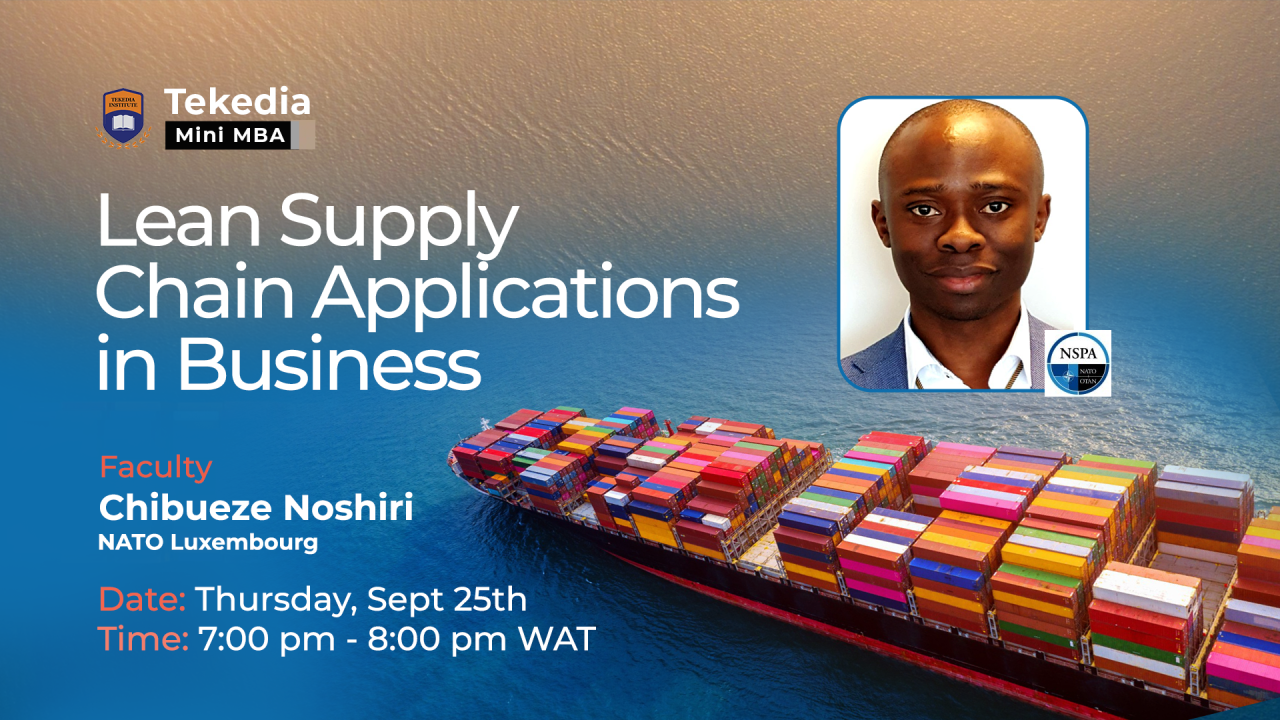
From NATO today, we will be learning from a zen-master of lean at Tekedia Mini-MBA.

Thur, Sept 25 | 7pm-8pm WAT | Lean Supply Chain Applications in Business – Chibueze Noshiri, NATO Luxembourg | Zoom link

Ethereum Price Forecast Eyes $7,500, But BlockDAG Hits Nearly 70% Of Its $600M Target: $1 Coming Soon?

0

Ethereum is still fighting to prove its strength, and even with an optimistic Ethereum price forecast, investors can see that progress feels slower than expected. Another of the so-called popular crypto coins shows hype but struggles to back it with consistent delivery. That leaves a real question: how long will holders wait for utility to catch up to price?

This is where BlockDAG becomes the stronger pick. Instead of relying on speculation or uncertain catalysts, the project has mapped out a clear $600M funding strategy to drive liquidity, real infrastructure, and sustainable demand. With a presale already passing $410M, BlockDAG is proving that scale and adoption can be engineered, not just hoped for. So while forecasts for other popular crypto coins keep holders guessing, BlockDAG is showing a pathway where a $1 target for BDAG isn’t a fantasy, it’s the outcome of careful planning and execution.

BlockDAG’s $600M Blueprint for a $1 Target

BlockDAG isn’t aiming for hype; it’s laying down a strategy designed to push BDAG toward $1. The project’s $600M presale goal isn’t just about raising capital; it’s structured to fuel CEX liquidity, build decentralized infrastructure, expand mining operations, and fund development grants. Each of these pillars directly boosts adoption, creates scarcity, and builds demand. Unlike many popular crypto coins that lean on speculation alone, BlockDAG is channeling presale money into real growth drivers that impact price sustainability.

So far, the presale has crossed $410 million, with roughly $40M added in the past month alone. This steady inflow signals not just confidence but also the strength of its roadmap. By distributing resources into liquidity pools and DePIN (Decentralized Physical Infrastructure Networks), BlockDAG ensures that when it launches on exchanges, there’s immediate depth and trading stability, a step often missing with other token launches.

Mining is another cornerstone. With over 20,000 X-Series hardware units sold across 130+ countries and 3 million users already mining through the X1 mobile app, BlockDAG is building a dual-layer validation system. This ensures decentralization while reinforcing the value of coins distributed during the presale. Holders benefit twice: early allocations in the presale and the prospect of securing future rewards via mining participation.

For anyone tracking the next wave of popular crypto coins, BlockDAG is currently available at a limited-time price of just $0.0016. The presale isn’t just funding development; it’s building the foundations for a coin that can scale and sustain a $1 price point. For early participants, the opportunity lies in buying into a system where the growth plan is already working in real time, not waiting for future promises.

Ethereum Price Forecast: Key Levels and Outlook

The latest Ethereum price forecast shows ETH trading in a tight zone just below resistance near $4,665. Analysts point to support levels around $4,520–$4,550, with deeper support near $4,370 if momentum weakens. On the upside, clearing resistance could drive ETH toward $4,820 and possibly $5,000 in the short term. Longer-term views differ: Citi projects $4,300 as a base case with upside potential toward $6,400, while Standard Chartered set a more bullish $7,500 year-end target.

Compared with other popular crypto coins, Ethereum’s story is different—it has institutional backing, high developer activity, and adoption through smart contracts. Still, even the most optimistic Ethereum price predictions depend on broader market conditions and usage growth across decentralized apps. For traders choosing between ETH and other major tokens, Ethereum remains one of the most traded and followed popular cryptocurrencies.

Summing Up

The current Ethereum price forecast highlights both opportunity and caution. Analysts note that ETH faces resistance around $4,665, with support zones near $4,520 and $4,370. While Citi has projected $4,300 as a base case with upside potential toward $6,400, Standard Chartered has gone further with a $7,500 target by year-end. These numbers show why Ethereum continues to rank among the most followed popular crypto coins, though its trajectory still depends heavily on macroeconomic conditions and network adoption.

BlockDAG, on the other hand, is building differently. Its presale has already passed $410M on the way to a $600M goal, with funds allocated to liquidity, decentralized infrastructure, mining expansion, and grants. Combined with a CertiK-audited EVM chain, 20,000 miners sold, and 3M active mobile miners, BlockDAG is creating an ecosystem where a $1 price isn’t speculation; it’s the outcome of clear planning. Unlike other popular cryptocurrencies, this project shows how scaling, demand, and utility can be engineered together.

Presale: https://purchase.blockdag.network

Website: https://blockdag.network

Telegram: https://t.me/blockDAGnetworkOfficial

Discord: https://discord.gg/Q7BxghMVyu

OpenAI, Oracle, and SoftBank Announce $400bn Expansion of U.S. AI Infrastructure Under Stargate Platform

0

OpenAI, Oracle, and SoftBank have unveiled five new large-scale artificial intelligence data center sites across the United States under Stargate, OpenAI’s flagship infrastructure program.

The announcement, which cements the consortium’s role at the heart of America’s AI race, pushes the initiative to nearly 7 gigawatts of planned capacity and more than $400 billion in secured investments over the next three years.

With this milestone, Stargate is now on course to meet—and possibly surpass—its $500 billion, 10-gigawatt target by the end of 2025, ahead of the original schedule announced in January.

Expansion Across Texas, New Mexico, the Midwest, and Ohio

In July, OpenAI and Oracle deepened their partnership with a deal to deliver up to 4.5 gigawatts of new capacity. That agreement, valued at over $300 billion across five years, marked one of the largest corporate partnerships in AI infrastructure to date.

As part of this phase, three sites have now been selected: Shackelford County, Texas; Doña Ana County, New Mexico; and a soon-to-be-announced Midwest location. Alongside a potential 600-megawatt expansion at the flagship Abilene, Texas, Stargate campus, these facilities are projected to add more than 5.5 gigawatts of compute power. Collectively, they are expected to generate over 25,000 direct onsite jobs and tens of thousands of additional roles in supporting industries nationwide.

Meanwhile, SoftBank will spearhead two additional projects. In Lordstown, Ohio, the Japanese conglomerate has already broken ground on what it calls an advanced data center design, expected to go live in 2026. Another site in Milam County, Texas, will be delivered in partnership with SB Energy, SoftBank’s renewable energy subsidiary, which is building the powered infrastructure to support rapid deployment. Combined, the SoftBank sites will add up to 1.5 gigawatts within 18 months, with room for multi-gigawatt scaling.

The five sites were chosen from more than 300 proposals submitted by over 30 U.S. states following a nationwide competition launched in January. The rigorous selection process prioritized scale, energy infrastructure, and speed to deployment. Officials say further U.S. sites will be announced in the coming months as the partnership accelerates beyond its $500 billion goal.

Oracle, which is delivering cloud infrastructure for Stargate, confirmed that its Abilene campus—already operational on Oracle Cloud Infrastructure (OCI)—is seeing rapid progress. The company began delivering NVIDIA’s GB200 racks in June, marking a major leap in AI computing.

OpenAI has since started running early training and inference workloads on the system, signaling that the infrastructure is already feeding into next-generation model development.

Leaders Emphasize Scale, Speed, and Access

OpenAI CEO Sam Altman described compute infrastructure as the “key” to ensuring AI delivers benefits at scale.

“AI can only fulfill its promise if we build the compute to power it. That compute is the key to ensuring everyone can benefit from AI and to unlocking future breakthroughs. We’re already making historic progress toward that goal through Stargate,” Altman said.

Oracle’s Clay Magouyrk highlighted the speed of deployment, saying: “Oracle’s reliable, scalable, and secure AI infrastructure is helping OpenAI rapidly scale its business. To meet this enormous demand, we continue to expand OCI’s footprint at an unrivaled pace to deliver the most performant and cost-effective AI training and inferencing.”

Backdrop of U.S. AI Industrial Strategy

The Stargate initiative was first unveiled in January at the White House alongside President Donald Trump, framed as a cornerstone of the Administration’s drive to expand U.S. AI infrastructure and compete globally. Administration officials have credited Trump’s industrial policy framework for accelerating both domestic investment and foreign partnerships in the sector.

With Oracle, SoftBank, and other partners, OpenAI is translating its $500 billion promise into large-scale physical infrastructure that brings jobs, regional development, and computing capacity critical to powering the next wave of AI breakthroughs.

Executives say Stargate is not just about meeting current AI demand but building the foundation for a trillion-dollar future where compute availability advances artificial intelligence to advance humanity.

“Stargate is harnessing SoftBank’s innovative data center design and energy expertise to deliver the scalable compute that powers AI’s future. Together with OpenAI, Arm, and our Stargate partners, we are paving the way for a new era where AI advances humanity,” SoftBank Chairman, Masayoshi Son, said.

Uber CEO Admits Self-Driving Cars Pose Job Threat to Drivers, Calls It a “Societal Question”

0

Uber CEO Dara Khosrowshahi has been blunt about what autonomous vehicles could mean for the millions of people who have built livelihoods on ride-hailing platforms.

Speaking at an All-In podcast summit, Khosrowshahi said human drivers will remain a major part of Uber’s network for the next five to seven years, but warned that “10 to 15 years from now, this is going to be a real issue,” adding that he has no “neat answer” for the social dislocation that could follow.

The company is already experimenting with autonomous options through partnerships such as its work with Waymo, but Khosrowshahi did not shy away from the human and political complexities ahead.

“For the next five to seven years, we’re going to have more human drivers and delivery people, just because we’re going so quickly,” he said. “But, I think, 10 to 15 years from now, this is going to be a real issue.”

He highlighted Uber’s efforts to create alternative on-demand work—labeling and other tasks to help train AI—as one way the company is trying to soften disruption, but acknowledged those roles require different skills than driving.

The Robotaxi Race: Who’s Launching, Who’s Partnering, and How They’re Trying to Scale

The industry is no longer hypothetical. Multiple firms are moving from labs and piloting to paying customers and app integration—often through deals with incumbent ride-hail apps—that aim to accelerate adoption while lowering unit economics.

Waymo, Alphabet’s autonomous-driving unit, is perhaps the farthest along in mainstream deployment. It now operates paid robotaxi services in several U.S. cities and has broadened coverage and product offerings aimed at business users, including a corporate bookings product that plugs Waymo into company travel programs. Waymo is expanding its footprint—now serving cities such as San Francisco, Phoenix, Los Angeles, Austin, and Atlanta—and completes more than a million autonomous rides per month, positioning itself as the most mature commercial robotaxi operator.

Rather than always building its own consumer brand, some AV developers are striking partnerships with large ride-hail platforms to gain immediate network scale. Waymo’s multi-city agreement to run its Waymo One fleet within the Uber app in selected markets is a clear example: Uber handles dispatching and payment while Waymo provides the fully driverless vehicles. That integration model lets robotaxi operators reach riders without having to build a consumer business from scratch.

Legacy automakers and start-ups have also formed alliances. Motional has run a long-standing commercial robotaxi service with Lyft, notably in Las Vegas, and maintains partnerships aimed at wider rollouts. The Motional–Lyft relationship exemplifies how AV companies are relying on incumbent ride-hail networks to reach real riders at scale.

New commercial tie-ups continue to surface. This month, a Lucid–Nuro–Uber arrangement took a visible step forward with the first delivery of a Lucid Gravity vehicle to be retrofitted for autonomous use, a milestone in plans to deploy thousands of robotaxis in the coming years under collaborations that involve vehicle makers, autonomy software firms, and ride-hail platforms. These industrial partnerships aim to solve manufacturing, retrofitting, and fleet economics in parallel.

Tesla remains a wild card. CEO Elon Musk has long promised a “robotaxi” future driven by Tesla’s Full Self-Driving (FSD) software. Tesla’s approach differs: instead of selling a standalone robotaxi fleet, Tesla plans a distributed model where consumer vehicles with FSD capabilities can be pooled as on-demand robotaxis. That model has sparked regulatory scrutiny and public confusion about what “robotaxi” means in Tesla’s terms—because many of Tesla’s public statements conflate supervised FSD features with fully driverless service.

Regulators have warned that supervised systems are not the same as true Level-4 robotaxis.

Risk, Regulation, and the Crash Test for Commercialization

Ambition runs headlong into regulatory reality. Cruise’s early charge into multiple cities and a rapid launch trajectory became a cautionary tale after safety incidents triggered permit suspensions and intense regulatory review. That episode showed how quickly public confidence and approvals can be jeopardized—forcing some operators to pause, re-test, and re-engage with regulators to restore trust and permissions.

Cities and state regulators are wrestling with how to certify and oversee robotaxis. Approvals vary widely across jurisdictions, and companies must navigate local requirements for testing, insurance, safety reporting, and human-supervision fallback strategies. That patchwork creates friction for scaling nationally and incentivizes partnership strategies—teaming with a local dispatch brand or proving reliability in a small set of cities first.

Even where regulators have green-lit services, city geography and user behavior shape the economics. Operators are focusing first on concentrated corridors—airport links, downtown commutes, and business travel—where predictable demand can be monetized while the systems accumulate safety data and learning. Waymo’s focus on airport connectivity and business accounts, for example, is a deliberate effort to capture high-value trips and predictable usage patterns.

Pilot data from commercial services suggest robotaxis can exceed many human drivers on efficiency metrics and utilization, but they still struggle with edge-case scenarios that human drivers manage easily—bad weather, unusual construction, and chaotic urban interactions. Some drivers told Business Insider they are skeptical that robotaxis can handle potholes and messy street conditions today; that skepticism helps explain why human drivers are not panicking yet. But efficiency gains from driverless fleets—if sustained—represent a structural pressure on labor economics for ride-hail platforms. (This dynamic was one of Khosrowshahi’s central points.)

What This Means for Uber and Drivers

For Uber, the short-term playbooks are straightforward: keep human drivers productive and pay them for demand that still requires human judgment; integrate robotaxi supply where regulators and partners allow; and expand alternative income streams on the platform (labeling, data work) to soften displacement.

“We’re expanding into other kinds of on-demand work as well to be able to adjust the kind of work available to people who want to earn on our own platform,” he said.

However, Khosrowshahi warned that there is no simple fix for the long run.

“This is a big, big societal question that we’re going to have to struggle with, and lots of others are going to struggle with too,” Khosrowshahi said.

In practice, that means Uber will run hybrid networks for years: human drivers handling most trips while robotaxis serve targeted corridors and scale gradually through partnerships (e.g., with Waymo) and vehicle supply deals. If robotaxis reach the scale their backers promise, the labor question moves from operational to societal—requiring public policy, reskilling programs, or new social supports to mitigate displacement.