DD
MM
YYYY

PAGES

DD
MM
YYYY

spot_img

PAGES

Home Blog Page 4550

Moralis CEO Believes Ethereum Could Hit $10K in 2023

0

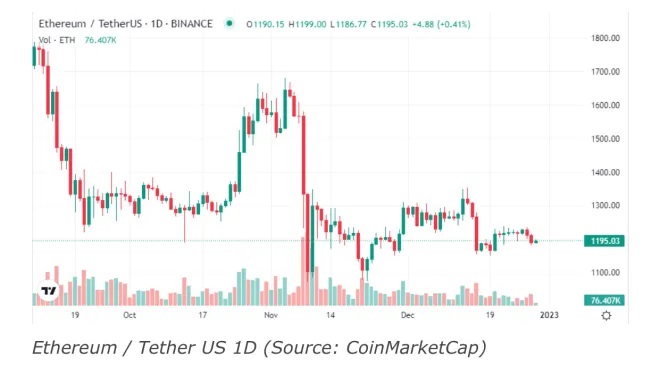
One of the cryptocurrencies in the red today is the biggest altcoin by market cap, Ethereum (ETH). According to the market tracking website CoinMarketCap, ETH saw a 0.08% drop in price over the last 24 hours and now trades at $1,194.81 after reaching a low of $1,185.70 over the same time period. The altcoin is also still in the red by about 1.55% over the last seven days.

The post Moralis Web3 CEO Believes Ethereum Could Hit $10K Very Soon appeared first on Coin Edition.

ETH did, however, strengthen against its biggest competitor, Bitcoin (BTC), by 0.48% since yesterday. Also in the red zone is ETH’s 24-hour trading volume which currently stands at $4,555,223,608 after a more than 3% decline. The altcoin’s market cap stands at $146,212,976,126.

About nine hours ago, the CEO and co-founder of MoralisWeb3 who goes by the name of Ivan on Tech, took to Twitter to ask the crypto community if they are still bullish on Ethereum (ETH). A few hours later, the CEO responded to his own tweet by confirming that he is, in fact, bullish on ETH. He even went as far as to say that he believes ETH could reach $10k very soon.

He also stated that he clings to this belief despite some of the criticism he has received for his opinion on ETH and its future performance.

The comments on his post mostly agreed with the fact that ETH has the potential to reach $10k, but many believe it might not happen as soon as the CEO believes it will.

Apparently, Ethereum’s energy consumption fell 99.99% following its merge to proof-of-stake. To people criticizing $ETH do you really think $BTC will become a global digital currency when energy consumption is just going to increase? Or followed the energy crisis in Europe?

NFTs enable creators to monetise their art and easily enter a global marketplace of collectors and traders. Whether they are on Bitcoin, Ethereum or any other chain, the underlying concept of digital collectables is not going away, Blockchain technology is harnessing the power of art.

Almost 1 Million Ethereum Were Sold by Whales, Causing Surge in Price

Meanwhile, Ethereum’s price performance in December was sad, to say the least. Poor fundamentals, a depressing macro situation on the market and a lack of network activity were the primary reasons behind the lack of momentum on the market.

However, the real reason might be far more prosaic after we take a look at whale wallets. According to the on-chain data, Ethereum whales who held up to 100,000 ETH have sold or moved up to 880,000 Ethereum since the beginning of this month.
At least part of that sum has most likely been sold on the market, corresponding to the selling pressure we witnessed on the market throughout the month.

Even though the trading volume on Ethereum has not been exceptional in December, with the poor liquidity on the market, even a selling pressure of 500,000 ETH would be enough to push the price of the second biggest cryptocurrency on the market below the $1,200 price level.

Another large contribution to the active redistribution of assets was part of the global trend of funds migration from centralized cryptocurrency exchange to self-custody.

Even though migration from exchanges to wallets is not associated directly with the selling activities, it could be a correlating factor, as some investors prefer liquidating their holdings rather than simply moving them to their own wallets.

As we mentioned above, the fundamental reason behind the plunging price of ETH could be tied to the decreasing network activity as more investors are leaving the industry for good, or at least until the market recovers.

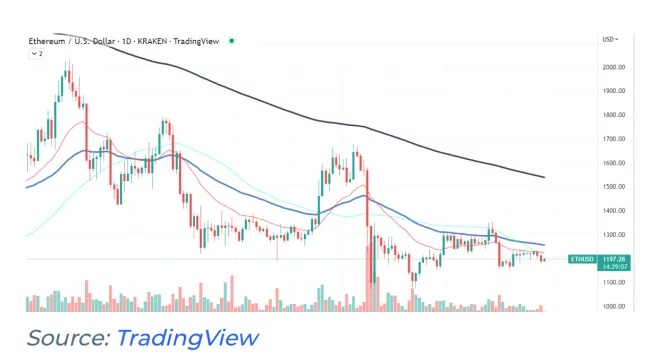
At press time, Ethereum is trading at $1,194, deliberately trying to hold the $1,200 price threshold, which acts as a platform for any move toward the next resistance.
Forecasters Predict Bitcoin price would surpass $600K if it matches Gold

0

Bitcoin (BTC) is due to copy gold’s explosive 1970s breakout as it becomes the world’s “hardest asset” in 2024. That was one forecasted from the latest edition of the Capriole Newsletter, a financial circular from research and trading firm Capriole Investments.

BTC is due to copy gold’s explosive 1970s breakout as it becomes the world’s “hardest asset” in 2024.

That was one forecasted from the latest edition of the Capriole Newsletter, a financial circular from research and trading firm Capriole Investments.

Bitcoin due big moves “and more” in 2020s

Despite BTC price action flagging at nearly 80% below its latest all-time high, not everyone is bearish about even its mid-term outlook.

While calls for a further drop before BTC/USD finds its new macro bottom remain, Capriole believes that 2023 will be bright for Bitcoin as a revserve asset.

The reason, it says, lies in the world economy’s financial history of the past century, and in particular, the United States after the dollar deanchored from gold completely in 1971.

Gold, as the world’s premier safe haven of the time, saw “huge” gains during the decade, and fifty years later, it is Bitcoin’s turn.

“Because gold was much smaller in the 1970s (and Bitcoin today is even smaller by comparison), it had capacity to make big moves through a decade of inflation and high interest rates,” Capriole wrote:

That’s one reason why we believe Bitcoin will do the same, and more, this decade.

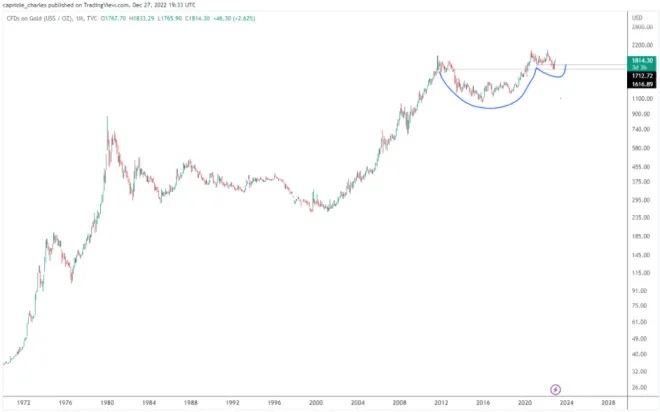
Accompanying charts underscored gold’s potential to repeat its 70s behavior, among which were a “cup and handle” chart structure playing out since 2010.

XAU/USD 1-month annotated chart. Source: Capriole Investments

When it comes to Bitcoin vying with gold for the safe haven crown, meanwhile, the potential lies in the numbers — at just 2.5% of gold’s market cap, BTC diving 80% from its $69,000 peak last year has little bearing on the overall picture.

“Given Bitcoin represents just 2.5% of gold’s market capitalization today, its 80% drawdown adds a mere 2% additional drawdown to the combined hard money (gold + Bitcoin) drawdown,” the newsletter continued.

Giving a total hard money drawdown of 24% through to November 2022, comparable with the 1970 and 1975 figures for gold.

Should the stage already be set for a Bitcoin copycat move of 70s gold, the growth potential is thus all the more impressive — even now, Bitcoin’s market cap is just 10% that of gold before its bull run of the time began.

“Bitcoin has more growth potential than gold because it is smaller. A like-for-like demand in both assets will result in a 40X greater price change for Bitcoin,” Capriole stated.

“The hardest asset in the world”

A further key argument echoed that long championed by commentators such as Saifedean Ammous in the popular book, The Bitcoin Standard.

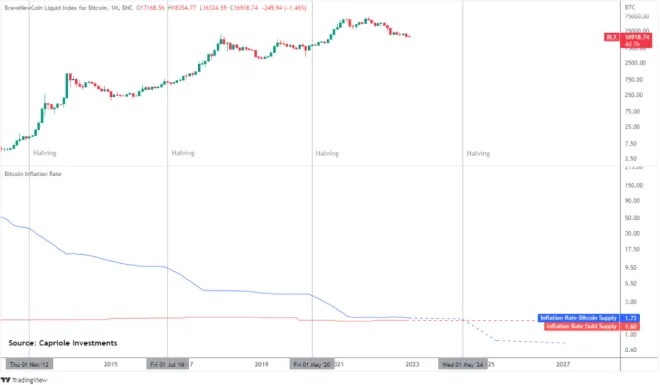
There, the debate focuses on investors’ shift to Bitcoin as its inflation rate drops below that of gold, increasing its monetary “hardness” versus the metal:

“There are many other attributes that make Bitcoin stand out from gold, such as its equitable decentralization, ability to transfer instantaneously and be used for micro-payments. But most importantly, Bitcoin is harder than gold.”

This, Capriole added, will confirm Bitcoin as “the hardest asset in the world” at its next block subsidy halving in 2024.

“All-in-all, gold went up 24X in the 1970s,” Capriole summarized:

“Now imagine the 2020s, where the Fed can’t afford to be as aggressive (debt is way higher today) and we have digital, accessible, harder money: Bitcoin.”

BTC/USD chart with Bitcoin, gold inflation rate data. Source: Capriole Investments

Is Pele a Nation or Global Legend?

0

Pele, Edson Arantes do Nascimento, died on December 29, 2022. According to various sources, he was born on October 23, 1940 in Três Coraçes, Minas Gerais, Brazil. While battling colon cancer, he was covered by several media outlets around the world and discussed by individuals and organizations on various digital platforms and in physical settings. Using Pele as a keyword for navigational search on Google yields approximately 270 million results, with the majority of publications focusing on his life times and death period, as of the time of writing this piece.

Aside from the mainstream news media, creative industry players have also curated a number of his activities on pitches and in general administrations for public consumption. Our investigations reveal that the public has been flooded with stories about how he helped some countries during their political crises, as well as how he supported the less fortunate in his immediate communities and beyond. For example, Netflix already has a film about his football career.

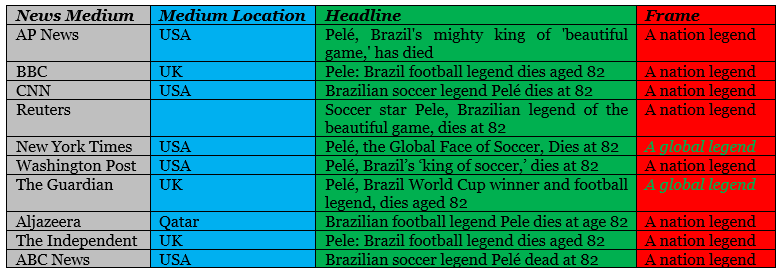
Exhibit 1: Select news media and their respective frames

Source: Media Organisations, 2022; Infoprations Analysis, 2022

Meanwhile, the purpose of this piece goes beyond explaining his life and achievements as reported in the media. The piece looks at how the “King of Soccer” was portrayed in the global media in the days leading up to his death. The selection and examination of prominent news organizations from the global north and south reveals that AP News, BBC, Reuters, Washington Post, Aljazeera, The Independent, and ABC News portrayed him as “a nation legend” rather than “a global legend” in their early reports. According to research, The New York Times and The Guardian, both based in the United States of America and the United Kingdom, regarded him as “a global legend.”

Based on the emerging insights, our analyst concludes that it is obvious that international media, such as those chosen for analysis, may create a “backward frame” when the death of an acclaimed international icon occurs in contrast to a “forward thinking frame”. When natural disasters occur, our analyst believes that “backward framing” occurs when media organizations and their employees fail to repeat previously held framing patterns of a specific person or organization. Those who used the “forward frame” by portraying him as “a global legend” solidify their previous belief that he was truly “a king of soccer.”

Turkey’s Central Bank has Completed Trial for CBDC Roll-out

0

The Central Bank of the Republic of Turkey (CBRT) has completed the first trial of its central bank digital currency (CBDC), the Digital Turkish Lira, and has signaled plans to continue testing throughout 2023.

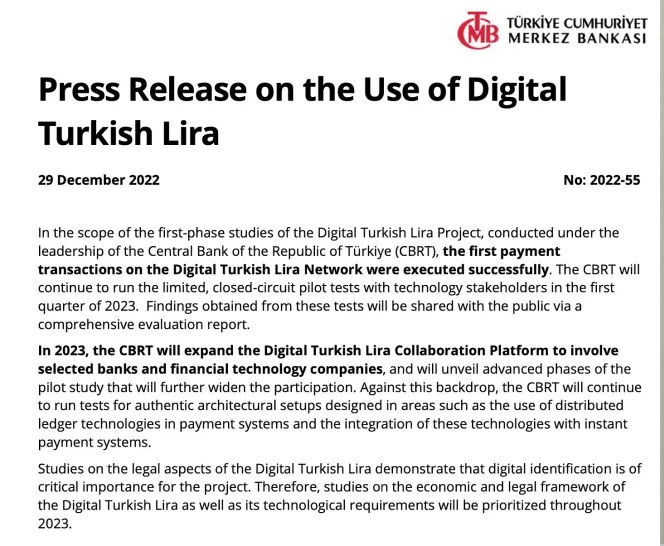
According to a statement released by the CBRT on Dec. 29, the central bank authority said it successfully executed its “first payment transactions” using the digital Lira.

It said it will continue to run limited, closed circuit pilot tests with technology stakeholders in the first quarter of 2023, before expanding it to include selected banks and financial technology companies in the rest of the year.

The Turkish central bank first announced it was looking into the benefits of introducing a digital Turkish Lira in Sept. 2021 in a research project called “Central Bank Digital Turkish Lira Research and Development.”

At the time, the government made no commitment to the ultimate digitalization of the country’s currency, noting it had “made no final decision regarding the issuance of the digital Turkish lira.”

In its most recent statement, the CBRT said it will continue testing the use of distributed ledger technologies in payment systems and their “integration” with instant payment systems.

It will also prioritize studying the legal aspects around the digital Turkish Lira, such as the “economic” and “legal framework” around digital identification, along with its technological requirements.

Several countries, including the United Kingdom and Kazakhstan, have recently begun piloting central bank digital currencies.

Relatively, China’s wallet app for its digital yuan central bank digital currency (CBDC) introduced a feature for users to send money in an electronic version of traditional “red packets”.

The Bank of England has opened applications for a proof of concept for a CBDC wallet, while the Kazakhstan central bank has recommended the introduction of an in-house CBDC as early as 2023with a phased implementation over three years.

The Reserve Bank of Australia (RBA) recently expressed hesitation about its own CBDC plans, with assistant governor Brad Jones warning in a speech on Dec. 8 that a CBDC could displace the Australian dollar and lead to people avoiding commercial banks entirely.

Cash-flow Management and How to Overcome Cash-flow Trap

0

Capital is an important factor of production; it is inevitably required to drive the strategy and success of a business or any creative enterprise. Hence, it is no brainer why most companies tend to prioritize cash flow among other things. However, too much emphasis on cash flow can be counterproductive to the business.

Cash flow is to the business what blood is to the body system. For instance, an injury in any part of the body preventing proper flow of blood through that area can have a ripple effect on the entire body system. Likewise lack of proper cash flow to adequately fund the execution of the marketing plans of a business will affect sales performance and this may result in employee demoralization due to delayed remuneration.

Cash flow is like a heavy rain; when proper channels are not created for the waters to flow through, problems such as erosion or flood may develop, therefore causing the environment to be inhospitable to the plants, animals or humans that are supposed to flourish or grow in that environment.

Many small businesses have failed not necessarily because of a lack of cash flow but due to cash flow trap. Cash flow trap entails a false consciousness that a business is doing well due to massive inflow of cash or funds from shareholders’ investments. This kind of mindset reinforces a lavish tendency of small business leaders. Usually, it is lack of clarity or inability of the business owners to distinguish between profit and cash flow that subjects them to the cash flow trap.

Therefore, Cash flow management is an essential skill for business managers to lead a successful business. Central to cash flow management is financial literacy which is the ability to read numbers and make business decisions based on numbers or data or facts. ‘’The ability to run a company from the financial statement is one primary difference between a small business owner and a big business owner’’ argues Robert Kiyosaki in his Rich Dad financial handbook entitled, Fire Yourself.

The following are recommended cash flow management tactics and how they can impact the financial performance of a business:

  1. Reviewing the business cash position daily and considering the business cash needs and sources for the week, month or quarter ahead allows managers to plan for any large cash need before it becomes a cash crisis.
  2. For businesses at the initial startup stage, practicing delayed gratification such as delaying personal rewards or making expenses that could wait until the business generates cash flow from sales helps to avoid overdependence on shareholders’ investment.
  3. Positioning the business for a multiple source of income through intrapreneurship fosters more creativity and liquidity.
  4. Ensuring a easy but secure payment system increases conversion rate
  5. Having investment plan for the cash at hand helps to maximize its earning potential
  6. Establishing good internal controls on the handling of cash averts leakages and shrinkages.

Regarding internal cash control, Robert kiyosaki suggested the following:

  • The people who record the cash receipts on the bank deposits should be different from those who post it to the accounts receivable and general ledger.
  • Also, the people authorized to sign checks should not prepare the vouchers or record the disbursements and post to the accounts payable and general ledger.
  • The person who reconciles the bank statement should have no regularly assigned functions related to cash receipts or cash disbursements.