DD
MM
YYYY

PAGES

DD
MM
YYYY

spot_img

PAGES

Home Blog Page 456

Rainbow Wallet’s $RNBW Token Launch As Coinbase’s Mag7 + Crypto Equity Index Futures Launch

0

Rainbow, a popular non-custodial Ethereum wallet known for its user-friendly interface and support for NFTs and DeFi, officially announced the launch of its native token, $RNBW, slated for Q4 2025.

This confirmation ties directly into Rainbow’s existing points program, which was introduced in December 2023 to reward users for activities like token swaps and wallet interactions—points that will convert into $RNBW tokens.

Token Generation Event (TGE) is expected in Q4 2025, with approximately 20% of the total supply released into circulation at launch. $RNBW will power new features like perpetual futures trading via a partnership with Hyperliquid and a gamified “King of the Hill” daily token experience to boost in-wallet activity.

Alongside the token reveal, Rainbow rolled out Phase 3 updates, including real-time pricing, instant balance refreshes, live candlestick charts, and expanded EVM network support in its in-app browser.

New users can still participate by downloading the wallet mobile or browser extension, importing an existing EVM wallet, applying a referral code for a 10% points boost, and performing swaps (e.g., at least $100 for bonus points). Invites and daily activity further increase earnings.

This move follows similar token teases from competitors like MetaMask and Rabby, signaling a broader trend of wallet providers tokenizing to enhance user incentives and ecosystem growth. Rainbow, backed by $19.5 million in funding, positions $RNBW as a tool for rewarding “fun onchain” experiences.

Coinbase’s Mag7 + Crypto Equity Index Futures

Coinbase Derivatives launched the Mag7 + Crypto Equity Index Futures—the first U.S.-listed derivatives product to bundle exposure to major tech equities and cryptocurrency ETFs in a single contract.

This hybrid instrument targets institutional investors seeking efficient hedging and diversified bets across traditional finance (TradFi) and crypto, addressing a long-standing gap in multi-asset derivatives.

Monthly, cash-settled futures with a notional value of $1 × the index price (e.g., $3,000 index = $3,000 contract). Quarterly rebalancing ensures alignment with market shifts, with MarketVector as the index provider.

Initially available on partner platforms for institutions; retail expansion planned soon. The launch coincides with rising institutional crypto interest and Big Tech’s alignment with risk-on sentiment, potentially boosting crossover trading volumes. It’s regulated under CFTC oversight with segregated accounts for compliance.

This product underscores Coinbase’s push into equity-linked derivatives, blending innovation sectors like AI-driven tech and digital assets into one efficient tool— a step toward seamless TradFi-crypto integration.

With features like Hyperliquid-powered perpetual futures and the “King of the Hill” gamified token game, $RNBW positions Rainbow as a “fun on-chain” hub, potentially boosting daily active users (DAUs) by 20-30% pre-TGE through referrals and activity multipliers.

However, it raises eligibility concerns—users must maintain transaction histories for point verification, and final tokenomics could dilute rewards if supply balloons. As an infrastructure play, $RNBW could enhance liquidity in EVM ecosystems by tying rewards to DeFi and NFT interactions, capitalizing on expected Q4 market recoveries.

Yet, recent drama, like the rejected acquisition of Clanker protocol offering 4% of $RNBW supply, highlights integration risks, sparking Base ecosystem volatility and ethical debates on DeFi mergers.

$RNBW could solidify Rainbow’s edge in user experience, but success hinges on transparent distribution and seamless app upgrades to avoid alienating its 1M+ user base.

Implications of Coinbase’s Mag7 + Crypto Equity Index Futures

Coinbase’s debut of the Mag7 + Crypto Equity Index Futures—the first U.S.-listed derivative blending “Magnificent 7” tech stocks, COIN shares, and BlackRock’s IBIT/ETHA ETFs—ushers in hybrid multi-asset trading, enabling institutions to hedge or speculate on tech-crypto convergence with a single, cash-settled contract 10% weighting per asset, quarterly rebalanced by MarketVector.

This $1x index notional (e.g., $3,000 at launch) addresses a key gap in fragmented markets, where 86% of institutions seek diversified crypto exposure but face operational hurdles. With a low 0.52 correlation between equities and crypto, the index offers a Sharpe ratio of 1.45 (vs. S&P 500’s 0.17), allowing efficient hedging—e.g., a 75/25 equity/BTC mix historically outperforms during stress.

It democratizes access for retail phased rollout post-institutional while providing leverage up to 10x, potentially drawing $5B+ in daily volumes by amplifying liquidity across TradFi and crypto. By including regulated ETFs, it legitimizes crypto as a core portfolio staple, aligning with rising institutional bets 59% allocating >5% AUM to digital assets.

Coinbase’s CFTC compliance and segregated accounts mitigate risks, positioning it as an “everything exchange” amid acquisitions like Deribit—though basis risk between ETFs and spot prices could widen in volatility spikes. The product could catalyze capital inflows to both sectors, boosting COIN’s valuation 10% weighting and ETF volumes, while signaling regulatory maturity.

However, it exposes users to amplified losses (e.g., 10% index drop = $300/contract hit) and policy shifts, like SEC tweaks to crypto ETFs. In essence, this futures product accelerates crypto’s mainstream integration, potentially reshaping $100T+ derivatives markets, but demands savvy risk navigation amid its innovative hybrid nature.
Kraken Partners with Legion to Launch Yield Basis (YB) Token Sale

0

Kraken, a major cryptocurrency exchange, has announced the debut of its new token launch platform, Kraken Launch, with the first project being Yield Basis (YB), a Bitcoin-native yield protocol created by Michael Egorov, the founder of the DeFi protocol Curve Finance.

The partnership involves Legion, a reputation-based access platform for token distributions, to ensure a fair and merit-based allocation process. Kraken Launch aims to provide users with early, compliant access to token sales in a transparent manner. This is the inaugural offering on the platform.

The YB sale will occur in two phases: Phase 1 is reserved for users with high Legion Scores a reputation metric, allocating about 20% of the supply. Phase 2 is open to all eligible Kraken users. YB tokens are expected to list on Kraken shortly after the sale, providing immediate liquidity.

Total supply is capped at 1 billion YB tokens, with 300 million in initial circulation. Yield Basis is designed to generate BTC-native yields through a fee-driven model on Ethereum, building on Curve’s automated market maker (AMM) architecture.

Automated Re-Leveraging maintains liquidity provider (LP) exposure aligned with underlying BTC assets, minimizing impermanent loss from AMM curvature risks. Locked veYB vote-escrowed YB tokens govern emissions and earn a share of protocol fees via a dynamic admin fee minimum ~10%, up to 100% based on LP opt-ins.

Approved by Curve DAO for a $60 million crvUSD credit line to seed three Bitcoin liquidity pools each capped at $10 million. This ties YB’s growth to Curve’s stablecoin ecosystem, with 35–65% of revenue shared with veCRV holders and 25% reserved for the Curve ecosystem.

This move comes amid Curve’s efforts to enhance CRV tokenomics through revenue-sharing, following Egorov’s proposal on September 17, 2025, to transform governance tokens into yield-bearing assets. The launch highlights growing demand for on-chain Bitcoin liquidity strategies.

Yield Basis introduces a novel way to generate BTC-native yields on Ethereum using Curve’s AMM infrastructure. This could drive greater adoption of Bitcoin in DeFi by enabling holders to earn sustainable yields without relying on volatile, high-risk strategies.

The protocol’s automated re-leveraging and dynamic fee structure 10–100% admin fees aim to minimize impermanent loss and provide stable returns, appealing to institutional and professional traders seeking low-risk BTC exposure.

By integrating with Curve’s $60 million crvUSD credit line and sharing revenue with veCRV holders, Yield Basis strengthens Curve’s ecosystem while competing with other Bitcoin-focused DeFi protocols (e.g., Aave, MakerDAO) for liquidity and user attention.

Kraken Launch’s use of Legion’s reputation-based scoring for Phase 1 allocations promotes merit-based access, potentially reducing bot-driven or whale-dominated token sales. This could set a precedent for equitable token distribution in the industry.

By offering early access to high-potential projects like YB, Kraken strengthens its position as a leading exchange for both retail and institutional users, competing with platforms like Binance Launchpool or Coinbase.

Yield Basis’s integration with Curve, including the 35–65% revenue share with veCRV holders and 25% allocation to Curve’s ecosystem, enhances CRV’s tokenomics. This aligns with Egorov’s vision to transform governance tokens into yield-bearing assets, potentially increasing CRV’s value and utility.

The allocation of 3% of YB tokens for Curve voting reserves suggests ongoing collaboration, giving Curve DAO influence over Yield Basis’s development and potentially aligning the two protocols’ long-term goals.

Yield Basis’s focus on professional traders and institutions, combined with its low-risk yield model, could attract traditional finance players to DeFi, especially as Bitcoin remains a preferred crypto asset for institutions.

Yield Basis’s success depends on effective management of liquidity pools and fee distribution. Any technical issues or mismanagement could undermine confidence in the protocol.

As a BTC-focused protocol, YB’s performance is tied to Bitcoin’s price stability and DeFi market conditions, which could impact yields and adoption. Other DeFi platforms offering Bitcoin yield strategies may challenge Yield Basis’s market share, requiring differentiation through innovation or partnerships.

The Kraken-Legion-Yield Basis partnership marks a significant step in integrating Bitcoin with DeFi, enhancing Curve’s ecosystem, and establishing Kraken as a player in token launches. It could drive institutional adoption, improve token sale fairness, and set new standards for yield-generating protocols.

Quantum Threats to Bitcoin: How the Crypto World Prepares for a Post-Quantum Future

0

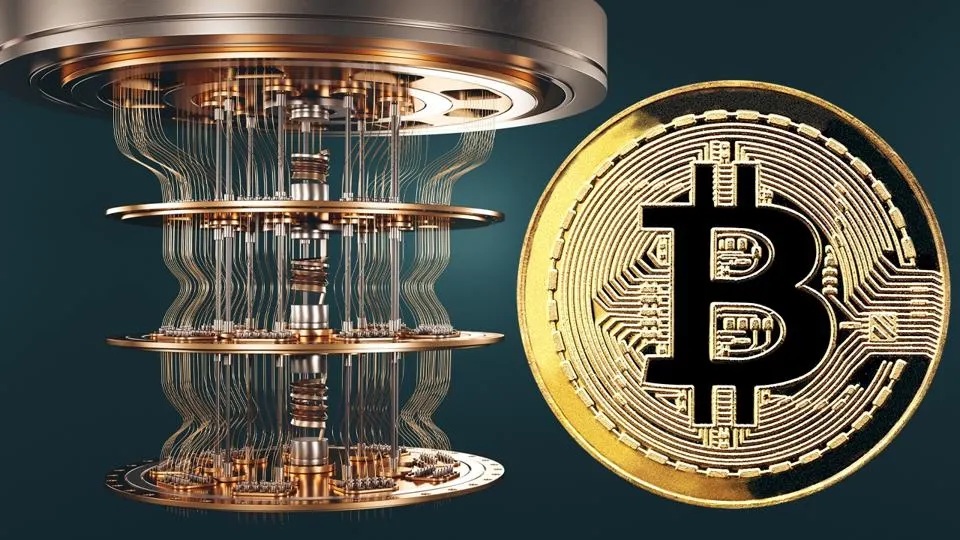
The rise of quantum computers will one day threaten Bitcoin’s cryptographic core. Researchers now think the danger — once a textbook idea — appears to be real. Studies point to technical obstacles that prevent a full attack. Meanwhile, proposals range from larger keys to alternative algorithms, trying to keep blockchain safe for users and developers for the future.

Most experts agree that Bitcoin’s elliptic?curve signatures may be at risk from quantum computers. A 2017 Roetteler study suggests that solving a 256?bit curve could need a quantum circuit whose cost grows roughly with the cube of the key size.

At a time when the price of Bitcoin is consistently above $100,000, IBM says it’s moving fast toward quantum fault tolerance. In its 2025 roadmap, the company introduced a plan called Starling, which may become operational by 2029. Starling is expected to hold about 200 logical qubits and to run 100 million quantum gates.

This sounds impressive, but the real twist lies in its error?correction method. Instead of the surface codes requiring thousands of physical qubits for each logical one, IBM appears to favor quantum Low Density Parity Check codes. These reportedly cut the physical qubit demand by as much as 90%.

Experts can’t agree on when Q?Day will arrive. Some mention 2027?2030. IBM’s plan outlines a “Starling” chip with about 200 logical qubits by 2029, and a stretch goal of roughly 1,000 logical qubits early in the 2030s.

Those figures are still likely below what’s needed to break Bitcoin security, but the progress appears to concern segments of the crypto world. As a result, migration ideas are starting to spread among developers and investors. This debate has already spilled into the broader crypto market, where XRP price performance — often viewed as a bellwether for investor sentiment in alternative assets — reflects both optimism about blockchain resilience and nervousness over the quantum threat.

How Cryptocurrencies Plan to Adapt

The crypto world already discusses concrete solutions. One of the plans, the Post?Quantum Migration and Legacy Signature Sunset BIP, is based on three steps. First, it would block new trades to at?risk addresses. Next, it would abandon old signatures after a short grace period. Finally, a recovery option could exist for stuck coins.

Another idea, QRAMP, would mandate transferring the funds from ECDSA locations to quantum?safe ones under community deadlines.

Switching Bitcoin to post?quantum safety may not be smooth. In a study published by Cornell University, Jamie J. Pont suggests at least 76 days of overall downtime, which seems costly for worldwide finance.

If the network can’t agree, compatibility issues might trigger splits or forks. The following table shows the actions required for a transition to post-quantum security.


Target audience


Recommended actions


Individual BTC holders

?     Migrate funds to new or quantum-resistant addresses immediately

?     Choose wallets or services implementing hybrid or PQC signatures

Developers / Wallet providers / Exchanges ?     Deploy PQC signature support and new address formats

?     Evaluate PQC schemes on the testnet for compatibility and performance


Bitcoin Community & Protocol Maintainers

?     Establish a clear migration timeline with milestones and deadlines

?     Maintain backward compatibility and smooth transitions to prevent fund loss

?     Educate all stakeholders including miners, node operators, wallet developers, and end-users


The threat quantum computers bring to Bitcoin, that once seemed far off, now feels more immediate. Ignoring this could cost a lot and damage trust in the overall crypto system. Still, solutions exist — post?quantum encryption and phased migration plans are already being developed. Coordinating a swift, well?timed, collective, global effort across multiple stakeholder groups remains the main issue.

Preparing for Q4’s Crypto Bull Market – Here Are 3 High-Potential Tokens Not to Miss

0

Missed the 2021 bull market and didn’t catch the explosive Cardano price rally or the meteoric Dogecoin price rise? Q4 2025 is gearing up for a parabolic run. With most top cryptos going at a discount and new ones emerging, the three best altcoins to invest in now are DOGE, ADA and Digitap ($TAP). $TAP, standing at the crossroads between DeFi and TradFi, is a must-have at $0.012.

Digitap ($TAP): Is it Among the Hidden Crypto Gems of 2025?

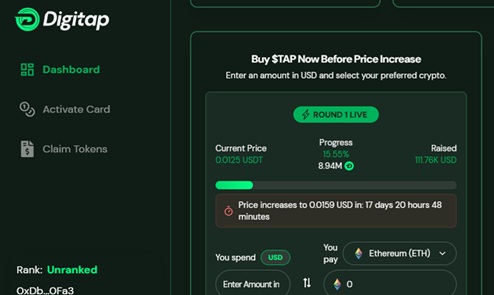
Compared to ADA and DOGE, Digitap ($TAP) is under the radar. In other words, a hidden crypto gem. As an emerging cryptocurrency, it isn’t as popular, although that is where the real gains are. Additionally, it represents the best of the worlds of decentralized finance and traditional finance, setting it up to explode in the future.

In the first round of the presale, investors have the opportunity to become early adopters of what has been dubbed the future of money and finance. At $0.012, investors are buying at the ground price ahead of the increase to $0.015 in the second ICO round. Hailed as the next 100x DeFi gem, early funding surpassing $160,000 in record time isn’t surprising.

It stands out even more as the world’s first omni-bank, positioning it as a must-have this year. A unique offering of this global payment platform is its combination of speed, privacy and trust in one app. Hence, experts have hailed it as “the last money app you’ll ever need.” Users requiring no KYC before transaction and its near-zero fee make it an undisputable leader in the PayFi revolution.

For Info about $TAP, visit Digitap.app Presale or Join the Community

Is Investing at the Current Cardano Price a Smart Choice?

According to CoinMarketCap data, the Cardano price is down by 73% from its 2021 all-time high of $3.10. Hence, buying at the current price of $0.82, investors are positioned for a 4x gain if it breaks out above its current all-time high.

Meanwhile, according to Messari, mindshare is at 0.5% after surging by 65% over the past week. This on-chain metric highlights the amount of social attention being received by ADA, which could be a bullish catalyst for the Cardano price.

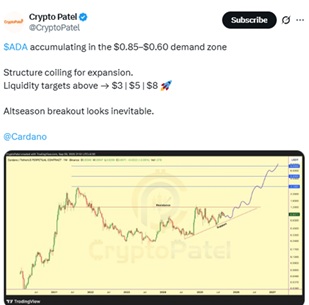
At the same time, according to CryptoPatel’s bold Cardano price prediction, the altcoin is poised for expansion, targeting $3, $5 and $8 this altseason. With a parabolic run expected in Q4, ADA is among the top cryptos to invest in.

Can the Dogecoin Price Break Past $1 and Outperform Other Memes?

The Dogecoin price reached $0.73 during the 2021 bull market, according to CoinMarketCap. This cycle, it could soar even higher, with experts advising investors to “lock in” this Q4. While it currently hovers around $0.24 following a 40% gain on the 90-day chart, investors should watch out for bigger moves.

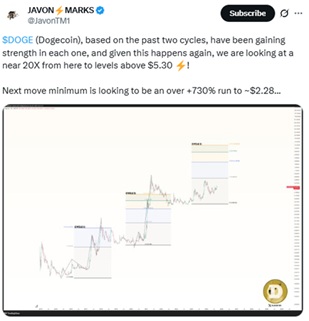
A projected rally past the $1 mark is perhaps the most common Dogecoin price prediction for this cycle. However, a bolder DOGE forecast is by Javon Marks. According to them, the dog-themed cryptocurrency has been gaining strength in each cycle and could soar as high as $5.30 this cycle, with $2.28 identified as a conservative target.

While the above might sound ambitious, the crypto market has continually surpassed expectations. Set to maintain its dominance above other memes, investing at the current Dogecoin price is lucrative, even if not as promising as the new DeFi-TradFi coin, Digitap.

DOGE vs. ADA vs. TAP

Ahead of the expected explosive market rally in Q4, the three high-potential altcoins worth betting on are DOGE, ADA, and $TAP. The Dogecoin price and Cardano price are expected to surpass previous highs, being among the top altcoins. Meanwhile, Digitap has been dubbed the next 100x gem due to its blend of traditional banking and DeFi.


Digitap is Live NOW. Learn more about their project here:

Presale: https://presale.digitap.app 

Social: https://linktr.ee/digitap.app

GTCO Reports N601 Billion Pre-Tax Profit in H1 2025, Declares N1.00 Interim Dividend

0

Guaranty Trust Holding Company Plc (GTCO) has published its audited half-year results for the period ended June 30, 2025, posting a pre-tax profit of N601 billion, down significantly from the N1 trillion recorded in H1 2024.

Profit after tax came in at N449.01 billion, less than half of the N905.57 billion earned in the corresponding period last year.

The Board nevertheless approved an interim dividend of N1.00 per share, unchanged from H1 2024. Payment will go to shareholders on record as of October 7, 2025.

Earnings Profile: Shift Toward Securities

GTCO’s gross earnings remained above N1 trillion despite the fall in profits, recording N1.073 trillion in H1 2025. The main driver was interest income, which jumped 71% year-on-year to N812.36 billion, expanding its share of gross earnings to 76%, compared with 44% in H1 2024.

Within that, interest income from securities surged 44% to N375 billion, overtaking income from loans and advances, which grew 22% to N299.63 billion. Securities now account for 35% of gross earnings, compared with 27% from loans, a striking shift for a group historically seen as a loan-driven institution.

Geographically, N256 billion of interest income was earned outside Nigeria, highlighting the growing relevance of GTCO’s international operations to its overall performance.

Cost Structure and Margins

Interest expenses rose sharply by 43% year-on-year to N154 billion, largely from customer deposits, which accounted for N147 billion. Yet costs amounted to just 18% of total interest income, preserving a strong spread. This helped push net interest income to N632.24 billion, up nearly 29% from last year.

Impairment charges climbed to N54.97 billion from N47.41 billion a year earlier. The bulk came from Stage 2 loans (N58.89 billion), suggesting increased caution over credits showing early signs of stress. A modest N4.27 billion write-back on Stage 3 loans softened the impact. After provisions, net interest income rose nearly 30% to N577.67 billion, evidence of resilient risk-adjusted performance.

Non-Interest Income

GTCO generated N151.46 billion in fee and commission income, up 33% year-on-year, though with uneven contributions:

  • Electronic banking income fell to N28.61 billion (down 12%).
  • Commission on touch points surged 617% to N24.78 billion.
  • Account maintenance fees climbed 12% to N17.58 billion.

This indicates that while digital channel fees came under pressure, traditional and point-of-service banking delivered a meaningful uplift.

Balance Sheet Strength

Customer deposits grew 19% to N11.878 trillion, accounting for 71% of total assets, which expanded 13% to N16.692 trillion. Loans and advances to customers increased 21% to N3.358 trillion, showing the bank is still expanding credit selectively. Cash and cash equivalents stood at N4.786 trillion, broadly stable.

GTCO shares have gained 63.2% year-to-date, closing at N90 per share on September 23, 2025. Investors appear focused on the group’s strong margins, balance sheet expansion, and steady dividend, rather than the sharp year-on-year earnings decline.

Analyst Outlook: What the Numbers Mean

GTCO’s results reveal a strategic pivot. The heavier reliance on securities income indicates the group may be prioritizing capital preservation and predictable yields over aggressive loan expansion amid economic uncertainties. Securities, often less risky than lending, have cushioned profitability in a challenging credit environment.

The shift, however, raises two questions. First, can GTCO maintain loan book growth at 20.5% without allowing impairment charges to escalate? The increase in Stage 2 provisions suggests early caution signs, though overall credit quality remains contained. Second, can the bank continue to generate above-market spreads when interest costs are rising at over 40% year-on-year?

On the positive side, GTCO’s N1.00 interim dividend underscores confidence in its capital buffers and future cash flow, despite lower profits. This could be interpreted as a bid to reassure investors during an earnings downcycle.

Comparatively, the group remains one of the best-capitalized banks in Nigeria, with its N90 per share valuation supported by robust asset growth and fee-based income expansion. Against peers like Zenith and Access, GTCO’s strategy of tilting toward securities and international operations could reduce earnings volatility, though at the cost of lower headline profits compared to the extraordinary H1 2024.

However, GTCO’s H1 2025 results paint a picture of a bank adapting to tighter economic and credit conditions. Profitability may have fallen by more than half, but the underlying performance — strong net interest income, disciplined cost management, stable impairments, and double-digit balance sheet growth — suggests the group remains resilient.

For investors, the key watchpoints over the next six months will be whether GTCO can sustain loan growth without asset quality deterioration, manage rising funding costs, and continue balancing securities income with core lending. If it succeeds, the stock’s strong rally could find further support, even as the broader sector grapples with macroeconomic headwinds.