DD
MM
YYYY

PAGES

DD
MM
YYYY

spot_img

PAGES

Home Blog Page 4565

What Does it Mean to Replace Manifestos with Blackboards in Nigerian Presidential Election?

0

Eligible Nigerian voters have 60 days, 20 hours, 59 minutes, and 54 seconds to cast their votes at various polling places. In the past 90 days, they have received a variety of messages from political parties, candidates, and their supporters despite the release of manifestos in piecemeal. It was done in piecemeal because not all of the major presidential candidates released their manifestos at the start of the campaign. Instead, they relied on algorithmisation campaign strategy, which allows them to leverage supporters who are not members of their parties for soft campaign messages aided by emerging technologies such as social networking sites.

Regardless of the delay in releasing manifestos, a day has never passed without public affairs analysts, social commentators, social influencers, activists, and media practitioners expressing their opinions on the composition and implementation of the manifestos. Mr Ayodeji Bakare of the Global Good Governance Initiative, Abuja, recently presented the results of his critical comparative analysis of the manifestos of the main contenders; Senator Bola Ahmed Tinubu, Alhaji Atiku Abubakar, and Mr Peter Obi. He determines the candidates’ plans for addressing problems and challenges as well as providing citizens with public services using a 5-power ranking meter scale (see Exhibit 1).

Exhibit 1: Power ranking meter of candidates’ manifestos
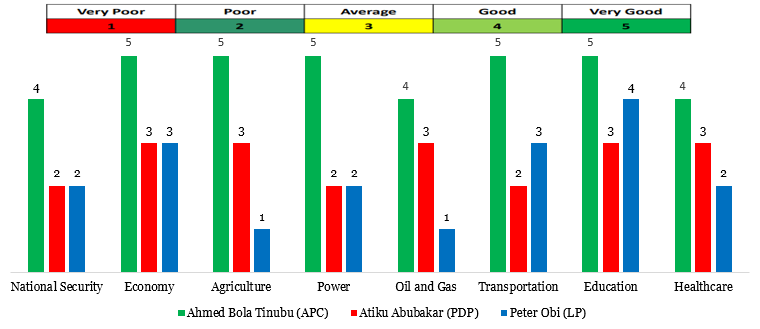
Source: Ayodeji Bakare of the Global Good Governance Initiative, 2022; Infoprations Formulation, 2022

His analysis and the recapitulation analysis performed by our analyst indicate that only the approaches or means of carrying out the declared programmes and/or policy directions of the major contenders are “better” for education, economy, and transportation. This conclusion was drawn because education (12), the economy (11) and transportation (10) received the highest scores out of a possible 15 for each of the areas identified by Mr. Bakare (after combining all the manifestos). Oil and gas, national security, agriculture, power, and healthcare had less than 10 points each.

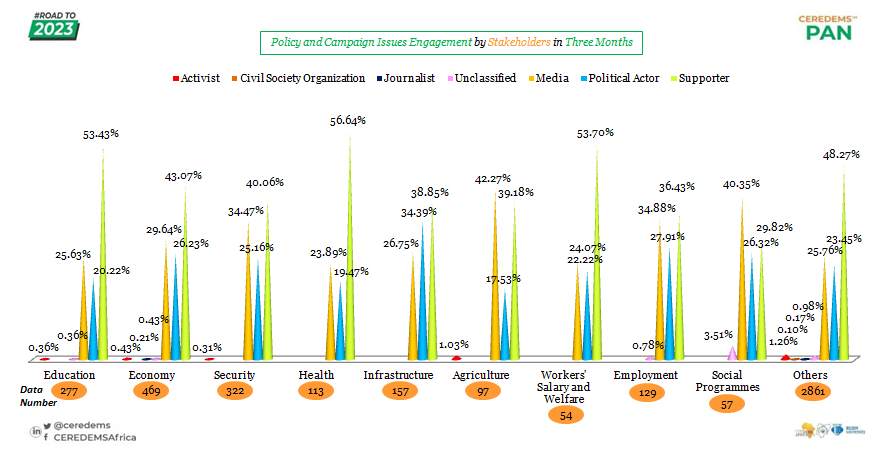
The examination of the ongoing results of monitoring of campaign activities by the Center for Research on Development of African Media, Governance, and Society (CEREDEMS Africa) and the Positive Agenda Nigeria along with Mr Bakare’s outcome indicates that political actors hardly engage the public on the areas and/or sectors that lack appropriate ways of addressing identified national challenges and providing the needed public services (see Exhibit 2 and 3).

Exhibit 2: Policy and campaign issues by political party
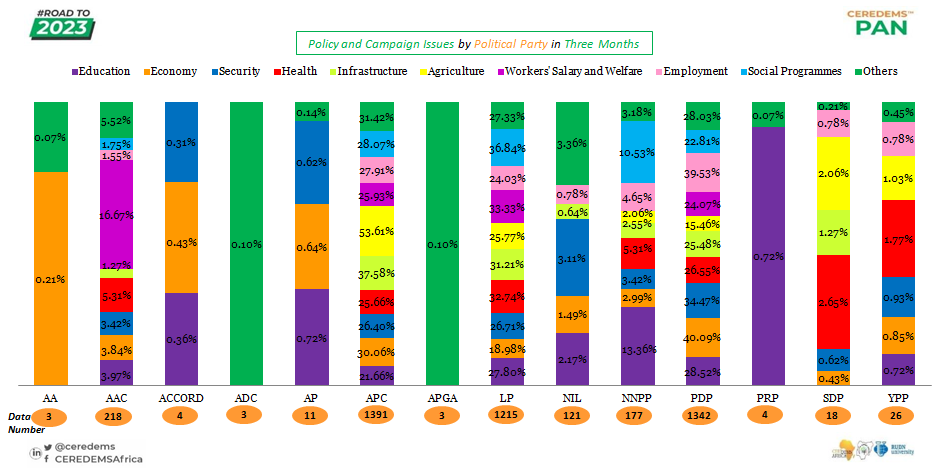
Exhibit 3: Policy and campaign issues engagement
As a result, concerned stakeholders should consider Professor Ndubuisi Ekekwe’s proposal to provide Blackboards to candidates. Professor Ekekwe recently posed three critical questions to the main contenders in his piece on the need for Nigerians to build Blackboards for them, and each candidate should be available for public debate on how to address issues confronting the country as well as how critical citizens’ needs will be met. “I do not care what is written in manifestos; I want to interrogate the aspirants as that is the living manifesto. How many blackboards do we order in case the one I have is not enough to contain all their answers?” Professor Ekekwe stressed.


Occultism: the Endangered and the Lost Treasures of the Ancient Wisdom

3

Occultism also known as mysticism or transcendentalism is an age-long vocation which probably ushered the beginning of enlightenment and human civilization. Occultism is a field of knowledge that aims to demystify, understand and explain mysteries or things that are inherently esoteric.

Since the Renaissance period, Occultism as a field of study or a system of practice has diminished in relevance among men and today it merely represents an endangered part of the ancient wisdom with some of its treasures lost to modernism and postmodernism. The sentiment and indignation often shared by some of the few surviving occultists and the modern initiates of the system is that enlightenment and civilization which is now generally associated to science is actually a corollary to demystification which is the traditional focus of occultism.

The divide between science and occultism arguably centres on the methodologies of both vocation rather than on their philosophies. Occultism centers on psychical method and science on systematic method. However, both vocations share a common purpose, and that is to advance the frontiers of knowledge and develop the state of humanity.

Unlike science whose evolution has been traced to the Renaissance or the Cartesian era, the dissection of the root and etymology of occultism is invariably accompanied by controversies. Several accounts that have traced the origin of Occultism reference different eras lived by the founding fathers of the different schools of occultism. However, the common belief is that occultism derived its essence from when man became conscious of his environment and identified his place in the cosmos.

But exactly when man became conscious of his environment is another focus of discussion entirely — it is as a matter of fact a question that curiously evades most attempts that have been put forward to answer it.

Many scholars have been disgusted by how berated and relegated to the background occultism has become today despite the beauty and contribution of the system to humanity. Mohammed Abdelbaki, a scholar from north Africa remonstrated:

“it’s unfortunate that occultism has come to be cast in such dark shadows, because it truly is a place of wonder and offers opportunities to enrich and embrace life in many ways.

“The key to understanding the realm of the occult is to approach it without fear, bias or desire to use it for unscrupulous reasons. It is a world of multifaceted possibilities, like a beautiful gemstone that reveals a different view of the world at every angle” he said.

In 2023, Improve Your Visibility and Thought-Leadership

6

From an entry level job in Diamond Bank to teaching electronics in Carnegie Mellon University, besides everything, these two things have worked for me: becoming Visible and demonstrating Thought-leadership (“the expression of ideas that demonstrate you have expertise in a particular field, area, or topic”).

 Yes, as 2023 arrives, I want you to upgrade your professional playbook and become more visible in your professional community. And as that happens, showcase that you sabi (you know). Of course, showcasing that you sabi does not make you proud neither does it mean you know it all. It simply means that you are telling people that you know something, and available whenever someone with that capability is required.

Until people can recommend you in your absence, your career will not advance. And how can they recommend you when they do not know that you know? Get out of that timid mindset and write (or make) your first professional article (or video). LinkedIn, Facebook, corporate newsletters, newspapers, etc can host them.

In 2023, invest  time to deepen the archives of your thought-leadership and scale your webinality 

The following are some suggestions on how to build a professional online persona. It is establishing your web personality (webinality) to explain that person you are.

Presence: Open at least one social media or blog account.

Specialize:  Define an area of interest and build around it. A five-minute online search should reveal what you represent. You need to differentiate yourself and showcase your core skills and unique capabilities to potential hiring managers.

Accuracy: Always remember that once that post goes online, you may not control who sees it. If you lie on your accomplishments, your classmate or co-worker is just an IP address away from challenging it. Make it accurate – always, otherwise, you will destroy your persona.

Comprehensive: While blog should be short, once in a while, develop comprehensive articles in your field and post them online. It could mean expanding a class project you worked on, adding more contents, and fully proving your expertise. Half-baked contents will not take you too far.

Judgment: What you post or share online defines who you are. Your profile defines you – values, interests and reliability. For employers, they want reliable team leaders and you must not offer less in your web personality.

Vertical Integration: Seek to connect with people ahead of you professionally while building a horizontally network.

Generosity: Share and exchange good ideas. Invite people to your network and be generous to promote good ideas from others. Write professional reviews on books, journals and articles. In no distant time, people will reward you.

Policy Matters: If you are working, ensure you adhere to policies on using the company’s name online. There is a threat that you could be a source of data leakage that can hurt competitiveness. Your profile must not be another portrait of your employer – you must be wise to separate both, where necessary.

Continuity:  Professional online branding is a continuous work-in-progress that requires constant tune-ups of networks, contents and profiles. It must be constantly nurtured.

Let Humans Speak for You

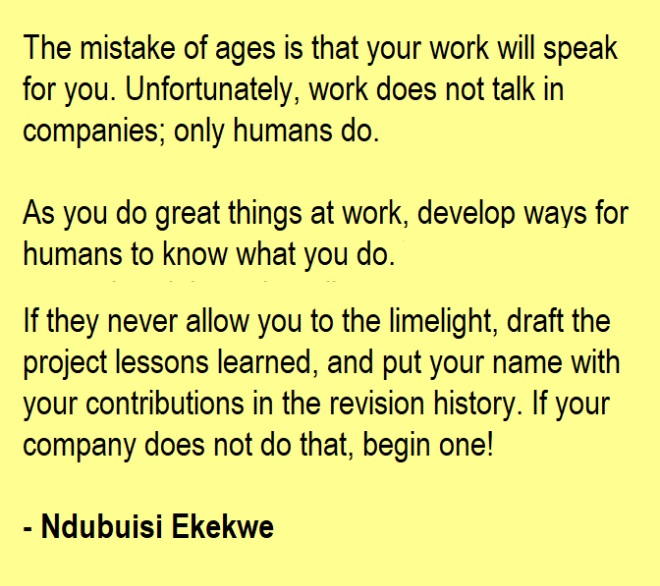
Work is inanimate and does not talk; only humans do. Until you make it easier for humans to speak on your behalf, your career will not thrive.

If your boss is the type who does not like to share accolades, here is what to do: draft a lesson learned report, put your name and share with everyone – and politely ask for feedback for the final report. By then, the words are out on who did what.

When humans speak on your behalf, besides the vibes from your “work”, you will experience a massive acceleration on your leadership and professional ascent. Make it happen in 2023.

Comment on Feed

Comment: This is a million dollar advice. Even in the corporate world, it is not necessarily the ‘best’ employees but the ‘visible’ ones that get ahead of others.

Our offerings and contributions must not only be good, they must be properly positioned for visibility. Respond to requests to undertake ad hoc tasks, speak up, ask intelligent questions and make useful contributions at workplace meetings. Seek for and embrace opportunities to attend high level and networking meetings. Showcase your knowledge and work portfolio. When you know you will be known.

The Seven Principles of Hermiticism

0

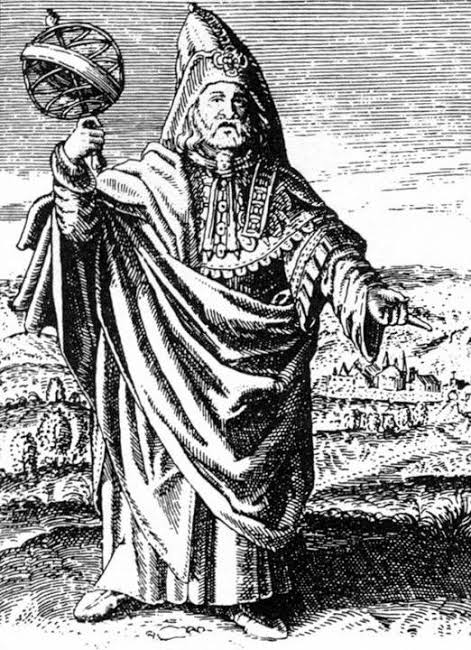
Hermetism is a brand of occultism whose name derived from the name of its founder, Hermes Trismegistus — a highly regarded sage of a much ancient Egypt who was immortalized as the “scribe of the gods”. According to oral tradition, Hermes lived in the same era as the biblical Abraham and it is believed that Abraham derived some of his mystic knowledge from the teachings of Hermes.

It was recorded that Hermes lived three hundred years in flesh, and after his demise, the Egyptians defied him and made him one of their gods, under the name of Toth. The people of the ancient Greece also made Hermes one of their many gods, addressing him as “Hermes, the god of wisdom”.

Trismegistus literally means thrice-great or the greatest-great. In the ancient lands, the name of Hermes Trismegistus was revered and often interpreted as the “fount of wisdom”. In modern dispensation, the term ” hermetic” is often used in a sense to mean “secret” or “sealed” so that nothing can escape.

Thus, the followers of Hermeticism are trained to observe the principle of secrecy. They strongly operate with a belief of not casting ‘pearls before swine’ or giving meat for babes. In other words, the hermetic followers do not believe in giving or preaching the truth to a people or a world that is not ready to accept or receive the truth. Hence, the following hermetic aphorisms:

“the lips of wisdom are closed except to the ears of understanding”.

“milk for babes and meat for strong men”

The All

The philosophical foundation of Hermeticism is the overaching influence of “the all” in the cosmic intelligence. The all is the ever-working mind and the universe represents the mental activities in the mind (of the all). The all is described as the substantial reality underlying all outward manifestations or appearances of things — it is the spirit which in itself is unknowable and indefinable. It can only be thought of or considered as a universal infinite living mind.

The Seven Principles

Underpinning the Hermetic philosophy are seven principles and universal laws, namely; mentalism, correspondence, vibration, polarity, rhythm, cause and effect, and gender.

Mentalism. The principle of mentalism presupposes that all aspects of the material universe, including the socio-economic state of man and the basest things, such as, matter, energy and ions, are manifestations of a mental process and therefore are of mental nature. This principle is the basic of Hermeticism and it guides the practices of both the teachers and the students of the vocation.

“He who grasps the truth of the mental nature of the universe is well advanced on the path to mastery. Without this master key, mastery is impossible, and the student knock in vain at the many doors of the temple” Kyballion.

Correspondence. The principle of correspondence holds that all the levels of existence share a set of identical laws even though each level has its unique law(s). Thus, a mastery of one level of existence, with respect to its law(s), could aid the mastery of another level of existence. This principle presupposes the aphorism,

“as it is above, so it is below”.

The law of correspondence is what is being used by the great masters to move from the known to the unknown. The magical effect of this principle is said to be used to uncover the veil of Isis, the river goddess of the ancient Egypt.

Vibration. The principle of vibration explains the evolution and involution of things to and fro the material and the spiritual spheres of existence. The principle holds that nothing is at rest or constant except that everything is ever on the move. A thing or being that apparently lies dormant has a lot of activities or processes going within it. These activities or processes, mental, spiritual or neurological, influence the state of the being.

Polarity and Rhythm. The principles of Polarity and Rhythm go hand-in-hand. Polarity entails two opposing extremes of the same nature, and Rhythm simply means an episodic movement between these opposing extremes, such as movement between happiness and sadness, optimism and pessimism, coldness and hotness, loudness and quietness, high and low etc..

Cause and effect. The principle of cause and effect explains the order in what may seem a mumble-jumbled world. Every event or occurrence has a cause. Thus, chance or luck is but a name for a cause not yet recognized. The ultimate cause of things is the all which is the cause of its ownself. Hence, it is pointless inquiring beyond it.

Gender. The principle of gender presupposes that all things worthy of knowing exist in complementary pairs, comprising the masculine and the feminine substances which are pivotal to procreation, regeneration and recreation of the same substance. This principle implies that for every ying there is a yang.

Together the seven Hermetic principles summarize Hermeticism as a system based on the mastery of the material universe through subjugation or manipulation of laws by conscious application of higher laws. The highest law is “the all”. Mastery of laws and proximity to the all depends on one’s level of mental transmutation.

Hence, according to the three initiates and veiled interpreters of the Kyballion, a compilation of Hermetic maxims, axioms and precepts, “the transmutation of mental vibration to another, rather than changing one kind of metal to another constitute the art of Hermetic alchemy”.

“From old Egypt have come the fundamental esoteric and occult teachings which have so strongly influenced the philosophies of all races, nations and peoples for several thousand years…. From her secret doctrines all nations have borrowed”. — the three iniates and veiled interpreters of the Kyballion.

Resource:

The Three Iniates. 1908. The Kyballion: A Study of the Hermetic Philosophy of Ancient Egypt and Greece. YOGEBOOKS, HOLLISTER MO.

Occultism: the Endangered and the Lost Treasures of the Ancient Wisdom

I do not believe in New Year Resolutions; I resolve daily and weekly

1

I do not believe in new year resolutions. Yes, it is an illusion to think that switching of a digit from 2022 to 2023 will deliver a new outcome, when you have not investigated, and resolved, to fix and deepen what matters: processes. One of the greatest victories in life is the victory over time, and that time is allocated to all of us, equally (24 hours in a day). Time, even in its limitless form, is the most scarce resource out there. Until you can win over it, via your processes, you cannot resolve your future.

Leave new year resolutions, focus on resolving your daily and weekly non-optimal processes. Buy an exercise book. Every Sunday night, take 10 minutes to list important things you want to get done in that week. Then every night before you go to bed, or if you prefer, early in the morning, list important tasks for the day. As the days go and the week passes, cross-out the completed ones. Keep optimizing those processes, keep improving on how you execute the tasks, and track these two indicators: quality and speed

In most things in the professional domain, those who can deliver high quality outcomes at the shortest time thrive. So, you must keep improving your processes while reducing the time required to execute tasks. 

If you blog, how can you take 30 minutes to put that content over 2 hours without loss of quality? If you send a management report, how can you beat the deadline with high quality results, and demonstrate that you are ready for more responsibilities? Those simple resolutions will make the mountain-size new year resolutions irrelevant. Happy new year ahead!