DD
MM
YYYY

PAGES

DD
MM
YYYY

spot_img

PAGES

Home Blog Page 4584

Why 2023 May Be The Year for the Nigerian Crypto Sector

0

My nickname in the office is “The Investor”. There are many reasons for this; none of which includes me having a US$20 million fund in my name to dole out capital to startups from (or at least not yet).

For the inquisitive, I literally started calling myself “investor” and everyone (my team members specifically) just literally took it up and it became the norm.

Warren Buffet is a great investor and one of the few global figures I look up to. I got interested in Buffet the day I realized that a share at Berkshire Hathaway (his holdings company) was worth hundreds of thousands of dollars (presently worth US$454,280). While you need to be rich to own 1% of most companies and sit on their board, you need to be rich to own one share of Berkshire Hathaway.

Occasionally, when I have the time, I try to listen to his annual briefings, not because I own a share in his business (we are getting there), but primarily to listen to snarky, witty, and outright savage responses from his partner Charlie Munger.

Warren Buffet has many rules for investing, one key one is to never invest in what you don’t understand, and this is where crypto comes in.

I like to start by saying I do not trade cryptocurrencies (or at least not yet). While I understand how blockchains work, the principle behind consensus protocols, SHA 256, etc. I don’t necessarily think I’m knowledgeable enough to put real money into cryptocurrencies and be able to predict its outcome. The fact that a single tweet from Elon Musk can shoot up the price of Dogecoin with no fundamental analysis backing its meteoric rise except the fact that the influential founder of an electric car company can change his name on Twitter to the “The Doge Father” and use a Dogecoin emblem as his profile image is pretty disturbing to me.

However, my cautiousness towards crypto hasn’t always been beneficiary. A former flat-mate of mine shared with me how he had about US$200,000 in Shiba Inu during the impeccable 2021 crypto market bull run before the market depressed and he had to off-ramp at US$70,000. He still feels hurt that he could have gotten more money out than he eventually did. The last time we talked he was sharing with me how he planned to buy a Mercedes Benz E350, while I’m planning to buy a N450,000 (US$1,000) Oculus Quest 2 VR headset amongst other things. Moral of the story: cautiousness doesn’t always pay :(

CRYPTO, TECH AND 2022

2022 has been an interesting year for African tech so far. This was the year of reckoning for startups raising money without a working business model, product-market fit, and/or even product solution fit. Global macro economical and geopolitical issues meant that investors held their purses tighter and were more than willing to drag founders who wanted to play games with them. It also meant companies without a path to profitability and sustainability had to either find one in time, furlough staff, or go out of business.

A couple of normal expected things also happened; digital payments volume (NIP) so far is up 49% YoY from November 2021 to November 2022, and those who believed MoMo PSB would “destroy all the fintechs in Nigeria” (whatever that was supposed to mean), were shocked that didn’t occur, and would probably be surprised to know that as of September 2022, MTN MoMo had about N1.745 billion (US$3.9m) in customer deposits and 1.8 million active MoMo wallets in Nigeria indicating an average user account balance value of N969 (US$2.18). For context purposes, Fidelity Bank, a licensed Tier 2 DMB in Nigeria had an average user account balance value of N277,700 (US$623).

While Crypto still remained a touch-not by commercial banks in Nigeria, and those who tried to test the school teacher (CBN) got beaten with a big stick, crypto transactions have continued to grow especially via P2P channels where the regulator has little or no visibility into.

The CBN launched its CBDC (the eNaira) in October of 2021, and shared at its one-year anniversary launch that it had processed more than N8 billion (US$17.9million) in its first year of existence, fintechs like Remita and Flutterwave have already started building propositions around the eNaira, with Remita being the leading fintech in that space making it possible for merchants to receive payments in eNaira and be settled in fiat, onboard eNaira wallets for transactions on the Remita Mobile App, fund eNaira wallets and even process outbound fund transfers to beneficiaries and have them settled in fiat.

However, while the Central Bank has been clear and unflinching on its belligerent perspective towards private cryptocurrencies, there are many reasons to believe that 2023 may be a good year for cryptocurrencies.

REGULATORY SIGNALS FROM POLICYMAKERS

The first real indicator of a change of heart this year was the Finance Bill the Minister of Finance, Budget and National Planning shared with the FEC (Federal Executive Council) in December of 2022.  Amongst the plethora of proposed changes was the proposal to tax digital currencies. The eNaira is a Central Bank Digital Currency and has no speculative value, so there is no “taxable potential” there. The only taxable cryptocurrencies are the speculative ones i.e Bitcoin, Ether, Shiba Inu, etc. and the only way to tax them is to make them legal.

The Finance Bill is a document that passes through a lot of stakeholders, and I imagine the CBN has some input in it. This is majorly speculation by the way and may have just been an oversight by an excited Youth Corper helping his boss at the Ministry of Finance draft out a document.

Another reason crypto may take a different turn in 2023 is the recently released PSV 2025 document by the CBN.

The PSV 2025 document is an 83-page policy document released by the CBN detailing the payment system vision plan for Nigeria by 2025. This document is a follow-up to the PSV 2020 plan. The PSV 2025 document lists thirteen recommendations by the CBN to bolster digital payment adoption in Nigeria. Interesting to note that of these thirteen recommendations, three were direct blockchain initiatives with the CBN indicating it would “consider the development of a regulatory framework for potential implementation of ‘Stable Coin”.

While the PSV 2025 isn’t about crypto primarily, the purpose of this piece is to highlight opportunities for crypto usage that may find expression in 2023 based on what the CBN is willing to be lenient about.

CROSS-BORDER TRANSACTIONS VIA CRYPTO

Hedging against inflation is a key reason people invest in cryptocurrencies. Another strong use case for crypto is cross-border transactions and remittances where bitcoin (or any other crypto) is used as a middle currency to facilitate the conversion between two currencies. Crypto fintech Hellicarrier (formerly BuyCoins) was a pioneer of this approach to remittances.

Cross-border trade and payments between African countries are a mess. In fact, cross-border trade generally is a friction-filled market that has loads of opportunities for disruption. Union54’s partnership with MasterCard that allows other fintech company’s issue virtual dollar cards to their customers for foreign purchases in US Dollars (albeit at black market prices) via Union54’s API has solved a significant problem in this space. VISA also has a similar proposition it extends to fintechs.

However, cross-border payments between African countries are an exceptionally friction-filled process. Here’s how it works; Assuming you want to send money to someone in Kenya from Nigeria, and you bank with Bank A in Nigeria while the beneficiary banks with say Bank B in Kenya, That process will involve Bank A debiting your dorm account to secure funds and passing it through Swift to Bank B in Kenya.

This is a friction-filled process that takes time, and the number of participants also makes it an expensive process with trade between African countries costing Africans US$5 billion in money transfer charges every year.

To solve this problem, some African countries have built regional payment systems that make it possible for these transactions to occur by placing participating banks and financial institutions on the same payment network, thereby reducing the need for a third-party currency (usually the US Dollar) for settlement.

PAPSS led by Afrieximbank is an Africa-wide initiative designed to solve this problem. With PAPSS, Central Banks and their participating banks (termed Direct Participants) are onboarded and integrated into the PAPSS platform. Direct participants are required to pre-fund an account with PAPSS to enable direct instant payment between participating banks without the need for the US Dollar for settlement.

While PAPSS is a unique and revolutionary infrastructure, there is a crypto perspective to this, where AfriEximBank can issue a stablecoin (or in better words, a Wholesale Central Bank Digital Currency) that can be used as a third currency for settlement. Imagine this wholesale CBDC is called “AfriCoin” and is hedged to the US Dollar (not pegged to the US Dollar, of which AfriEximBank would have to hold the US Dollar equivalent of its AfriCoin holding).

All participating banks will be required to pre-fund with their local currencies and be issued an equivalent amount of “AfriCoin” in their settlement accounts with AfriEximBank. When a customer of Bank A in Nigeria wants to send money to a customer of Bank B in Kenya, the first step will be to debit the customer of Bank A and immediately pass information through AfriEximBank to Bank B in Kenya that funds have been secured, Bank B in Kenya will accordingly make funds available to the beneficiary in Kenya in Kenya Shillings. At the end of the day (or at settlement time) Bank A’s position at AfriEximBank will be debited of AfriCoin to settle Bank B’s position. A simple net settlement and everyone goes home happy. In the unlikely situation of a participating bank deciding to leave the network, its AfriCoin value can be converted back to its local currency and returned to it.

Settlement via crypto or a wholesale CBDC is a strong proposition to empower cross-border African trade, and one that may likely see some headway in 2023 since fintechs like Zone are already towing this path, even though I feel an initiative like this may be more successful if led by a consortium of Central Banks and/or an Afrieximbank as against a fintech.

THE POTENTIAL OF ICOs

The first time I heard of a crypto rug pull was in 2018 with ICOs. For the uninitiated, ICO is short for Initial Coin Offering; a system of raising capital by issuing tokens to the public in exchange for real money or more stable cryptocurrencies like Bitcoin, Ether, or even USDC.

ICOs are like IPOs except there are unregulated and instead of getting shares you get tokens (and you can lose all your invested money and have nobody to hold).

The Ether project (Ethereum) started with an ICO that raised 31,000 BTC (US$18.3 million as at the time) in 2014 before ICOs eventually went mainstream in 2017.

A couple of Nigerian companies also hopped on the ICO bandwagon in 2018 with KoraPay reportedly raising US$12 million in an ICO in 2018, while SureRemit raised US$7 million to roll out its digital voucher system. Most ICOs ended up as scam projects. So people are generally wary of them.

However, the potential of ICOs even in Nigeria is phenomenal especially if the tokens issued are Utility tokens. Here is an example: Imagine a community wants to build a road but the government has refused to support the project, the community could raise an ICO with each participating investor getting a utility token for their investment. When the road is ready, a tollgate can be set up for fee collection. The only way to pass that gate will be via the utility token issued to early investors in the project. This means that investors will not only have free access due to their utility tokens, they will also be able to sell those Tokens to people interested in plying that road at a decent markup to realize their original investment in the project. This opens up a lot of investment opportunities and development opportunities for local communities and can be a revolutionary use case for ICOs.

P.S: I am not ignorant of the fact that local communities in Nigeria may not have the infrastructure required to access digital tokens, nothing stopping them from investing via an intermediary (an agent network, etc.) and receiving those tokens the same way airtime vouchers are distributed (paper slips). There can also be provisions for original utility token investors to have lifetime access depending on how such a system is designed.

CAN STABLECOINS CURB DOLLAR-INDUCED INFLATION

One of the stand-out recommendations from CBNs PSV 2025 document was to “consider the development of a regulatory framework for potential implementation of ‘Stable Coin”.

Regardless of what anyone says, a key goal of the present CBN administration is to control the exchange rate. A bunch of initiatives have been embarked upon to achieve this including banning BDC operators, incentivizing exporters via its RT200 non-export proceeds repatriation program, and even its “Naira 4 Dollar” scheme to incentivize remittances through official channels. However, demand for the US Dollar has continued to skyrocket with the US Dollar exchanging on the black market for N748 per US$1 as of the time of writing this.

The first thing to understand is that dollar scarcity is a Nigerian (and possibly African) problem, not a global problem. USDC is a stablecoin pegged 1:1 with the US dollar and may be a potential solution to this. While the US Dollar is scarce in Nigeria, this isn’t the case in other countries. A system where instead of issuing people the US Dollar, you issue them USDC that can then be converted to USD in the country the beneficiary wants to spend that money may be of high value.

Since USDC is being issued to the customer in Nigeria, there is less pressure on the real US Dollar and since demand for US Dollars in the beneficiary’s country isn’t high, the beneficiary may find it easier to convert USDC to real US dollars for spending.

While the market cap for USDC is about US$44.9 billion and may not be sufficient to solve Nigeria’s FOREX problem, considering Nigerians spent US$11.6bn in three years on education alone. it may be a step in the right direction, or at least a sector-focused proposition for a fintech to take on.

REGULATE THE EXCHANGES

The FTX debacle was a major blow in the face of all crypto supporters globally. Even Asemota acknowledged that in a tweet. Prior to the FTX debacle, the SEC was amongst the few (if not the only) Nigerian regulator with an accommodating view of crypto. They had issued a regulatory document on that wise, however, after the FTX debacle, they did an about-turn and retracted their support for “Digital Currencies” essentially denying their baby.

While the FTX debacle was no doubt a shame, it is important to note that what happened with FTX and SBF (Sam Bankman-Fried) was more of a corporate governance problem than a crypto problem. SBF could have been the CEO of any company and still been fraudulent, he succeeded with a crypto company because of the presence of little or no regulatory oversight on crypto.

While I will not sound naïve and deny that crypto is not used by unscrupulous entities to perpetrate fraud (the easiest way to move fraud money from a foreign country to Nigeria without being detected is via crypto), crypto still has a legitimate use case that pushes people to embrace it regardless of the ban; hedging against inflation. Buying USDC as a safety net from a devaluing currency is a strong proposition that banning crypto will likely find hard to stop.

The truth is banning crypto exchanges from interacting with the banking system didn’t stop crypto trading, however, it made users revert to P2P (peer-to-peer) channels making trading more decentralized than centralized. The majority of illegal crypto activity occurs on unsupervised P2P networks, as most crypto exchanges can flag large crypto transactions as suspicious.

Regulators need crypto exchanges to be more centralized than decentralized to enable proper regulatory oversight and monitoring. Crypto transactions will continue to occur regardless of what the regulators think, the solution is to make them more centralized via stronger regulatory oversight than keeping them decentralized by allowing them to stay unregulated and banned from our centralized banking system.

2023 may be the year the CBN decides to put a more observant eye on crypto exchanges by restoring their connection to the banking system, regulating them, and putting a closer eye on their activities.

CONCLUSION

While a lot happened in 2022, 2023 may turn out to be a unique year for blockchain-based innovations. The possibility of a widely adopted blockchain-based payment solution, blockchain propositions for Identity management, regulation of crypto exchanges, and a whole lot of Distributed Ledger Technology Initiatives may begin to manifest themselves in 2023. Let’s see how the year goes.

Inspired By The Holy Spirit

Twitter User OxSea Hinted on Wyre and Changelly Liquidity Crunch [Changelly Response Added]

0

While the crypto sector is still recovering from the FTX collapse, crypto influencer 0xSea.eth hinted at Wyre and Changelly’s liquidity crisis in a Twitter thread.

0xSea.eth took to Twitter with claim that Changelly has frozen $3 million in user funds after Wyre also held back a large withdrawal. The core developer questioned the reliability of centralized exchanges and crypto wallets by citing withdrawal issues of a user.

He claimed that user K who tried to swap USDT with USDC on Nov. 11, is unable to withdraw $2,932,345 even after a month.

Is the hardware wallet Ledger reliable?

Due to events such as FTX, many people felt that CEX is no longer safe, so they withdrew their coins and put them on cold wallets. But are cold wallets necessarily safe?

It has been reported before that the funds through the ledger support service provider Swap were lost for no reason. But this is not an isolated case, my friend K has also experienced a similar thing, the amount is as high as 3 million US dollars, and it has not been resolved yet, what happened is as follows.

Due to the problems in FTX and the market’s concern about FUD and USDT in the market, K intends to replace USDT in Ledger with USDC.

Ledger live recommended the Changelly team platform, promising real-time arrival without registration.

K had never heard of the Changelly platform before, but because it was recommended by Ledger, he felt that there should be no problem, so he tried it out with a small amount of exchange, and it quickly succeeded.

Then, he then operates on Changelly to convert USDT equivalent to USDC of USD 2,932,345. After K’s operation was completed, a few hours later, the platform displayed “transaction broadcast successful”, but in fact the funds had not yet arrived, so K contacted customer service.

An unexpected thing happened. He was asked to do KYC, but this was only proposed after he contacted the customer service. Ledger Live did not prompt him during the previous operation.

That is to say, Changelly first received USDT before asking K to open an account and pass KYC. K cooperated to complete all the steps. Then the other party’s security team sent an email requesting the source of funds. K provided a bank statement.

While waiting for review, the platform continued to ask K for details such as address attribution and source of funds. K answered all questions and provided relevant business contracts. Changelly said received and under review.

Another week later, Changelly asked K to provide proof of source of funds and to explain several of the transactions. K originally thought that Changelly might have misunderstood the English date format and thought that the contract was signed after the payment was received.

In this regard, K explained that the contract was signed on June 7, 2021, not July 6. The first payment was made on June 15, after the contract was signed. One of the payments was dated Dec. 7, not July 12.

After K explained the above problems by email, Changelly further asked K to explain the relevant payment corresponding to the contract. K this time noted each transaction, the nature of the transaction, and the payment for the corresponding contract.

As a result, the incident eventually took a desperate step, and Changelly team has never responded since. Another week passed, during which K kept sending emails to try to contact Changelly team, and offered to hold a meeting with the Changelly management team to explain all the problems at once.

If the other party is unwilling to accept, you can also send USDT back to the sending address. However, email inquiries fell silent, and the other party did not reply.

At the same time, K also emailed Ledger twice, and the customer service said it had been forwarded to Changelly and asked K to wait.

Since November 11th, 3 million USD has been withheld for more than a month without reason. Why was this large exchange deliberately delayed by Changelly?

K doubts whether Changelly team still has the ability to pay. After a simple search of the platform, Changelly appears to be a “recidivist”.

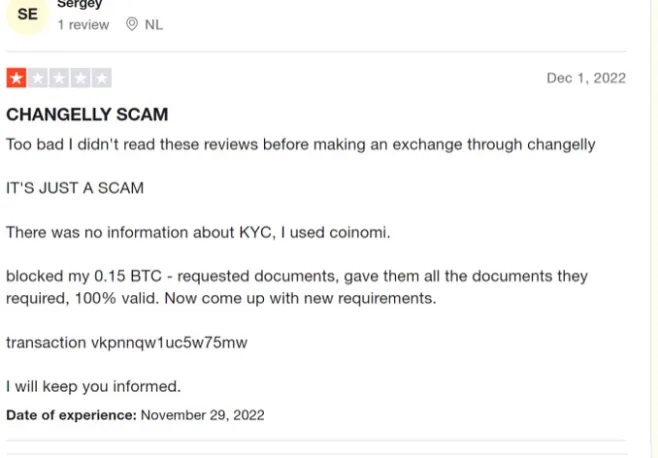
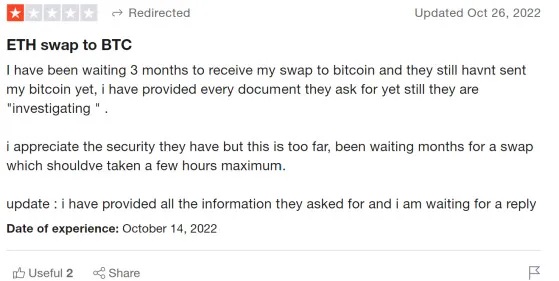
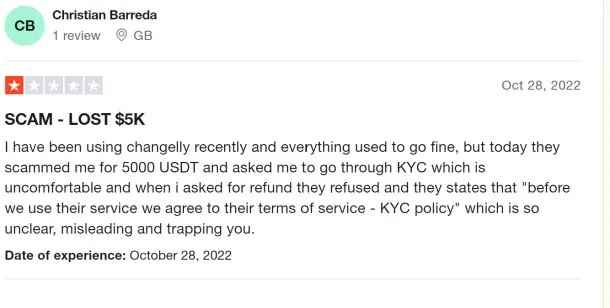
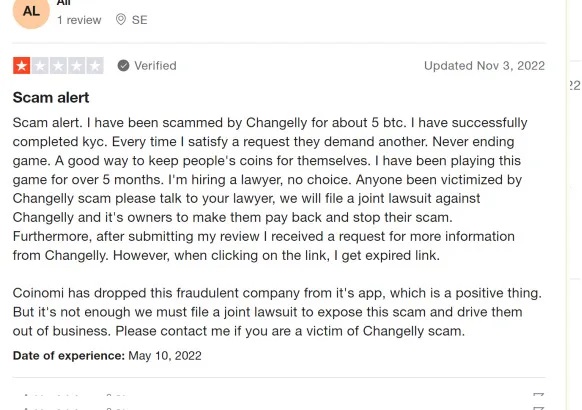
The official website has a Trust Pilot customer rating page, in which there are nearly 400 1-star negative ratings. According to feedback from other customers, Changelly has also seized or delayed the payment of other customers’ funds through KYC and other reasons.

On the Trust Pilot page, some customers who lost funds commented and guessed that this is Changelly’s business model, which seizes customer funds for no reason, and then lends them out to earn interest by taking advantage of the time difference.

Through delay or seizure, some funds become sedimented funds, or even Changelly’s team profits.

This large amount of nearly 3 million US dollars, in a turbulent market environment, K worried about the unreliable exchange service provider, so he found Ledger, pgauthier and P3b7, and was recommended by Ledger to its exchange partner Changelly team, But in the end, in the above process, K lost the funds in this way, and has not received a response from the other party so far.

The official Ledger website lists 4 exchange service providers— namely; Changelly team is one of them, and it is also recommended by Ledger Live by default.

A few weeks ago, there was a problem with Wyre exchange, this time it is Changelly, a simple USDT/USDC exchange took so long and has not been answered yet. K’s request is very simple, that is, to return the 3 million funds. At present, K is preparing to call the police in Hong Kong.

However, Ledger Support has requested to wade into the issues but maintain further discussion should be done privately via Twitter Dms.

Editor’s Note: The Changelly team sent us this response and we’re publishing it as received.

I am writing to you on behalf of Changelly.com. We would like to address the issue highlighted in this article written by Paul Ugbede Godwin.KYC checks indeed exist on the Changelly platform but are triggered on a minuscule number of transactions. You can find a more detailed review of our KYC policy here 

Even if the procedure is triggered in the first place, there is a very high possibility that the user and/or the funds in question are connected to fraudulent/other illegal activities. Such situations require more thorough investigations. 

Regarding the particular case of the user with alias “K”, we are conducting an investigation because we have very strong reasons to suspect the user/funds in question are DIRECTLY related to a major well-known infamous scam that occurred some time ago in the crypto community. (Sadly, for now, we cannot disclose the name of the scam yet.) 

We are trying to be as thorough as we can in our investigation, but sadly, it takes time. Once the investigation is concluded, we will take measures according to its outcome, but for now our reasons to suspect the user in some kind of involvement in a major scam of the past are almost concrete.  There already were a few cases where Changelly helped to identify and return stolen funds to their rightful owners (Case of Bithumb for example). Similar outcome would be great to the community in general if the suspicions were proven to be true, which we think they might be. 

As for the negative reviews that you highlight in the article, we do not understand that point completely and consider it to be nothing but confirmation bias. We have ±2800 reviews on Trustpilot, and 75% of those are 5 stars. Sadly, you didn’t mention that at all.  Yes, we do have a number of dated negative reviews on our platform. The absolute majority of these cases have been successfully resolved. We really understand the concerns of the community in light of recent events in crypto markets, but the situation here is nothing like the headlines of the few recent months.  We all know that sadly there is some money of criminal origin circulating in the market, and we believe that any business which intends to stay on the market should do its part to restrict such circulation when they can. 

But we kindly ask you not to jump to conclusions so swiftly, it seems a little bit like FUD to us. Some influencers and media outlets made content on the story without trying to understand the situation fully, not to mention without trying to contact us to hear our side of the story, and we don’t think this is completely fair. And this particular letter serves as clarification from Changelly.

We have no intention of freezing users’ funds forever and, what’s more, have no intention of taking and using them. 

Hope we were able to clarify the issue and transfer our thoughts clearly.  Thank you, and be sure to email us, if you have any questions. 

Best swaps,

Marketing team

Binance to Purchase Voyager Digital Assets After Emerging as The Highest Bidder

0

The world’s leading crypto exchange platform Binance is set to purchase Voyager Digital’s assets after it emerged as the highest bidder.

Binance agreed to buy the bankrupt crypto platform assets for $1.022 billion, as it seeks to return crypto to voyager digital’s customers.

Speaking on the recent acquisition of the company, Voyager Digital wrote on Twitter, “After a review of strategic options focused on maximizing value returned to customers on an expedited timeframe, Binance.US has been selected as the highest and best bidder for our assets.”

Reports reveal that Binance is also spending another $20 million on other assets of incremental value.

Its recent acquisition plan will enable voyagers’ customers to connect with Binance and receive their crypto assets based on their previous positions on Voyager Digital.

Also commenting on the deal, Binance CEO Brian Shroder said via a statement “Our bid is a reflection of our guiding principle that customers should come first.  Our goal is simple: return users their cryptocurrencies on the fastest timeline possible.

“We hope our selection brings to an end a painful bankruptcy process which saw customers unfairly dragged into it at no fault of their own. Upon close of the deal, users will be able to seamlessly access their digital assets on the Binance.US platform where they will continue to receive future disbursements from the Voyager estate.”

However, the deal hasn’t been sealed yet, due to the Chapter 11 process, which mandates a court hearing on January 5, 2023, in which the Bankruptcy Court will decide if it approves the deal.

Recall that Voyager digital, a high-profile crypto broker in July 2022 filed for bankruptcy, citing market volatility and the collapse of crypto hedge fund three arrows which owed it $650 million.

In its bankruptcy filing, the firm disclosed that it had between $ 1 billion to $10 billion in assets with more than 100,000 creditors, while stating that it owed Sam Bankman-Fried’s Alameda research $ 7 million as well as several other firms.

According to the chief executive of Voyager Stephen Ehrlich, he disclosed that the platform was built to empower investors, but was however negatively impacted following the prolonged volatility and contagion in the crypto markets over the past few months.   

He further disclosed that all these necessitated the firm to file for chapter 11 bankruptcy while noting that this move provides for an efficient and equitable mechanism to maximize recovery.

Voyager’s bankruptcy marks another episode in crypto’s rocky year, as the recent collapse of FTX has sent shockwaves to the industry with several other crypto exchange companies filing for bankruptcy, while some have seen a decline in their valuation.

Nigerian Court Halts DSS’ Attempt to Arrest Central Bank Governor Emefiele

1

The move by the Department of State Services (DSS) to arrest and detain the Central Bank governor Godwin Emefiele has been thwarted by a federal high court.

An Abuja high court declined to grant the application by the DSS over lack of evidence. The secret service had filed an application marked FHC/ABJ/CS/2255/2022 to arrest and detain Emefiele over allegation that he is involved in terrorism financing and other economic crimes.

But Justice JT Tsoho, the presiding judge, ruled in declining the motion ex parte, that the secret police did not provide any concrete evidence to substantiate its claims that the CBN governor was in any way involved in terrorism financing and economic crimes.

“In the light of the foregoing reasons, I decline to grant this application ex parte. If the applicant believes that the evidence available to it so far is sufficient, then it can as well arrest and detain the applicant, even without the order of the court. If however the applicant desires to still pursue this application, then it should place the respondent on notice considering the sensitive public office that he occupies,” the judge held.

Furthermore, Justice JT Tsoho had declined to approve the application because of the governor’s arrest will have on Nigeria’s economy.

“The honorable judge also wondered why the name of the respondent was given simply as ‘Godwin Emefiele’ without a material disclosure that he is the same person as the CBN governor, a high ranking public official who occupies an extremely sensitive position,” a source quoted by TheCable said.

According to the court, arresting and detaining Emefiele will have grave consequences for Nigeria’s fragile economy given his status. The court added that the DSS’ application should have been sanctioned by the president.

Although the secret service said in its application that the central bank governor has been involved in terrorism financing, many believe that the move to arrest him is political.

A coalition of rights activists, Arewa Youth Consultative Movement and public interest lawyers, operating under the aegis of Coalition of National Interest Defenders, had raised alarm on Monday that there is a plot by the DSS to arrest and detain Emefiele for allegedly financing terrorism.

The coalition said the move has been orchestrated by politicians who are not happy with the new naira redesign and withdrawal policy announced by the CBN. They said the new CBN policy, which makes vote-buying difficult as Nigeria approaches 2023 general elections, has irked many politicians.

But in response, the DSS has issued a statement, warning the public not to allow themselves to be used to undermine its investigations. A statement issued on Monday by Peter Afunanya, the DSS spokesperson, said the service will not succumb to blackmail or be distracted by those seeking to use propaganda to undermine its lawful investigations.

According to the spokesman, the DSS’ sole responsibility is to investigate matters of national security concern in the overall interest of Nigerian citizens.

“As such, the Service will continue to disseminate actionable intelligence to the relevant authorities devoid of any sentiment.

“While professionally discharging its mandate, the DSS pledges to remain focused and unbiased. It will not, by any means, succumb to propaganda, intimidation and the desperation of hirelings to undermine it.

“It will also not give room to the use of falsehood and deceit to misdirect public understanding and perceptions of issues of national importance,” Afunanya said.

However, it is not clear who is telling the truth at this point as both institutions of the government have been repeatedly caught being partisan.

In December last year, the Inter-governmental Action Group on Money Laundering in West Africa (GIABA), a taskforce set up by the Economic Community of West African States (ECOWAS), reported that the terror group, Islamic State’s West Africa Province (ISWAP) moved a whooping N18 billion annual revenue through the Nigerian financial system to fund its activities.

Based on this report, which earned the Nigerian government criticism as it exposed its failure to track terrorism financing through the Nigerian financial industry, many believe that the central bank governor may actually have a case to answer.

Why Data Analytics Is Crucial for Small Businesses

1

As the business world continues to evolve and data-driven decision-making becomes the norm, data analytics has become increasingly important for small businesses.

Data analytics offers the ability to maximize efficiency, reduce costs, and gain a competitive edge. It provides insight into customer behavior, market trends, and financial performance that can be used to make informed decisions that drive growth and profitability.

This guide will provide an overview of why data analytics is crucial for small businesses, how to implement it, and the benefits it can provide.

What Is Data Analytics and Why Is It Important for Small Businesses?

Data analytics is the process of collecting, analyzing, and interpreting data to discover patterns and trends that can be used to inform decision-making. It’s a powerful and versatile tool for many business functions and processes.

Companies can apply data analytics to various data types, including customer, market, and financial data. These different datasets can then be utilized to drive strategic decisions across an organization. Additionally, data analytics in small businesses provides insight and knowledge that can help drive growth and increase profitability.

The competitive landscape for small businesses is fierce. For organizations to succeed, they need a clear and comprehensive understanding of their customers and the market in which they operate. With the help of data analytics, small businesses can obtain this type of insight and knowledge to help them stay competitive and thrive in their respective industries.

Benefits of Data Analytics

Customer Insight

The ability to better understand customer behavior and preferences is one of the most important benefits of data analytics. By collecting and analyzing data, businesses can gain a comprehensive understanding of their customers. This can be applied to everything from marketing campaigns to product development and customer service.

Market Trends

Understanding market trends can help businesses make strategic decisions that can positively impact their performance. Using data analytics to identify market trends can help companies improve their competitive edge by making informed decisions. Everything from market segmentation to product development and distribution can be included in this process.

Financial Performance

The financial health of a business is vital for its long-term sustainability and success. Companies can use data analytics to analyze economic trends and make decisions to enhance their financial performance. This can cover anything from finances to potential ways to cut costs.

Regulations, Compliance, and Risk Management

Collecting and analyzing data can help businesses ensure they are following regulations and managing risk. This can involve monitoring and reducing cybersecurity threats, as well as managing risk-based capital.

Competitive Advantage

You can obtain a competitive advantage by applying data analytics to comprehend your customers, market trends, and financial performance. This could help you distinguish your company from your competitors and establish yourself as a leader in your industry.

Data Analytics Tools

Business Intelligence Software

Business intelligence software is designed to provide users easy access to data across multiple sources, formats, and applications. It allows users to visualize data, create reports and dashboards, and perform analyses to identify trends and make strategic decisions. Business intelligence software is excellent for small businesses as it can be easily accessed from any device and simplifies the data analytics process.

Data Visualization Tools

Data visualization tools make it simpler to visualize data and understand how your organization is performing. Heat maps, graphs, charts, and sentiment analysis can all be included in this type of analysis. Tools for data visualization can streamline the data analytics process and make it simpler to comprehend and interpret data.

Data Analytics Tools

Data analytics tools are designed for businesses that want to expand their data analytics capabilities and extend their data science capabilities. Artificial intelligence and machine learning are all included in this, as well as predictive and advanced analytics. Depending on the tools you use, they can require a monthly or yearly subscription fee.

How to Implement Data Analytics in Small Businesses?

Before you can begin implementing data analytics, it’s vital to understand your company’s current state. This includes understanding the data you have access to and what’s currently being collected, and the processes involved in managing that data and making it available for analysis.

  • Start with the customer — A good practice is to start with the customer. This can involve understanding who your customers are, what they want, and why they buy from your company. By doing so, you can build a profile of your ideal customer and inform decisions across the company that can improve your customer service.
  • Move on to the market — Understanding the market your company operates in is crucial for market-focused companies. You can do this by determining the market trends, the segments your company serves, and the competition.
  • Finish with the financials — Although it may not be the most exciting part, understanding your company’s financial health is crucial for data analytics. What this means is that you’d be identifying your company’s current cost structure, revenue model, and more.

Once you’ve collected and organized the data, it’s time to analyze it.

Conclusion

Small businesses can profit from data analytics. Not only does it give better insight into who they need to target and what product or service to push, but it also helps them grow over time. In this day and age, you must collect and analyze data to keep your business competitive, whether you use a tool or hire someone.