DD
MM
YYYY

PAGES

DD
MM
YYYY

spot_img

PAGES

Home Blog Page 4630

Inheritance Law :- Personal Estate Representatives Under Nigerian Law

0

As stated in my last article on inheritance law, securing estate succession and inheritance rights by way of a grant of Probate or a letter of administration requires first having a set of personal representatives recognized by law.

This article will be dealing with the topics of :-

– Who personal representatives are.

– Eligibility criteria for personal representatives.

– The types of personal representatives allowed under Nigerian law

– The duties of personal representatives

– The grounds for the removal of personal representatives

– Liabilities of personal representatives

Who is a personal representative?

A personal representative in Inheritance and Estate Succession Law is a person or corporation appointed and charged with carrying out the instructions of a deceased testator as contained in a will or disposal of assets in an estate according to the directions of law or a court where the deceased did not have a will, and  the administration of any residuary assets left in the estate of a deceased.

What are the types of personal representatives recognized by Nigerian law?

Personal representatives can be :-

– Executors named in a will.

– Administrators appointed by a Probate court

– A Trustee appointed by a will or a Probate court.

What actually happens where an appointed personal representative also dies?

Where a personal representative dies, his own personal representative becomes a representative of the original party that appointed the first representative. This chain of representation can only be broken by :-

– The first personal representative not having a will himself

– The failure of the first personal representative not naming an executor in his will

– The failure of the original personal representative to obtain probate of the will from the original testator.

Who is qualified to be a personal representative?

The following persons can be personal representatives –

  1. The Administrator-General of a State
  1. A partnership
  1. A Corporation
  1. Public Trustees
  1. Infants (subject to certain conditions)

What happens when an infant or minor is appointed as an executor in a will?

Such an infant will be unable to obtain a Probate grant or act as an executor until he reaches the age of adulthood, which means that in his place a temporary executor known as a Guardian ad litem will have to act.

When are Administrators to be appointed by a court?

Administrators are appointed when :-

– A person dies intestate (without a will).

– No executor is appointed in a valid will or the one appointed cannot take up the administration.

– Where there’s pending litigation on an estate left behind as a result of intestacy.

– Where an executor becomes mentally disabled. 

Who is entitled to act as an administrator for the purpose of securing a letter of administration?

The following persons are eligible to act as Administrators in the event of intestacy –

– Spouses married under the Matrimonial Causes Act

– Spouses married under Customary law

– Children of the deceased

– Parents of the deceased

– Full-siblings of the deceased  

– Half-siblings of the deceased

– Grand parents of the deceased

– Uncles and aunts of the deceased

– The Administrator-General of the state where the estate of the deceased is located

– Creditors of the deceased

What are the accounts to be maintained by a personal representative?

The accounts to be maintained by a personal representative are :-

– Inventories

– Accounts of Administration

– Vouchers with the executor or Administrators

– Affidavits of verification.

What are the guidelines for personal representatives in dealing with the estate of a deceased?

The guidelines for personal representatives are :-

– To maintain accounts in their proper format.

– To maintain separate bank accounts so as to prevent co-mingling of funds.

– To obtain receipts for all payments.

– To make payments out of estate accounts by means of cheques.

When can legal liabilities arise against personal representatives in the discharge of their duties?

Liabilities can arise against personal representatives in the following cases –

– For cases of waste by the personal representative.

– For taxes due on the estate managed by the personal representative.

– Where there is fraudulent conversion of the estate by a personal representative.

– For the Liabilities of co-personal representatives in the discharge of their duties.

What are the qualities of a personal representative?

A personal representative should be :-

– Willing and able to exercise professional skill in managing the estate.

– A person of integrity not inclined to profit from the estate.

– Young enough to survive a testator.

– A person without a conflict of interest.

– Literate and skilled enough to function in the capacity of a personal representative.

– Matured and able to work with other personal representatives.

– Familiar with the business of the deceased so as to avoid mismanagement and waste.

 Personal Representatives –  Guardians & Administrators

Pursuant to my last article on this subject matter, it should be noted that grants of representation can be either :-

General :- To cover all assets of the estate; or

Limited :- Restricted in terms of extent of purpose.

This article installment will be looking more at legal rules surrounding Guardians, Administrators and Executors as follows :-

What are guardians required for probate matters?

Where an infant is appointed as an executor he cannot perform in that capacity during his period of minority as a result of which probate will have to be procured by an adult known as a Guardian AD LITEM who will then be given a Grant Durante Minore which will empower him to act in the place of the infant during his minority years.

What does the law say about individuals who attempt to or actually administer and deal in the assets of an estate without a probate grant?

Such individuals, regardless of their relationship with the testator (except where they fall under the inheritance priority listing under various Administration of Estate Laws in Nigeria) would be legally classified as unauthorized meddlesome interlopers known in law as Executors De Son Tort.

Are named executors in a will under a legal obligation to act in that capacity whether they want to or not?

No they are not. Any executor unwilling to act in that capacity can reject his appointment via a process called a renunciation. This renunciation cannot be partial.

When exactly can an administrator be appointed?

An administrator should be appointed when :-

– A deceased dies fully or partially intestate.

– No executor is appointed in a valid will or the one appointed cannot take up the administration.

– There is pending legal action requiring the appointment of an administrator known as an ADMINISTRATOR PENDENTE LITE.

– An appointed executor becomes mentally disabled in which case an ADMINISTRATOR DURANTE DEMENTIA is appointed.

– An executor fails to complete an execution brief which may require that a probate court appoints an ADMINISTRATOR DE BONIS NON ADMINISTRATION.

What exactly is a double probate?

A double probate grant occurs where a willing executor named in the will is not able to act when the other executors got their grants , as a result of which he then applies later when an encumbrance or obstruction to his initial probate grant is removed. 


Editor’s Note: Inheritance law continues to evolve in Nigeria. For example, Abia State signed this into law.

Governor Okezie Ikpeazu has granted his assent to the Bill which guarantees the right of female persons to inherit and own property in their father’s family, thereby making it Law in Abia State.

It will be recalled that the Abia State House of Assembly passed the Bill some weeks ago to bring Abia State in conformity with international best practices in the area of eliminating all forms of discrimination against women.

While appending his signature on the Law, Governor Ikpeazu made it clear that his administration shall at all times lean on the side of reason and common sense in the discharge of its obligations to the people of Abia State, noting that it has become anachronistic to continue to treat women as second class citizens even in their own families.

The Governor thanked the State Assembly led by the Speaker for dredging up enough courage to pass this Bill which he described as historic, positively disruptive and capable of setting our society on the path of equal opportunities and sustainable development.

The Governor is of the firm view that this is about the most important legislation passed by the State House of Assembly.

He congratulated Abia women for this feat and assured them that the Abia State Government will continue to support them.

The proper citation of the Law is THE FEMALE PERSONS RIGHT OF INHERITANCE OF PROPERTY LAW, 2022, while the Long Title of the Law is “A Law to provide for the Right of a Female Person to Inherit and Own Property and for other Matters Connected Therewith”.

By this, Abia State has become one of the first states in Nigeria to have this Law fully in place.

The Honorable Speaker of the State Assembly, Rt Hon Engr. Chinedum Orji, the Permanent Secretary/Clerk of the State House of Assembly, Sir John Pedro Irokansi, PhD, Secretary to Government, Barrister Chris Ezem and the Chief of Staff to the Governor, Chief Okey Ahiwe witnessed the event.

Sir Onyebuchi Ememanka

Chief Press Secretary to the Governor.

Kaduna 2022 LG Performance Report: Kaduna Residents’ Voting Behaviour and 2023 General Elections

1

Among the 36 states of the federal republic of Nigeria including the Federal Capital territory, Abuja, 3 states in the northern region invariably appear as the cynosure of all eyes during general elections due to their voting strengths. The three states, namely; Kano, Kaduna and Kastina are often referred to as the 3Ks or sparsely as the treble-keys to winning elections in Nigeria through the northern half of the county.

In a Dailypost article published on October 27, it is reported that ahead of 2023 general elections, analysis of the preliminary register presented by INEC reveals that six states namely; Lagos, Kano, Kaduna, Rivers, Kastina and Oyo have the highest registered voters. As at the time of the report, Lagos leads the group, recording over 7million registered voters, followed by Kano which has 5.9million registered voters and Kaduna which has 4.4million registered voters. Rivers, Kastina and Oyo have 3.53million, 3.51million and 3.27million registered voters respectively.

A recent Kaduna State Local government performance report accessible here, perhaps gives a broader insight into the readiness and preparedness of Kaduna indigenes and residents toward the forthcoming 2023 general elections. Since the Local Government is the closest tier of government to the people, it remains a very powerful force in both interstate and intrastate elections and electioneering.

Championed by the Ymonitor, an initiative under the The Future Project (TFP), a developmental organization dedicated to building a network of empowered citizens through jobs, entrepreneurship and active citizenship, the Local Government Performance Review (LGPR) serves as a means for citizens at the grassroots to assess the terms of public service delivery and make demands for better governance and revitalize the LG systems in Nigeria. The project has also been executed in Lagos, Cross River, Kwara, Yobe and Abia states.

The Kaduna LGPR comprises the survey report to assess the delivery of public goods and effective service by Local govt authorities in Kaduna state. The study comprised a survey of 1350 Kaduna residents most of whom (89.5percent) are between the ages of 18 and 47 years and most of whom (83.2percent) possessed a post secondary educational qualification (minimum of NCE or ND).

The respondents are selected across 22 LGAs in the state namely; Soba, Zango kataf, Zaria, Sanga, Sabon Gari, Makarfi, Lere Kudan, Kubau, Kajuru, Kagarko, Kaura, Kauru, Kaduna South, Kaduna north, Kachia, Jema’a, Jaba, Igabi, Giwa, Chikun, Birni Gwari.

Out of the 1350 responses gathered from the LGAs, 1250 responses were considered to be valid for analyses. The following revelations developed from analysis of data generated from the survey:

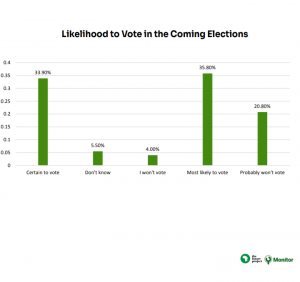
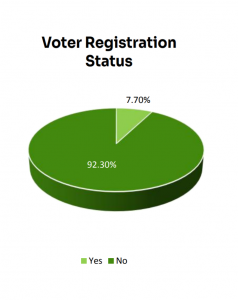
Even though majority of the respondent, about 69%, declared their readiness and preparedness to participate in the coming elections, only 7.7percent are active registered voters. This may not be a cause for alarm, especially, if most of the votes from Kaduna come from less educated individuals. Besides, since data from INEC indicating Kaduna as the third highest in the country in terms of the numbers of registered voters, the previous assumption may likely hold as true.

Majority of the participants described their Local government administration as “close to them and that they are aware of their activities”. Only about 5.5%% opined that their local government authorities are not close to them and they are not aware of their activities.

About 93.8% of residents in Kaduna state know where their local government secretariat is located; 84.7% of them know the name of any elected public officials in their local government and 86.5% have used any of the services provided by the Local Government Officials in the last 12 months. This shows that Kaduna residents have a very high level of awareness of projects or actions of their LGs. And a high level of local government administration awareness should influence political participation at the grassroots.

However, overall, the study reveals, despite high level of awareness of local government administration and activities by the people and the closeness of local government authorities to the people as well as high number of residents satisfied with their LGA activities, the level of political participation of the Kaduna residents has still been less than expected.

It is suggested residents of Kaduna should be sensitised more on the significance of local government to grassroots development and approaches to holding local administrators accountable. Also, institutional and human capacity building for local government councils of Kaduna State to adapt modern tools of local governance that are being used worldwide are considered highly important.

Tekedia Mini-MBA Capstones – Tekedia Capital Commits $100k

0

Hello,

Let me begin by congratulating Tekedia Mini-MBA learners who will graduate tomorrow. You are now #ready2lead. We truly appreciate the opportunity to co-learn with you over the last few months. We do hope that this process has improved, deepened and accelerated your leadership ascent. Thank you for choosing Tekedia Institute!

I also want to remind members who participated in Tekedia Capstone, the research project component of Tekedia Mini-MBA, to share their final reports with Tekedia Capital, if they are raising funds. Tekedia Capital funds startups, and companies, and would like to explore working with some of the projects we encountered during the program.

Please note that due to IP related issues, Tekedia Institute cannot share your documents with Tekedia Capital, as they are distinct entities. The email to share is capital@tekedia.com. Tekedia Capital has mapped out $US100,000 for early stage investments on ideas emanating from Tekedia Institute learners.

Meanwhile, remember the Graduation Ceremony tomorrow at 7pm WAT; Zoom link is here.

Graduation Lecture: Building Category-King Companies and Winning in Business
Date/Time: Sat, Dec 3 | 7pm – 8.30pm WAT
Presenter: Prof Ndubuisi Ekekwe
Zoom Link – here

All certificates will be ready from Dec 4, 2022; we have already populated them in the server waiting for the closure. Please follow the steps in the Board and request yours from Dec 4.

As always, we’re all smiles that you chose our Institute. Thank you. The next edition of Tekedia Mini-MBA will begin on Feb 6 to end on May 6, 2023, and we are revamping the curriculum; alumni members get a 50% discount. Help us tell your friends, co-workers, neighbours and associates, to come, and co-learn, with us.

Regards,

Ndubuisi
info@tekedia.com

Trader Joe To Deploy On Ethereum’s Layer-2 Network; Arbitrum One

0

Trader Joe, a one-stop Decentralized Trading platform on the Avalanche network, will be deploying the highly innovative and efficient Liquidity Book AMM onto Arbitrum One, a next-generation Layer-2 network, bringing zero slippage trades and discretized liquidity provisioning to all Arbinauts.

Why Arbitrum?

Arbitrum, is the leading Ethereum Layer-2 scaling solution, developed by Offchain Labs. Since launching in August 2021, TVL has grown to hold a majority share (over 50%) in the L2 segment and the ecosystem home to more than 400 DeFi and NFT projects.

The Arbitrum ecosystem is packed with progressively innovative protocols, as well as having presence from many industry leading DeFi protocols. Deploying Liquidity Book onto Arbitrum, will be a great addition to the vibrant ecosystem.

Exporting Innovation on the Avalanche Chain is the birthplace and true home of Trader Joe and that will not change. Avalanche will remain our top priority for all growth efforts. The aim was to always innovate on the frontiers of DeFi at a global level. We have achieved our first step with the launch of our new AMM, Liquidity Book, the most efficient AMM built to date that offers an unparalleled user experience that is fully on-chain and decentralized.

Deployment to Arbitrum One is the next step in this global expansion effort and we look forward to introducing the innovative AMM built on Avalanche, and also working with new partners to benefit the collective DeFi ecosystems of Arbitrum and Avalanche — An aspect on our Mission statement we would see through its growth.

What exactly is deploying onto Arbitrum?

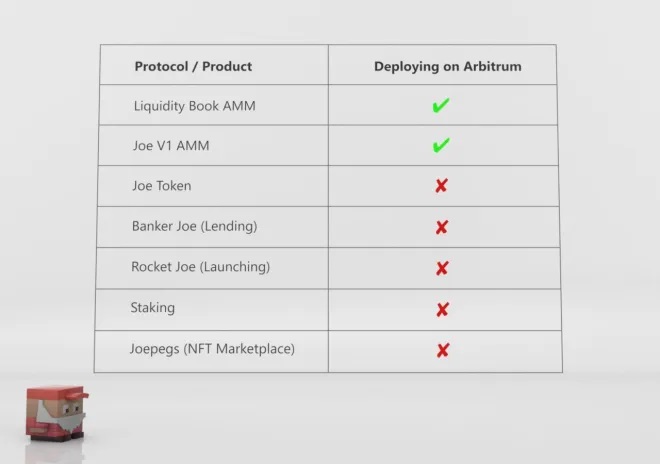
Liquidity Book AMM and Joe V1 will deploy on the Arbitrum One network, this move will combine a next generation AMM protocol with a next-generation Layer-2 network.

A quick recap on Liquidity Book: The Liquidity Book AMM is highly efficient, flexible and composable AMMThe key features of Liquidity Book AMM: Novel Volatility Accumulator that controls a volatility adjusted dynamic fee Discretised bin architecture enabling the concentration of liquidity Composable architecture with fungible token receipts Minimal trading fees, thanks to zero slippage swaps.

What is NOT deploying onto Arbitrum?

Trader Joe, will not be deploying the JOE Token, nor the full suite of DeFi products that has been built on Avalanche in this initial phase.

For clarity, the below graphic clearly highlights what is deploying and what is not deploying on Arbitrum One. Disclaimer: Whilst this is the primary plan, there may or may not be changes in the future.

What is the expected timeline for Deployment?

Trader Joe, is working closely with the Offchain Labs team to launch onto the Arbitrum testnet within the coming days. We expect that mainnet will be deployed onto the Arbitrum One network by early January and all communications will be prompt in the expected timeframe.

Notable Provisions of the Central Bank of Nigeria Act 2007

0

The Central Bank of Nigeria is the apex regulator Nigeria’s Banking and Finance sector, having a wide jurisdiction over the licensing, operation and even the winding up of service providers within this sector.

The CBN Act was passed in 2007 and effectively repealed the CBN Act of 1991, but there’s still not enough written on the piece of legislation creating this very vital government agency.

This article will thus be looking at some of the most notable provisions of this act one by one and their effects on Banking and Financial services in Nigeria today.

These provisions are as follows :-

Establishment :- The CBN in its opening section is established as a corporation having perpetual succession, a common seal, and it can sue and be sure in its corporate name. Also, the CBN is an independent body in the discharge of its functions, meaning that it is immune to external oversight or intrusions.

Objects :- Under the act, the CBN was created for the following objects :

– Ensuring monetary & price stability in Nigeria.

– The issuance of legal tender(currency) in Nigeria.

– The promotion of a sound financial system in Nigeria.

– The maintenance of external reserves to safeguard the international value of the Nigerian legal tender.

– Acting as a banker and provider of economic and financial advice to the Federal Government.

– The determination of the Naira exchange rate.

– Acting as a banker to other banks in Nigeria.

Management :- The CBN is managed on a day-to-day basis by a governor or in his absence, one of the deputy governors nominated by him and shall be answerable the CBN Board of Directors for his acts & decisions.

The CBN Board of Directors :- This board is responsible for the policy and general administration of the affair & business of the CBN. This board is made up of –

– The CBN Governor who shall also be the chairman of the board.

– 5 deputy governors of the CBN.

– The permanent secretary, the Federal Ministry of Finance.

– 5 directors.

– The Accountant-General of the Federation

CBN Director Appointments :- The 5 CBN directors shall be appointed by the President of Nigeria subject to confirmation by the Senate and in making these appointments, the president shall have due regard to fair representation in line with the principle of Federal Character. 

These directors shall hold office for 4 years and be eligible for a reappointment term of another 4 years.

The Monetary Policy Committee :- This is a policy created by the CBN Act for the purpose of facilitating the attainment of the objectives of price stability and to support the economic policy of the Federal Government. This committee is made up of :-

– The CBN Governor

– The 4 deputy CBN governors

– 2 members of the board of directors of the CBN.

– 3 members appointed by the President of Nigeria.

– 2 members appointed by the CBN governor.

The CBN Board Secretary :- This CBN secretary is basically a company secretary of the CBN appointed by its board and is responsible to the board through the governor.

The secretary must be a lawyer of at least 10 years cognate experience and is responsible for :-

– Convening meetings of the CBN Board on the authority of its chairman.

– Recording the minutes of all meetings of the board and such other meetings as the board may direct.

– Acting as a secretary to any committee of the board.

– Keeping in safe custody the common seal is the bank.

– Maintaining and keeping minute books and a register of the directors of the bank.

Prohibited Activities :- Under the CBN Act, the CBN is not to engage in activities that include –

  1. Trading activities or having interests in any commercial, agricultural or industrial undertaking except as provided under the act.
  1. Purchasing shares of any corporation or company including those of any banking institution except as provided under the act.
  1. Granting loans upon the security of any shares.
  1. Granting secured advances except as provided under this Act.
  1. Opening accounts for or accepting deposits from persons except as provided under the act.

Services to the Federal Government :- The CBN under the act is entrusted with rendering the following services to the Federal Government –

  1. Receiving and disbursing Federal Government funds and keeping account of them.
  1. Handling Federal Government banking and foreign exchange transactions.

The CBN can also act as a banker to state and local governments in Nigeria.

The Financial Services Regulations Coordinating Committee :- This is a committee created by the CBN Act and which is made up of –

  1. The CBN Governor
  1. The Managing Director, Nigerian Deposit Insurance Corporation
  1. The Director General, Securities and Exchange Commission (SEC)
  1. The Registrar General, The Corporate Affairs Commission (CAC)
  2. A representative of the Federal Ministry of Finance not below the rank of a director.

The purposes of this Committee includes –

  1. Coordinating the supervision of financial institutions especially conglomerates.
  1. The reduction of arbitrage opportunities usually created by differing regulations and supervision standards among regulators in the economy.
  1. Deliberating on such other issues as may be specified from time to time.

Payment & Settlement Systems :- The CBN under this Act shall facilitate the clearing of cheques and credit instruments for banks carrying on business in Nigeria and for this purpose, the bank shall at any appropriate time establish houses in premises provided in such places as the CBN may consider necessary.

Tax Exemption :- The CBN under this Act is exempted from the payment of income tax under the Companies Income Tax Act (CITA) or any subsequent amendment as well as exempted from any tenement rate, ground rent or such other property tax imposed under any legislation dealing with real property.

Exemption from the Jurisdiction of the Companies and Allied Matters Act (CAMA) :- The CBN is exempted from any provision of the Companies and Allied Matters Act or any subsequent amendments.

Liquidation :- The CBN under this Act shall not be placed in liquidation except pursuant to legislation enacted in that behalf and only in the manner directed by that legislation.