DD
MM
YYYY

PAGES

DD
MM
YYYY

spot_img

PAGES

Home Blog Page 4690

Orange Rolls Out 5G Network in Botswana

0

African 5G penetration has received a boost with the launch of Orange Botswana’s 5G commercial services, marking Orange’s first affiliate to roll out a 5G network in the continent.

Africa’s 5G penetration is the slowest in the world for factors mainly attributed to insufficient 5G devices. 5G mobile subscriptions are expected to hit just 10% by 2027, according to Ericsson mobility report. The penetration will depend much on local mobile network operators like Orange Botswana that secure licenses for 5G spectrum from various governments.

Orange Botswana said the 5G service, which will be available in greater Gaborone and Francistown, will cover 30% of the population from the 11th November 2022 while other cities will follow in early 2023. The 5G technology will enable new healthcare, education and security services.

“The launch of 5G technology in Botswana will allow us to scale-up this technology and gain experience for other Orange countries across Africa. The benefits and potential impact of this are promising. It will help promote Africa’s digital inclusion, resulting in socio-economic growth and job creation.

“It is also ensuring Africa’s skills development on digital management tools and is in line with the ambitions of the African Union “Digital Transformation for Africa (2022 – 2030). It begins here and now, in Botswana,” Jerôme HENIQUE, CEO of Orange Middle East and Africa said.

The company said this 5G launch will further support innovation and digital inclusion in the country, putting Botswana at the forefront of 5G in Africa and is closely aligned with the government’s ambition to leverage Fourth Industrial Revolution (4IR) innovation towards transforming Botswana into a knowledge-based economy, leaving no-one behind.

5G, with its ultra-high speed and low latency, will support new disruptive services such as e-health, connected vehicles, connected cities, real-time gaming, smart homes and learning through VR and augmented reality. It offers a new world of possibilities to companies, innovators and society at large.

The subscription of Prepaid offers is accessible through Orange Yame App, USSD and Card to Wallet.

Already, the company has launched services powered 5G network, which it believes will spur partnership with the government to further the deployment of 5G infrastructure.

Orange Botswana has partnered with MRI Botswana to create a “Connected Ambulance” project that will allow Doctors to guide Paramedics through life saving procedures on their way to hospitals. This telemedicine intervention will change lives and would not have been possible without 5G. Orange Botswana is looking forward to collaborating with government and enterprises to implement 5G-based use cases.

Orange Botswana introduces new 5G fixed broadband services and mobile data bundles. The offers are available for residential customers, small and medium enterprises and include value added services. The fixed offers are available from 15 Mbps for Prepaid and from 20Mbps for Postpaid with a monthly rental from BWP 699 (€53 per month). The subscription of Prepaid offers is accessible through Orange Yame App, USSD and Card to Wallet.

After this very first commercial launch of its 5G services in Botswana, Orange Middle East and Africa intends to maintain its efforts in getting the latest and most advanced technologies in all its MEA countries adding value to local economies and continuously bridging the digital gap within the African populations.

In other countries, regulation boards still have not officially initiated the 5G licenses attribution process although many of them, such as in Cote d’Ivoire showed a clear will to make the 5G spectrum available in 2023. Meanwhile, Orange is collaborating with several regulatory bodies to help build a 5G deployment roadmap while testing the technology and developing use cases that fit with the local populations’ needs.

“At Orange Botswana, we are excited to be bringing in a new technology that will allow economic players to discover new possibilities enabled by 5G, and the way it could positively transform their daily activities. 5G connectivity is an incredible opportunity for businesses and the government, who are eager to take their operations to the next level. It is going to change how customers experience connectivity,” Nene MAIGA, CEO of Orange Botswana said.

Although device availability remains the biggest challenge of 5G roll out in Africa, telecom companies’ push to deploy the infrastructure and service nevertheless, is seen as a positive sign for wider future adoption.


The Binance’s Warren Buffett Playbook to Prevent Crypto Recession

1

A few days ago,  I wroteWarren Buffett lent money to Goldman Sachs in the valley of the 2007-2008 great recession and calmed markets”. When Binance pulled out of the FTX acquisition deal, I noted that the crypto world desperately needed its Warren Buffet: “Indeed, FTX is largely a yoyo company and cannot meet its obligations, and if that happens, the domino effect will be the first Great Crypto Recession with no saviours on sight.”

To avoid recession after the FTX collapse, which is causing havoc for Binance and others, Binance now wants to bailout, not really FTX, but some entities in the industry. It is setting up an ‘Industry Recovery Fund’.

But note this, Warren Buffett did not save the banks during the great recession; it was the government which did. But Buffett provided a quasi-bridge which supported the government’s playbook. Indeed, besides this Industry Recovery Fund, Binance and its peers should march to the Securities & Exchange Commission (SEC) and say: “Please regulate the cryptocurrency industry. We need help”. 

The most important pending innovation in the crypto industry is US government regulation. If that happens, many good things will take shape.


Crypto Liquidity Crises Force Binance to Set up ‘Industry Recovery Fund’

Crypto Liquidity Crises Force Binance to Set up ‘Industry Recovery Fund’

0

Following the recent crypto liquidity crisis caused by the collapse of FTX, CEO of Binance Changpeng Zhao in a bid to help projects who are otherwise strong but in a liquidity crisis has disclosed that the firm is setting up an ‘Industry Recovery Fund’.

In a statement made via a Tweet, he said, “To reduce further cascading negative effects of FTX, Binance is forming an industry recovery fund, to help projects who are otherwise strong but in a liquidity crisis. More details to come soon. In the meantime, please contact Binance Labs if you think you qualify.

Crypto is not going away. We are still here. Let’s rebuild,” he added.

The Binance CEO also stated that other industry players with cash are welcome to co-invest in the project to mitigate the liquidity of cryptocurrencies in the market.

Following his recent announcement, it has led to a surge in the price of Bitcoin and the overall crypto markets. Bitcoin surged from a 24-hour low of $15,906 to a high of $16,580 while Ethereum bounced from a 24-hour low of $1,180 to a high of $1,233.

Also, while speaking at a summit in Bali, in a gathering of G20 leaders, the CEO called for new but stable rules and regulations for the industry, noting that new players in the industry are cutting corners, without following due processes.

In his words, “We’re in a new industry, we’ve seen in the past week, things go crazy in the industry. We do need some regulations, we do need to do this properly, we do need to do this in a stable way”.

The FTX collapse which saw it lose over $ 2 billion in value of FTT token, wiping out approximately $100bn from the crypto market cap has no doubt landed a big blow to the crypto industry.

Given FTX’s high profile, which saw it strike deals with sports stars like Tom Brady and a massive $135 million deal to rename the Miami Heat stadium, there are fears that its collapse will have a cascading effect on the entire industry, with more big firms predicted to follow the same path.

In a recent event, the company’s CEO Sam Bankman-Fried filed for Chapter 11 bankruptcy after the dramatic events that saw the exchange platform face a liquidity crunch which led to the freeze of withdrawals after customers rushed to get their funds off the trading platform.

There are reports the firm may have used customers’ deposits to fund bets at Bankman-Fried’s hedge fund, Alameda Research, a violation of US securities law.

Currently, the collapse has sent panic to businesses and organizations that have made investments in the platform, as they face the risk of their funds vanishing after FTX halted withdrawals of funds.

Recall that Binance tried to rescue the platform but walked away from the deal after it stated that the company has so many issues beyond its control, majorly manhandling of customers’ funds.

Financial Experts and industry players have disclosed that the FTX crash has posed a serious challenge to the crypto industry, stating that it will take a long time before it recovers.

“This was one of the most trusted entities in the crypto space, so it will take some time to recover”, said Jay Jog, co-founder of Sei Labs.

Tekedia Capital Invests in FuelFact to Digitize Downstream Oil & Gas Sector

0

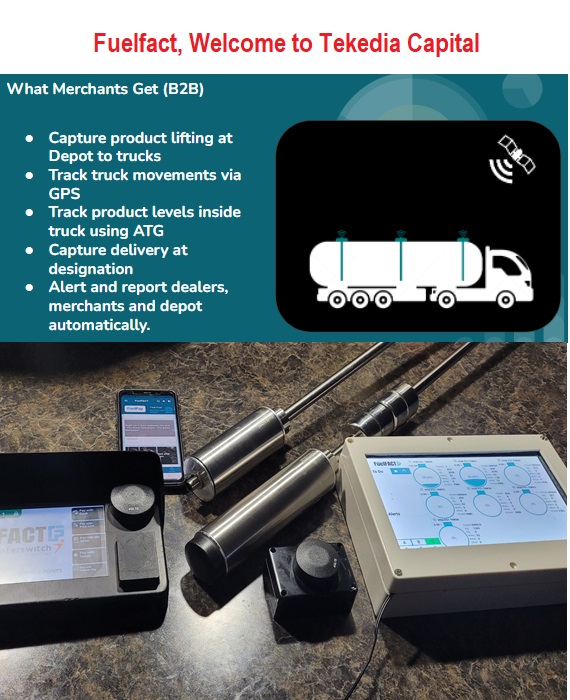
On behalf of our members and partners, Tekedia Capital is excited to announce an investment in FuelFACT Technologies Solutions Inc. FuelFact has created a category-king solution which brings uncommon transparency and visibility in the downstream sector of the oil & gas sector. From the depot to the storage tanks, to the dispensing units, FuelFact delivers revenue assurance to partners.

With its FuelPay technology,  you have the first integrated forecourt automation (FCA), Wetstock management (WSG), and FuelPay epayment platform, in Nigeria. Its customers are some of the leading players in the downstream oil & gas sector.

Tekedia Capital welcomes founders Isidore and Igbo to the best investing ecosystem in Africa: welcome to Tekedia Capital, the 2021 winner of Best VC/Angel Fund – Nigeria.

To learn about Fuelfact, go here . For Tekedia Capital, go here.

Dr. Yasam Ayavefe Provides an Overview On Thermodynamic Solar System – The Objectives, Actions And Challenges

0

As with solar thermal, technologies related to this sector aim to convert solar radiation into thermal energy.

The principle of these technologies is to intensify the solar radiation sufficiently to be able to heat a heat transfer fluid at a high temperature (250°C to 2000°C).

The heat thus stored by the fluid can be used directly for industrial uses or used to generate electricity via a steam turbine.

Compared to photovoltaic, where production stops in the absence of sun, production can continue beyond the insolation period where there is a storage tank for the heated fluid.

There are several types of technologies: 

Cylindrical-parabolic solar power plants: Parabolic troughs with a radius of curvature of 2 to 2.5 m and a length of about 20 m concentrate the sun’s rays on a tube of heat transfer fluid.

Linear Fresnel reflectors, which can be regarded as a technology derived from cylindrical-parabolic plants, employing flat and near-ground half-plane mirrors and concentrating rays on fixed receiver tubes.

These mirrors can rotate to follow the path of the sun throughout the day.

Tower solar power plants: Multiple adjustable mirrors, called heliostats, concentrate solar energy on a single boiler located on a tower.

Dish-Stirling solar parabolas: This technology uses a parabolic mirror about ten meters in diameter in an external combustion Stirling engine whose hot source is sodium, the driving gas is helium or hydrogen.

Under conditions known to date, these technologies require significant direct sunlight.

Important Figures of the Sector

According to tests conducted for the first time in 2015, the photovoltaic figures are as follows:

  • Around 95 GW in Europe
  • Approximately 230 GW worldwide.

Objectives

Released on November 2, 2016, the multi-year energy program set a target of 10.2 GW for 2018 and a range of 18.2 to 20.2 GW of solar capacity for 2023.

The multi-year energy program is aimed at accelerating the development of the photovoltaic sector compared to the pace of development in previous years.

It places priority on artificial sites to protect projects while emphasizing competitive solutions such as ground-mounted photovoltaic plants.

To achieve these targets, new calls for tenders were launched in 2016, resulting in approximately 1.6 GW of project allocation for 2017.

Thermodynamic solar requires very good direct sunlight conditions (>1900 kWh/m²/year). This limits the potential to specific geographic regions: Mediterranean countries in Europe, United States, India, North and South Africa Africa, Middle East, China, Australia, South America.

thermodynamic solar water heater

thermodynamic panels inventor jailed

thermodynamic solar heat pump

bunsen thermodynamic solar panel system

energie thermodynamic solar water heater

energie thermodynamic solar system

thermodynamic panels vs heat pump


Thermal Energy

Production and installed capacity

The European fleet of solar collectors amounted to 47,000,000 m², equivalent to 32.9 GWth at the end of 2014.

In 2014, the European solar market, the sector devoted to hot water and heating production, showed a further decrease with the collector area installed below 3 million m² (ie 2150 MWth equivalent) bar, down 3.7. This is the sixth consecutive year of decline, with an installation level comparable to 2007.

The industry has entered the phase of redirection of sales points. Especially in the renewal market, if the thermal regulations are strengthened, in individual residences and collectively, if there are prospects, new markets can be conquered in terms of industrial applications and areas of solar collectors, in terms of connecting heat to heating networks.

The expansion of these high-power plants will thus contribute to a drastic reduction in production costs. In addition, the development of hybrid solutions will contribute to the development of the sector. 

Actions and Challenges

Improve regulations to encourage industry development.

In the new housing sector, thermal regulations, which include the obligation to use renewable energy in detached houses, are in favor of the sector.

However, solar is in competition with some equipment that costs less to install and also meets its criteria. Strengthening regulatory criteria in the thermal regulation of new buildings will make it possible to promote more efficient solar equipment.

Improve quality and reduce costs.

Structuring the market and optimizing the systems has made it possible to reduce the equipment cost by 20% to 25% over the last five years.

Efforts still need to be made for high installation costs. The development of large-scale solutions in industry should also have an impact on individual and collective solar prices.

In the individual sector, the sector is structured and certificates are created for sensors and installation. The industry must collectively increase skills.

It should also manage any counter references that may have been observed in the past due to design, implementation or operational issues. RGE competence is being developed in response to these concerns.

Dr. Ya?am Ayavefe 

Click the below links to view Dr. Yasam Ayavefe’s projects:

https://greenclimate.io/

Yasam Ayavefe

Milaya Capital