DD
MM
YYYY

PAGES

DD
MM
YYYY

spot_img

PAGES

Home Blog Page 4721

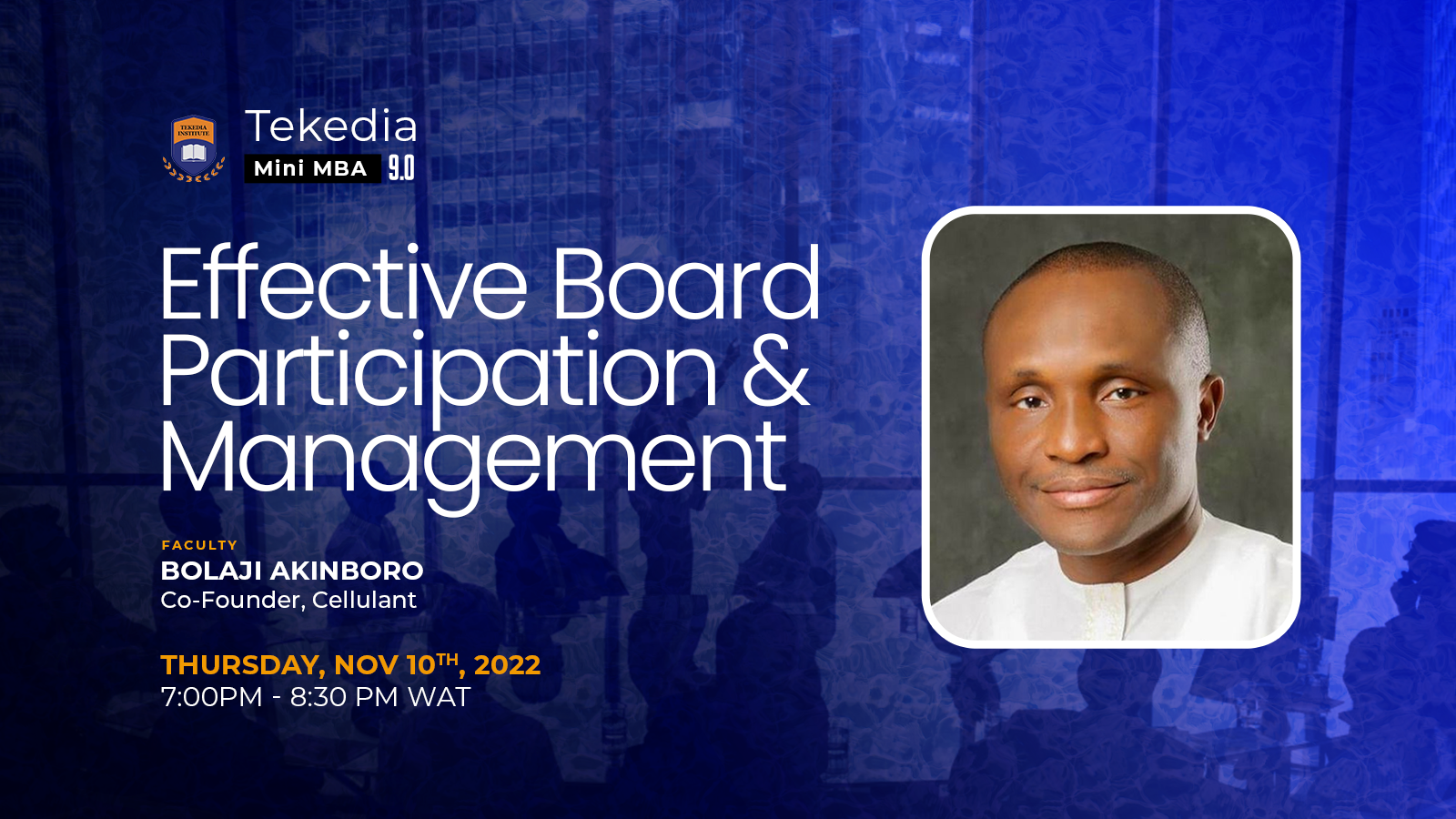
Effective Board Participation & Management at Tekedia Mini-MBA

0

He needs no introduction because he is one of the pillars of the modern financial operating system in Africa, just as the blood and the spinal cord are to the central nervous system. Bolaji Akinboro, co-Founder of Africa’s pioneering fintech giant, Cellulant, will be in class tomorrow to teach “Effective Board Participation & Management “ at Tekedia Mini-MBA. He is now the co-founder of T??r??Net & chairman of Voriancorelli.

Yes, we want you to understand how to serve and be served in the Board! With his friend, Bolaji co-founded Cellulant in 2004 (yes, 2004), and today that company has served our continent. They faced bottlenecks, being pioneers in that nascent industry, but they triumphed. This is a very important course in Tekedia Institute. Zoom link in the Board.

Tekedia Institute >> learn from the best.

(Tekedia Practice, Tekedia Industries, Tekedia Startup Masterclass, etc, learners, request access from Admin).

The Principle of Probable Cause

0

The principle of probable cause has been enshrined in most Constitutions of the world as a way to curtail the excessiveness and abuse of powers of law enforcement agencies, especially, that of police officers.

It has been provided that the privacy of individuals should be respected at all times and their privacy can only be invaded on probable cause or legal reasonable justifications.

This principle is of the effect that it is illegal for a law enforcement agent to randomly stop and search any individual; his person or his property without a probable cause or reasonable justification, if not it will amount to harassment and invasion of privacy which is an infringement on the fundamental right to privacy of the citizen.

The phrase probable cause as a legal principle took its root in the constitution of the United States in the Fourth Amendment, and it provides thus; “The right of the people to be secure in their persons, houses, papers, and effects, against unreasonable searches and seizures, shall not be violated, and no Warrants shall issue, but upon probable cause, supported by Oath or affirmation, and particularly describing the place to be searched, and the persons or things to be seized”.

In Nigeria, the fundamental right to a citizen’s privacy is provided for in S.37 of the constitution of the federal republic of Nigeria, 1999, and it reads thus; The privacy of citizens, their homes, correspondence, telephone conversations, and telegraphic communications is hereby guaranteed and protected.

Subsequently, the Administration of the Criminal Justice Act, 2015 provides that before a search is to be conducted on a person or his property, the law enforcement agencies that intend to carry out this search must first apply to the court for a search warrant, telling the court that they have probable cause or reason to believe that the citizen or his property is involved in a crime hence why they need to conduct the search. If the law enforcement agency fails to successfully show that it has probable cause to carry out the search the court is at liberty to deny granting the search warrant.

Therefore, Probable cause as a legal principle simply means “the reasonable grounds to believe that a particular person has committed a crime or is about to commit a crime to justify conducting a search on him or on his property.

If a police officer cannot show that he has a reasonable ground to believe that a person has committed a crime or is about to commit a crime or is in possession of criminal elements thereby giving that police officer the probable cause or reasonable ground to conduct a search on that individual, that police have committed a crime of encroachment of the fundamental right to privacy of a citizen.

Think outside Nigeria and expand that business offshore

2

I was in UBA House in a meeting when the CEO dropped a line which shaped how I have seen the playbook of expanding outside Nigeria. Former UBA boss, Kennedy Uzoka, had noted that UBA Africa (UBA operations outside Nigeria but within Africa) was a money maker. Today, we’re learning that 84% of Access Bank* profit comes from its offshore operations: “Nigeria’s largest bank by total assets, Access Bank, raked in N123.9 billion in profits from its foreign operations in the first 9 months of 2022 as the bank’s aggressive investments outside Nigeria continue to pay off.”

Indeed, excluding South Africa, within sub-Saharan Africa, Nigeria is the most competitive market. And because of that competition, companies do not have the freedom to pack gross margins anyhow without the risk of losing customers. But when you move outside Nigeria, the quasi-blue ocean becomes evident. More so, the costs of doing business in some of those countries are lower (no diesel generator, etc) and you can keep most of what you make.

Good People, what is your growth strategy outside Nigeria? Has it ever occurred to you that in Senegal, through a solid partnership, you can outperform whatever you are doing in Nigeria? Most of these economies are still in their infancy levels, and margins are super-high.

Indeed, if the banks think profits abound outside Nigeria, trust that data. Access Bank* possibly has less than 20% of its workforce outside Nigeria, but is picking 84% of profit from those. Think outside Nigeria and expand that business offshore.

Ghana leads the pack: Apart from Access Bank Guinea and South Africa, all the bank’s foreign operations reported a pre-tax profit with Ghana reporting the highest at about N31.6 billion.

  • This compares to the N34.1 billion pre-tax profits reported in Ghana for the whole of 2021.

  • The UK operations also did very well in the first 9 months of this year reporting N22 billion compared to N22.6 billion reported in the whole of 2021.

  • Access Bank Ghana’s operations are the largest outside Nigeria with about 52 branches as of 2021.

Fintech: Kuda Makes Major Expansion Drive in The U.K With Remittance Offerings

0

Nigerian Digital bank Kuda has made a major expansion drive in the U.K by offering remittance products for Africans.

Due to the myriad of problems in remitting money to Africa, Kuda seeks to offer users convenience with zero transaction fee, while setting a flat fee of £3 transfer limit for £10,000.

The fintech firm disclosed that it expects most of the transactions that will take place on its platform to fall between £350 to £500.

Speaking on the firm’s remittance expansion to the U.K, Chief executive officer of Kuda Babs Ogundeyi said, “Africans in the UK are faced with barrier after barrier when it comes to financial services, from challenges setting up accounts to prohibitive and inconsistent fees on meaningful transfers.

“They are forced to limit each transfer to a few hundred pounds to avoid losing money or face escalating exchange rates with bigger transfers. But for us, it’s not just a remittance play. There’s a user experience, convenience, and price factor involved too.

To that end, Kuda is adopting a different approach that doesn’t involve charging transaction fees. Kuda is entering the U.K. market by setting a flat fee of £3 with a transfer limit of £10,000. Kuda expects most of the transactions that will take place on its platform to fall between £350 to £500.

“Ultimately, Kuda is building a one-stop shop for Africans, including other services outside remittance. And our plan is not just for Africa, but for Africans everywhere.

“The U.K. is the first of the ‘outside of Africa’ destinations. We plan to be in other African countries and expand the remittance services to customers there and the diaspora market.”

Unlike its remittance product, which might have been built in-house, Kuda, like many neobanks, will rely on a third party, usually a banking-as-a-service platform, to provide these financial services.

The fintech firm disclosed that it would save Nigerians millions, as well as other African countries that suffer similar expensive payments. It also revealed its plans to provide direct debits and local transfers to Nigerians in the U.K. down the line.

Last year, the firm raised a $55m Series B funding round led by Valar Ventures and Target Global which saw its valuation at $500m. This funding has so far helped the firm to expand its focus.

EFCC Appeals Court Judgment Committing Its Chairman Bawa to Prison

0

Nigeria’s anti-graft agency, the Economic and Financial Crimes Commission (EFCC), has appealed the judgment of an Abuja Federal High Court that convicted its Chairman, Abdulrasheed Bawa for contempt of court.

Bawa told journalists that he has taken the step to appeal judgment after Justice Chizoba Oji ordered the Inspector General of Police to see that the EFCC boss gets sent to prison.

Speaking on the development, the EFCC spokesman, Wilson Uwujaren, said in a statement that the order of Justice Oji came as a surprise to the agency. He said the judgment that resulted in sending Bawa to prison for contempt of court happened three years before he became the EFCC’s chairman.

The court had in a November 21, 2018 court ruling, ordered the EFCC to release seized property belonging to Air Vice Marshal Rufus Adeniyi Ojuawo, after it found him not guilty of the charges leveled against him by the anti-graft agency. The property include N40 million and a Range Rover Sport (Supercharged) Ojuawo was accused of corruptly receiving as gratification from one Hima Aboubakar of Societe D’Equipment Internationaux Nigeria Limited.

Uwujaren explained that despite inheriting the judgment, Bawa has released the Range Rover Sport and is working to see that the N40 million is returned to Ojuawo.

“This ruling is surprising, as it creates a wrong impression of the person of the Executive Chairman of the EFCC as encouraging impunity. As far as the relationship between the EFCC and the judiciary is concerned, the Executive Chairman, Mr. Abdulrasheed Bawa, has been an apostle of rule of law, due process, and close collaboration between the two institutions in justice administration.

“As an investigator, and the only chief executive of a law enforcement agency, who regularly goes to court, the executive chairman will not tolerate impunity or disregard any lawful orders of court. Abdulrasheed Bawa, in his capacity as Executive Chairman of the EFCC since March 5, 2022, did not disregard any order of court.

“For the benefit of the public, the said order of the FCT High Court was given on November 21, 2018, three years before Abdulrasheed became EFCC Chairman. This fact is germane as the contempt process is quasi criminal in nature and must be served on the person involved. In this case, Bawa as incumbent chairman of the EFCC, was neither served form 48 nor form 49.

“Despite this fact, the executive chairman, upon being aware of the said order of November 21st 2018, had released the Range Rover in question to the Applicant on the 27th of June, 2022 and had approved the process of the release of the remaining N40m.

“Taking into cognisance the procedural lapse in the contempt proceedings, the commission has initiated a process to set aside the entire contempt proceedings and committal of the executive chairman for contempt.

“Despite the discomfort of this ruling, which is seemingly promoted by misinformation, the commission remains committed to working closely with the judiciary in furtherance of the fight against economic and financial crimes in Nigeria,” the statement said.

Explaining why he failed to execute the order of the court respecting Bawa, the Inspector General of Police, Usman Alkali, said he was not aware of the October 28 judgment that committed the EFCC boss to prison for contempt of court.