DD
MM
YYYY

PAGES

DD
MM
YYYY

spot_img

PAGES

Home Blog Page 4849

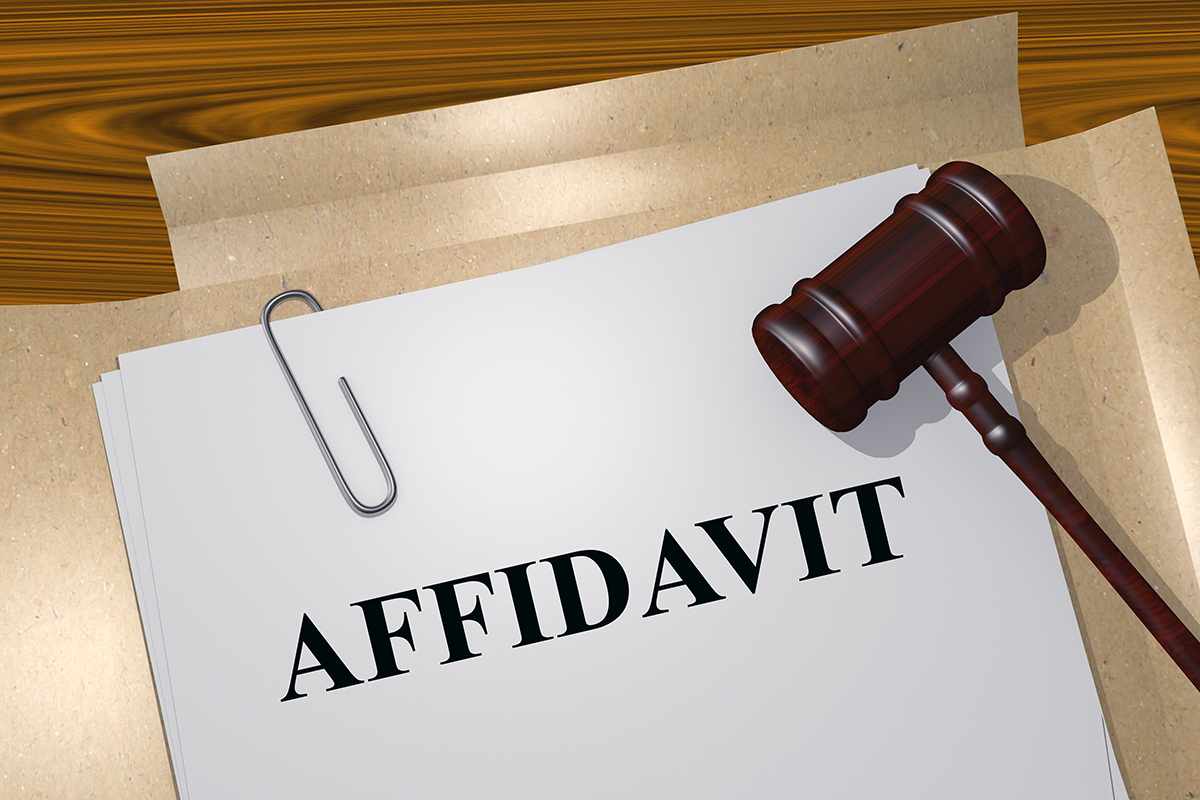
An Affidavit; What it truly is

0

I was drafting an affidavit for a client this morning and it occurred to me that many people (including the client that needs the affidavit) have no slightest clue of what an affidavit is. Some just know that it is a legal document obtained from the court or from a lawyer who is a notary public but it is more than that.

The word Affidavit is derived from the Latin word “Afihdayvit” which when loosely translated means “for he has declared or stated under oath”.

An Affidavit, therefore, is a written statement voluntarily made by a person called the affiant or the deponent under oath or affirmation which is administered by a person who has been authorized by law to do that which can either be a notary public or an official of the court known as the commissioner for oaths.

By law, for an affidavit to be authorized by the commissioner for oath or the notary public, the deponent must be present to have sworn or adopted the written statement in person. This is to say that it is illegal for another person to swear an affidavit on behalf of another person or for an authority to authorize an affidavit in the absence of the deponent.

Because an affidavit is a type of verified statement showing, or containing a verification, it is therefore made under oath. It is believed that when a deponent swore to an affidavit the statement he makes is true and he believed all the acts stated therein to be true (to the best of his knowledge) because he is under oath and lying under oath is a serious criminal offense called perjury.

So as not to be held liable for the crime of perjury, you are therefore advised that before you sign an affidavit read the document thoroughly to ensure that the information written therein is accurate and truthful.  If the affidavit includes any statements that are just mere opinions, conjectures, or beliefs of the deponent, it needs to be stated that such paragraphs or statements are just an opinion or honest beliefs of the deponents which may or may not be the truthful representation of the facts.

You can use an affidavit to correct or change the content(s) of an official document.

Some common forms of affidavit may include but are not limited to the following;

* Court affidavits

* Affidavit of non-membership of a secret cult.

* Self-proving will affidavit.

* Affidavit of power of attorney.

* Financial affidavit.

* Affidavit of a lost document.

* Affidavit of identity theft.

* Affidavit of loss of property

* Affidavit of change or correction of details

An affidavit can be simplified to be the written version of swearing under oath, to tell the truth.


Ndubuisi Ekekwe To Speak at Ecobank Group Financial Webinar

0

The global market systems are undergoing major redesigns as a result of many perturbations triggered by covid-19 and Russia-Ukraine war. Inflation is high and central banks are fighting with many tools. As the fights continue, investors are seeing many dislocations as those monetary and economic policies push positionings of asset classes.

Next week, I will deliver a presentation on How to Rise above Rise in Price at Ecobank Group’s Financial Webinar. Register free here – https://lnkd.in/eYqNCh-n


MTN Named The Best Network in Sub-Saharan Africa

0

Multinational mobile telecommunications company MTN has been named the best network in sub-Saharan Africa, according to data from Ookla and UmlauT.

With billions of tests and counting, Speedtest by Ookla the global leader in internet performance testing and metrics used insights from its data platform, “Speedtest,” to measure four network providers in Sub-Saharan Africa which are Airtel, MTN, Orange, and Vodacom, which also account for 62% of internet subscriptions in Sub-Saharan Africa.

This test was conducted to determine which network providers have the fastest internet speeds and which cities have the fastest internet connections.

After the test was completed, MTN South Africa came in the first position with a median download speed of 65.95 Mbps, followed by Vodacom South Africa and Safaricom Kenya, with median download speeds of 48.71 Mbps and 36.25 Mbps, respectively.

When the internet download speeds of major African cities were conducted, Vodacom Johannesburg took first place with a speed of more than 81 Mbps while MTN Cape Town and MTN Johannesburg came in second and third, with speeds of more than 60 Mbps in both cities respectively.

The report also revealed that in Nigeria, MTN’s median download speed is currently at 26.3 Mbps.

MTN outperformed Orange in Côte d’Ivoire and Vodacom in South Africa, both in terms of median download and upload speeds. While MTN had faster download speeds in the Democratic Republic of the Congo, MTN outperformed Airtel in Rwanda in terms of median download speed.

MTN Nigeria once again outperformed Airtel in terms of 4G availability, with MTN having 83.8% 4G availability against Airtel’s 77.9%.

Recall that MTN last month launched its 5G network in a few cities in Nigeria, showing its readiness to offer Nigerians the best of service with 5G technology making it the first telecom operator in the country to roll out 5G technology services on its network.

According to the company, the implementation of the 5G network was to accelerate the actualization of the national targets in the Nigerian National Broadband Plan, the National Digital Economy Policy and Strategy, as well as other sectoral policies designed to enhance Nigeria’s digital transformation.

MTN is no doubt the largest mobile network in Africa, in terms of indigenous networks, where the top five are owned and operated by non-African companies.

With a subscriber base of 152.3 million, the company employs 17 509 workers, operating in 21 African countries, including South Africa, Nigeria, Ghana, Sudan and Congo.

In-house Legal Counsel in Nigeria – All You Need To Know

0

In procuring Legal services, there is usually a set of various delivery platforms through which as a client or employer you can access those legal services. One of the most commonly used Legal service providers however is the In-house Legal counsel, a type of lawyer that will be the focus of this article.

What this article aims to do is deal with the topics of :

-Who exactly an In-house Legal counsel (or In-house counsel) is.

– The purpose of hiring in-house counsel.

– The functions/duties of an In-house counsel.

– The legal services an In-house counsel can & cannot render in Nigeria.

Who is an in-house counsel?

An in-house counsel is a type of lawyer hired as a salaried & usually full-time internal employee of a company, organisation, agency or corporation for the purpose of performing a set of defined legal functions/services.

Why hire in-house counsel?

You might need to hire an in-house counsel for the purpose of having in a standby position, readily available legal assistance for the purpose of greatly reducing the Legal risk & compliance portfolio of your business or organisation.

What are the functions of an in-house counsel?

The functions of an in-house counsel are :

– the rendering of general & industry-specific Regulatory compliance services to their employers;

– to render legal advisory services to their employers;

– rendering dispute/litigation management services to their employers;

– rendering contractual & legal documentation vetting services for their employers;

– rendering corporate governance and company secretarial services to their employers;

– rendering legal audit and external solicitor/retained external counsel management and liaising services to their employers;

– rendering representation services in courtroom and dispute resolution proceedings as agents of their employers.

Are there legal services that in-house counsel cannot render in Nigeria and if they exist, what are they?

Yes, such services exist. In-house counsel are also governed by the Rules of Professional Conduct for lawyers in Nigeria and as such, cannot render the following services to their employers :

– the rendering of documenting Legal opinion and contractual documentation/signing services for their employers;

– where being employed as military officers, appearing in court martial proceedings in lawyer robes and gowns;

– preparing Deeds of Assignment and Land sale documentation services for their employers;

– aiding the unauthorized practice of law (mainly in the form of acting as retained counsel to their employers and preparing legal documents for their employers while in fact being salaried staff/in-house counsel of the company);

– appearing in court robed in a lawyer’s wig and gown while still being in-house counsel;

– allowing their employers to engage in the touting of their services and charging fees for those services(this is a very rampant practice among Real Estate Development companies and Mortgage banks in Nigeria). 

Is it possible to hire in-house counsel on a contract/non-salaried basis?

Yes and no. This is because while you can hire a lawyer or law firm as an outsourced or seconded Legal adviser/manager, such legal counsel will either not be working full-time or as your internal employee, which is basically what in-house counsel are. You thus need to know exactly what suits your business needs in terms of relevance, competence and affordability.

What is the legal effect of a contract or documentation prepared and signed by an in-house counsel?

Such a document will be voidable as it will constitute unauthorized practice of law and such an in-house counsel risks professional suspension and disbarment. Any employer aiding such unauthorized practice of law also risks a 2-year jail term under the Legal Practitioners Act of Nigeria.

Conclusion :- It can be seen that the In-house counsel is a legitimate and innovative model for the delivery of always available legal services for the purpose of Legal risk management for many companies, although they are not applicable to every situation requiring legal input. 

Nigerian Senate Approves Buhari’s N8.4trn Borrowing Plan

0

The Nigerian Senate on Wednesday approved the N8.4 trillion borrowing plan presented to it by President Muhammadu Buhari, aimed at funding fuel subsidies in 2023.

The approval defied the recommendation of the Senate Committee to slash the N3.6 trillion mapped out for the subsidy to N1.7 trillion. Buhari is to present N19.76 trillion 2023 Appropriations bill to the joint session of the National Assembly on Friday.

The N3.6 trillion subsidy fund is to cover from January to June 2023, when the Buhari administration has set to end the subsidy regime. The N3.6 trillion was factored in the 2023-2025 Medium Term Expenditure Framework and Fiscal Strategy Paper (MTEF/FSP).

The Minister of Finance, Budget and National Planning, Zainab Ahmed, had in August, told the House of Representatives’ Ad Hoc Committee investigating the Petroleum Products Subsidy Regime from 2013 to 2022, that not ending the subsidy means that the federal government will have to borrow more than N6 trillion to offset the budget deficit that will result from it.

“One thing that stands out in the Medium Term Expenditure Framework was that if the nation holds on to fuel subsidy as it is designed now, we will be incurring from January to December, a subsidy cost of N6.4tn. But we suggested to the Federal Executive Council, and the council approved that, maybe, we could look at the option of exiting the subsidy (regime) half year. So, if we did that, then the cost would be N3.35tn, which is half of the N6.7tn,” she said.

The Senate Joint Committees on Finance and National Planning and Economic Affairs, which worked on the fiscal document, had recommended that the cost of petroleum subsidy be capped at N1.7trn in 2023. This is after Ahmed informed the Committee that under-remittance from revenue-generating agencies have made it impossible for the government to fund the subsidy in 2023 without borrowing.

However, the Senate approved a fiscal deficit of N11.3 trillion, projected revenue of N9.352 trillion and new borrowings of N8.437 trillion (including foreign and domestic borrowing), subject to the provision of details of the borrowing plan to the National Assembly.

In addition, the Senate approved an increase in the oil benchmark from $62 to $73 per barrel and a daily oil production of 1.83 million barrels per day, an increase from the current oil output that has fallen below 1mbpd.

In its recommendation, the Senate also gave a nod to the exchange rate of N437.57/US$1 and the projected Gross Domestic Product (GDP) growth rate of 3.75%; as well as 17.16% inflation rate.

The red chamber of the national assembly also consented to the Statutory transfers totaling N722.11 billion; Debt Service estimate of N6.31trn; Sinking Fund to the tune of N247.7bn; Pension, Gratuities and Retirees Benefits of N827.8bn.

Nigeria’s revenue growth has been dampened by some factors that have apparently slipped out of government’s control. At the helm of these factors is crude oil theft.

On Tuesday, the Chief Executive of Nigeria National Petroleum Company Limited (NNPC), Mele Kyari, revealed that the company has uncovered an illegal 4km pipeline that has operated undetected in the past nine years, from the Forcados export terminal Delta State into the sea, exporting about 250,000 barrels of oil per day.

“Oil theft in the country has been going on for over 22 years, but the dimension and rate it assumed in recent times is unprecedented,” Mr Kyari said.

The Senate President Ahmad Lawan said based on observations and findings made by the Senate Committee, Nigeria is in a war situation as far as crude oil theft and under-remittance of revenue by many of the MDAs are concerned.