DD
MM
YYYY

PAGES

DD
MM
YYYY

spot_img

PAGES

Home Blog Page 4856

Nigeria Moves to Replace ASUU with Breakaway Faction CONUA

0

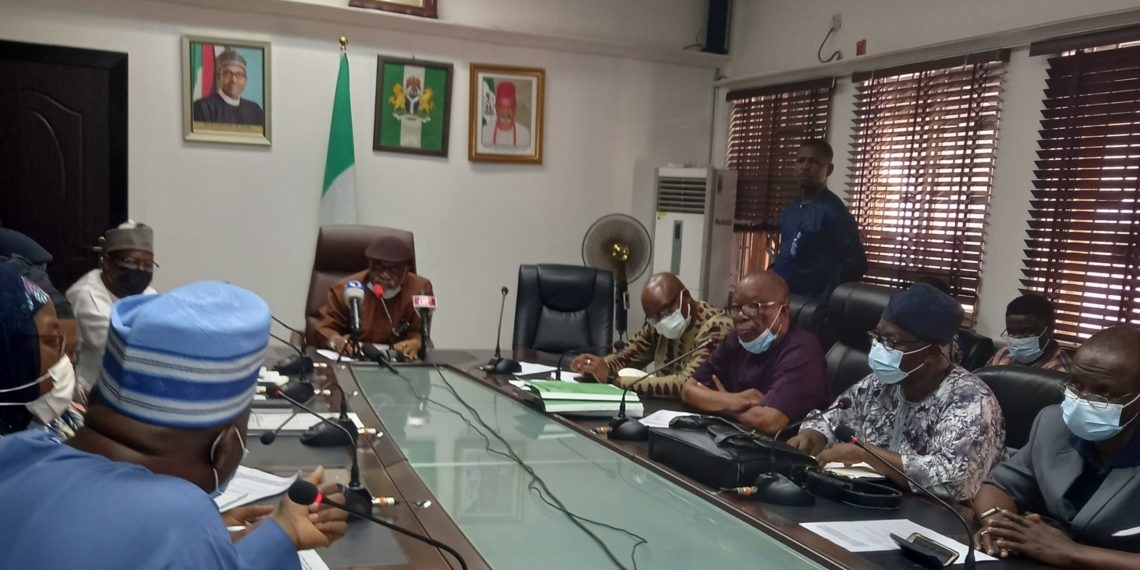
As the controversy between the federal government and the Academic Staff Union of Universities (ASUU) nears its eighth month, the government has moved to replace the union with its breakaway faction.

Daily Trust reports that Congress of Nigerian University Academics (CONUA), a breakaway faction of ASUU, has been officially registered as a trade union in a move to reopen academic activities in public universities.

According to the report, a source at the Ministry of Labour and Employment had revealed on Tuesday, that the Minister of Labour and Employment, Chris Ngige, will present a Certificate of Registration to the new union before the end of the day.

It was also reported that Ngige also issued certificates of recognition to National Association of Medical and Dental Academics (NAMDA).

Nigerian public universities have been on strike for seven months now. The striking academic workers under ASUU are demanding better welfare packages and funding among others for the universities.

The source said that the move by the government to recognize CONUA is part of processes to deregister ASUU as the newly registered body would represent Nigerian academics in discussions with the Buhari regime as a full-fledged labor union.

”The Minister, on behalf of the federal government will today present Certificate of Registration to the Congress of Nigerian University Academics (CONUA). With that, ASUU may cease to exist again in our universities,” the source said.

Repeatedly, ASUU and the federal government have failed to settle their differences. The bone of contention has been funding and the use of the union’s University Transparency and Accountability Solution (UTAS) instead of the government’s mandated Integrated Payroll and Personnel Information System (IPPIS) for salary payment.

In an attempt to reopen the schools, the federal government had previously deployed a no-work no-pay policy but it was defied by the ASUU. In September, the government threatened to deregister ASUU as a trade union over its alleged failure to submit its audited reports as required by law in the past five years. The Registrar of Trade Unions was said to have written a query to the ASUU, asking why its certificate of registration should not be withdrawn for breaking the law.

In a further attempt to force the striking workers back to work, the government last month filed a lawsuit against ASUU at the National Industrial Court and won. The court, in an interlocutory ruling ordered the union to discontinue the ongoing strike until the suit is determined, citing education as a matter of national interest.

But ASUU appealed the judgment, praying for the stay of execution of the trial court’s ruling pending the hearing and determination of the interlocutory Appeal.

Government’s move to create a new academic union in the stead of ASUU appears like its final resort to solve the lingering crisis. The government has repeatedly said that it does not have the money to meet the N1.2 trillion that ASUU is demanding, and it’s also not willing to change its stance on the mandated use of IPPIS.

However, there is concern that this move will further complicate the matter as ASUU would likely seek a redress in court. Also, it will severely deplete the quality of education and the academic workforce of Nigerian public universities that is already below par.
African Startups Defy Global Economic Slowdown, Doubles Funding in First Half of 2022

0

Startups in Africa have no doubt recorded an exponential growth this year as they have continued to attract an increase in funding.

The funding for African startups is reported to have doubled in the first half of 2022, despite the global slowdown. The continent has defied all odds during this unfriendly economic period to record an increase in its funding.

Venture capital deals on the continent reached $3.5 billion in the first six months through June, more than double the amount recorded in the same period last year 2021.

The funds were raised by 300 companies, with 27% of the companies led by female founders, or having at least one female founder. This compares to 25% in the previous year.

The increase in investment of startups in Africa is largely driven by startups raising larger amounts to expand on the continent through organic means as well as acquisitions.

Kenyan-based e-commerce firm Wasoko, a startup transforming communities across Africa by revolutionizing access to essential goods and services, raised $125 million to expand Cote d’Ivoire and Senegal, and also Kenyan solar fintech M-Kopa raised $75 million to expand its operations in Ghana and Nigeria. 

African startups raised $3.1 billion in the first half (H1) of 2022, more than what they had raised in H1’2021 and H1’2020 combined, which amounted to $1.7 billion, setting a record in startup investment.

Funding raised in H1 2022 saw a double increase to what was realized in H1 of 2021, 2020, 2019, and 2018 which were $1.2 billion, $531 million, $454 million, and $169 million respectively.

It doesn’t come as a surprise that Fintech startups in the region have continued to attract the majority of investment inflows, accounting for 89% of deals in the financial sector.

While West Africa accounted for the largest share of deals by volume, East Africa recorded the strongest growth in its share of deal volume when compared to the previous year. 

Analysts and experts have disclosed that If the current trend continues, fundraising will hit $7 billion this year, 35% more than the $5.2 billion raised in 2021.

A total of $4.7 billion startup deals were done on the continent in the period driven by a significant amount of fresh capital raised by fund managers in 2021, increasing interest in Africa’s venture ecosystem and overall larger ticket sizes. 

The continent has also been described as the only market to see more than single-digit growth in the period, according to the report. Private capital investors achieved 22 full exits between January and June 2022, a 29% increase.

This compares to a 37% decline in exits globally as fund managers chose “to hold fast to their portfolio rather than risking divestment at unfavorable prices given falling valuations in public and private markets,” according to the report. 

Still, there are indications that deals will slow on the continent next year as private capital fund-raising declined 20% in the first half of 2022 to $700 million, the report shows. 

ARCON Case Against META (yes, Facebook) in Nigeria

0

Game on: “The Advertising Regulatory Council of Nigeria (ARCON) has sued Meta Platforms Incorporated, owners of Facebook, Instagram and WhatsApp platforms, for showing unapproved advertisements to the Nigerian audience…. In the lawsuit ARCON is seeking N30billion in sanction for the violation of the advertising laws and for loss of revenue as a result of Meta Incorporated’s continued exposure of unapproved adverts on its platforms.”

ARCON has been decimated. In 2018, one of the largest PR/OOH/advertising empires in Nigeria flew me into Nigeria to present an expert analysis of its sector to the Board.  I made a 3-hour presentation and concluded that “this industry is imperiled because the disintermediation is unbounded and unconstrained by geography and none of the industry players possibly will be able to build a moat to protect the decades-old castle. Your competitors are in America and your customers are already with them”. Read  here

This is not a bad lawsuit: it is necessary for the developing world since we do not control any of these platforms which are mopping all the opportunities in markets. Yet, I do not see how you can win it in Africa with our evidently weak positioning.

Comment on Feed

Comment: Sovereign agencies need to get to understand that there is now a virtual environment that breaks down sovereign barriers and homogenizes markets globally, but at the same time, has a drill down function to target niche collections of individuals.
This new ‘Wild West’ isn’t going to change. It is no longer possible to get protectionist in a specific geo market. The way to respond is to come up with a gorilla strategy to counter the perpetrator by contesting them at their core.
But just as ARCON feels the heat from Meta. Meta is still a dinosaur compared to blockchain enterprises, and its trying to find new clothes as quickly as it can.
That’s a hint for ARCON. Ndubuisi

My Response: “Sovereign agencies need to get to understand that there is now a virtual environment that breaks down sovereign barriers and homogenizes markets globally” – indeed, They are eating all the pizzas leaving locals with nothing

Nigerian Government Sues Meta For Unapproved Advertisement, Demands N30 Billion Damages

0

The Advertising Regulatory Council of Nigeria (ARCON) has sued Meta Platforms Incorporated, owners of Facebook, Instagram and WhatsApp platforms, for showing unapproved advertisements to the Nigerian audience.

In a statement it released on Tuesday, ARCON has confirmed that Meta together with its agent, AT3 Resources Limited has been charged for its negligence that has caused the Nigerian Government huge loses in the suit filed before the federal high court in Abuja.

In the lawsuit ARCON is seeking N30billion in sanction for the violation of the advertising laws and for loss of revenue as a result of Meta Incorporated’s continued exposure of unapproved adverts on its platforms,” the statement reads.

According to the Punch, the the apex regulatory body for Nigeria’s advertising ecosystem, ARCON is seeking a declaration that the continued publication and exposure of various advertisements directed at the Nigerian market through Facebook and Instagram platforms by Meta Platforms Incorporated without ensuring same is vetted and approved before exposure is illegal, unlawful and a violation of the extant advertising Law in Nigeria.

The cable also reported that the Nigerian advertising regulatory agency decried the continued exposure of the “unvetted” adverts which has led to a “loss of revenue to the federal government”. The agency reaffirms it would not permit unethical and irresponsible advertising on Nigeria’s advertising space.

According to ARCON, the Council is not regulating the online media space. Rather, it’s focus is on advertising and marketing communications on the online platforms in line with its establishment Act, the punch reported.

Google Shuts Down Its Translate Service in China

0

American tech companies are giving up efforts to stay afloat in China amidst censorship that has made their operations difficult.

On Monday, Google announced that it has shut down its Google Translate service in mainland China due to low usage, marking the end of one of its last remaining products in the South Asian country.

CNBC reports that the dedicated mainland China website for Google Translate now redirects users to the Hong Kong version of the service – but it is not accessible from mainland China.

“We are discontinuing Google Translate in mainland China due to low usage,” Google said in a statement.

Late last year, LinkedIn, the only American-based social media company allowed in China, announced that it’s shutting down its services due to growing censorship that had severely limited users’ freedom of expression.

This is the trajectory for American tech companies not outrightly banned in China, giving equivalent Chinese companies the opportunity to thrive.

CNBC noted that, like others, Google has had a fraught relationship with the Chinese market. For instance, in 2010, the tech giant pulled its search engine from China in because of strict government censorship online. Its other services — such as Google Maps and Gmail — are also effectively blocked by the Chinese government.

Local competitors such as search engine Baidu and social media and gaming giant Tencent have capitalized on the gap to dominate the Chinese internet landscape in areas from search to translation.

Google’s attempts to penetrate the Chinese market had met a brick wall due to the country’s strict rules and free speech advocates calling on tech companies not to enable China’s censorship by playing by their muzzling rules. CNBC reports below how in addition to censorship, the US – China soured relationship is adding to the ordeal of US tech companies in China.

Google has a very limited presence in China these days. Some of its hardware including smartphones are made in China. But The New York Times reported last month that Google has shifted some production of its Pixel smartphones to Vietnam.

The company is also looking to try to get Chinese developers to make apps for its Android operating system globally that will then be available via the Google Play Store, even though that’s blocked in China.

In 2018, Google was exploring reentering China with its search engine, but ultimately scrapped that project after backlash from employees and politicians.

American businesses have been caught in the middle of continued tensions in the technology sphere between the U.S. and China. Washington continues to fret over China’s potential access to sensitive technologies in areas such as artificial intelligence and semiconductors.

In August, U.S. chipmaker Nvidia disclosed that Washington will restrict the company’s sales of specific components to China.