DD
MM
YYYY

PAGES

DD
MM
YYYY

spot_img

PAGES

Home Blog Page 4880

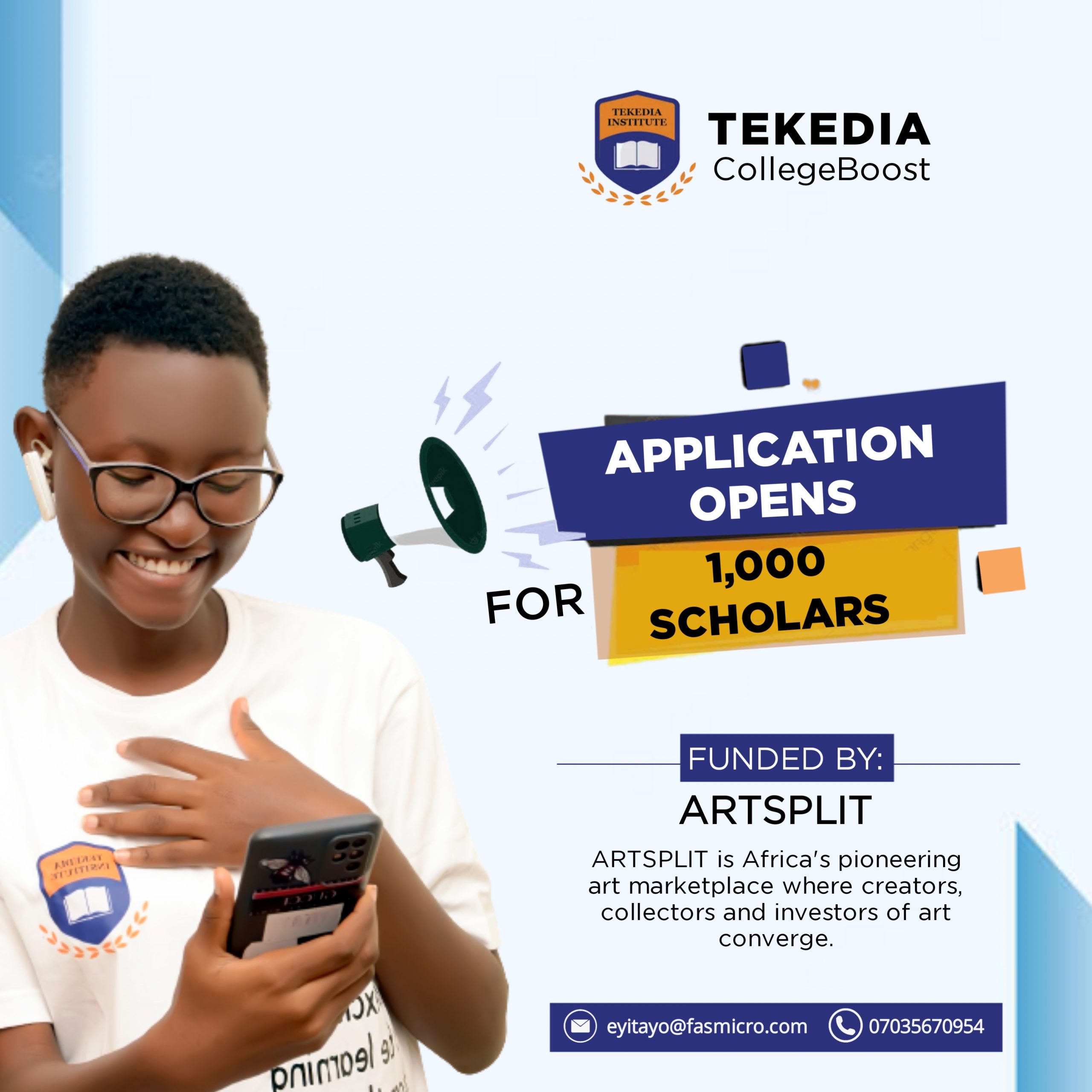
ARTSPLIT Funds 1,000 Tekedia CollegeBoost Scholarships for Undergraduates

0

Courtesy of an organization which loves creativity and innovation, Tekedia CollegeBoost (mini-MBA for students) has full scholarships for 1,000 college students (universities, polytechnics, colleges of education, etc) across Africa. ARTSPLIT is Africa’s pioneering art marketplace where creators, collectors and investors of art converge. Yes, you create and also buy within an amazing digital ecosystem the startup has created.

Thank you ARTSPLIT leaders –  Onyinye Anyaegbu, Nonso Okpala, Rotimi Awofisibe (ACA,ACITN) – Chartered Accountant –  for giving Tekedia Institute community this opportunity.

Students, here is the link to apply, all full scholarships courtesy of ARTSPLIT  . I hope to welcome everyone to class.

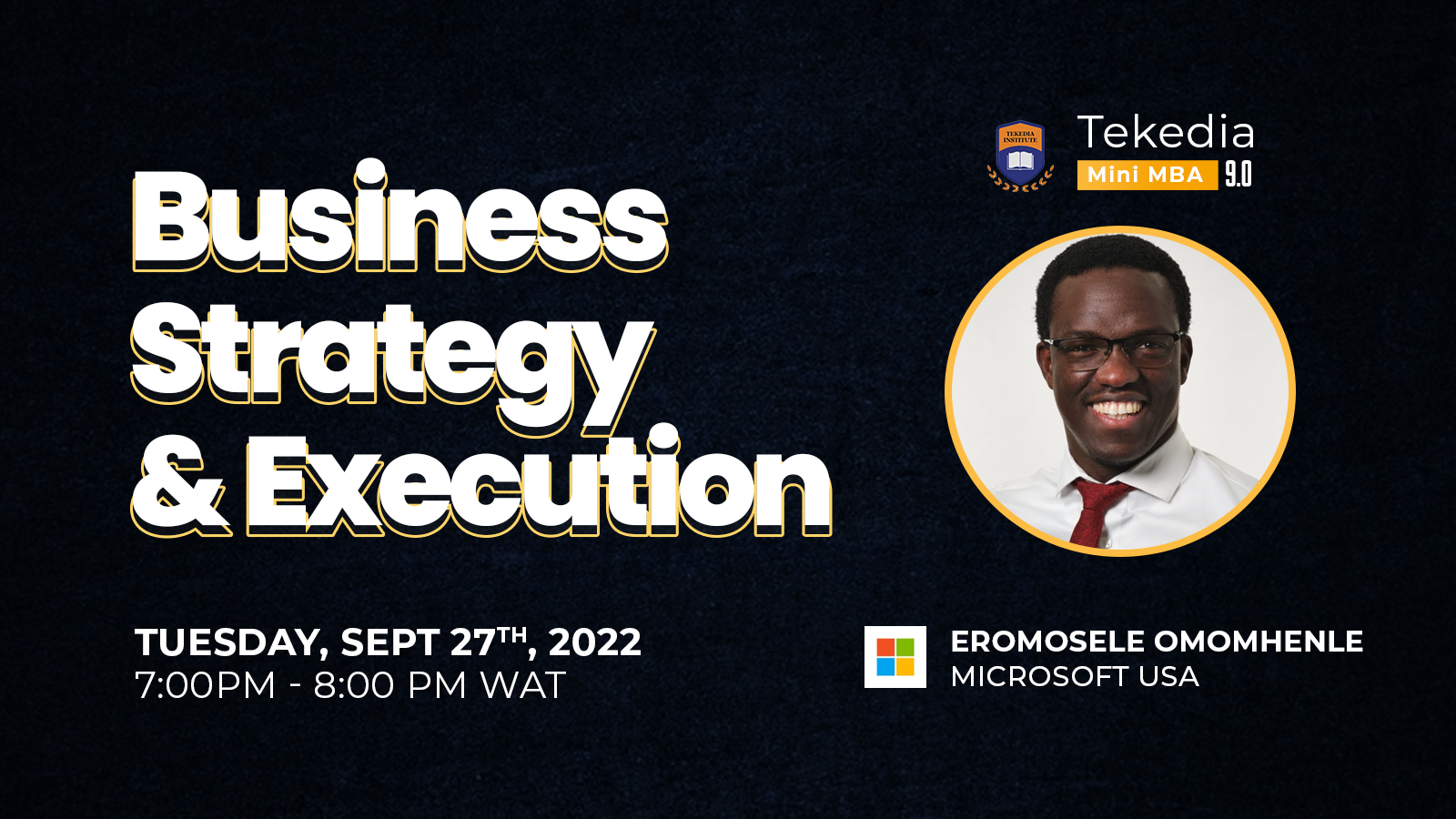
Business Strategy and Execution at Tekedia Mini-MBA

0

Tekedia Mini-MBA Live continues this week. Eromosele Omomhenle F.IMS, a Senior Manager, WW ISV Alliances and Partner Development at Microsoft USA will be teaching Business Strategy and Execution. Mr. Omomhenle leads the Global Strategy, Business Growth and Revenue Performance for Microsoft’s Top Global partners in the Business Applications Ecosystem.

What is your business strategy? How is that evolving as a result of changing market dynamics? How do you execute? And what can you do to make it better? Come to Tekedia Institute and master the mechanics of business strategy and how you can design, develop and apply one for your organization.

Tekedia Institute >> learn from the best!

ASUU-Nigeria Conflict: ACMAN Shares Insights On How to Fund University Education, Leveraging Capital Market Instruments

0

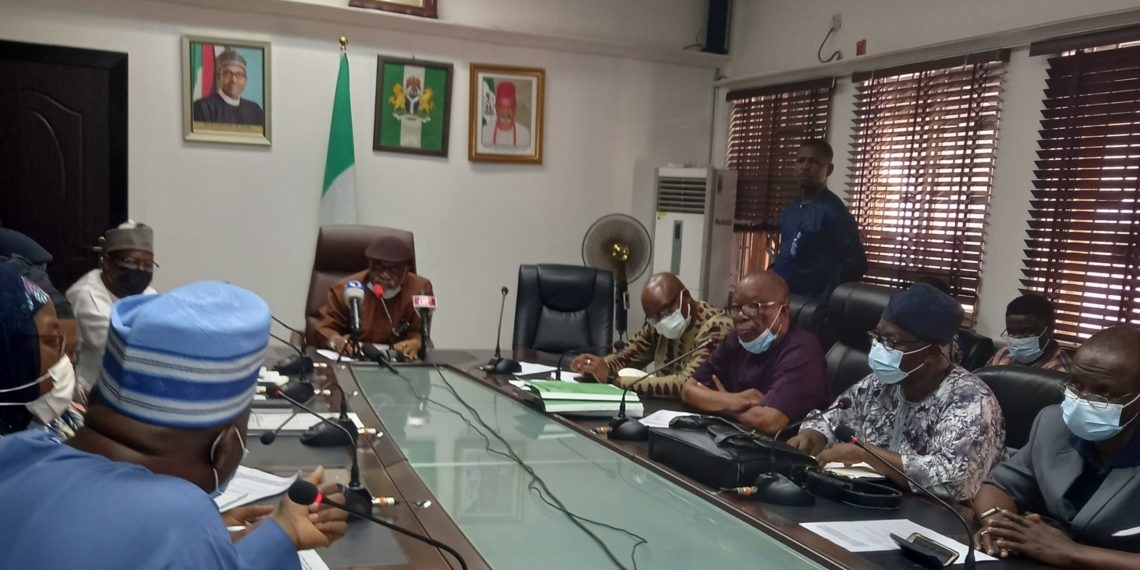
Public university education funding has been a major problem in Nigeria and a source of constant conflict between the Federal Government and notable academic and nonacademic pressure groups in the country. On several occasions the conflicts have been poorly managed, leading to months of industrial action by the union. This has had negative impacts not only on the Nigerian students in terms of delayed academic calendar but also on the overall economy due to incessant halt in university activities that have indirect economic impacts.

The ongoing face-off between the Academic Staff Union of Universities (ASUU) and the Federal Government has been over seven months and still counting, and there seems to be no end in sight. Concerned stakeholders have been challenged to seek permanent solution to the problem of funding to public universities and the incessant ASUU strike.

Based on the foregoing, the Association of Capital Market Academics in Nigeria (ACMAN) during its recent webinar on sustainable funding for universities has described the capital market as a viable and veritable platform where sustainable funding could be raised for both private and public universities in Nigeria. The capital market presents long-term funding opportunities that could be leveraged to raise high-volume capital for projects in the universities through issuance of bonds, experts suggested at the webinar.

Speaking at the webinar, Mr Suleyman Ndanusa, former director-general, Securities and Exchange Commission (SEC) and former pro-chancellor of Ibrahim Badamosi Babangida University in Niger State observed that at a time of huge financial crisis and national budget deficit, funding challenges for universities could only get worse, except urgent efforts are made to develop new value propositions and creative sources of funding in line with modern economic trends rather than the traditional source of funding. According to him;

“Nigerian universities can raise straight project tight bonds for students’ accommodation, alumni bonds/projects can be packaged to attract alumni investments, while new infrastructure can be funded through impact bonds.

“Instead of waiting for alumni members to give free money for projects, you can entice members with a bond they can invest and get returns but at the same time, creating resources for the university to do projects” he noted.

On his part, Oluwole Adeosun, president, Chartered Institute of Stockbrokers (CIS) noted that over-reliance on government direct funding is the cause of continuous lockdown of Nigerian universities, like the ongoing ASUU strike. According to him, while other competing priorities like health and infrastructure compete for government funding amid dwindling revenue, new funding initiatives for universities must to be developed to nip the current funding challenges with university education in the bud. According to him;

“The federal government should have the political will to exploit the capital market because it has the capacity to provide the much needed fund. I can tell you that there is N14 trillion of capital funds that is just placed in federal government bonds, then you borrow the entire funds that should have been used for development.

“Go to Chile, it is the pension fund that funds infrastructural development in Chile where we took this model of pension fund from. But here, 70 to 80 percent of the N14 trillion is directed at non-yielding projects. That is not where it should be. It should be tied to specific projects and those projects will pay themselves up over time.”

Speaking on new funding initiatives, Mr Adeosun said the capital market, in terms of issuance of government-backed university bonds on the stock exchange, would generate large amounts of money over time to finance different types of infrastructure in the universities.

Furthermore, universities can key into SUKUK as a viable source of funding for requisite research and development. This was suggested by Kabiru Dandago, federal commissioner of tax tribunal and former finance commissioner in Kano State, who also urged the government to refrain from seeing SUKUK as a debt instrument, but rather as an investment tool which can be utilised in advancing capital projects in Nigerian universities.

Universities can also go for an endowment fund which can be used to raise large amounts of funds that can be invested in capital projects usually in the capital market, Solomon Adebola, vice chancellor, Adeleke University, Osun State, said. He explained further that the endowment funds are usually placed in four main categories, including restricted endowment funds which can be invested in specified areas as dictated by the donor of the fund; unrestricted endowment funds which are to be used strictly at the discretion of the university; term endowment fund where the principal, not just the interest, is utilised after a specified period as given by the owner and the donor; and quasi endowment fund used to fund a specific purpose as given and dictated by the donor of the fund. According to him;

“Universities can also place commercial papers to raise funds in capital markets as specified by SEC and the regulations. They can invest in blue chip shares of corporate bodies and such shares are not to be kept in but could be held when the values have been seen to hold up and effectively optimised.

“We should note clearly that the funds that are generated must be re-invested in things like construction of hostels for students, in which case this will bring many more students and therefore raise more money in terms of school fees from the school and that can be used for other things” he added.

Seth Akutson, former vice chancellor, Greenfield University and first vice president, ACMAN, noted that ownership and management structure of universities play a key role in their ability to easily secure capture investment through the capital market. This often give most private universities better leverage since they are well placed to run as a business. He suggested that rather than engage in the technical aspect of running a business, universities can outsource their businesses to business experts who can run them efficiently and make profits while they focus on their academic and research activities. These outsourced businesses can then approach the capital market and get funding for such businesses on behalf of the universities.


Google CEO Defends Cost-cutting Measures As Workers Express Concern

0

Google CEO Sundar Pichai has come under fire from employees as they express concern over cost-cutting measures, as the company tries to navigate an unfamiliar environment of slowing growth and cost-cutting.

At a meeting held at the company, Google’s CEO was faced with tough questions from employees as they asked questions relating to cuts, travel and entertainment budgets, managing productivity, and potential layoffs.

It was reported that Sundar Pichai, CEO of Google, spent much of the meeting addressing concerns from its workers about the company’s cost-cutting actions.

In a response to the questions asked, the CEO however denied that the company is embarking on “aggressive cost-saving” but rather told its employees that they should not “equate fun with money” at an all-hands meeting this week.

The company’s spending came under scrutiny at the company-wide briefing in New York where Sundar Pichai said growth would be constrained going forward.

In response to a question asked from one of its employees that asked why the company was slashing travel budgets and making cuts in other areas even while the company was making and reporting profits and sitting on large cash reserves.

He said, “Look, I hope all of you are reading the news, externally. The fact that you know, we are being a bit more responsible through one of the toughest macroeconomic conditions underway in the past decade, I think it’s important that as a company, we pull together to get through moments like this.”

He further disclosed that the company was acting responsibly during one of the most difficult economic periods this decade and urged that staff pull together to help weather the storm.

What he said on cost-cutting

On cost-cutting, he said: “I remember when Google was small and scrappy. Fun didn’t always — we shouldn’t always equate fun with money. I think you can walk into a hard-working startup and people may be having fun and it shouldn’t always equate to money.”

On why the company has shifted from “rapidly hiring and spending to equally aggressive cost saving”, Pichai said, “I’m a bit concerned that you think what we’ve done is what you would define as aggressive cost saving. I think it’s important we don’t get disconnected. You need to take a long-term view through conditions like this.”

He further disclosed that Google was still pursuing investments in long-term projects like quantum computing and that it’s important to be “to be smart, to be frugal, to be scrappy, to be more efficient” in uncertain times.

Following the global inflation that ravaged economies of Nations, Google isn’t the only company that had to cut costs and slow hire, as several other tech companies massively laid off their employees.

It was reported that a total of 20,009 tech workers were laid off between May and June 2022 by global technology companies that are grappling with the ongoing economic meltdown. So far in 2022, tech companies worldwide have laid off a total of 35,000 workers.

Investors Pull Out Almost $140 Million From Digital World, After Plans To Merge With Trump’s Truth Social

0

Investors are pulling out millions of dollars from Digital World Acquisition Corporation, a company that intends to merge with Donald Trump’s Truth Social platform.

The special purpose acquisition company in a Securities and Exchange Commission filing, disclosed that investors have backed out of $140 million in commitments of the $1 billion previously announced by the company.

Following this move from investors, the company shares are currently trading at around $20, down significantly from $97 highs earlier this year, but still above the $10 liquidation price.

The investors who signed up for the deal about a year ago were able to back out if it was not completed by September 20.

Investors who walked away were however not disclosed in the filings, but it was reported that a company, Sabby Management, which planned to put in $100 million, has opted out.

Sources have disclosed that more investors may also withdraw their commitments now that the deadline has passed and are awaiting more favorable terms to be put to them by the company.

Digital World Acquisition Corp. has struggled to close the Truth Social merger deal and has previously blamed the SEC for delaying the deal amid criminal and civil investigations.

The Securities and Exchange Commission (SEC) started examining the deal in June over the possibility that Trump Media and Digital World had held discussions before the special purpose acquisition company (Spac) went public last year without informing the watchdog.

As a result of this, the directors of Digital World received subpoenas in June from a grand jury in the Southern District of New York.

Digital World has faced difficulty in getting sufficient shareholder approval for the merger and could be forced to liquidate and return investors’ cash if the deal is not completed.

The company however disclosed earlier this month its extension of deadline for completion by three months.

A key vendor had previously complained that Truth Social bills were going unpaid. A major web-hosting operator said Truth Social owed about $1.6 million in contractually obligated payments, an allegation suggesting the operation’s finances are in significant disarray.

In another setback, Truth Social’s application for a trademark was turned down last month because its name was too similar to other operations.

Truth Social is hardly the juggernaut some investors had hoped. The social media platform is largely a forum for Trump, who repeatedly posts messages touting himself and reposts articles from right-wing media praising him each day.

Trump launched Truth Social after he was booted off Twitter in the wake of the Jan. 6, 2021, riot at the U.S. Capitol. Ever since then, Trump has been using the Truth platform much as he did with Twitter to hit back at his enemies, also stating how he won the 2020 U.S presidential election which brought in President Joe Biden.

Last month, Digital World warned in an SEC filing that a dip in Trump’s popularity could hurt the business. The filing noted that Truth Social’s success hinges on the “reputation and popularity” of the investigation-plagued Trump, who chairs the Trump Media and Technology Group, which owns and operates the social media platform.

The SEC filing reads, “In order to be successful, TMTG will need millions of those people to register and regularly use TMTG’s platform,” the filing warned. “If President Trump becomes less popular or there are further controversies that damage his credibility or the desire of people to use a platform associated with him,” the planned merger with Digital World “could be adversely affected”.