DD
MM
YYYY

PAGES

DD
MM
YYYY

spot_img

PAGES

Home Blog Page 4880

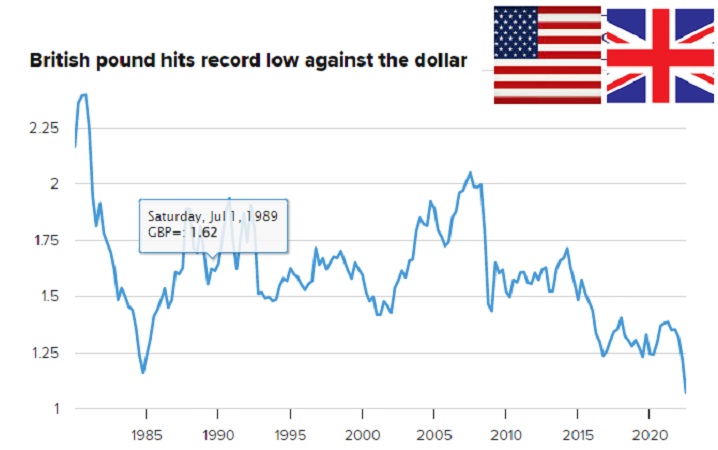
As US Dollar Envelops British Pound; the Lesson from Uwadiegwu

1

Possibly by December 2023, the US Dollars would be stronger than the Great Britain Pound. You can blame Russia’s war in Ukraine and the associated impacts on global energy prices. Also, you can add the impacts of Brexit – and the recently announced century-old conversative playbook of tax cuts in a drying treasury.

But here is the deal: the biggest challenge for Britain in the league of G7 (and G20 extension) is that since 2000, no British company has joined Fortune Global 500 (hope I am right!!!). Most of the ones there are century old companies which Britain used its imperial power to grow.

When innovation stalls, currency struggles. It is as simple as that. The US dollar is the safest currency to store wealth at least this decade because with companies like Apple, Google*, etc, America has a great defense no matter what happens in Washington DC.

Do not worry about the US debts that much. You know why? The debt is denominated in US currency which means they can zero-out the obligations in many ways unlike other countries which have to earn USD to pay their dollar debts.

In an Igbo novel (Uwadiegwu), the man dropped a great hint: when you borrow, go to your kinsman so that if the debt goes bad, he may lock you up but at the same time he would be expected to take care of your family since he is your kinsman! That is how debts work: pains are lesser when the debt is home.

Russia’s war on Ukraine will cost the world $2.8 trillion by the end of 2023, said the Organization for Economic Co-operation and Development (OECD), adding that the fallout has caused it to cut its growth forecast for the global economy — again. The 38-member intergovernmental forum now expects global GDP to grow 3% this year, and 2.2% in 2023, compared to pre-war projections of 4.5% growth in 2022 and 3.2% in 2023. Even though the war’s ripple effects have hurt food and supply chains globally, the OECD warns Europe risks paying a heavier price if energy shortages worsen this winter. (LinkedIn News)

Comment on Feed

Comment 1: Thank you for your insight. On britian, you are spot on! On Europe, data available says the last decade has seen a surge in European markets and economies led by Germany and a few others. This growth undoubtedly was powered by cheap energy from Russia. Germany at the epicentre of Europe enjoyed everything from discounted oil, coal to cheap gas. This lowered their production cost and give them production edge. Coupled with their technological advancement that rivals the west, the stage of trade manipulation was set, slowly, and carefully.

This regional growth continues to restructure globla trading map. The Eurozone despite certain challenges in a few member countries seem the most stable and the biggest winner of the last decade but they were silent about the quantum dislocation which the “evil oil” as labelled by UN seems to be providing.

China, was leading world growth from Asia from electronics, space to automobile. The visionary and strategic growth by these 2 giants worry many political and business leaders from the west, especially as this also translates to stronger political tie and economic transformation for Russia.
The west won’t watch helplessly, they mapped out a stealth offensive – to cut out the root – Russia.

Comment 2: It is long overdue. What is the strength of the Pound Sterling? What percentage of world production does UK produce? Their closure to others evident by the brexit will sink the country. There is serious trouble for UK and I don’t see a way out for them soon. Prosperity goes beyond human and economic theories, sometime, love and warmness play a great role in it. UK committed a grave mistake by deleting herself from EU. It’s time to face the long term impacts and results.
Nigeria’s Revenue Dropped to N885bn, The Lowest in A Quarter

0
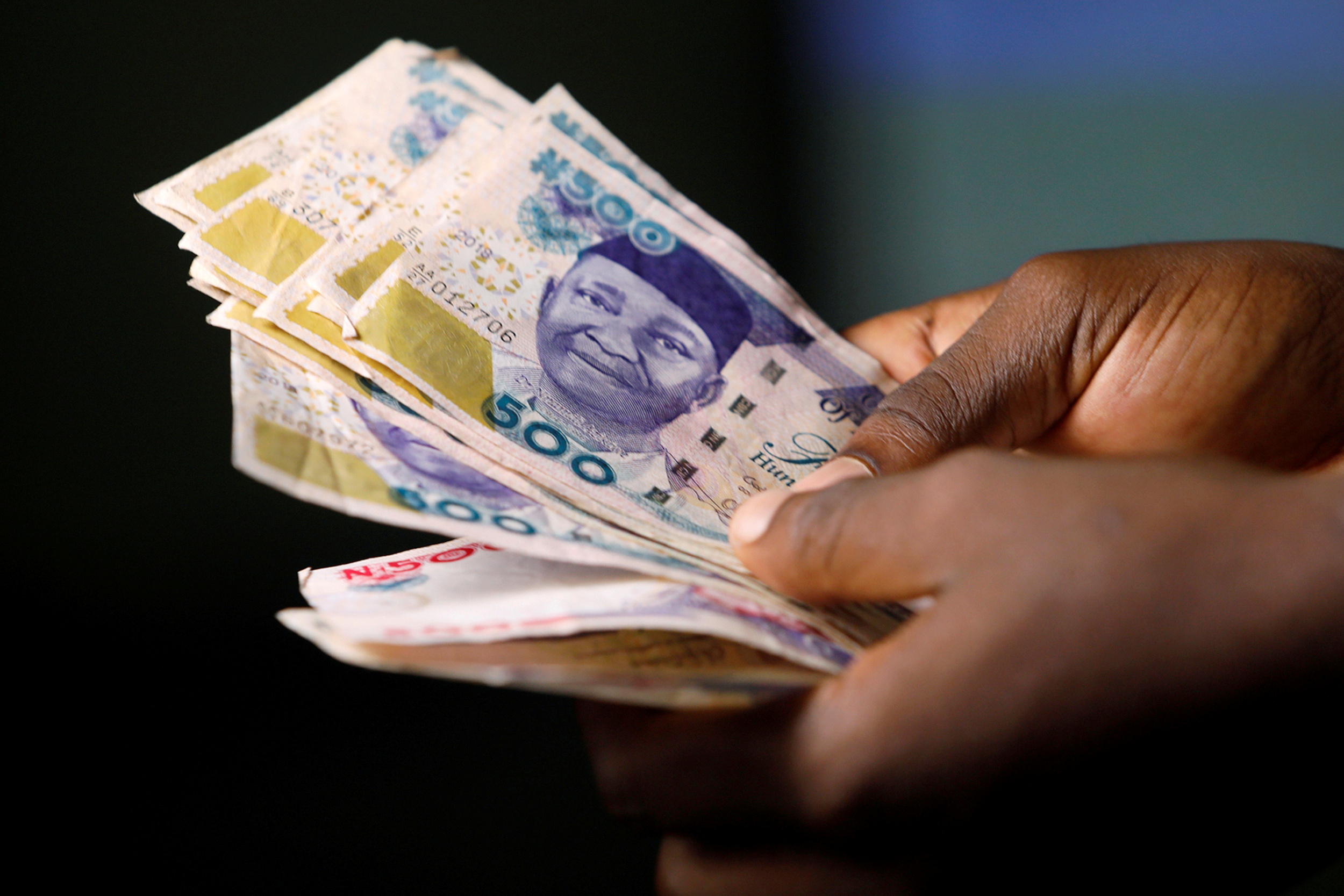
Nigerian naira banknotes are seen in this picture illustration, September 10, 2018. REUTERS/Afolabi Sotunde/File Photo

Nigeria’s struggle with revenue shortfalls has continued on its downward trajectory that has left the federal, state and local governments gasping for air due to the resulting financial crisis.

A report by The Cable shows that in August, the federation’s revenue dropped by N371 billion to N885.5 billion, according to the monthly Federation Accounts Allocation Committee (FAAC)’s report released by the office of the accountant-general of the federation on Friday.

The revenue drop, which is the lowest in three months, falls significantly short when compared with the preceding months. In the last two months, the country’s revenue topped N1 trillion, with N1.22 trillion and N1.26 trillion recorded in June and July respectively.

According to the report, the revenue shortfall represents a 29% dip in the monthly revenue when compared to July 2022 and 24 percent when compared to June 2022.

The report said the statutory revenues amounted to N654.36 billion, while value-added tax increased from N190.26 billion in July to N231.17 billion in August. Statutory revenues include collections by Nigerian Upstream Petroleum Regulatory Commission (NUPRC), Nigeria Customs and others.

The poor revenue impacted FAAC distribution for the month. The revenue distributed among the three tiers of government slumped by N280.948 billion to N673.137 billion when the N954.085 shared in July is not taken into account.

The federal government took the lion share, N259.641 billion; states received N222.949 billion, while the local government councils received N164.247 billion.

This underlines the depth of Nigeria’s revenue crisis that has forced the country to significantly increase its debt portfolio since 2015. The Africa’s largest economy is largely oil-based, but has struggled to cash in on the oil windfall orchestrated by Russia-Ukraine conflict. This is as a result of issues ranging from oil theft, pipeline vandalism and the importation of refined products.

With the remedy of the oil revenue shortfalls being borrowing, Nigeria’s total public debt has risen to N42.80 trillio, stirring concern that the country is heading into serious debt problem even though the Minister of Finance Zainab Ahmed has repeatedly allayed fears about the growing debt profile.

On Friday, Ahmed, while speaking at the Nigeria International Economic Partnership Forum in New York, said Nigeria only has a revenue problem, not a debt problem. She said that at $100.1 billion or N14.6 trillion “Nigeria’s debt is 24 percent of the nominal GDP and below 40 percent threshold set in the debt management strategy”.

“Nigeria operates a four-year rolling medium-term strategy which guides the borrowing strategy of the federal government. And we have specific indices that we closely monitor. The public debt that we set is 40 percent, and we are at 24 percent,” she had said.

However, experts are worried that downplaying the impact of Nigeria’s growing debt profile will only exacerbate the economic strains, especially in the future. The non-oil sectors of the economy – farming, ICT etc have failed to make up for the gap created by the drop in oil revenue. This has resulted in the federal government borrowing to service debts.

Earlier this month, the Minister told Senate Committee on Finance that Nigeria’s 2023 budget is expected to have a N12.43 trillion deficit due to import duty waivers and fuel subsidy payments, amplifying the concern that the country’s poor revenue situation will continue to affect governance in the future.

Nigeria needs better #leaders

0

President Buhari would have been the best president in Nigerian history if he was never an elected one . But since his second ascension into this job, many things have happened which you would not have expected from a former military general. In my village, we have military generals and whenever they come along, you see decisiveness.

From electricity to water board, oil corporation to education regulators, there are many confusions. In short, it seems no one really understands what is happening. The Customs will give a number on fuel import. The oil corporation will produce a different one. The central bank comes with something else. And the big one: you pay for an international passport and after 7 months, your nation cannot print it for you. And that has been normalized and accepted!

Yet, I may be unfair for blaming the President. The issue here is this: where has the “old” Nigeria with a decent working system gone? Go to the New York office of the Nigerian embassy, do the biometrics at 9am and at 2pm return to pick the passport. That scene was just 9 years ago. Why did Nigeria discard that system for the current system where after 7 months, you are not sure of the passport! What is going on?

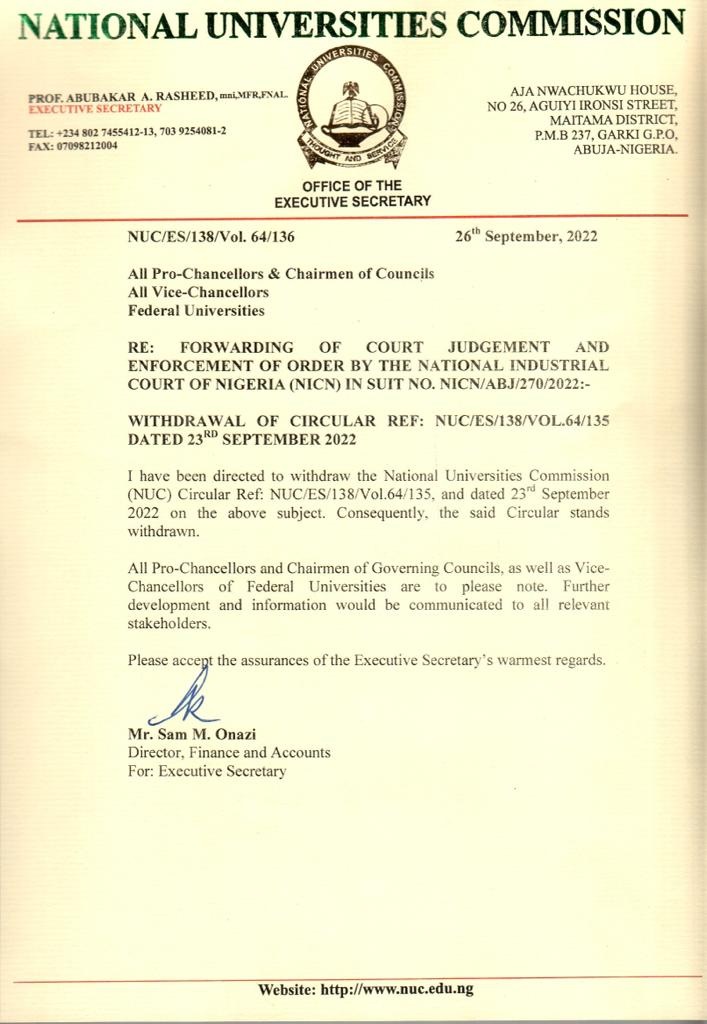
Indeed, even the university system regulator cannot understand the figures of speech with its nonsensical circular, and was forced to withdraw its answers! Nigeria needs better #leaders.

Join Tekedia Capital Deal Flow And Co-invest in Finest African Startups

0

We’re in a cycle and you are invited. We will fund the next empires of the future at Tekedia Capital. Begin here and explore the startups.

Tekedia Capital offers a specialty investment vehicle (or investment syndicate) which makes it possible for citizens, groups and organizations to co-invest in innovative startups and young companies in Africa and around the world. Capital from these investing entities are pooled together and then invested in a specific company or companies.

Tanzania Scraps Levy Imposed On Mobile Money Transfer

0

East African country Tanzania, has scrapped fees imposed on mobile money transactions. The government had to backtrack the implementation of levies on electronic transactions following a public outcry from the citizens.

Before the levy was introduced, Tanzania’s mobile money industry was booming, which saw a total of 9.5 trillion shillings ($4 billion) being transacted electronically.

The number of mobile money accounts in the country stood at nearly 26 million at the end of 2019, while the market size was valued at US$45.5 billion.

The recent removal of the levy will be implemented on October 1, which was disclosed by the finance and planning Minister Mwigulu Nchemba while addressing the parliament.

He said; “I would like to present this report whereby we have made the following adjustments that would reduce the burden of transaction fees in society.

“The amendments made are to cancel the levies for transferring money from banks to mobile networks (and vice versa) and to cancel levies for transferring money within the same bank.

“The government will scrap the fee for transferring money from one bank to another, and also waive the transaction fee on withdrawal of cash through bank agents and ATMs for values not exceeding Tsh30,000 ($12.81).

“We discussed and reviewed a number of issues including reducing tax and levies’ burden on the people, encourage the use of cash transactions, simplifying tax collection, and avoid double taxation for both parties –that’s the sender and receiver”.

The minister further noted that the government is looking to reduce its expenditure by slashing spending on things such as conferences, training, refreshments, and trips to cover the revenue it will forego from the canceled levies.

Although, before the removal of transaction fees, the minister stated that it enabled the Government to provide basic services for its citizens in the financial year 2021/2022.

For example, the Government spent a total of 7 billion shillings ($58,043) resulting from the levy of transactions for building classes. However, after a careful review, it has deemed it fit to scrap the fees due to the negative impact it had on the lives of its citizens.

In July 2021, the government of Tanzania introduced a levy on mobile money transfer and withdrawal transactions, excluding merchant, business, and government payment transactions.

The levy applied in addition to VAT (18%) and excise duty on mobile money transfers and withdrawal fees (10%).

Following criticism from the Tanzanian citizens, the fee was reduced by 30% in September 2021. Due to the introduction of the mobile money levy, the number of P2P transfers and cash-out transactions fell heavily in July and August 2021 to only slightly stabilize in September 2021.

Also, there was a massive decline in the use of mobile money, as users removed their assets from their mobile money accounts to use them through alternative payment methods such as cash.

Tanzania’s Telecom companies in Tanzania also disclosed that they witnessed an immediate change in their revenue since the government introduced the levy, as it dropped drastically because consumers were no longer using the service anymore.The levy also took a great toll on online businesses because of the increase in cost for customers.

With 26.1% of Tanzanians living below the poverty line (equal to $1.35 per person per day in purchasing-power-parity terms), the scrapping of the levy imposed on electronic transactions is indeed sigh of fresh air for Tanzanian citizens as it will reduce the financial burdens of its citizens, especially those in rural areas.