DD
MM
YYYY

PAGES

DD
MM
YYYY

spot_img

PAGES

Home Blog Page 4884

Strategic Notes on Creating a Culture of Data-Driven Business in Nigeria

0

Every step in a business setting requires data in order to make the best decisions for growth, especially in terms of gaining a competitive advantage. Carl Anderson defines data-drivenness as “the development of tools and abilities.” “Most importantly, a data-driven culture.” Data-driven businesses have existed in advanced economies for over a decade. From Facebook to Walmart, business activities are carried out using data gathered from various sources. Tesco is one of the most well-known retailers in the world, and it has used data to gain market share. Casinos have also made marketing a science.

Data-driven companies, according to evidence, have an open attitude toward employee data use. Companies that fail to align with data-driven practices have a tendency to lose competitive advantage, market share, and revenue games. According to a recent PwC survey of business executives, 30% of companies are heavily data-driven, compared to 45% and 53% in the United States of America and China, respectively.

To make a company data-driven, the necessary data must be accessed, collected, and reported to the beneficiaries. These are the appropriate elements of the data value chain. However, the most difficult challenges for most businesses are how to extract data, refine it, and ensure its effective utilization. Despite the challenges, research has shown that many businesses are developing new business models based on extracting, refining, and ultimately capitalizing on data.

This is necessary because models that predict and optimize business outcomes are critical to the long-term sustainability of values created and delivered to consumers. Aside from these, businesses must manage operations, communicate with customers, pay employees and suppliers, and plan for the future, among other things. Apple and Amazon are constantly leveraging big data to present relevant products and services to customers. According to a study conducted by the MIT Center for Digital Business, organizations that rely heavily on data-driven decision making have 4% higher productivity rates and 6% higher profits.

Data Enabled Business: Asking the Right Questions

To enable companies, create data enabled business, the Cambridge Service Alliance in its study came up with the six questions for the facilitation of big data use in today’s competitive business environment. The questions include what do we want to achieve by using big data? What is our desired offering? What data do we require and how are we going to acquire it? In what ways are we going to process and apply this data? How are we going to monetize it?

The answers to these questions, as well as their eventual application, are the responsibility of each employee. According to experts, everyone should be expected to collect, analyze, and learn from data on a regular basis. When employees generate data, it must be shared among them and used for strategic thinking, planning, and reporting in accordance with internal monitoring against goals and objectives for telling the company’s stories.

This phase of developing a data-driven culture is well-known in companies like Google, Apple, and Facebook. The core four strategies for new start-ups who want to use data to serve potential market opportunities include having much hands-on access to data as possible, setting measurable goals using the SMART technique, making data available to everyone, and hiring the right data scientists.
2023 ELECTIONS and Reenactment of Paper-Tiger Women Representation in Nigeria’s Senate

0

Women have not really gotten much representation from the local to the state and federal levels since the return to democratic governance in 1999. Social commentators and public affairs experts have described this over time as the persistence of the historically pervasive exclusion of women from public administration. They claim it also means that various initiatives and policies aimed at increasing women’s participation in politics are still just paper tigers.

Few women were senators from the eighth to ninth national assemblies (particularly in the senate section). This was because political parties presented fewer female candidates during the elections that resulted in the composition of the two national assemblies. Apart from this, existing gender bias and cultural issues have been significant factors preventing a significant number of women from serving in the Senate, State Assembly, and House of Representatives.

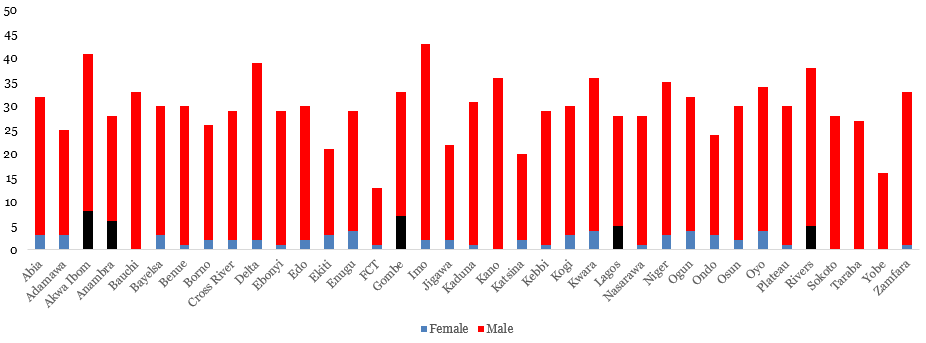
Our analyst looks at the most recent list of candidates submitted by political parties to the Independent National Electoral Commission as the general elections of 2023 get closer. Similar to the few female senators from previous assemblies, our analyst found that less than 10% of the 1,098 candidates for senate positions submitted by political parties are women. Voters are anticipated to choose 109 senators from among the 1,098 candidates to represent their various constituencies. According to analysis, political parties have fielded 92 female candidates, compared to 1,006 male candidates.

According to a state-by-state analysis, Akwa Ibom (8), Gombe (7), Anambra (6), Lagos (5), and Rivers (5) have the most female senatorial candidates. This does not imply that the states are gender sensitive. According to our analyst, the figures fall short of the percentages predicted by various women-led organizations and existing provisions for women’s representation in Nigerian politics. The states with the most male candidates are Imo (41), Delta (37), Kano (36), Rivers (33), Niger (32) and Zamfara (32). When one considers previous promises and policy thrusts toward adequate women participation in politics, political parties in these states and states where female candidates are not presented remain gender insensitive.

 Exhibit 1: Senate candidates by gender

Source: Independent National Electoral Commission, 2022; Infoprations Analysis, 2022

Which of the Dominant Parties is Gender Sensitive?

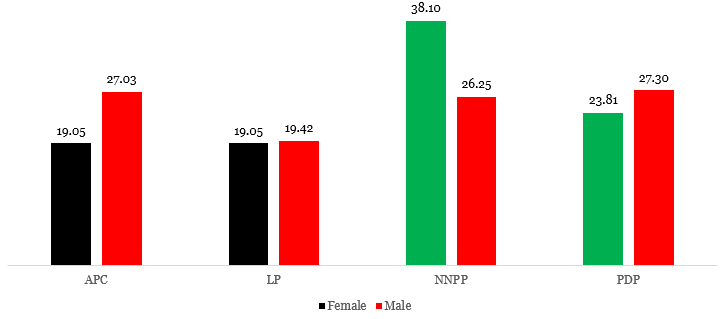
The four major political parties have 402 senatorial candidates out of 1,098 total candidates. 94.77% of the 402 candidates are men, 5.22% are women. Analysis shows that the People’s Democratic Party and New Nigeria Peoples Party are more interested in including women than the All Progressives Congress and Labour Party. Our analyst observes that APC doesn’t seem to replicate the impression that women have of it over time. This submission is made in accordance with a recent survey that found that more Nigerian women expressed support for the party than for the PDP.

These insights imply that women’s political marginalization in Nigeria and closing the gender gap in the national assembly will be difficult to achieve in a short period of time. The insights also suggest that the structures for implementing women-focused political participation policies and initiatives should be reconsidered.

Exhibit 2: Dominant political parties and their sensitivity to women representation

Source: Independent National Electoral Commission, 2022; Infoprations Analysis, 2022

The Boldness of the Attorney General and Lessons for Nigeria

1

US ex-President Trump has fought many battles. He battled his party’s structures to win the presidential primaries. He worked against all odds to be elected the president. Going to the courthouse was a regular routine. Largely, he has been just fine. But something is brewing here as Letitia James, the attorney general of New York, files a “fraud lawsuit” against the former president.

People, it is like the Commissioner of Justice/ Attorney General of Ogun State going against Obasanjo or the Bayelsa state equivalent against Jonathan? Is that possible in Nigeria? NOT POSSIBLE.

This post is not about Trump (he will be fine, lawyers need to pay bills). I am focusing on the contrast of the judiciary “separation  from the executive arm”, making it possible for a  state AG  to have the boldness to summon and file charges against a former president.  We are still reading the book titled “Democracy” in Nigeria; we’re just in Chapter 1 with nine chapters waiting. Hope we can get to Chapter 3 before 2030!

Donald Trump and three of his children have been hit with a fraud lawsuit after a New York investigation into their family company – the Trump Organization. It alleges that they lied “by billions” about the value of real estate in order to get loans and pay less tax. Prosecutors say the Trump Organization committed numerous acts of fraud between 2011-21.

Mr Trump has dismissed the lawsuit as “another witch hunt”. The former president’s eldest children, Donald Jr, Ivanka and Eric Trump, were also named as defendants alongside two executives at the Trump Organization, Allen Weisselberg and Jeffrey McConney. The lawsuit has been brought by New York Attorney General Letitia James, who is the state’s most senior lawyer, after a three-year civil investigation. Her office does not have the power to file criminal charges, but is referring allegations of criminal wrongdoing to federal prosecutors and to the Internal Revenue Service.

Nigeria Surpasses Kenya To Regain The Top Position For Crypto Adoption In Africa

0

Nigeria has reportedly overtaken Kenya to reclaim the first position as the leading country with high crypto adoption rate.

The latest ranking sees Nigeria in 11th position in the world, with an adoption score of 0.521. Occupying second place is Morocco, which ranks 14th, with an index score of 0.507.

While last year’s crypto leader in Africa Kenya, occupied the 3rd position, with an adoption score of 0.397, while ranking 19 globally.

Both Kenya and Nigeria are reported to have improved significantly in their adoption score, with Nigeria gaining 100.39%, from a 0.26 index score in 2021, while Kenya gained 41.79%, from an index score of 0.28 in 2021.

This new report, ranked countries by focusing on five major indexes which includes; On-chain cryptocurrency value received at centralized exchanges, weighted by purchasing power parity (PPP) per capita, On-chain retail value received at centralized exchanges, weighted by PPP per capita, Peer-to-peer (P2P) exchange trade volume, weighted by PPP per capita and number of internet users, On-chain cryptocurrency value received from DeFi protocols, weighted by PPP per capita, and On-chain retail value received from DeFi protocols, weighted by PPP per capita.

Despite the Central Bank of Nigeria (CBN) ban on crypto transactions in 2021, about 33.4 million Nigerians still trade or own crypto assets.

In 2021, according to Google trends, Nigeria was reported as the country with the highest number of bitcoin searches globally, which revealed the widespread adoption of cryptocurrency in the country.

The increase in the number of crypto traders in the country has been majorly attributed to the constant devaluation of the naira, which has depreciated by more than 209 percent in the past six years. The citizens of the West African country see these digital assets as a way to hedge against the plunging naira.

Meanwhile, as the naira continues to lose value, coupled with the rising inflation and high unemployment rate, the challenging economic climate in the country has continued to make cryptocurrencies an attractive alternative source of income.

The typical Nigerian has become interested in trading crypto because of its possibility of offering financial freedom. In 2020, the number of jobs in the crypto industry multiplied by more than twice the previous number.

Nigerians have leveraged the numerous job opportunities in the crypto industry, such as  cryptocurrency writing, Crypto trading, game development, NFT marketing, etc.

According to data by Merchant Machine, if the crypto use rate in the country continues this way, the entire population of the African country will be using digital assets by 2030. 

Nigeria’s Central Bank Unveils A New Playbook To Save Naira

19

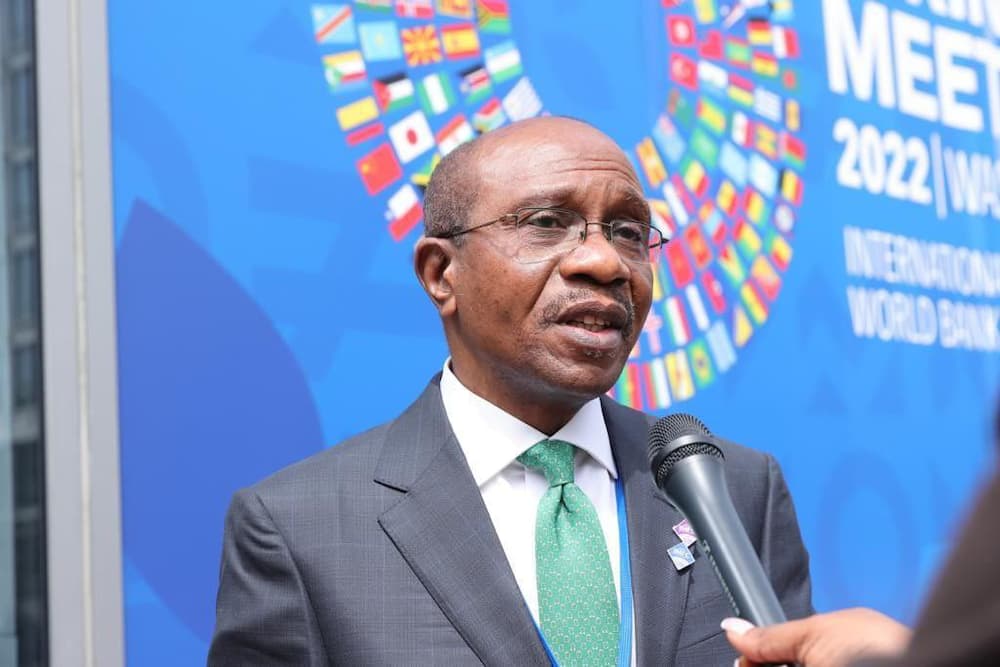
A message to Nigerian banks by the high priest of Nigerian banking: “The era is coming to an end when because your customers need $100 million in foreign exchange or $200 million, you now want to go to the CBN and pack all the dollars. It is coming to an end before or by the end of this year. We will tell them don’t come to the Central Bank for foreign exchange again, go and generate from export proceeds,” Central Bank of Nigeria governor Godwin Emefiele.

The Nigerian forex crisis is spiraling out of control in defeat to the stringent policies initiated by the Central Bank of Nigeria (CBN) to tackle it.

The backdrop is not only evident in rising inflation rate, now 20.52%; it is also visible in its bearing on international transactions. The CBN has continued to limit the amount of dollars that Nigerians can spend on international POS. But that, like every other initiative it has taken, has failed to ameliorate the forex crisis.

Now banks are completely running out of dollars even though the CBN had earlier in the year, halted supply to Bureau de Change operators, opting to supply dollars to banks that will in turn sell directly to customers.

If the CBN does it, what that means is simple: you cannot run a manufacturing business in Nigeria which uses imported raw materials without having a clear strategy to deepen exports. In other words, every business in Nigeria which uses foreign inputs should have a foreign desk that can receive foreign currencies.

This is not a radical playbook. In Tekedia Capital, we encourage our startups to do everything necessary to earn US dollars, Euro, Pounds, etc even as they pack Nairas. Our thesis has been clear: Nigeria’s economic growth is slower than population growth, and within years, most of the big brother policies in Nigeria will stop working. Only companies that take charge of their futures will remain and thrive.

Nigeria’s Forex Crisis: First Bank to Suspend Int’l Transactions on Naira Cards