DD
MM
YYYY

PAGES

DD
MM
YYYY

spot_img

PAGES

Home Blog Page 49

PeniWallet Has Processed Over $900M Trading Volumes, Six Months After Launch

0

PeniWallet, the non-custodial crypto wallet developed by the SMC DAO ecosystem tied to $WKC and projects like WikiCatCoin, has indeed shattered expectations by processing over $900 million in total transaction volume within just six months of its official launch in June 2025.

This milestone, tracked transparently via smcstats.com analytics, underscores the wallet’s rapid ascent in a crowded DeFi space—fueled by features like seamless BNB Chain support, mass transfers via “Spray” enabling sends to 1,000+ addresses in one tx, and bank-grade security without compromising user control.

As of early December 2025 from community-reported dashboards and on-chain data $900M+ up from $894M at the four-month mark in September, with daily peaks hitting $1M+ in August. 265K+ overall, with single-day highs of 6.5K August 12 and consistent weekly volumes like 8K txns/$540K late July.

64K+ wallets created, 52K+ app downloads ~10K+ on Google Play, 4K+ on iOS by July, accelerating post-backend upgrades. 1.9K+, tokens supported with $WKC dominating activity—driving burns and holder growth ~2K new holders in one day, 300B $WKC torched for $20K value. $30K+ for the ecosystem, highlighting early monetization via tx fees and integrations.

This isn’t hype—it’s verifiable momentum in a bearish 2025 crypto winter, where overall exchange volumes dipped to $1.59T monthly lows in November. PeniWallet’s growth mirrors Pendle’s TVL surge earlier in the year but on the wallet front, outpacing many incumbents like Trust Wallet in niche adoption speed.

Hitting $900M in half a year isn’t just a vanity metric—it’s a signal of structural shifts with ripple effects across DeFi, WikiCat $WKC, and beyond. In an era of hacks, $600M+ lost to exploits YTD, PeniWallet’s encryption, biometric auth, and self-custody model have converted skeptics.

64K wallets in six months implies ~10K/month organic growth, rivaling early MetaMask phases. Reduced friction for retail onboarding, especially in emerging markets via Spray’s charity/rewards tools—potentially slashing remittance costs by 50-70% vs. traditional rails.

Ecosystem Synergies with $WKC and SMC DAO

The wallet isn’t standalone; it’s the on-ramp for WikiCat’s deflationary mechanics, 1% auto-burn per txn and SMC’s community treasury. $WKC’s MC exploded from $7M to $255M post-launch, and volumes here directly amplify burns— 300B tokens in a day.

A self-reinforcing loop—higher wallet activity = more $WKC utility = scarcity-driven price pumps. Projections from community analysts peg $1B volume by year-end, which could 2-5x $WKC if historical patterns hold.

As the “flawed but fierce” precursor per founders, PeniWallet’s backend upgrades pave the way for Peniremit—a full remittance bank on BNB Chain, teased for September but delayed to Q4. Scaling to billions in cross-border flows could position SMC DAO as a “crypto-native Western Union,” capturing 1-2% of the $800B global remittance market.

Revenue share already $30K funnels back to DAO governance, boosting $WKC staking yields and community grants. Amid BTC ETF outflows ~$900M single-day in November and low vol, PeniWallet’s BNB focus dodges ETH gas woes while riding Solana-like speed narratives.

Upside in a liquidity thaw—whales could rotate from equities ~$900B inflows post-election into DeFi plays like this. Backend “frustrations” like transaction delays risk churn if unaddressed, and regulatory scrutiny on wallets/remittances could cap global expansion.

In short, $900M is the spark: PeniWallet’s proving wallets can be utility engines, not just keychains. For $WKC holders, it’s rocket fuel—expect volatility as Peniremit nears, but the trajectory screams multi-bagger potential.

WikiCat’s burn mechanism is turning scarcity into a superpower. With that 1% auto-burn on every transaction chipping away relentlessly, hitting 50% feels like it’s not just inevitable, but imminent.

No new tokens minting in, no team dumps lurking; it’s all about that daily grind toward diamond-hoofed deflation. Over 45% of the original 1 quadrillion total supply is already torched around 454 trillion gone, leaving roughly 546 trillion circulating.

At this pace—think 200-300 billion burned per day during peaks, like the 1T scorched in just five days back in August—the math points to crossing that historic half-burn mark in a matter of weeks, maybe sooner if volume spikes.

In a sea of inflationary memes, WikiCat’s setup is pure catnip for long-term plays: reduced supply + steady demand from the SMC DAO education ecosystem = upward pressure that could make early bags purr.

If you’re stacking, eyes on that liquidity pool—it’s already lean at ~14T, so any real inflows could ignite exponential pumps. What’s your take—riding the burn wave to the moon, or got a target price in mind for the 50% pop?

Ethereum’s Bullish Run Looks Promising, but Ozak AI Prediction Outshines in ROI Models

0

Ethereum continues building one of the strongest bullish structures in the market as investors position early for the next leg of expansion. Its role in powering Layer-2 ecosystems, staking infrastructure, institutional liquid staking demand, and smart-contract growth keeps ETH firmly in the spotlight as a top performer heading into 2025–26.

Yet even with this impressive momentum, analysts are increasingly noting that Ethereum’s ROI outlook—while strong—cannot match the explosive upside projected for Ozak AI, an early-stage AI-native project whose small market cap, deep utility, and fast-growing Ozak AI Presale give it a far steeper long-term growth curve.

Ethereum Builds a Strong Structure

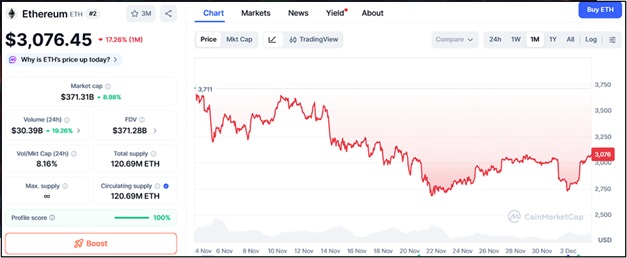
Ethereum, trading near $3,076, is following a clean upward trend supported by strong demand zones at $2,985, $2,912, and $2,851. These levels have served as repeated accumulation points for institutional buyers, long-term stakers, and ecosystem developers. ETH’s bullish momentum remains intact, but for a decisive breakout, the asset must overcome resistance at $3,138, $3,260, and $3,372, each historically linked to large continuation moves.

With Layer-2 networks thriving and increasing institutional interest in ETH as a yield-bearing asset, the long-term case remains powerful. Still, its massive valuation naturally limits multiplier potential — a reality that is steering many traders toward smaller, AI-driven tokens with far greater upside.

Why Analysts Say Ozak AI Outshines ETH in ROI Forecasts

Where Ethereum offers stability and proven demand, Ozak AI offers exponential possibility. The project enters the market as a next-generation AI intelligence layer for Web3, integrating millisecond-speed prediction engines, multi-chain analytics, and ultra-fast 30 ms signal execution delivered through its partnership with HIVE. This real AI infrastructure positions Ozak AI not as a speculative token but as a high-functioning utility system capable of powering automated strategies, real-time insights, cross-chain analysis, and AI-driven execution.

Through its integration with SINT, Ozak AI gains autonomous AI agents capable of reading blockchain data, executing tasks, automating workflows, and responding to voice commands — a rare level of real utility for an early-stage project. This depth of functionality is why analysts consistently estimate that Ozak AI’s long-term multiplier potential far exceeds that of established assets like Ethereum.

Ozak AI Presale Momentum Confirms Its Explosive Upside

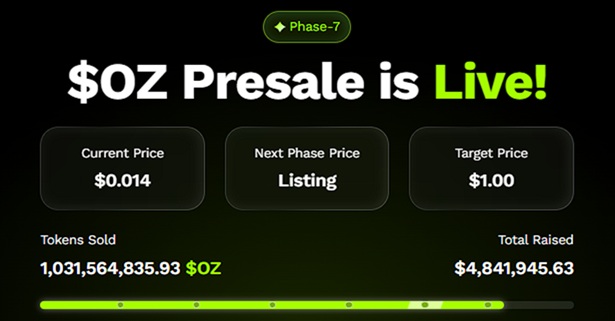
The acceleration of the Ozak AI Presale is strengthening its breakout narrative. With over $4.8 million raised and more than one million tokens sold, demand is mirroring the early accumulation patterns of past cycle giants that later moved 50x–100x after launch. Strategic partnerships support this momentum:

  • Perceptron Network’s 700K+ node infrastructure provides decentralized intelligence inputs.
  • HIVE delivers lightning-fast market signals and real-time data flows.
  • SINT contributes advanced AI agent technology for automated execution.

This synergy positions Ozak AI uniquely within the AI-crypto sector, giving it a transformative edge as AI becomes the dominant narrative of the next cycle.

ETH Stays Strong—Ozak AI Leads in ROI Potential

Ethereum remains a top-tier asset with strong fundamentals, rising demand, and massive ecosystem strength. Its bullish structure suggests further upside and continued dominance within the smart-contract sector. However, when it comes to raw ROI potential, analysts overwhelmingly identify Ozak AI as the market’s standout. Ethereum may shape the infrastructure of Web3—but Ozak AI is being positioned to shape the next generation of high-growth AI-powered crypto.


About Ozak AI

Ozak AI is a blockchain-based crypto project that provides a technology platform that specializes in predictive AI and advanced data analytics for financial markets. Through machine learning algorithms and decentralized network technologies, Ozak AI enables real-time, accurate, and actionable insights to help crypto enthusiasts and businesses make the correct decisions.


For more, visit:

Website: https://ozak.ai/

Telegram: https://t.me/OzakAGI

Twitter: https://x.com/ozakagi

Myriad Markets Launches Pool with Trust Wallet Integration

0

Myriad Markets, a decentralized prediction market platform built by DASTAN, the parent company of Decrypt and Rug Radio, officially introduced “Myriad Pools” on December 4, 2025.

This feature marks a key step in the platform’s evolution toward greater decentralization by allowing external users to provide liquidity to its markets, rather than relying solely on internal team-provided liquidity.

Deeper liquidity pools mean tighter spreads, reduced slippage, and a smoother trading experience when buying or selling shares in prediction markets, like on events in crypto, politics, sports, gaming, culture, or tech.

Participants can earn a share of the platform’s revenue from trading fees plus additional incentives, which are yet to be fully detailed (TBA). This could include points toward potential airdrops of the $MYR token, based on community speculation.

Myriad Pools build on the platform’s constant function market maker (CFMM) model, where liquidity is added to pools backing specific market outcomes. Traders interact with these pools to buy/sell shares, and imbalances adjust prices dynamically while keeping the total shares constant.

The feature is designed to support Myriad’s automated markets, which resolve every 5 minutes, and integrates with chains like BNB Chain, Abstract, and Linea for low-cost access. Early access is available via a waitlist on Myriad’s site. Users connect EVM-compatible wallets and can start providing liquidity once rolled out.

With prediction markets booming alongside Polymarket and Kalshi, this addresses a core challenge: liquidity depth. Community buzz on X highlights it as a low-risk entry for passive earners, potentially boosting $MYR airdrop eligibility.

Constant Function Market Makers (CFMMs) are a foundational mechanism in decentralized finance (DeFi) and automated market making systems, particularly popularized by protocols like Uniswap. They enable permissionless, automated trading without traditional order books by relying on liquidity pools and mathematical invariants.

At its heart, a CFMM is an automated market maker (AMM) that uses a constant function or invariant to determine prices and facilitate trades. Unlike centralized exchanges that match buyers and sellers via bids/asks, CFMMs maintain a pool of assets where traders interact directly with the pool.

The key innovation is a mathematical formula that must remain constant before and after each trade. This invariant governs how prices adjust dynamically based on supply and demand.If a trade imbalances the reserves, the price shifts to restore the invariant.

No external oracles or human intervention is needed for pricing—it’s purely algorithmic. Users trade by adding one asset to the pool and removing another. The amount received is calculated to keep the invariant unchanged.

Typically, a small fee (e.g., 0.3%) is skimmed from trades and distributed to LPs as rewards. CFMMs are “constant function” because the product, sum, or other function of the reserves stays fixed, ensuring the system is self-balancing.

In Myriad’s case liquidity is added to pools for market outcomes. Traders buy/sell shares, and imbalances adjust prices while keeping total shares constant—suggesting a constant-sum-like model.

After the event, winning shares redeem for $1 or equivalent, losers for $0. Unresolved markets resolve via oracles or automation (e.g., every 5 minutes in Myriad’s automated markets). Pool starts with 50 Yes shares and 50 No shares.

Price of Yes = Yes reserves / total = 0.5 (50% probability). Trader buys 10 Yes shares: Deposits collateral, pool becomes 40 Yes and 60 No. New Yes price ? 0.6. This creates a probability-based market where prices converge to true odds via crowd wisdom.

In platforms like Myriad, they democratize prediction betting by making liquidity provision open, potentially with rewards like token airdrops. This launch aligns with Myriad’s broader mission to embed prediction markets into everyday content consumption via browser extensions and media integrations.

Europe’s DSA Fine of X Highlights How Government Policy Normalization Affects Innovations

0

The EU’s Digital Services Act (DSA), a landmark regulation aimed at promoting transparency, accountability, and user safety on large online platforms.

X designated as a “very large online platform” (VLOP) under the DSA, was found to have breached several key transparency requirements. The penalty totals €120 million, equivalent to approximately $140 million at current exchange rates, representing about 5% of X’s estimated global annual revenue.

The Commission’s two-year investigation identified three main areas of non-compliance Misleading Verified Badges. X’s shift under Elon Musk’s ownership—changing blue checkmarks from indicators of account verification based on identity and notability to a paid subscription perk via X Premium—was deemed “deceptive” and not aligned with industry standards.

This design could mislead users about the authenticity or credibility of accounts, potentially amplifying misinformation or scams. The fine for this infraction is €45 million. X failed to provide adequate access to its public data and algorithms for independent researchers, public authorities, and regulators.

The DSA requires VLOPs to enable such access to support studies on systemic risks like disinformation or election interference. This breach carries a €40 million penalty. X’s ad library lacks the required level of detail and accessibility, making it hard for users and watchdogs to scrutinize targeted ads for potential biases or violations.

This drew a €35 million fine. The Commission emphasized that the fine was calculated proportionally, considering the infringements’ gravity, duration, and impact on EU users— X has over 100 million monthly active users in the bloc.

EU tech chief Henna Virkkunen stated: “We are not here to impose the highest fines. We are here to make sure that our digital legislation is enforced and if you comply with our rules, you don’t get the fine.”

This follows earlier probes into X’s content moderation and risk assessments. In contrast, TikTok avoided a fine today by agreeing to concessions, such as improving its ad library transparency, and called for “equal and consistent” application across platforms.

The decision has sparked criticism from U.S. figures. Vice President JD Vance posted on X: “Rumors swirling that the EU commission will fine X hundreds of millions of dollars for not engaging in censorship.

The EU should be supporting free speech not attacking American companies over garbage.” Elon Musk has not yet commented publicly, but the fine could fuel ongoing transatlantic tensions over tech regulation similar to GDPR or antitrust cases against Apple and Meta.

X can appeal the decision, potentially escalating to the EU’s General Court. Non-compliance with DSA rules can lead to fines up to 6% of global turnover in future cases. The Commission has ordered X to remedy these issues within a set timeframe, with ongoing monitoring.

X must address the violations within 90 days, including redesigning its blue checkmark system to reduce “deceptive” elements like clearer distinctions between paid and verified accounts, enhancing its ad repository for better transparency on targeted ads, and granting researchers fuller access to public data and algorithms.

Failure to comply could escalate to the DSA’s maximum penalty of 6% of global annual revenue—potentially billions for X. This forces X to balance Musk’s free-speech ethos with regulatory realities, possibly diluting features like paid verification that drive Premium subscriptions.

Though manageable for Musk’s portfolio— xAI, Tesla, SpaceX, the fine adds to ongoing costs from global scrutiny. It reinforces perceptions of X as a regulatory lightning rod, potentially deterring advertisers already wary of misinformation risks.

Musk is expected to contest the ruling, likely via appeal to the EU’s General Court, prolonging uncertainty and legal expenses. Expect tweaks like hybrid verification via paid badges labeled as such and API expansions for academics, which could improve trust but frustrate users valuing X’s “unfiltered” vibe.

In the long term, this might accelerate X’s pivot toward non-EU markets or integration with Musk’s other ventures for data handling. This enforcement validates the DSA’s teeth after its 2023 rollout, targeting “very large online platforms” like X, Meta, and TikTok.

It sets a benchmark for future cases—TikTok settled similar ad transparency charges today by agreeing to fixes, avoiding a fine, while probes into Meta and Temu loom. The EU positions itself as a global regulator, exporting standards via the “Brussels Effect,” where companies comply EU-wide to avoid fragmentation.

This ruling underscores the EU’s push to hold Big Tech accountable for platform design choices that affect user trust and societal harms.

Unveiling of Abia State’s 25-year Development Plan this December

0

Umu Abia, get ready for something big! I am excited to share that our Governor, Dr. Alex Otti, will unveil Abia State’s 25-year Development Plan this December. This vital document is a blueprint for our future, detailing our visions and strategies for tomorrow, next week, next year, and for the next quarter-century. It represents our collective vision to seize opportunities, tackle challenges head-on, and lead Abia State toward a resilient and globally competitive future.

Within this document, you will find our plan to unleash “prosperity through enterprise”, as encapsulated in our coat of arm, across Abia State. It is robust, built on the essential foundations of any strong economy: People, Tools, and Processes. This is a bankable and implementable roadmap that Abians will be proud to own.

Abia is open for business and investment!

Prof Ndubuisi Ekekwe

Member, Abia State Global Economic Advisory Council