
DD
MM
YYYY

PAGES

DD
MM
YYYY

spot_img

PAGES

Home Blog Page 4906

White House Unveils Principles for Tech Reform

0

The White House has unveiled principles for tech reform. In a meeting it convened on Thursday with experts and specialists on the harms that tech platforms cause, six key areas to be addressed were highlighted.

The six ideas, entitled “Enhancing Competitors and Tech Platform Accountability,” had been launched after President Joe Biden administration officers earlier conceived the idea. They include: competition; privacy; youth mental health; misinformation and disinformation; illegal and abusive conduct, including sexual exploitation; and algorithmic discrimination and lack of transparency.

The US government has been exploring ways to regulate its burgeoning tech industry, especially social media, without trampling on free speech.

“The rise of tech platforms has introduced new and difficult challenges, from the tragic acts of violence linked to toxic online cultures, to deteriorating mental health and wellbeing, to basic rights of Americans and communities worldwide suffering from the rise of tech platforms big and small,” a statement from the meeting said.

Factors contributing to the harm created by tech were highlighted by experts and specialists who graced the meeting. The debate hung mainly on the good and “the harms that tech platforms trigger and the necessity for higher accountability.”

According to the highlight of the meeting, the experts raised, among other issues, the use of private data and monopoly.

One participant explained the effects of anti-competitive conduct by large platforms on small and mid-size businesses and entrepreneurs, including restrictions that large platforms place on how their products operate and potential innovation. Another participant highlighted that large platforms can use their market power to engage in rent-seeking, which can influence consumer prices.

Several participants raised concerns about the rampant collection of vast troves of personal data by tech platforms. Some experts tied this to problems of misinformation and disinformation on platforms, explaining that social media platforms maximize “user engagement” for profit by using personal data to display content tailored to keep users’ attention—content that is often sensational, extreme, and polarizing.

Other participants sounded the alarm about risks for reproductive rights and individual safety associated with companies collecting sensitive personal information, from where their users are physically located to their medical histories and choices.

Another participant explained why mere self-help technological protections for privacy are insufficient. And participants highlighted the risks to public safety that can stem from information recommended by platforms that promote radicalization, mobilization, and incitement to violence.

Many of the participating experts explained that technology now plays a central role in access to critical opportunities like job openings, home sales, and credit offers, but that too often companies’ algorithms display these opportunities unequally or discriminatorily target some communities with predatory products. The experts also explained that that lack of transparency means that the algorithms cannot be scrutinized by anyone outside the platforms themselves, creating a barrier to meaningful accountability.

One explained the risks of social media use for the health and wellbeing of young people, explaining that while for some, technology provides benefits of social connection, there are also significant adverse clinical effects of prolonged social media use on many children and teens’ mental health, as well as concerns about the amount of data collected from apps used by children, and the need for better guardrails to protect children’s privacy and prevent addictive use and exposure to detrimental content.

Experts also highlighted the magnitude of illegal and abusive conduct hosted or disseminated by platforms, but for which they are currently shielded from being held liable and lack adequate incentive to reasonably address, such as child sexual exploitation, cyberstalking, and the non-consensual distribution of intimate images of adults.

At the end of the meeting, White House officials promised that Biden’s administration will continue to “work to address the harms caused by a lack of sufficient accountability for technology platforms.” They added that they will “continue working with Congress and stakeholders to make bipartisan progress on these issues, and that President Biden has long called for fundamental legislative reforms to address these issues.”

The meeting underscores Biden’s administration commitment in making tech platforms healthy for people and harmless for the environment. It is not clear what further plan the administration has in mind. However, the meeting signals an imminent shift from how the tech industry is currently being run.
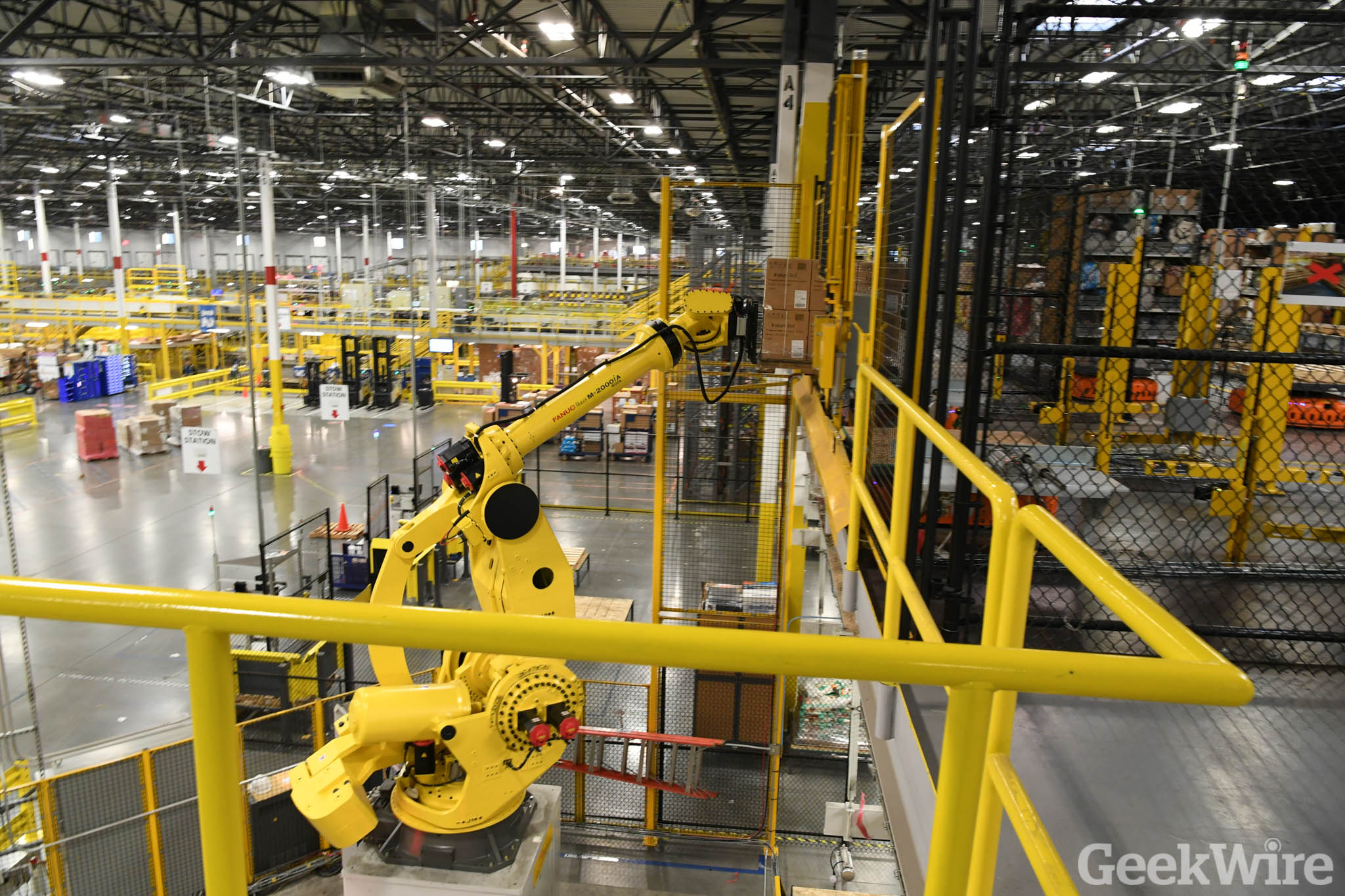

Amazon is Buying Cloostermans in Another Move to Expand its Robotic Workforce

0
Cyber Monday 2016 at Amazon Fulfillment Center in Dupont WA. (Photo by GeekWire/Kevin Lisota)

In a further push to accelerate the engagement of robots as part of its workforce; Amazon said Friday it has acquired a Belgian company, Cloostermans, which designs technology to manage the flow of robots through warehouses.

The acquisition adds to the e-commerce giant’s investments in tools to automate its logistics network, a move that has seen significant increase in recent time. Amazon has acquired other robotics in Europe as its workforce dwindles amid labor disputes.

Though Amazon did not disclose details of the deal, Cloostermans will be added to the division of 2012-launched Amazon Robotics.

“We’re thrilled to be joining the Amazon family and extending the impact we can have at a global scale,” said Frederik Berckmoes-Joos, CEO of Cloostermans, in a statement in a blog post published by Amazon. “Amazon has raised the bar for how supply chain technologies can benefit employees and customers, and we’re looking forward to being part of the next chapter of this innovation.”

A decade after the acquisition of Kiva Systems, its first foray into robotics, Amazon has acquired iRobotm, Dispatch, Zoox and Canvas technology in deals worth billions of dollars.

“Amazon’s investments in robotics and technology are supporting how we build a better and safer workplace for our employees and deliver for our customers,” Ian Simpson, vice president of global robotics at Amazon, said in a company blog post.

However, the push is believed to have been inspired by labor shortage in the US, which recently has seen the rise in companies shutting down because they can’t find workers.

Cloostermans builds technology to move and stack heavy palettes and totes, and robotics used to package products for customer orders. Amazon has been using those products or its e-commerce operation since 2019, making it a long customer of Cloostermans. The ecommerce leviathan said it’s making the acquisition to ramp up its R&D and deployment in that area.

The technology, the company said, will help robots operate alongside its warehouse employees, including to improve worker safety and to reduce packaging waste.

Amazon’s decade-long foray into robotics has seen the deployment of more than 520,000 robots in its warehouses. The company said it recently added its first fully autonomous mobile robot, which can maneuver around employees and does not need to be restricted to certain areas of a warehouse.

Amazon’s romance with robot staff was notable in the wake of Covid-19, which came with a level of unprecedented surge in retail sales. With the safety restrictions limiting human contact, Amazon touted drone delivery.

But a lot has changed since then. With the safety restrictions lifted as the pandemic’s waves die down, Amazon is relaxing its logistics expansion plan as the Covid-induced surge in e-commerce orders has dropped significantly.

However, Amazon is yet to contain its labor crisis. With unionization growing across its warehouses amid staff shortage, it looks like robots will form an integral part of the company’s future as it is counting on automation as part of its strategy to serve its growing markets.

Cloostermans was founded in 1884 as a manufacturer of machinery for textiles manufacturers, and has been redesigned over the years to serve as an engineering and automation company. Although Amazon did not share terms of the deal, Cloostermans’ about 200 employees will likely form part of the deal – joining Amazon.

Victor Ekpenyong Funds 30 Scholarships to Tekedia CollegeBoost

0

Tekedia Institute is very excited to announce that we have received more scholarship funds. Victor Ekpenyong, CEO of Kenyon International West Africa Limited is funding 30 scholarships to enable college students in African universities, polytechnics and colleges of education attend Tekedia CollegeBoost, a mini-MBA designed for college students.

We want to thank Mr. Ekpenyong for his generosity. We wish Kenyon more wins across markets and territories.

Eyitayo Adeleke, mMBA will work with our non-profit partners to handle the selections. Follow Tekedia Institute as they do that via that handle; I will also share here.

What is the Token to the Cryptoverse Rescue? It is Neither Flow Nor Aave but Big Eyes Coin (BIG)!

0

The universe has been experiencing a great influx of cryptocurrencies since the invention of Bitcoin. However, some of these coins are just hype but no action. In fact, others cause harm to the ecosystem as mining poses great risk to the world’s ecosystem. Nevertheless, Big Eyes Coin (BIG) is here to the rescue. Join the train as Big Eyes Coin (BIG) does what Flow (FLOW) and Aave (AAVE) have failed at.

Why Users Should Not Miss Out of the Big Eyes Coin (BIG) Community

Big Eyes Coin (BIG) is exclusively a community token with an ecosystem that is created on user participation and monetization. Big Eyes Coin (BIG) is vested with the objective of veering crypto wealth into the Decentralized Finance (deFi) ecosystem while safeguarding the marine territory; an essential component of the world’s ecosystem. To this effect, a visible charity wallet has been designed to earmark 5% of Big Eyes (BIG) tokens for safeguarding the oceans. Community tokens are tested and trusted sources of wealth for Community and charity. However, Big Eyes Coin’s intentions transcend generating 1000x profits. Big Eyes Coin (BIG) yearns to give its users more. This it will, by assembling a self-propagating blockchain ecosystem with a hyper growth. The blockchain will utilize Non-Fungible Tokens (NFTs) to provide users with permission to more events and contents that will endear users to the token and its blockchain.

Additionally, Big Eyes Coin (BIG) is cooking up NFT collections that will be rated in the top ten. This indicates that the community is bound to get value for its token. In addition, profits from NFT events will undergo a burn or not to burn vote by the community. Users have no worries as transactions are void of pay and buy tax, and fees. So, it is not just hype after all, it is action.

200 billion Big Eyes (BIG) tokens have been minted. 70% was for sale during the public presale. 20% was for exchanges. 5% was for marketing wallet. 5% was for charity. 10% was for tax NFTs. 4% was allocated to the actual seller(s) of the NFTs. 5% was allocated to holders. 1% was for charity.

Own, Stake And Earn Freshly Minted Flow (FLOW) Tokens

Flow (FLOW) is the local token of the Flow blockchain. In fact, it is crucial to conserving and running the Flow (FLOW) blockchain. Flow was developed to deliver a blockchain that possesses dependable decentralization and is void of sharding. It is also meant to supply scalable solutions and applications for games, apps, and further digital assets. Flow (FLOW) tokens can be employed as the foremost payment currency of Decentralized Applications (dApps) running on the Flow blockchain. These dApps can also use Flow (FLOW) tokens for other transactions. They could even suffice as rewards when users earn. Moreover, users who own and stake Flow (FLOW) tokens have the potential to become nodes. They also become authorized to  partake in the management of the platform. Such users are rewarded by Flow with a mixture of freshly minted Flow (FLOW) tokens and a percentage of the transaction fees.

Loan Aave (AAVE) Tokens And Enjoy Liquidity

Aave is a Decentralized Finance (DeFi) lending and borrowing platform. Aave (AAVE) token is an ERC-20 governance token as well as the currency of the Aave blockchain. As a governance token, it comes handy in decisions regarding the development of Aave protocol and delivery of its services. Aave provides liquidity to its users when users loan their tokens by proposing inviting interest rates to lenders. However,  users hoping to borrow are given competitive rates. Nevertheless, borrowers are required to supply a loftier value of Aave (AAVE) tokens than they want to borrow. This procedure is known as collateral.

The Big Eyes (BIG) token’s and network’s goal is not one meant to fade with the night. For a protracted tenure, Big Eyes Coin (BIG) is resolved to contend on an efficient and technical echelon with currencies that are top bananas in the cryptoverse.

To find out more about Big Eyes Coin (BIG), visit the links below:

Presale: https://buy.bigeyes.space/

Website: https://bigeyes.space/

Telegram: https://t.me/BIGEYESOFFICIAL