DD
MM
YYYY

PAGES

DD
MM
YYYY

spot_img

PAGES

Home Blog Page 4984

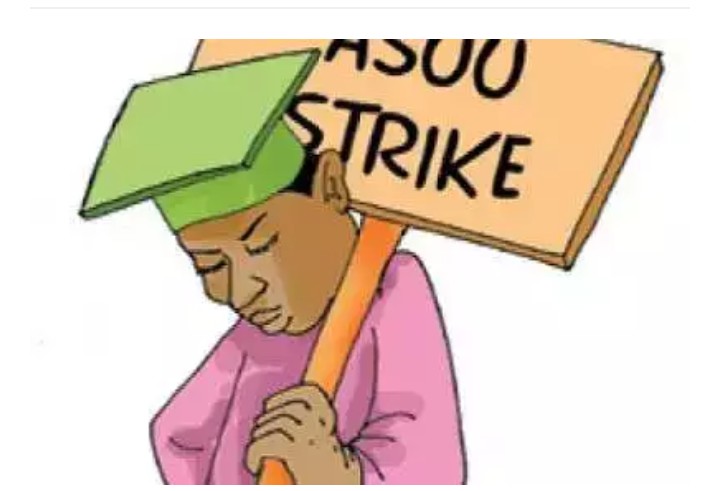
Will Allowing the Price Mechanism to Drive Public University System in Nigeria Resolve the Incessant ASUU Strike?

0

“Higher education and the huge numbers are contradictory to begin with…What is causing the decline of German culture? The fact that higher education is not prerogative anymore — democratism of a cultivation that has become commonplace.” — Friedrich Nietzsche, Twilight of the Idols.

Bowen University, a private university in Nigeria, recently became a victim of social media attacks on Twitter after the private university published on the social media platform a controversial post which was alleged to make mockery of students in the public universities who have been forced to stay at home since February due to the Academic Staff Union of Universities’ (ASUU) strike whereas these students should be in the classrooms or have finished a semester like some of their counterparts in the private universities.

The post which consist of a picture of a group of graduating students of Bowen University with the caption, “this is what finishing four years in a four-calendar-year in Nigerian University looks like…you should be here” was bitterly criticized by Nigerian youths who believed the University was being unnecessarily insensitive to the plight and emotional state of public university students.

However, some other persons believe there is nothing politically incorrect or morally wrong about the post; they argue that the post which is characteristic of competitive marketing communication only showcases the unique selling point of the university and offer alternatives to those who care to listen or can afford the university’s proposed value.

It’s been over six months since the Nigerian public universities have been shutdown due to the ongoing industrial action by the Academic Staff Union of Universities (ASUU) and millions of Nigerian students in the public universities have shown their disappointment in the system for depriving them of their rights to learn and be meaningfully engaged when they are expected to be in the classrooms.

The current wave of ASUU strike started on 14 February 2022 barely into the completion of the first academic session that ensued the previous wave of strike in the year 2020 which also lasted more than 6 months. Since 2007, the Nigerian public universities have been shutdown intermittently for more than 146 weeks due to ASUU strike which has become a perennial problem in country.

The issue of ASUU strike is now synonymous to a culture in the Nigerian public universities, and an effect to this is a popular joke that if, for instance, you are doing a-4-year course in a Nigerian public university, you should prepare to graduate in 5 or 6 years or, worse still, if you are studying medicine which is a 7 years program, you should plan to graduate in about 10 years after factoring in ASUU strike and some other internal disruptions that cause deferment of academic calendar.

The recurrence of ASUU strike and its disruptive effect on the academic calendar does not only frustrate the dreams and aspirations of many students who are expected to be in the labour market at a certain age limit in order to stand a good chance to secure quality jobs that befits their qualifications; it also contributes to the pressure and backlog of unemployed graduates in the labour market every year.

The average age of getting an entry level or graduate trainee job in Nigeria is 24 years. And while it is not unusual to hear employers of labour make remarks such as “Nigerian graduates are unemployable”, perhaps it is also relevant to consider the possibility that a quarter or half of these so called unemployable graduates are those who are readily cut out on age due to delayed academic calendar and protracted years of study in the university.

In a highly digital economy which requires fast-paced thinkers and actors that can quickly innovate or improvise to keep up with the current market ordinance, the Nigerian public universities, which are supposed to be places where industry leaders are nurtured and shaped, are characterized by slow academic calendar and highly mechanical models.

Thus, overtime, employers of labour across industries have preferred to base graduates’ employability on the strength of their extra-curricular experiences including community service, internships and volunteering rather than the strength of their academic grades. The problem of town-gown disconnect or industry-academia gap has raised more politically driven quick fixes than long-term management-based solutions which has exacerbated the problem rather than nip it in the bud.

Since the establishment of ASUU in 1978, the Union has been conditioned to see industrial action as the best language or mechanism to pressure the Federal Government to yearn to its demands which often include but are not limited to issues such as wages and welfare conditions of university staff members,  infrastructural facilities in public universities, and university-education centered policies etc.

However, recently, the ASUU has been more agitated than ever, accusing the Government of being dishonest and lacking the political will to position the Nigerian University education to be able to compete globally, especially considering the fact that the Government has yet to make good the memorandum of understanding it reached with the Union since 2009.

The Federal Government on the other hand has accused ASUU of being unrealistic with its demands and insensitive to the current economic realities of the country. Thus, the loggerhead between the Union and the Government has been on a merry-go-round, and efforts to resolve it have resulted in deadlocks after deadlock.

As Nigerians continue to hope for a permanent solution to this incessant strike which not only disrupt academic activities but also indirectly affect the economy of the country, sadly, the best solution available seems to be the worst and most unlikely conceivable option. In a mixed economy such as Nigeria, when the Government’s mechanism fail to achieve its intended objective, the reasonable alternative is to allow the price mechanism to aid or correct the imperfection of the former.

Currently, in Nigeria, the supply of labour far exceeds the demand for labour which implies that the cost of producing graduates increases while there is no corresponding increase in tax payers’ money which is being used to subsidize education in the public universities. Therefore, the most logical thing to do is to cut down on the cost of production which in this case suggests that the federal government needs to reduce the amount of subsidy that goes into funding university education or tertiary education generally.

According to the Secretary General of the Committee of the Vice Chancellors of Nigerian Universities, Professor Yakub Aboki Ochefu, during an interview with TVC Break fast show on Friday, 12 August,  the cost of training an average student per year in Science, Social sciences and Arts and Humanities from 100 level to 400 level is between N2million and N3million while a medical student will require between 3million and N5million. In Federal Government owned public universities, the federal government provides 95 percent of the cost while the remaining 5 percent comes from users/maintenance charges which are often incurred by the parents or guardians of the students.

Analysing the numbers, one needs no divine revelation to understand that the current situation is not statically feasible especially in an economy with as much as 33percent unemployment rate and 53.40percent youth unemployment rate. Thus, the Government and ASUU can work together to reexamine and restructure the education subsidy scheme to suit the current realities of the country.

While university education subsidy can be removed or better still tentatively reduced, the social cost of reducing the subsidy must be offset by increasing scholarships, bursaries, assistantships and loan facilities to qualified or deserving students. The federal government in partnership with relevant agencies should work out a sustainable structure towards achieving this. This will not only preempt waste in the public universities, it will promote inclusiveness and enhance merit and efficiency.

Another way the Government can reduce cost while achieving efficiency in the public universities is to encourage investment in these institutions from interested individuals, corporate organisations, non-governmental or non-profits organizations and especially the Universities’ Alumni. This will enhance internal ingenuity and promote the Town-Gown relationship which has long been endangered and now almost extinct in the country.

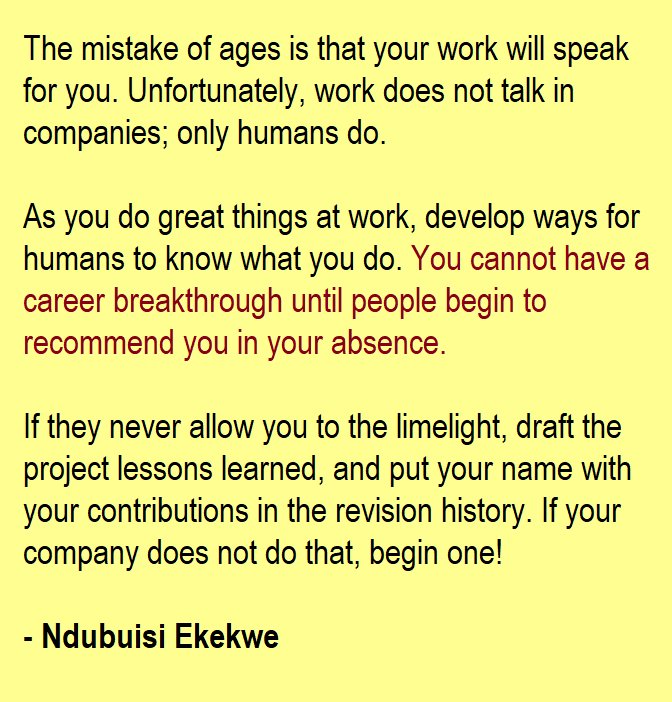
Things talk, your #work is not one of them. Make it easier for humans to talk for you in that company!

0

The illusion of ages is that your work will speak for you. Unfortunately, work does not talk; only humans do.

As you do great things at work, develop ways for humans to know what you do. You cannot have a career breakthrough until people begin to recommend you in your absence. 

If they never allow you to the limelight, draft the project lessons learned, and put your name with your contributions in the revision history. If your company does not do that, begin one!

Africa Fintech Foundry Collaborates With The CBN To Support 10 Startups, To Increase The Adoption of eNaira

0

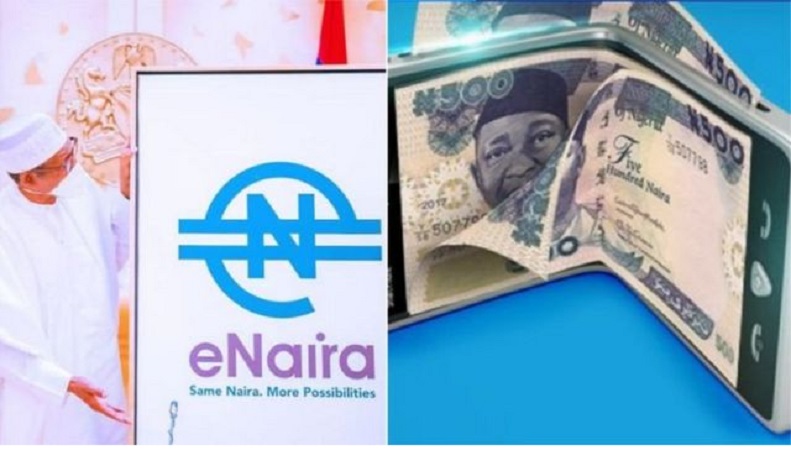
Recall that the eNaira was launched by the Nigerian Federal government in 2021, which made it the fifth digital currency to be launched in the world, and the first in Africa, with the aim that it would increase remittances, foster cross-border trade, improve financial inclusion and enable the government to make welfare payments more easily.

Recently, the African Fintech Foundry (AFF), an access bank initiative that aims to nurture and accelerate the growth of Fintech startups in Nigeria, disclosed that it is collaborating with the Central Bank Of Nigeria (CBN) to support 10 startups in the country to increase the adoption of eNaira in the country.

The head of Africa Fintech Foundry, Mr. Daniel Awe while speaking on the sideline of the semi-final pitching of the eNaira Hackathon 2022, disclosed that the top 10 startups, innovators, and entrepreneurs, were part of the over 5,000 startups that registered for the eNaira hackathon.

He further stated that there was a need to increase the adoption of eNaira in the country, as it enhances financial inclusion, supports the digital economy, and improves economic activities.

Mr. Awe revealed that despite the widespread criticism that ensued during the launch of the eNaira, with a lot of Nigerians preferring cryptocurrency, he disclosed that if they look inwardly, they will begin to see the truth that the eNaira is going to be a successful product.

See what he said;

“eNaira was introduced by CBN in 2021 as a digital currency and a lot of people have asked the question, what is actually the usefulness of this eNaira? A lot of people have also criticized eNaira, that they prefer cryptocurrency, but the truth is that the eNaira is going to be a successful product when there are use cases where people are able to see problems it is going to be solving”. 

On the other hand, speaking on the eNaira Hackathon platform, he disclosed that it is a place where innovators, developers, entrepreneurs and coders will  come together to solve problems as well as create innovative ideas where the eNaira is leveraged.

He further disclosed that the platform was layered on eNaira, so that consumers will now begin to see the benefit of the eNaira, also giving them the opportunity to see the problem that the eNaira will solve. At the final of the hackathon program, the top 10 startups will be awarded prices in eNaira.

The first position is going to get 5 million eNaira, the second position will get 3 million, eNaira while the third position will get 2 million eNaira, and the remaining will get 1 million eNaira.

After these top 10 startups are awarded the eNaira, they will then proceed to resume in the African Fintech Foundry accelerator program, where some of them will get some funding to start up their businesses on their ideas, and these startups will be closely guided by the CBN and AFF.

Mr. Awe disclosed that by the time these startups come up with good businesses with their innovations, employment would be created and they would increase the adoption of eNaira.

However, the adoption of the eNaira has been trailed with skepticism and uncertainty as some Nigerian citizens disclosed that they have issues trusting the Central Bank Of Nigeria, due to the fact that they banned the transaction of cryptocurrency in the country.

E-Payments In Nigeria Hit N204.5 Trillion Between January And July 2022

0

As many businesses in Nigeria continue to adopt the E-payment system, where customers can pay for goods and services without the use of physical cash, this has resulted in a 40% increase in E-payments in the country, when compared to N145.8 trillion recorded in the same period of last year.

Just recently, the Nigeria Inter-bank Settlement System (NIBSS) disclosed that transactions worth N204.5 trillion were performed electronically in Nigeria between January and July this year, through the NIBSS instant payment platform (NIP).

Last year, Nigeria was among the African countries that recorded high online payment methods. 35 percent of E-commerce payments occurred by card, and 21 percent by bank transfer. The NIBSS disclosed that the value of E-payment recorded was a reflection of the increase in the volume of deals within the period.

The NIP volume rose to 2.7 billion in seven months, showing a 42% increase over 1.9 billion recorded in the same period last year. Over the years, Nigerian banks have exposed NIP through their various channels, such as Mobile Apps, Bank Branch, Internet Banking, Supplementary Service Data (USSD), POS, and ATMs to their customers.

The NIBSS instant payments (NIP) has become the Nigerian financial industry’s preferred funds transfer platform that guarantees instant value to the beneficiary. Recall that the Central Bank of Nigeria, CBN in December 2011, introduced the cashless policy, which was kick-started in Lagos in January 2012 to reduce the amount of physical cash in circulation.

Its adoption of the cashless economy was to increase the operational efficiency of the monetary policy, provide alternatives that aid easy transactionless and greater reach, improve financial inclusion, etc. This policy has no doubt encouraged the use of electronic platforms for settlement or payment for goods and services.

There is no disputing the fact that the high rate of electronic transactions in Nigeria, reveals that a large percentage of Nigerians are embracing the cashless policy of the Central Bank of Nigeria.

The covid-19 pandemic allowed for the blossoming of digital payments, which has paved the way for the continued growth in e-payments transaction volume and value in Nigeria, reflecting the enduring shift away from cash.

According to the International Monetary Fund (IMF), the value of mobile money transactions in Nigeria increased to 9.72 percent of the Gross Domestic Product in 2020 because of the Covid-19 pandemic. The IMF also disclosed that the pandemic pushed a lot of people to explore internet banking and other digital transactions, as it has also led to the growth in agency banking like the POS Service.

Of the 986,252 registered POS in the nation, an all-time  high of 955,234 was deployed in January 2022, which is 100.89 percent of the 475,494 that was recorded in January 2021.

The Nigerian E-payments industry is still poised for further growth, as alternative payment channels continue to evolve. Also, its favorable demographics and regulatory support, have continued to inform expectations of accelerated growth of the Fintech industry in Nigeria.

The surge of electronic transactions has also caused the loss of transactions with Cheques, which has continued to maintain its downward trend. On the other hand, aside from the fact that there is a surge in E-payment in Nigeria, in Africa, its rapidly expanding population has made Africa’s digital payments system one of the quickest in the world.

Anambra Government to Charge Presidential Candidates, etc to Paste Campaign Posters in the State

0

Anambra State government appears prepared to generate revenue from the 2023 general elections campaign.

The Light of The Nation has announced that Presidential candidates for the 2023 election will pay as much as N10 million for permission to paste campaign posters in the state’s territory.

The MD/CEO of Anambra Signage and Advertising Agency (ANSAA), Tony Odili Ujubuonu, made the decision on Friday in Awka, the state’s capital.

Also affected by the decision are both Senatorial and House of Representatives candidates. According to the announcement, all the Senatorial candidates across board will pay N7 million, House of Representatives candidates will pay N5 million, while State Assembly candidates will pay N1 million.

The Nation reported that the state also issued notice for the costs for out of home media and mobile advertising, pegging them at  N100,000 for 48 sheets billboards, N500,000 for spectacular billboards, N500,000 gantry displays; N100,000 for irregular shaped billboard; N50,000 for branded vehicle; and N5,000 for Keke rear branding.

In the notice, the Anambra State government equally banned the use of posters on bridges and road demarcations along the streets of the state.

Ujubuonu said the pasting of campaign posters on street light poles, round-about and other public buildings had been prohibited.

According to the public notice, materials in advert forms such as posters, public address system, banners, fliers, bunting, T-shirts, caps and sundries must be fully paid for and approved by the government authorities.

Ujubuonu said that the payment of posters should be made to the government revenue account before they could be pasted.

He noted that politicians who default in the payments would face legal prosecution before election.

“As campaign for 2023 general election officially commences next month, September; Anambra State Signage and Advertisement Agency (ANSAA), in charge of all forms of Advertising in the state wishes to bring some important information to your notice.

“That posting of posters on bridges, road demarcations; street light poles, round-abouts and public buildings remain prohibited.

“That every campaign material and advert forms such as posters, public address systems, Banners, Fliers, Buntings, T-shirts, caps and sundries must be duly approved for after full payment of the requisite fee.

“That every billboard must be displayed through a registered advertising practitioner after the advertising content has been vetted by the APCON” the notice said.

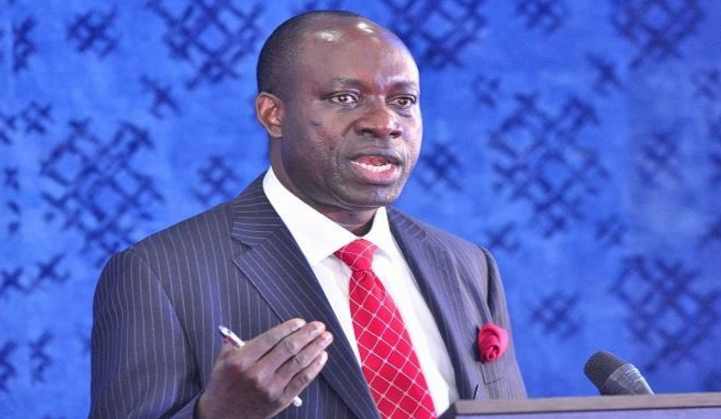
The Anambra State government has been looking for ways to boost its revenue generation since governor Charles Soludo took office. He had decried meeting empty treasury and has sought to borrow N100 billion within his first 100 days in office.

Among the steps the State government has taken to boost its revenue is the increment in levies imposed on commercial vehicles operators.

However, it is not clear how the aspirants will respond to this new approach that has been described as outrageous.