DD
MM
YYYY

PAGES

DD
MM
YYYY

spot_img

PAGES

Home Blog Page 5

Presale Analytics Show Ozak AI Achieving a 4.6× Faster Funding Pace Compared to Similar AI Token Launches

0

Ozak AI’s presale has been gaining traction, with fundraising rates 4.6x faster than comparable AI token launches. The $OZ  token, which is currently under presale, is priced at $0.014, attracting those who are looking for exposure before the larger market launch.

The increased popularity demonstrates growing confidence in Ozak AI’s AI-powered market intelligence platform, clear development plan, and growing community interest, making this phase a crucial entry point before market curiosity and demand surge further.

Presale Demand Accelerates at an Unmatched Pace

Ozak AI presale demand is at a record-high level, reaching $6.12 million after selling over 1.12 billion tokens, now at Phase 7, with each token priced at $0.014. Ozak AI was provided at $0.001 in Phase 1, resulting in a 1,300% increase and possible 14× returns for early investors before listing.

The presale received funding at a 4.6x faster rate than previous AI token launches, indicating considerable market trust. As Ozak AI prepares for its $1 IPO, early players may receive up to 71× returns, making this presale phase one of the most profitable possibilities in the AI-crypto space.

Investor Confidence Grows Around Ozak AI’s Utility and Roadmap

Ozak is developing to help all investors, regardless of their level of knowledge, make better financial market decisions. Before making any market moves, customers can analyze trends and hazards, which provide real-time details about cryptos and data about stocks.

Moreover, investors can develop and train their own custom Prediction Agents (PAs) and tools without knowledge of coding, making advanced analytics accessible to everyone. These observations can be shared, and users can receive rewards in $OZ. That platform features an Eon dashboard for monitoring insights and asking questions, basically a user interface.

$OZ token holders can utilize it for governance, fee reductions, and staking. Ozak AI is gaining popularity among early investors as a result of its innovative features and useful applications.

Strategic Partnerships & Security of Ozak AI

Ozak AI has various significant agreements that enhance its legitimacy and growth potential. The platform’s collaboration with Meganet allows Ozak AI to digest data quickly and provide real-time financial insights. The most recent alliance is with Openledger, an AI-blockchain infrastructure that works with Ozak AI agents to give community datasets and train models for improved performance.

Furthermore, Ozak AI’s commitment to security and credibility, as evidenced by CertiK and Sherlock audits, provides investors with a respectable base.

Conclusion

Ozak AI’s presale sets a new record in the AI-crypto sector, attracting 4.6x faster fundraising than other AI token launches. The present phase tokens are trading at $0.014 ahead of their upcoming $1 listing, and early investors are already seeing significant gains attributed to a robust AI platform, strategic partnerships, and strong security. Ozak AI’s presale phase represents a critical and final opportunity for early investors to take advantage of the potential benefits in a rapidly growing market.


For more information about Ozak AI, visit the links below,

?Website: https://ozak.ai/

Twitter/X: https://x.com/OzakAGI

Telegram: https://t.me/OzakAGI
U.S. Seals Trade Deal with India Trade, Signaling Washington’s Bid to Reassert Itself After EU Breakthrough With New Delhi

0

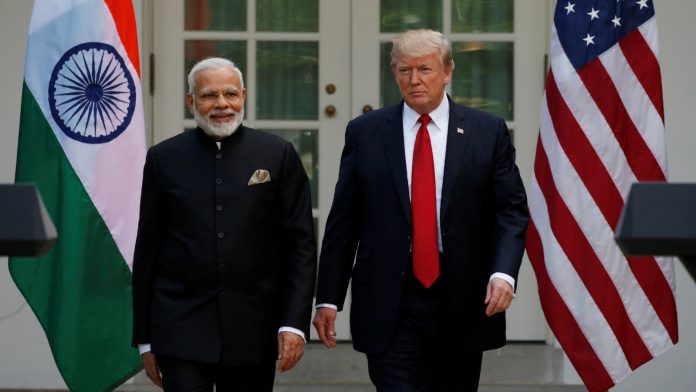
U.S. President Donald Trump’s announcement that Washington has reached a trade deal with India has landed with clear geopolitical intent, coming just days after Europe sealed its own long-awaited free trade agreement with New Delhi and amid a flurry of new trade pacts among major global economies.

The agreement, disclosed by Trump on Monday via his Truth Social platform, cuts U.S. tariffs on Indian goods to 18% from 25% and removes an additional 25% levy imposed last summer in response to India’s continued purchases of Russian oil. Trump said India had agreed to halt those purchases and would instead buy more than $500 billion worth of U.S. energy, technology, agricultural, and coal products, while also easing barriers faced by American exporters.

Although no official joint statement or detailed framework has yet been released, the speed of the announcement has drawn attention. The deal follows closely on the heels of the EU-India free trade agreement, which both sides hailed as historic after decades of stalled negotiations. The timing underscores Washington’s determination not to be eclipsed by Europe in one of the world’s fastest-growing major economies.

Since the start of the year, several global trading partners have moved ahead with new agreements, including the EU with India and China with Canada, at a time when the United States has relied heavily on tariffs as leverage. That approach had raised concerns that Washington was drifting to the margins of global trade diplomacy. The U.S.-India deal appears designed to counter that perception.

Terry Haines, founder of Pangaea Policy, said the agreement was a direct response to Europe’s momentum. He described it as a national-security-driven economic pact that ties trade more closely to strategic alignment, arguing that it shows the U.S. is capable of advancing major deals even amid broader geopolitical tensions.

The role of top-level political engagement has also been highlighted. Farwa Aamer, director of South Asia Initiatives at the Asia Society Policy Institute, noted that India-U.S. negotiations had been underway for some time, but said the EU’s breakthrough may have injected urgency into Washington’s efforts. In her assessment, leadership-level involvement was decisive in pushing the deal across the line.

Indian Prime Minister Narendra Modi confirmed the agreement on Monday, welcoming the reduction in tariffs on Indian exports and thanking Trump for his leadership. His statement, however, did not address the question of Russian oil, leaving uncertainty over how quickly, or to what extent, India would alter its energy sourcing.

For New Delhi, the deal fits into a broader strategy of diversifying economic partnerships. The EU agreement offers long-term access to a massive market, even though its tariff reductions will be phased in gradually. Securing a parallel arrangement with the United States strengthens India’s position within Western supply chains and provides a counterbalance amid global trade volatility.

Ranen Banerjee, partner and economic advisory leader at PwC India, said the combination of agreements with Europe and the U.S. could give a meaningful boost to jobs and manufacturing. He described the outcome as mutually beneficial, particularly if it translates into higher exports and sustained investment inflows.

The strategic implications may outweigh the immediate economic effects. Arpit Chaturvedi, South Asia adviser at Teneo, said the U.S. deal carries greater geopolitical weight than the EU pact alone. In his view, stabilizing trade ties with Washington reinforces India’s place in Western strategic thinking and helps reset bilateral relations on a more equal footing.

Still, economists are urging caution until more details emerge. Samiran Chakraborty, Citi’s chief economist for India, pointed out that key elements remain unclear, including the timeline for India’s proposed purchases of U.S. goods and the scope of any reductions in India’s own tariffs and non-tariff barriers. Without that clarity, assessing the deal’s long-term impact remains difficult.

There is also skepticism about how much relief the agreement will bring to U.S. consumers. Paul Donovan, chief economist at UBS Global Wealth Management, said Indian imports account for less than 3% of total U.S. imports, limiting the potential for tariff cuts to ease domestic price pressures. He added that tariff reductions are often less likely to be passed on to consumers than increases.

Overall, the deal appears as much about signaling as substance. By moving swiftly after the EU-India agreement, Trump has sent a message that the United States intends to remain central to global trade negotiations and strategic partnerships.

Palantir’s AI Bet Pays Off as Government Spending Drives Earnings Beat, but Scrutiny Trails the Rally

0

Palantir Technologies’ shares surged 11% in premarket trading on Tuesday after the data analytics firm delivered a stronger-than-expected fourth quarter, underscoring how rising government and enterprise spending on artificial intelligence is translating into real revenue momentum — even as political and ethical scrutiny around its work intensifies.

The company reported fourth-quarter revenue of $1.41 billion, comfortably ahead of Wall Street expectations of $1.33 billion, according to LSEG data. The results capped a volatile stretch for the stock, which had slumped sharply late last year amid broader concerns that enthusiasm around AI-linked software companies was running ahead of fundamentals.

Despite November marking Palantir’s worst month in two years, the stock still ended 2025 up 135%. That rally has cooled somewhat in early 2026, with shares down about 17% year to date at Monday’s close before the earnings-driven rebound.

Chief executive Alex Karp struck a confident tone following the release, calling the performance “the best results that I’m aware of in tech in the last decade” in an interview with CNBC. His remarks reflected a belief that Palantir has moved beyond speculative hype into a phase where AI adoption is driving durable, large-scale contracts, particularly in the public sector.

Founded as a data intelligence company focused on complex analytics for governments, Palantir has increasingly positioned itself as a core infrastructure provider for AI-driven decision-making. Its software is used by U.S. agencies, including the Department of Defense, the Internal Revenue Service, and the Department of Homeland Security, as well as by corporate clients seeking to integrate AI into operations.

That government focus is now a central pillar of its growth story. Palantir said U.S. government revenue rose 66% year on year, highlighting accelerating adoption of its platforms across defense, security, and public administration. The company has secured a string of large, multi-year deals that have bolstered confidence in the visibility of future earnings.

In July, Palantir signed a software contract worth up to $10 billion with the U.S. Army, one of the largest agreements in its history. That was followed in December by a $448 million contract with the U.S. Navy aimed at accelerating shipbuilding production, a deal that underscored the Pentagon’s push to use AI and data analytics to modernize procurement and logistics.

Investors have long wrestled with Palantir’s valuation, which has often been described as stretched relative to traditional software peers. Yet some analysts now argue that the company’s pricing looks more defensible in the context of the wider AI ecosystem.

“Although Palantir’s valuation is still frothy, it appears more reasonable relative to recent venture rounds for companies tied to the AI ecosystem,” said Louie DiPalma, an analyst at William Blair, in a note published ahead of the earnings release.

He added that Palantir’s operating margin could expand from around 50% to as much as 65% over the next five years, driven largely by growth in high-margin government and defense contracts.

That margin story is central to Palantir’s longer-term appeal. Unlike many AI-focused firms that continue to burn cash as they chase scale, Palantir has emphasized profitability and disciplined cost control, arguing that its platforms are already deeply embedded in customer workflows and therefore expensive to replace.

Still, the company’s close ties to law enforcement and immigration agencies remain a flashpoint. In recent weeks, Palantir’s work with U.S. Immigration and Customs Enforcement has drawn renewed attention following protests in Minneapolis, where federal agents shot two demonstrators during clashes tied to immigration enforcement operations.

While Palantir was not directly involved in the incidents, the controversy has revived broader debates about the role of private technology firms in surveillance, policing, and immigration control.

This has exposed Palantir to stark juxtaposition. On one hand, it is benefiting from governments’ willingness to spend heavily on AI tools amid geopolitical tensions and national security concerns. On the other hand, that same dependence on state power exposes the company to reputational and political risks that do not show up neatly in earnings models.

However, Palantir appears well-positioned to capture a significant share of accelerating AI spending in 2026, particularly from defense and public sector clients seeking to turn vast data troves into operational advantage. The challenge for investors is weighing that opportunity against the ethical, regulatory, and political questions that continue to shadow the company’s ascent.

Musk Forges $1.250tn Record-Breaking AI–Space Colossus With xAI–SpaceX Merger

0

Elon Musk on Monday confirmed that SpaceX has acquired his artificial intelligence startup xAI in a deal that reshapes the global technology landscape and sets a new benchmark for mergers and acquisitions.

The transaction formally unites Musk’s ambitions in artificial intelligence and space infrastructure, combining the world’s most valuable private rocket company with the developer of the Grok chatbot.

The decision marks the clearest step yet toward building a tightly integrated personal conglomerate that spans space, AI, communications, mobility, and neurotechnology, binding his most ambitious bets into a single corporate orbit.

Musk said on Monday that SpaceX had acquired xAI in a deal that values SpaceX at about $1 trillion and xAI at roughly $250 billion, according to people familiar with the transaction. Investors in xAI will receive 0.1433 shares of SpaceX for every xAI share, while some executives are being offered a cash alternative priced at $75.46 per share. The combined entity is expected to price shares at around $527, one of the people said.

The transaction, first reported by Reuters last week, overtakes the $203 billion Vodafone–Mannesmann takeover in 2000 to become the largest merger ever recorded, based on data compiled by LSEG. It also comes as SpaceX is preparing for what could be a landmark initial public offering later this year, with people familiar with the matter saying the listing could value the company at more than $1.5 trillion.

Musk framed the deal in sweeping terms, describing it as the next phase in a shared mission to extend intelligence beyond Earth. Behind the rhetoric, the industrial logic is more concrete. xAI, the developer of the Grok chatbot, is one of the most capital-intensive businesses in the AI race, with costs driven by chips, data centers, and electricity. SpaceX, through its Starlink satellite network, already operates one of the world’s largest private communications infrastructures and generates steady cash flow.

By bringing xAI under the SpaceX umbrella, Musk is effectively internalizing the infrastructure stack needed to compete with rivals such as Alphabet’s Google, Meta, Amazon-backed Anthropic, and OpenAI. Starlink offers global data distribution and a growing enterprise and government customer base, while SpaceX’s launch and satellite operations provide leverage over where and how future compute and data assets are deployed.

Ali Javaheri, a senior emerging spaces analyst at PitchBook, said Starlink was already a cash-flow engine and that the addition of AI created a new revenue layer. He noted that Starlink could also become a distribution surface for AI services and data, particularly if policy shifts allow certain categories of customer data to be used for model training. The longer-term prospect of orbital or space-based data centers, while still speculative, adds to a narrative that positions SpaceX as an integrated infrastructure platform rather than a pure rocket company.

The deal also underscores how Musk has been consolidating his businesses into a more unified structure. Last year, he merged social media platform X into xAI through a share swap, giving the AI startup direct access to real-time data and a built-in distribution channel. Earlier in his career, he used Tesla stock to acquire solar installer SolarCity, folding energy generation into his electric-vehicle ecosystem. Alongside Tesla, Neuralink, and the Boring Company, the SpaceX–xAI tie-up tightens what investors increasingly view as a single, interconnected industrial empire.

However, that strategy is believed to have come with risks. Investors have already expressed unease about aggressive spending and valuation assumptions across Musk’s companies. SpaceX was last valued at about $800 billion in a recent insider share sale, while xAI was valued at roughly $230 billion as recently as November, according to the Wall Street Journal. Combining them at higher figures concentrates both upside and downside into one balance sheet, just as public markets remain sensitive to capital intensity in AI and infrastructure.

Regulatory and governance questions are also likely to follow. SpaceX holds billions of dollars in contracts with NASA, the U.S. Department of Defense, and intelligence agencies, all of which have some authority to review transactions for national security implications. The deal may also draw attention to conflicts of interest, given Musk’s overlapping leadership roles and the potential movement of engineers, data, and proprietary technology between his companies.

Still, the timing suggests strategic calculation. Hyperscalers and AI developers are locked in a global build-out of compute and data-center capacity, with AI-related data-center deals hitting a record $61 billion in 2025. By merging xAI into SpaceX ahead of a potential IPO, Musk is presenting investors with a broader story: not just rockets and satellites, but a vertically integrated platform that links launch, connectivity, data, compute, and AI services.

In effect, the transaction formalizes what has been taking shape for years. Musk is no longer running a collection of loosely related ventures. He is assembling a personal conglomerate, designed so that each business feeds the others, and positioning it for the public markets as a single, expansive bet on the infrastructure of the future.

Disney Shares Steady as Succession Clock Ticks, With Investors Weighing Leadership Risk Against Strong Parks Performance

0

Disney shares edged higher in premarket trading on Tuesday as investors turned their attention away from headline earnings and toward a question that has increasingly dominated sentiment around the stock: who will succeed Bob Iger as chief executive.

The media giant’s shares were up 0.14% as of 7:05 a.m. ET, a muted rebound after the stock fell 7% on Monday. That sell-off came even as Disney reported solid quarterly results, highlighted by its Experiences division — which includes theme parks, resorts, and cruise operations — surpassing $10 billion in revenue for the first time in a single quarter.

Overall, Disney posted quarterly revenue of about $26 billion, up 5% year on year and ahead of Wall Street expectations of $25.7 billion. The numbers underscored the continued resilience of its parks-led businesses at a time when streaming profitability and legacy media assets remain under pressure.

Still, the market reaction made clear that earnings strength alone is no longer the decisive factor for Disney’s valuation.

Succession uncertainty weighs on sentiment

At the center of investor unease is the unresolved leadership transition. Disney’s board is meeting this week and is expected to vote on Iger’s successor, according to people familiar with the matter who spoke to CNBC on condition of anonymity. The decision would mark the second attempt to engineer an orderly handover from Iger, one of the most influential executives in the company’s history.

Iger first stepped down in 2020 after a 15-year run, handing the reins to Bob Chapek. That transition unraveled within two years amid internal tensions, strategic missteps, and declining morale, culminating in Chapek’s abrupt dismissal in late 2022 and Iger’s return.

That episode continues to loom large over Disney’s governance story. Analysts at Jefferies described the “impending leadership transition” as an “overhang on shares,” even as reports suggest a resolution is close. Bank of America analysts echoed that view, saying succession uncertainty has weighed on the stock in recent weeks.

Iger himself offered an unusually candid assessment on Monday’s earnings call, acknowledging that “trying to preserve the status quo was a mistake” when Chapek was appointed. He said that when he returned, there was “a tremendous amount that needed fixing,” from strategy and culture to cost discipline.

A stronger hand — but lingering questions

Iger struck a more optimistic tone about the state of the company he will leave behind, saying his successor would be “handed … a good hand in terms of the strength of the company,” alongside opportunities for growth and the need to keep evolving in a rapidly changing media landscape.

That comment reflects the paradox facing Disney investors. On one side, the company’s Experiences division has become a reliable earnings engine, providing cash flow stability and offsetting volatility in streaming and advertising. The division’s scale and profitability have elevated its strategic importance, making leadership continuity there especially critical.

On the other side, Disney is still navigating structural shifts in how audiences consume content, how streaming platforms are monetized, and how to balance creative ambition with financial discipline — challenges that will define the next CEO’s tenure.

Who could take the helm?

Among the leading internal candidates is Josh D’Amaro, chair of Disney Experiences, who has been widely credited with driving growth and operational discipline across parks and resorts. Industry insiders and Disney sources have previously told CNBC that D’Amaro is a top contender, particularly given the division’s growing contribution to earnings.

Dana Walden, Disney’s co-chair of Entertainment, is also seen as a serious candidate, bringing deep experience in television and content strategy at a time when Disney is reassessing its entertainment portfolio.

Bank of America analysts noted that, given the Experiences division’s outsized role in Disney’s profit base, appointing D’Amaro would likely be “well received by the investment community,” a signal that investors may favour operational certainty over broader strategic experimentation.

For now, Disney’s financial performance is doing its job: revenue is growing, parks are thriving, and expectations are exceeded. Yet the market’s restrained response suggests that investors are less focused on what Disney earned last quarter and more concerned with what comes next.

Until the board delivers clarity on succession and convinces investors that this transition will avoid the pitfalls of the last one, Disney shares may continue to trade with a leadership discount, even as the underlying business shows signs of renewed strength.