DD
MM
YYYY

PAGES

DD
MM
YYYY

spot_img

PAGES

Home Blog Page 5

Top 5 Cryptos to Buy Right Now: BlockDAG Edges Out BNB, PEPE, SOL & ADA

0

The crypto market in April 2026 is moving fast, and the window to get in at the right price is closing on several assets. Whether you are a first-time buyer or someone looking to grow a portfolio, picking the right coins matters more than ever. This listicle breaks down the top 5 cryptos to buy this month, covering price data, key developments, and why each one deserves your attention. From a high-momentum presale to established Layer-1 giants, these are the names worth watching.

The top 5 cryptos to buy right now are BlockDAG, BNB, Pepe, Solana, and Cardano. Each one tells a different story, but all five have something compelling happening right now. Read on.

1. BlockDAG: Final Hours at $0.000022

BlockDAG is the most urgent entry on this list of top 5 cryptos to buy. BDAG is currently available at $0.000022 through the AfterSale window, which is closing in hours. The open market price already delivers 85x on that AfterSale entry price, meaning buyers who get in now are sitting on an 85x gap the moment trading begins, which is starting very soon. That kind of entry point does not come back once the window shuts.

BlockDAG is a Layer-1 blockchain that combines Directed Acyclic Graph architecture with Proof-of-Work security. It processes multiple blocks simultaneously, giving it strong throughput and scalability without sacrificing security. The network is built for decentralized applications, tokenized assets, and high-frequency financial activity. BDAG is already live on five exchanges, BitMart, P2B, Biconomy, BiFinance, and AscendEX, with on-chain USDT also now active on the BlockDAG network. The $10B market cap milestone has been crossed.

The roadmap is executing on schedule. Late April brings full exchange coverage. May sees DEX integration and liquidity provider incentives. June brings the Super App, lending protocols, oracle integration, and dApp ecosystem activation. Batch 3 of the AfterSale activates next week, which means the price floor moves up. The $0.000022 entry is available for hours, not days.

2. BNB: Holding Strong While Others Bleed

BNB is one of the most resilient coins on any top 5 cryptos to buy list right now. It is currently trading at around $607, with a market cap of approximately $82.8B and a 24-hour trading volume of $1.47B. BNB hit a January 2026 high of $780 and has seen a roughly 22% drawdown from that peak, significantly better than Bitcoin’s 47% and Ethereum’s 29% drops over the same period.

The ecosystem is active and growing. Tether’s tokenized gold product XAUt is now live on BNB Chain, pushing real-world assets on the network to around $3.2B. The January 2026 Fermi hard fork reduced block time from 0.75 seconds to 0.45 seconds, bringing finality down to approximately 1.1 second. BNB Chain also extended its zero-fee carnival for USDC and USD1 until April 30, with over $4.5M already covered in gas fee reimbursements. The all-time high stands at $1,369.99.

3. Pepe: Meme Coin Market Waking Up

Pepe makes the top 5 cryptos to buy list because the meme coin sector is showing signs of life. PEPE is currently trading at $0.00000353, with a market cap of $1.49B and a 24-hour trading volume of $370M. The all-time high is $0.00002803, meaning PEPE is still roughly 87% below its peak, with a circulating supply of approximately 413.77 trillion tokens across more than 500,000 wallets.

The broader meme coin market cap climbed to $34B after a 1.3% daily gain led by Dogecoin, PEPE, and BONK. PEPE itself surged 25% at the start of 2026 and led a roughly 70% gain in the first week of the year. Short-term technical indicators are still bearish, with price sitting below major exponential moving averages, but accumulation is happening and volume is rising. For high-risk, high-reward exposure, PEPE remains one of the most recognized names in the meme category.
4. Solana: Watching the $80 Line

Solana is a coin that earns its spot on the top 5 cryptos to buy list despite a difficult run. SOL is currently trading at approximately $79.65, ranked #7 by market cap at $45.6B. The Fear and Greed Index sits at 12, Extreme Fear, and only 11% of technical indicators are currently bullish. SOL has posted six consecutive red months since October 2025, down roughly 73% from its all-time high of $293.

The fundamentals, however, remain strong. The Solana ecosystem has reached roughly $1.7B in tokenized real-world asset value, stablecoin liquidity on-chain sits in the billions, and spot Solana ETFs have pulled close to $1B in cumulative inflows. Two U.S. banks are now settling USDC transactions on Solana. The $80 level is the critical support to watch, a hold here could set up a recovery toward $85 and $100. Risk-tolerant buyers watching for a floor entry are paying attention to SOL right now.

5. Cardano: Development Ahead of the Price

Cardano rounds out the top 5 cryptos to buy for April 2026 on the strength of its fundamentals against a discounted price. ADA is currently trading at approximately $0.24–$0.25, with a market cap of roughly $8.9B. It is down 80% from its all-time high of $3.10 and 49% year to date. Immediate resistance sits at $0.26–$0.28, with support at $0.236.

The development pipeline is one of the most active in crypto right now. The Midnight privacy sidechain mainnet launched at the end of March with Monument Bank already live for tokenized deposits. The Protocol 11 hard fork, targeting a full overhaul of on-chain voting and treasury management, is backed by 680 weekly commits across 80 repositories. Circle’s USDCx stablecoin has been deployed on Cardano, strengthening institutional DeFi infrastructure. The CLARITY Act, which would formally classify most crypto assets as commodities, is targeting a Senate markup in late April with 72% odds of passing on Polymarket. ADA is already designated a digital commodity under the existing framework.

Summing Up

These are the top 5 cryptos to buy in April 2026, each with a distinct case for being in your portfolio. BNB is holding resilience. PEPE is riding meme sector momentum. SOL is watching a key support level with strong institutional backing underneath it. ADA is building hard while the price is suppressed.

But BlockDAG stands apart. The top 5 cryptos to buy conversation in April 2026 starts and ends with the $0.000022 AfterSale entry. An 85x gap between the AfterSale price and open market price, with trading starting very soon, does not come along often. This is the window. It is closing in hours.

Uniswap & Solana Face Crashes; Investors Rush to Secure BlockDAG’s $0.000022 Rate for Huge 85x Instant ROI

0

The broader market currently feels the strain, and technical charts are starting to tell a consistent story. Uniswap is currently retracing toward $3.36, with its RSI hovering at 38 and Bollinger Band resistance firmly at $4.18, leaving traders without a clear sign of a reversal. Meanwhile, the Solana price is holding at $83.61, sitting below major moving averages as weekly ETF outflows of $4.24 million weigh on its performance. Both assets are flashing signals for a cautious approach.

However, BlockDAG provides a completely different narrative. BDAG is currently valued at $0.4 on CoinMarketCap, which represents a massive 39,900% jump from its Stage 1 price point. A Limited Time Priority Access offer at $0.000022 is still available through the official BlockDAG (BDAG) site, but this window shuts soon and will not be reopened.

The open market valuation has already surged past this introductory rate. With active futures markets, an accelerating list of exchange partnerships, and a market cap exceeding $10 billion, analysts are now setting their sights on a $1 target. As the global trading window looms, the opportunity for this specific early entry is rapidly disappearing.

Bearish Indicators Cloud the Uniswap Price Prediction

Uniswap remains a cornerstone of the DeFi world, functioning as a fully decentralized automated market maker (AMM) on the Ethereum network. It allows users to swap assets without third-party interference, making the UNI token a favorite for those seeking liquidity and utility.

Currently, the Uniswap price prediction suggests a continued correction toward $3.36, with a secondary support level at $3.22. The daily charts reflect a downward trend, further supported by an RSI of 38 that indicates persistent selling momentum. Low volatility on the 4-hour charts is currently preventing any significant recovery attempts.

For those following the Uniswap price prediction, resistance at $4.18 and the support floor at $3.22 are the levels to watch. Short-term forecasts indicate that additional minor pullbacks are likely if the current selling pressure does not subside.

Solana Price Navigates Downward Momentum & ETF Exits

The Solana price currently sits at $83.61, placing it below the SMA-20 ($88.41), SMA-50 ($85.96), and SMA-200 ($141.20). This positioning confirms a period of sustained selling, with the Ichimoku Kijun at $88.36 serving as the immediate ceiling. The Solana price faced extra pressure as US spot ETFs recorded $4.24 million in weekly outflows, signaling a shift toward bearish positioning among institutional players.

While technical indicators like the MACD and an RSI of 39.3 suggest the asset is entering oversold territory, the recovery has been limited to small intraday bounces. The Solana price is expected to fluctuate between $81.18 and $84.14 in the near term, with a broader five-day range of $80 to $86.50. Unless new buyer interest appears, the technical outlook remains under pressure.

BlockDAG Hits $0.4 on CMC as Trading Deadline Nears

BlockDAG was built as a high-performance Layer 1 blockchain with a structured rollout designed to prioritize stability and developer growth. This phased approach has prepared the network for wide-scale participation, giving early adopters a distinct advantage. Its current framework, featuring active futures and upcoming mining hardware shipments, supports a highly strategic market entry.

The Limited Time Priority Access rate of $0.000022 is currently live on the BlockDAG website. This specific offer expires in hours, providing a final chance to secure a position before global trading begins. This date is a hard cutoff; once it passes, the introductory price will be retired permanently.

On CoinMarketCap, BDAG is valued at $0.4 today, representing a 39,900% increase from Stage 1 and a 700% rise from its listing price. Because the open market price is already significantly higher than the Priority Access rate, these last hours are the last moments for buyers to enter at this specific level.

Liquidity is already flowing through active futures markets, and mining hardware will be delivered between April and June to strengthen the network’s foundation. With a confirmed BTCC listing above $0.15 and active presence on BitMart, and P2B, the project is expanding its reach faster than anticipated.

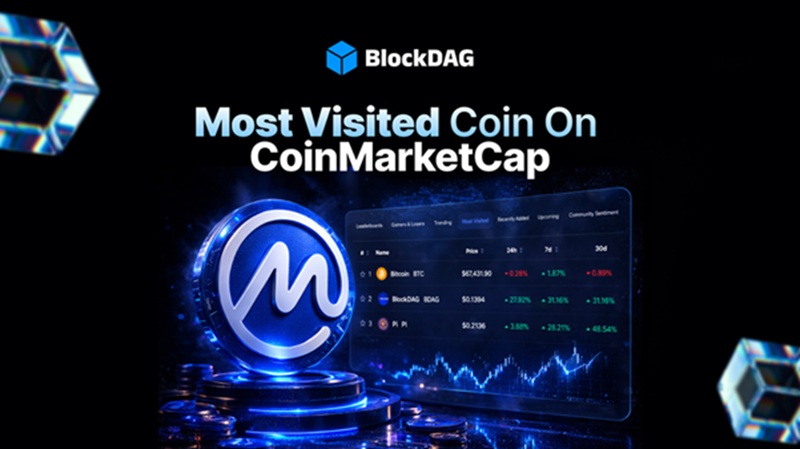
BlockDAG’s market cap has surpassed $10 billion, and it currently ranks as the second most-visited asset on CoinMarketCap, trailing only Bitcoin in traffic. This high visibility and massive market size suggest a project with serious longevity. Analysts are now projecting a $1 target for BDAG, a goal that appears increasingly realistic given the project’s recent performance.

Final Thoughts

The Uniswap price prediction continues to look soft, with resistance at $4.18 likely to cap any short-term rallies. Similarly, the Solana price is battling bearish technicals and steady ETF outflows, keeping it trapped in a narrow range between $80 and $86.50.

In this environment, BlockDAG stands out. Its $0.4 valuation, liquid futures, and growing exchange footprint indicate a project that is already reaching significant scale. The Priority Access entry at $0.000022 closes soon. For anyone identifying the best crypto to buy, this hard deadline represents a pivotal moment in the project’s journey.

Presale: https://purchase.blockdag.network

Website: https://blockdag.network

Telegram: https://t.me/blockDAGnetworkOfficial

Discord: https://discord.gg/Q7BxghMVyu

Treasury Yields Hold Near Multi-Month Highs as Markets Brace for Trump’s Iran War Update and Inflation Test

0

U.S. Treasury yields held largely steady on Monday, but the calm in the bond market masked a deeper unease as investors positioned for two potentially market-moving catalysts.

The Treasury market is in a waiting phase ahead of President Donald Trump’s press conference on the Iran conflict and the release of the personal consumption expenditures (PCE) index, the Fed’s preferred inflation gauge.

The President’s address could reshape expectations for Federal Reserve policy. Investors are increasingly pricing the Iran war not as a temporary geopolitical disturbance, but as a growing macroeconomic shock with the potential to alter the Federal Reserve’s policy path.

The benchmark 10-year Treasury yield held around 4.35%, while the 2-year note hovered near 3.86% and the 30-year bond approached 4.92%, keeping long-dated borrowing costs close to their highest levels in several months.

Against the backdrop of Trump’s address, the muted day-to-day movement is not seen as stability.

The bigger story is the sharp repricing that has already taken place. Before the conflict intensified, the 10-year yield was trading below 4%. It has since climbed roughly 35 to 40 basis points, a significant move for the world’s benchmark risk-free asset.

That move tells a deeper story about what markets now fear. Ordinarily, geopolitical crises push investors into Treasuries, causing yields to fall as demand for safe assets rises. This time, yields have instead risen even as global tensions escalate.

That inversion suggests that inflation fears, driven by surging oil prices and supply-chain risks, are outweighing the traditional safe-haven bid. This is increasingly becoming a stagflation trade. Markets are now pricing a scenario in which growth slows because of the war’s economic fallout, while inflation remains sticky or even accelerates because of higher energy costs.

That is one of the most difficult environments for central banks to navigate. As oil prices remain elevated amid uncertainty around the Strait of Hormuz, investors are reassessing whether the Fed can deliver any rate cuts this year. Reuters reported that markets have sharply trimmed expectations for easing, with some desks now pushing any meaningful cuts into 2027.

The yield curve offers further insight. The spread between the 10-year and 2-year yields now stands at roughly 50 basis points, reflecting a steeper curve than earlier in the year. That steepening is often interpreted as a sign that investors expect higher long-term inflation and term premium, rather than imminent recession alone.

In practical terms, bond buyers now demand greater compensation to hold long-dated debt in an environment where inflation uncertainty is rising.

The geopolitical dimension remains the dominant driver. President Trump’s ultimatum to Iran over the reopening of the Strait of Hormuz has introduced a binary risk event into markets. If diplomacy gains traction and the waterway reopens, crude prices could fall sharply, easing inflation expectations and allowing yields to retrace.

Some analysts estimate that such an outcome could pull WTI crude lower by $20 to $30 per barrel, which would likely trigger a rally in Treasuries.

The downside scenario is more severe as any strike on energy infrastructure or a prolonged closure of Hormuz could send oil into the $130 to $150 range, significantly worsening inflation expectations and pushing Treasury yields even higher.

This is why this week’s inflation data takes on unusual significance. The PCE report will be scrutinized not just for headline inflation, but also for any early signs that the oil shock is feeding into core prices, transport costs, and consumer goods. If the data comes in hotter than expected, it could reinforce the view that the Fed must stay restrictive for longer.

That would likely pressure the long end of the curve further. The broader significance is that the Iran war is now clearly affecting global capital markets beyond commodities. It is also influencing the price of money itself. Higher Treasury yields feed directly into mortgage rates, corporate bond issuance, valuation models for equities, and the cost of refinancing U.S. government debt.

For equities, this creates a double burden: geopolitical uncertainty on one hand and higher discount rates on the other. This is especially problematic for technology and other growth sectors, whose valuations are highly sensitive to long-term yields.

Another important point is liquidity.

Trading volumes are thin because of holiday conditions in parts of Asia and Europe, which can amplify price swings. Even seemingly minor headlines from the White House or Tehran could therefore trigger outsized moves in yields, oil, and equities.

In effect, the Treasury market is no longer reacting purely as a safe haven. It is increasingly functioning as the market’s clearest gauge of whether the Iran conflict evolves into a full-fledged global inflation shock. For now, yields are steady. But the steadiness is less a sign of calm than a reflection of a market bracing for a decisive headline risk event over the next 48 hours.

IMF Analyses How Smart Contracts and Tokenized Finance Represent a Structural Shift in Financial Architecture

0

The International Monetary Fund (IMF) recently published a note titled “Tokenized Finance”, analyzing how representing financial assets and liabilities on programmable digital ledgers via permissioned shared ledgers, smart contracts, and tokenized money represents a structural shift in financial architecture.

While tokenization promises benefits like near-instant (atomic) settlement, 24/7 trading, greater transparency, reduced intermediary costs, improved liquidity, and fractional ownership, the IMF cautions that it could amplify systemic risks without proper safeguards.

The Four Key Risks Identified by the IMFNews coverage of the IMF note consistently highlights four primary risks to global financial stability: Interoperability and Fragmentation. Tokenized ecosystems are likely to involve multiple platforms, consortia, and jurisdictions with differing settlement assets, liquidity pools, or collateral rules.

This could lead to fragmented liquidity, impaired par convertibility; assets not trading at equal value across platforms, reduced netting efficiency, and complications in crisis management. Without common standards, markets risk becoming siloed, undermining overall efficiency and increasing vulnerabilities.

Amplified Financial Stability Threats from Speed and Automation

Features like automated margin calls, continuous settlement, algorithmic feedback loops, and smart contract-based risk management compress response times during stress. Traditional buffers e.g., settlement delays disappear, allowing stress events to unfold faster—potentially turning minor issues into rapid liquidity crises or flash crashes.

Concentration risks like reliance on a few platforms or settlement assets could further exacerbate contagion. Tokenized transactions often occur on shared ledgers spanning multiple countries, but resolution and supervisory powers remain national. This mismatch complicates coordinated responses to failures, legal disputes, or insolvencies, making it harder to manage cross-border spillovers or unwind positions effectively.

The ease of cross-border movement for tokenized assets and money especially dollar-denominated stablecoins heightens risks of volatile capital flows, rapid currency substitution, and erosion of monetary sovereignty. This could accelerate dollarization or capital flight in response to global conditions, weakening local policy tools and financial stability in these economies.

The IMF views tokenization as more than incremental efficiency gains—it fundamentally alters settlement, liquidity, and risk dynamics by shifting some trust from institutions to code and programmable rules. Atomic settlement and transparency can mitigate certain traditional risks, but speed, automation, and potential concentration introduce new ones. The note stresses that long-term success depends on anchoring tokenized finance in public trust through.

Clear policy frameworks and safe settlement assets. Robust governance of code and smart contracts. Legal certainty for tokenized instruments. Strong international coordination to address fragmentation and cross-border issues. It also outlines a policy roadmap involving safe-money settlement, interoperability standards, consistent regulation, and adapting central bank tools for 24/7 tokenized markets.

Adoption of tokenized assets is still relatively modest; reports mention figures in the tens of billions but growth projections vary widely, with some seeing potential for trillions in tokenized real-world assets over time. The IMF’s analysis aligns with broader discussions on tokenization’s vulnerabilities related to liquidity mismatches, leverage, interconnectedness, and operational fragilities.

In summary, the IMF is neither outright opposed nor uncritically optimistic. It sees transformative potential but urges proactive, coordinated policy responses to prevent tokenized finance from amplifying instability rather than enhancing resilience.

Drift’s Postmortem Report Attributes Compromised Security Council as Cause of Hack

Meanwhile, Drift Protocol, a Solana-based DeFi perpetuals exchange, suffered a major exploit on April 1, 2026, with approximately $280–285 million drained from user deposits in its borrow/lend markets, vaults, and trading funds.

The team quickly released an initial statement and followed up with a more detailed post-mortem; published around April 4–5, linking the incident to a sophisticated, months-long operation. They emphasized that the attack did not stem from a bug in Drift’s smart contracts or programs, nor from compromised seed phrases.

Instead, it involved unauthorized access to the Security Council’s administrative powers via a novel attack using durable nonces on Solana. Attackers gained control by exploiting durable nonces (a Solana feature meant to prevent transaction expiration). They tricked or manipulated the security council into pre-signing or approving transactions that could be executed later.

This enabled a rapid takeover: the hackers introduced a rogue asset and removed pre-set withdrawal limits, allowing the massive drain. The operation appeared highly staged, with pre-signed durable nonce transactions executed shortly after a legitimate test withdrawal from the insurance fund.

Deposits in core markets were hit, but assets like DSOL including staked validator holdings and the Insurance Fund remained unaffected (the latter was withdrawn for safety). Drift responded by: Freezing remaining protocol functions. Updating the multisig to remove the compromised wallet. Collaborating with security firms, bridges, exchanges, and law enforcement to trace and freeze stolen assets.

A full technical post-mortem was promised and partially delivered via updates, with ongoing forensic work. Multiple sources, including blockchain analytics firms like Elliptic and PeckShield, along with Drift’s own assessment, point to a North Korean state-affiliated group with medium-high confidence it’s the same actor behind the October 2024 Radiant Capital ~$50M hack.

The operation reportedly spanned about six months: It began around fall 2025 at a major crypto conference, where attackers posed as representatives of a quantitative trading firm. They built trust via Telegram, continued contact, and allegedly used social engineering (malicious links, malware, fake apps) to compromise developer machines over time.

This mirrors tactics seen in other high-profile incidents, including the massive 2025 Bybit breach ~$1.5B also attributed to North Korean actors. North Korea has been linked to a huge portion of crypto thefts in recent years, often laundering funds through complex chains.  Significant TVL drop; reports of 50%+ collapse in some analyses, frozen functions, and user concern. The DRIFT token reportedly fell sharply.

Critics and attorneys like Ariel Givner highlighted potential operational security lapses, such as not keeping signing keys on fully air-gapped systems, insufficient due diligence on external developers and contributors met at events, and risks from Telegram chats or unvetted code. Some described it as possible civil negligence for failing basic protections around multisig and admin controls.

On-chain tracking shows large transfers of stolen funds (hundreds of millions), with efforts underway to monitor and freeze them via exchanges and bridges. Recovery from DPRK-linked attacks has historically been very difficult. Community sentiment notes the recurring theme in DeFi hacks: even with audited code, admin/key management and human and social engineering vectors remain the weak points.

Drift has stressed the attack was sophisticated and intelligence-operation-like rather than a simple smart-contract flaw. The protocol is working on recovery and hardening measures, but the incident underscores ongoing risks in DeFi around privileged access, multisig security, and persistent nation-state threats.

Andreessen Horowitz Posits Artificial General Intelligence is Already Here But Not Evenly Distributed Yet 

0

Marc Andreessen, co-founder of Andreessen Horowitz, posted on X saying AGI is already here – it’s just not evenly distributed yet. This echoes similar recent comments from tech leaders like Nvidia’s Jensen Huang, who has also suggested we’ve achieved AGI in a practical sense.

Andreessen’s phrasing plays on the famous quip about the future or personal computers, or electricity already being here but unevenly spread—implying that frontier AI systems today can already perform at or beyond human-level across a wide range of cognitive tasks for those with access (big labs, enterprises, power users), even if everyday consumer tools feel more like advanced narrow AI or assistants.

AGI (Artificial General Intelligence) traditionally means AI that matches or exceeds human intelligence across any intellectual task—not just specialized ones like image generation, coding, or conversation. Definitions vary wildly: Strict academic versions require full autonomy, novel scientific discovery, physical embodiment, or self-improvement without human intervention.

Pragmatic industry views which Andreessen seems to lean toward focus on economic usefulness: systems that can do most white-collar work, reason through problems, code autonomously, or handle multi-step workflows at human or superhuman levels.

Current frontier models e.g., advanced versions of GPT, Claude, Grok, Gemini, etc. already ace benchmarks that would have seemed impossible a few years ago: passing bar exams, solving complex math competitions, generating creative work, debugging codebases, or acting as research assistants.

They have limitations—hallucinations, lack of true long-term planning in open worlds, no real-world embodiment without robotics integration, and uneven reliability. But Andreessen’s point is that the general part is here for many practical purposes, especially when chained into agents or workflows.

The bottleneck is now distribution, productization, cost, energy, and integration into real economies—not raw capability. This fits his long-standing techno-optimist stance. He’s argued AI will save the world by boosting productivity, countering demographic decline, and making intelligence abundant and cheap like electricity or the internet.

In recent interviews and a16z discussions, he emphasizes that we’re still early: models are improving rapidly, the real boom in applications, agentsand robots hasn’t fully hit, and progress feels both explosively fast and frustratingly incremental depending on your vantage point.

Top labs and well-funded companies have the best models, compute, and fine-tuning. Most people interact with watered-down or older versions via apps. Raw intelligence exists in the cloud, but turning it into reliable, safe, cheap products like AI employees that run businesses end-to-end is the next phase.

a16z has highlighted how the AI future is already here, it’s just not productized yet. Like early internet or PCs, benefits accrue first to those with skills, capital, or infrastructure. Over time, it spreads. If it’s AGI, why can’t it independently run a company, invent breakthrough physics without guidance, or handle unpredictable physical tasks flawlessly?

Many argue we’re in proto-AGI or narrow-but-broad territory, with true generality including robust agency and novel invention at scale still ahead. Andreessen isn’t denying ongoing progress—he’s saying the threshold has been crossed for what matters economically right now. Andreessen has bet big on AI (a16z has deployed billions).

His view contrasts with doomers focused on existential risk, emphasizing instead that slowing down risks ceding leadership and missing massive upside in science, medicine, creativity, and abundance. He sees AI as augmenting and accelerating human potential, not replacing it wholesale—though he acknowledges it will disrupt jobs and creativity.

Whether you agree depends on your AGI definition. By loose, capability-focused metrics, frontier AI already outperforms most humans on many isolated tasks and combines them impressively. By stricter ones requiring seamless, unsupervised generality in the real world, it’s aspirational.

Either way, the trajectory is clear: capabilities are compounding quickly, costs are falling, and integration into software, agents and robots is accelerating. This isn’t hype from a random voice—Andreessen called the internet’s potential early.

The debate will rage on, but his call highlights a shift: many in the industry now treat AGI arrived as a diagnosis of the present, not a distant forecast. The open question is how society distributes, governs, and builds on it.