DD
MM
YYYY

PAGES

DD
MM
YYYY

spot_img

PAGES

Home Blog Page 5

Amodei Warns AI Elite of Impending Backlash, as Wealth Concentrates in the Age of Artificial Intelligence

0

Anthropic CEO Dario Amodei has issued a blunt warning to his peers in the artificial intelligence industry over their perception of the technology and attitude toward it.

In his warning, Amodei challenged his peers to dismiss public anxiety about AI at [your] peril, or risk triggering a political and social backlash that could reshape the sector in far harsher ways than many executives expect.

“You can’t just go around saying we’re going to create all this abundance, a lot of it is going to go to us, and we’re going to be trillionaires, and no one’s going to complain about that,” Amodei said in an interview with Axios. “Look, you’re going to get a mob coming for you if you don’t do this in the right way.”

The comments followed the publication of Amodei’s 19,000-word essay, The Adolescence of Technology, a sweeping meditation on how artificial intelligence could transform economies, politics, and social contracts. In it, Amodei argues that AI should be treated not as just another productivity tool, but as a “serious civilizational challenge” on par with industrialization or the advent of nuclear power.

At the center of his argument is a stark forecast about wealth concentration. Amodei openly predicts that AI will create unprecedented levels of economic output and efficiency, but that much of this new value will accrue to a narrow set of companies and individuals who control the most powerful models, data, and infrastructure. In his telling, the emergence of trillionaires is not a rhetorical flourish but a plausible outcome of AI-driven markets.

That prospect, he argues, makes traditional political assumptions about taxation and redistribution obsolete.

“I don’t think this is the tax policies of old,” Amodei said. “This is for a world where people are trillionaires.”

While Amodei stops short of proposing a specific framework, his essay suggests that new forms of taxation may need to be either broadly applied or explicitly targeted at AI companies. The alternative, he warns, is not the absence of redistribution, but the arrival of poorly designed, reactionary policies driven by public anger once the scale of inequality becomes politically impossible to ignore.

His intervention sets him apart from many technology leaders who emphasize AI’s potential to lower costs, boost growth, and raise living standards, often downplaying the distributional consequences. Amodei does not dispute the promise of abundance. Instead, he frames the central question as who ultimately benefits from it.

In both the essay and the interview, he urges policymakers to act early, not only on taxation but also on transparency and governance. He says he has advised lawmakers to push for stronger AI transparency laws, which would give regulators and the public clearer insight into how powerful systems are trained and deployed.

He has also backed continued restrictions on the export of advanced AI chips to China, arguing that controlling access to compute remains a key lever in managing global AI competition and security risks.

Amodei’s tone reflects his reputation as one of the industry’s more cautious voices. Often described as holding a “doomer” outlook, he has long emphasized existential and systemic risks from advanced AI. Yet he is careful to distinguish between what he sees as misdirected fears and what he considers the real stakes.

He dismisses claims that data centers are draining water supplies, saying they “don’t use that much water,” and characterizes anxiety over rising electricity bills as understandable but secondary.

“I think in the long run, it’s not about power bills,” he said. “It’s about enormous abundance, and whether they get their piece of the abundance.”

That framing places Amodei’s warning squarely in the realm of political economy rather than science fiction. His concern is less about machines turning hostile than about societies fracturing if AI-driven gains accrue too narrowly, leaving large segments of the population feeling excluded from a transformation they were promised would benefit everyone.

Amodei’s message adds pressure on both policymakers and industry leaders to confront uncomfortable questions early, especially as governments around the world scramble to regulate AI. In his view, ignoring those questions risks turning today’s optimism about AI into tomorrow’s backlash, with consequences that could be far more disruptive than any carefully designed reform.

As XRP and Pudgy Penguins Trade Sideways, ZKP Crypto’s Supply Crunch Sets the Stage for a Surge

0

Crypto markets entered late January with total capitalization near $3 trillion, while daily volumes topped $100 billion amid uneven sentiment. XRP news shows tight consolidation at support, and Pudgy Penguins price action stays volatile, but can either deliver outsized profit now?

That uncertainty fuels attention toward ZKP, which researchers describe as a privacy-first AI network and data marketplace built on advanced cryptography. Analysts highlight its energy efficiency, hybrid consensus, and proof-based monetization as a structural upgrade overall.

Technical analysts call Stage 2 the pivot point, where 190 million coins maintain balance. When Stage 3 reduces supply to 180 million, experts anticipate market psychology to drive increased demand, boosting valuations and positioning ZKP as the best crypto to buy.

ZKP Crypto: The Supply Pressure Thesis

ZKP crypto is designed as a private AI network and decentralized data marketplace that rewards users for computation, storage, and verified data. Built on Substrate, it blends zero-knowledge cryptography with real utility, aiming to solve privacy abuse, data leaks, and unfair value extraction across global users and institutions seeking long-term upside worldwide.

Analysts focus on its technical depth: hybrid Proof-of -Intelligence and Proof-of-Space, zk-SNARK verification at 128-bit security, AES-256 encryption, and energy use near 10 watts per terabyte. These mechanics support scalable AI computation while keeping sensitive information mathematically sealed.

Market researchers describe the current presale auction phase as a pressure-building zone, with 190 million tokens released daily to keep liquidity steady. This balance is why some experts already label Zero Knowledge Proof the best crypto to buy, citing disciplined distribution and controlled inflation.

According to technical analysts, the next supply adjustment reduces daily issuance to 180 million tokens. Behavioral models suggest shrinking availability shifts sentiment fast, as participants rush ahead of scarcity, compressing timeframes and amplifying valuation expectations tied to presale milestones.

With a fixed 257 billion supply, 99% lower energy use than Bitcoin mining, and earning paths from Proof Pods, staking, and data markets, analysts see compounding upside. That setup is why experts again frame ZKP as the best crypto to buy before momentum accelerates.

XRP News: Price Holds Key Support as Traders Watch Next Move

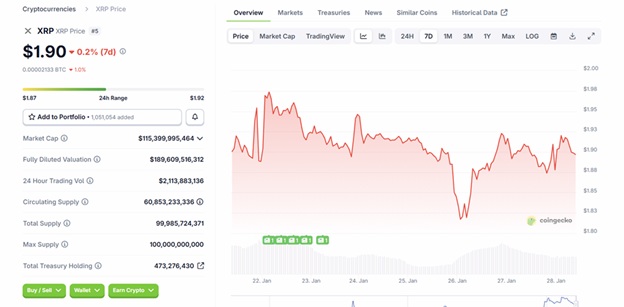
Recent XRP news shows the token trading near $1.88–$1.90 after a 4% pullback, with buyers defending the $1.80 zone. Analysts flag $1.77 as a critical level, noting that a break below it could deepen losses. Despite this pressure, exchange balances are at multi-year lows, suggesting holders are moving coins off platforms and reducing near-term sell supply.

On the development side, Ripple’s Middle East expansion and Saudi sandbox testing support the long-term payments story. Chart watchers see XRP moving in a tight range unless the $2.30 resistance breaks. The latest XRP news reflects a market waiting for direction, where strong fundamentals contrast with cautious sentiment and broader risk-off conditions across crypto.

Source- CoinGecko

Daily volume remains steady, while analysts note that sustained holding above support could set the stage for a momentum shift once overall market confidence improves later this quarter if liquidity and macro pressure ease globally now.

Pudgy Penguins Price: Volatility Around Key NFT Events

Recent Pudgy Penguins price action shows the token trading near $0.0095 – $0.0099, after a sharp 17% pullback ahead of the January 29 NFT snapshot. Circulating supply sits near 62.8 billion tokens, placing market capitalization around $620 – $630 million.

Volume remained active as traders repositioned, while short-term volatility reflected event-driven selling rather than a broad loss of interest across the ecosystem. Community discussions and exchange data suggested holders continued watching roadmap updates closely.

In the days following the snapshot, Pudgy Penguins’ price stabilized within a narrow range, signaling a cautious balance between buyers and sellers. Analysts noted that brand partnerships, including recent sports licensing news, support visibility, but price growth depends on sustained demand.

With meme-driven cycles often short, traders are weighing whether utility expansion can offset speculative fatigue during the coming months. Market participants continue tracking social engagement metrics and on-chain activity for early trend signals this quarter ahead.

The Final Take: Does ZKP Have the Edge as the Best Crypto to Buy?

Recent XRP news points to consolidation near key support, with holders reducing exchange supply while price waits for a clear trigger. Pudgy Penguins’ price action tells a different story, driven by NFT events and short bursts of volatility, followed by stabilization as traders reassess demand.

Analysts reviewing ZKP crypto note a presale auction structure designed to control distribution and behavior. Daily issuance remains steady, which researchers say keeps liquidity balanced and sentiment calm before the next structural shift arrives.

As issuance tightens, experts expect psychology to change quickly, pushing attention toward ZKP crypto. That setup is why analysts increasingly describe it as the best crypto to buy, comparing its timing and structure against slower-moving alternatives across current market conditions globally.

Find Out More about Zero Knowledge Proof:

Website: https://zkp.com/

Buy: https://buy.zkp.com/

X: https://x.com/ZKPofficial

Telegram: https://t.me/ZKPofficial

HBAR Slips, XRP Refuses to Break: Can ZKP’s $5M Giveaway Redefine the Top Crypto to Buy Right Now?

0

Markets are entering a slower, more selective phase as recent volatility exposes weak conviction. Hedera (HBAR) is slipping toward critical support, while the XRP price continues to defend a level that has defined its structure for years. These contrasting signals are forcing traders to pause, reassess risk, and question whether recent moves reflect opportunity or exhaustion across major assets and speculative sectors alike right now.

At the same time, attention is drifting away from short-lived breakouts toward how participation is structured. In that shift, Zero Knowledge Proof (ZKP) is being discussed alongside majors as traders debate the top crypto to buy in an environment where transparency and contribution matter more than momentum. This change is reshaping expectations across the market after months of volatility and failed rallies seen recently everywhere.

HBAR Structure Weakens Near Key Support

Recent weakness in Hedera (HBAR) reflects mounting structural stress rather than routine consolidation. Price is down more than 10% on the week, and the chart is pressing into a developing head-and-shoulders formation.

Support between $0.100 and $0.102 now carries outsized importance, as a daily close below this zone would confirm a breakdown and project roughly 20% downside if selling pressure accelerates quickly under broader market weakness conditions seen recently across altcoin markets overall.

Capital flow metrics reinforce the risk. Chaikin Money Flow has slipped decisively below zero, signaling real outflows rather than low-volume drift. Sentiment has also fallen to multi-month lows, historically a warning sign for Hedera (HBAR).

While early dip buying is visible, the structure remains fragile, keeping downside scenarios active for traders assessing the top crypto to buy during periods of elevated uncertainty and volatility that challenge conviction across markets at this stage, now broadly speaking.

XRP Mirrors 2017 Cycle With Extended Consolidation

Unlike weaker setups, the XRP price continues to respect a major long-term trendline. After breaking above the resistance that capped price action for nearly seven years in December 2024, XRP has spent the past year consolidating above that former ceiling, which has now flipped into support.

Multiple pullbacks toward this level have held firmly, signaling acceptance rather than distribution so far despite broader market volatility and sentiment shifts seen across crypto assets recently this cycle clearly.

This behavior mirrors XRP’s 2017 cycle, when a long-term breakout was followed by extended consolidation before continuation. As long as the XRP price remains above this trendline, the structure favors reaccumulation rather than failure.

A decisive breakdown would be needed to invalidate the setup, keeping XRP relevant in the top crypto to buy discussion during periods of uncertainty and rotation, where patience often defines eventual trend resolution for longer-term participants watching closely right now.

Zero Knowledge Proof Brings Participation Back Into Focus

As price-driven narratives lose traction, Zero Knowledge Proof (ZKP) is being evaluated through structure rather than momentum. Its on-chain, presale auction that replaces fixed pricing and private allocations, releases $190M tokens every 24 hours. This model removes timing advantages entirely and emphasizes consistency over speculation during volatile market conditions seen recently across crypto markets.

Beyond distribution, ZKP is built around verifiable contributions. The network uses zero-knowledge proofs to validate off-chain computation, enabling privacy-preserving AI workloads without exposing underlying data. This technological focus positions ZKP as infrastructure, designed to operate independently of market cycles and short-term sentiment shifts.

Proof Pods anchor this design. These plug-and-play units perform validated compute tasks and generate zero-knowledge proofs, tying rewards directly to measurable work. As more Proof Pods come online, network capacity expands alongside participation, creating alignment between contributors and the protocol rather than passive holders alone. This mechanism supports long-term scalability without relying on hype cycles or constant speculative inflows from traders globally.

In parallel, ZKP has introduced a $5 million giveaway, awarding $500,000 worth of tokens to each of ten winners. Participation requires holding ZKP tokens and completing defined steps, reinforcing commitment over casual interest.

For traders comparing other assets, this model reframes how the top crypto to buy is evaluated during periods of heightened uncertainty and market rotation.

Closing Note!

The divergence across assets is becoming clearer. Hedera (HBAR) highlights how quickly downside risk can build when structure weakens, while the XRP price demonstrates what trend acceptance looks like through repeated support tests.

These differences are reshaping how traders frame risk and opportunity in a market defined by uncertainty rather than straightforward momentum trades that dominated earlier cycles during expansive market phases now fading away.

Against this backdrop, ZKP offers an alternative lens. By combining transparent distribution, working technology, and contribution-based rewards, it shifts attention toward sustainability. As traders reassess the top crypto to buy, systems built to function through volatility may matter more than short-term price moves in an increasingly selective market environment where patience and structure are rewarded over speed and speculation during uncertain cycles ahead.

Explore Zero Knowledge Proof:

Website: https://zkp.com/

Buy: buy.zkp.com

X: https://x.com/ZKPofficial

Telegram: https://t.me/ZKPofficial

Bitcoin Reclaims $90,000 Price Amid Dollar Weakness And Policy Uncertainty

0

The price of Bitcoin surged above the $90,000 mark on Wednesday, extending a rebound from last week’s sharp sell-off.

The crypto asset reached an intraday high of $90,428 before experiencing a minor retracement, trading around $89,647 at the time of reporting.

Bitcoin price rallied after reports of the US dollar crashing spread across the market. Recent data show that the US dollar has fallen to its lowest level in four years, raising concerns about the strength of the world’s dominant reserve currency.

As the dollar weakens, market players are beginning to shift attention to alternative assets such as precious metals and digital currencies, including BTC, which is increasingly viewed as a potential hedge against rising inflation and currency depreciation.

Also, the recent rally comes as investors await the Federal Open Market Committee (FOMC) rate decision later today. Analysts caution that while the rebound provides short-term relief, it does not resolve the broader structural pressures facing the crypto market amid a dense cluster of U.S. macroeconomic and policy risks.

According to QCP Capital’s January 28 Market Colour, Bitcoin’s recovery has alleviated immediate liquidation pressure but has not diminished the longer-term forces that keep downside protection firmly in place.

Historically, a weakening U.S. dollar tends to support risk assets like Bitcoin by easing global financial conditions and boosting liquidity. Cointelegraph notes that BTC has often staged major breakouts in the months following sustained declines in the dollar index, particularly when the DXY falls below the 96 level.

Traders emphasize that Bitcoin bulls must maintain the $80,000–$84,000 support zone to prevent a deeper correction, with potential bear market targets as low as $58,000. On the upside, key resistance lies between $90,000 and $94,000, aligned with the 50-day and 100-day moving averages. Beyond that, a retest of the $98,000 psychological level—coinciding with the short-term holder cost basis—could be possible if buying momentum continues.

Market uncertainty is further fueled by the looming possibility of a second U.S. government shutdown on January 31. Polymarket data suggests a 76.5% probability of a shutdown if Congress fails to approve funding in time, although a $1.2 trillion funding package has already passed the House.

During the last major U.S. government shutdown, which lasted nearly 43 days ending in November, crypto markets experienced heightened volatility but avoided a full collapse. Delays in key economic data, such as jobs and inflation reports, made it harder for traders to price risk.

During that period, Bitcoin declined roughly 9%, falling from around $103,000 to $94,000, while altcoins dropped between 12% and 25% due to reduced liquidity.

Outlook

Bitcoin faces a critical test in the coming days as it navigates macroeconomic headwinds and potential U.S. policy disruptions. Sustaining support above $80,000–$84,000 remains crucial to avoiding deeper corrections, while a sustained move above $94,000 could signal renewed bullish momentum.

Traders are closely monitoring the FOMC decision, which could act as a catalyst for volatility. A dovish stance could further weaken the dollar and support BTC’s upside, whereas a hawkish move may trigger a temporary pullback. Additionally, the possibility of a U.S. government shutdown adds an element of political risk, potentially limiting liquidity and causing short-term price swings

However, traders remain cautious as political uncertainties and liquidity constraints continue to pose short-term downside risks for the broader crypto market.

Amazon’s Sweeping Corporate Overhaul: Second Round of 16,000 Job Cuts Targets Bureaucracy Amid AI

0

Amazon.com Inc. escalated its organizational restructuring on Wednesday, announcing the elimination of approximately 16,000 corporate roles globally, just three months after slashing 14,000 positions in October 2025.

The combined reductions total around 30,000 jobs, representing nearly 10% of the company’s estimated 350,000 corporate workforce, as the e-commerce giant intensifies efforts to streamline operations, reduce bureaucratic layers, and enhance decision-making speed in an era dominated by artificial intelligence advancements.

Beth Galetti, Senior Vice President of People Experience and Technology, detailed the cuts in an internal memo shared on Amazon’s corporate blog, framing them as a continuation of initiatives launched last fall.

“As I shared in October, we’ve been working to strengthen our organization by reducing layers, increasing ownership, and removing bureaucracy,” Galetti wrote.

She noted that while many teams completed changes in October, others required additional time, leading to the current phase.

The layoffs span multiple divisions, including Amazon Web Services (AWS), retail operations, Prime Video, human resources, and advertising, with impacts felt across global teams.

U.S.-based employees affected by the cuts will receive at least 90 days to search for internal opportunities, with those unable to secure new roles or choosing to depart offered severance packages, continued health insurance benefits, and outplacement support.

For international staff, assistance will comply with local labor laws, including consultation processes where required.

The announcement followed an inadvertent early disclosure: on January 27, some AWS employees received a calendar invitation and email referencing “Project Dawn” and impending organizational changes, sparking widespread confusion before the official reveal.

The message was quickly recalled, but it amplified anxiety among the workforce.

CEO Andy Jassy has positioned these reductions as critical to fostering a more agile, “startup-like” culture, emphasizing that they are not primarily driven by cost savings or direct AI automation but by aligning the organization with long-term innovation goals. Jassy previously linked efficiency gains from AI to eventual headcount reductions, noting in 2025 that the technology would enable faster invention and operational streamlining.

Galetti echoed this in her memo, assuring that while no new rhythm of mass layoffs is planned, teams will continue evaluating structures for optimal customer impact.

The cuts coincide with Amazon’s broader efficiency initiatives, including the closure of its Amazon Go convenience stores and Amazon Fresh grocery outlets, announced earlier this week. The decision affects dozens of locations, as the company cited challenges in delivering a “truly distinctive customer experience with the right economic model.”

Some sites will transition to Whole Foods Market formats, while Amazon shifts focus to online grocery delivery and its established supermarket chain.

Amazon’s global headcount exceeds 1.5 million, with the corporate segment comprising a smaller but critical portion dedicated to strategy, technology, and innovation. The company has aggressively trimmed management layers, tightened spending, overhauled performance reviews, and mandated a five-day office return for most corporate staff since late 2025.

These measures accelerated post-pandemic, as explosive growth gave way to slower expansion, prompting executives to address what they termed a “bloated” structure.

The reductions mirror a sector-wide trend in Big Tech, where firms are reallocating resources toward AI while optimizing workforces. Microsoft eliminated about 15,000 positions in 2025, with CEO Satya Nadella emphasizing focus on AI transformation. Meta Platforms has automated roles in risk and operations, informing employees that their functions were being replaced by AI systems.

Across the industry, over 20,000 tech jobs have been cut in early 2026 alone, per tracking from Layoffs.fyi.

Amazon’s stock dipped modestly in after-hours trading following the announcement, but the company’s financial health remains strong, with 2025 revenue topping $600 billion and AWS continuing to dominate cloud computing.

Jassy’s vision for a leaner, more innovative Amazon includes record $125 billion capital expenditures projected for 2026, largely for AI infrastructure. For the workforce, however, the cuts represent a period of uncertainty, even as hiring persists in high-priority areas like AI and cloud services.