DD
MM
YYYY

PAGES

DD
MM
YYYY

spot_img

PAGES

Home Blog Page 5

RedotPay Delays IPO Amid Binance Regulatory and Legal Challenges

0

The financial markets are sending a strikingly mixed signal this week: U.S. equities are pushing deeper into record territory while Bitcoin has lost momentum and slipped back below the $63,000 level.

The crypto payments industry is facing another reminder that regulatory and legal uncertainty can complicate even the most ambitious expansion plans, with RedotPay reportedly delaying its planned initial public offering amid growing pressure surrounding its relationship with Binance.

The S&P 500 closed Thursday, August 13, at a record 7,798.99, gaining 0.65%. The Nasdaq Composite also advanced 0.81%, while the Dow Jones Industrial Average added 0.13%. The rally came as investors responded positively to signs that inflationary pressures may be cooling.

July producer prices were unchanged, strengthening expectations that the Federal Reserve could avoid another interest-rate increase in September.

That optimism has not translated evenly across financial markets. Bitcoin, which has increasingly traded alongside other risk assets, has struggled to maintain its recent upside momentum.

The cryptocurrency fell below $63,000 as traders reduced bullish exposure, with market data showing BTC around the $62,000-$63,000 range. Recent weakness has undermined the attempted breakout above important technical levels and raised questions about whether Bitcoin can regain its previous momentum.

The divergence is important because it challenges the assumption that improving macroeconomic conditions automatically benefit cryptocurrencies. Softer inflation should theoretically support risk assets by reducing expectations for tighter monetary policy.

Yet Bitcoin’s response has remained muted. This suggests that crypto-specific positioning, profit-taking, liquidity conditions and technical resistance may currently be more influential than the broader equity rally.

Meanwhile, RedotPay’s situation highlights a different challenge for the digital-asset sector: regulation and business relationships can become major obstacles when crypto companies attempt to transition into mainstream financial markets.

RedotPay, a Hong Kong-based crypto payments company known for its cryptocurrency-linked cards, has been considering an IPO at a potential valuation of roughly $4 billion.

Its plans have been complicated by a major legal dispute with Binance. Binance-affiliated entities have sued RedotPay’s founders, seeking approximately $472.8 million and alleging that more than 470,000 users were diverted from Binance’s card ecosystem.

RedotPay has rejected the allegations and said it intends to defend itself. The dispute arrives at an especially sensitive moment. An IPO requires investors to have confidence in a company’s regulatory standing, revenue model, governance and ability to manage legal risks.

A major dispute involving one of the industry’s largest exchanges could therefore complicate investor appetite, even if RedotPay’s underlying payments business continues to expand. The company’s experience illustrates the growing intersection between crypto and traditional finance.

As digital-asset firms pursue public listings, institutional capital and regulated payment infrastructure, they face standards that extend beyond token adoption. Corporate governance, compliance, contractual relationships and regulatory scrutiny increasingly matter just as much as user growth.

For markets, the contrast is revealing. Wall Street is celebrating cooling inflation and the possibility of a less restrictive Federal Reserve, while Bitcoin remains vulnerable to selling pressure. Crypto businesses seeking mainstream legitimacy are discovering that regulatory and legal complexity can materially affect their growth strategies.

The next phase of this market may therefore depend less on whether crypto can simply follow stocks higher and more on whether digital assets can demonstrate the institutional stability investors increasingly demand.


YouTube Raises Monetization Requirements: 8,000 Watch Hours and 20M Shorts Views Coming in 2027

0
A picture shows a You Tube logo on December 4, 2012 during LeWeb Paris 2012 in Saint-Denis near Paris. Le Web is Europe's largest tech conference, bringing together the entrepreneurs, leaders and influencers who shape the future of the internet. AFP PHOTO ERIC PIERMONT (Photo credit should read ERIC PIERMONT/AFP/Getty Images)

YouTube is preparing to make one of its biggest changes to creator monetization in nearly a decade, raising the eligibility requirements for its Partner Program and forcing aspiring creators to rethink how they build audiences on the platform.

Beginning February 1, 2027, creators working toward monetization will face significantly higher thresholds for both long-form watch time and Shorts views.

Since 2018, YouTube’s Partner Program has represented an important milestone for creators looking to turn their content into a sustainable source of income.

Under the existing requirements, creators generally need at least 1,000 subscribers and either 4,000 valid public watch hours within the required period or 10 million eligible Shorts views over 90 days. These requirements have already demanded considerable consistency, creativity, and audience engagement.

That equation is about to change. From February 1, 2027, the subscriber requirement will remain at 1,000, but the watch-time threshold will double from 4,000 to 8,000 hours. For Shorts creators, the target will also double, rising from 10 million qualified views in 90 days to 20 million.

The changes effectively mean that creators must generate substantially more engagement before qualifying for monetization. For creators who are already monetized, there is no immediate reason for concern. Existing members of the Partner Program will not be affected by the new eligibility thresholds.

The real impact will fall on creators who are currently building toward monetization or those planning to launch channels with the expectation of reaching the existing requirements. The move could significantly change the creator economy.

YouTube has become increasingly competitive, with millions of creators producing videos across virtually every category imaginable. Higher eligibility standards could allow the platform to place greater emphasis on creators who can demonstrate sustained audience interest rather than simply reaching a subscriber milestone.

For new creators, the update should not necessarily be viewed as a reason to delay starting. If anything, it makes starting earlier even more important. Anyone hoping to reach monetization before the new rules take effect has a limited window to build the necessary audience and watch time under the current system.

The fundamental strategy, remains unchanged. Creators still need to produce content that people want to watch, share, and return to. Consistency remains one of the most important factors in building a channel, while strong storytelling, useful information, distinctive presentation, and audience engagement can help turn occasional viewers into loyal subscribers.

The change highlights the growing importance of treating content creation as a long-term operation rather than a quick path to income. Creators who focus exclusively on hitting numerical thresholds may struggle, while those who build recognizable brands and communities could be better positioned to benefit from YouTube’s ecosystem.

The higher requirements raise the cost of entry, but they do not fundamentally change the path. The formula is still simple: create, publish, learn from the numbers, improve, and repeat. For anyone considering starting a YouTube channel, the message is clear.

The threshold is moving higher, but the opportunity is still there. Start creating now, show up consistently, and give your audience a reason to keep watching. The numbers may take time to follow, but momentum begins with the first video.

Lookonchain Data Shows Bitcoin Short Reaches $136M as Liquidation Risk Builds

3

A major Bitcoin short position is drawing increasing attention across the crypto market after Lookonchain data showed one wallet continuing to increase its bearish bet.

The position has now reached approximately 2,136 BTC, worth around $136 million, making the trader one of the largest identifiable on-chain Bitcoin bears at a time when market positioning remains highly sensitive to sudden price movements.

The scale of the position is significant not only because of its dollar value, but because of the liquidation level attached to it.

According to the data, the wallet faces liquidation at approximately $64,592 per Bitcoin. That level creates a potentially important battleground for the market. If Bitcoin climbs through it with enough momentum, the trader could be forced to close the short, potentially adding further buying pressure to an already rising market.

This is the basic mechanism behind a short squeeze. A trader who expects Bitcoin to fall borrows or sells the asset with the intention of buying it back at a lower price. If the market instead rises sharply, losses increase.

When the price approaches the liquidation threshold, leveraged positions can be automatically closed by the trading platform. Those forced closures require Bitcoin to be bought back, creating additional demand and potentially pushing the price even higher.

The 2,136 BTC position therefore represents more than a single trader’s market view. It has become a potential source of volatility.

Bitcoin does not need to remain above $64,592 for an extended period to create pressure. A rapid move through the liquidation zone could trigger a chain reaction if other traders are positioned similarly.

The situation highlights the increasingly transparent nature of cryptocurrency markets. On-chain analytics allow investors to track large wallets, monitor transfers and identify concentrated positions that might previously have remained hidden from public view.

While wallet data does not necessarily reveal the identity or complete strategy of the trader, it can provide valuable clues about market positioning. However, liquidation risk should not automatically be interpreted as a guaranteed short squeeze.

Large traders can hedge positions elsewhere, add collateral, reduce exposure, or manage their positions through multiple wallets and exchanges. On-chain data also provides only part of the picture. The wallet’s 2,136 BTC position may represent one component of a broader trading strategy.

Still, the $64,592 threshold deserves attention because it represents a clear technical and psychological level for this particular position.

If Bitcoin approaches it, traders are likely to watch open interest, funding rates, spot volume and liquidation data closely. A breakout accompanied by strong spot buying would provide a stronger signal that a squeeze could develop.

Conversely, if Bitcoin fails to reclaim the level and sellers regain control, the massive short could continue working in the trader’s favor. That makes the current setup a direct contest between bearish conviction and bullish momentum.

The key lesson is that leverage can amplify both sides of the market. A $136 million short may reflect strong confidence in lower prices, but it also creates a potentially powerful source of forced demand if the market moves against the position.

As Bitcoin tests the boundaries around the liquidation zone, this whale short has effectively become another pressure point for the market. A decisive move above $64,592 could turn one trader’s bearish conviction into fuel for a broader Bitcoin rally.

Why Bank of America Expects the Fed to Raise Interest Rates Again

0

While traders interpreted July’s inflation report as a reassuring sign that the Federal Reserve can ease its monetary policy, Bank of America strategist Aditya Bhave sees a very different picture.

For Bhave, the latest data does not signal that the inflation battle is over. Instead, it reinforces the argument that the Federal Reserve may need to keep monetary policy restrictive and deliver three additional interest-rate hikes this year.

July’s Consumer Price Index came in at 3.4%, broadly matching expectations and initially calming financial markets. Investors had been watching inflation closely for evidence that price pressures were continuing to moderate after the volatility seen earlier in the year.

The in-line reading therefore provided some relief, particularly for traders hoping that the Fed could avoid further tightening.

Bhave, remains skeptical. His central argument is that the Federal Reserve moved too aggressively toward supporting the economy last year, cutting interest rates because policymakers were concerned about weakening labor-market conditions.

Those fears, in his assessment, failed to materialize to the extent expected. With employment proving more resilient than anticipated, Bhave believes policymakers now face the difficult task of reversing part of that earlier easing.

His forecast amounts to another 75 basis points of tightening, potentially spread across three rate increases. Such a path would represent a significant shift from the expectations of investors who have increasingly positioned for monetary policy to become less restrictive.

It would put renewed pressure on borrowing costs across the economy, from mortgages and corporate loans to consumer credit. One of the biggest disagreements between Bhave and the market centers on the labor market.

A recent shock jobs report raised concerns that economic momentum could be deteriorating rapidly. Bhave has dismissed that report as largely a one-off event rather than evidence of a sustained collapse in employment. If the labor market remains fundamentally resilient, the Fed would have greater room to prioritize inflation over growth.

The more persistent threat, according to Bhave, is services inflation. Unlike goods prices, which can fall relatively quickly as supply chains normalize and commodity costs decline, services inflation can remain stubborn because it is closely connected to wages, rents, insurance, healthcare, and other domestic costs.

Sticky services prices could therefore prevent inflation from returning to the Federal Reserve’s desired level even if headline CPI continues to moderate.

That creates a complicated policy environment for Fed officials. Cutting rates too soon could allow inflationary pressures to regain momentum, while maintaining or increasing rates risks slowing economic activity and weakening employment.

The challenge is particularly important because monetary policy operates with a lag, meaning decisions made today can affect economic conditions months later. Bhave’s forecast represents a sharp warning against complacency. A 3.4% CPI reading may look manageable, but the underlying composition of inflation matters just as much as the headline number.

If services prices remain elevated and employment stays stronger than expected, investors may have to reconsider assumptions about rapid monetary easing. The debate is no longer simply about whether inflation is falling.

It is about whether inflation is falling quickly enough for the Federal Reserve to relax. Bhave’s position is clear: the process is unfinished, and policymakers may still have considerable work ahead before they can confidently declare victory.

My Question to Governors Soludo and Lawal During NiDEC 2026

0

During the NiDEC 2026 fireside conversation with Governor Chukwuma Charles Soludo of Anambra State and Governor Dauda Lawal of Zamfara State, I raised a simple but consequential question: Can Nigerian states create large, professionally managed investment vehicles that allow ordinary Nigerians in the diaspora to participate in building their economies?

I asked Governor Soludo whether we could expect something comparable to a Transcorp Plc at the state level in Anambra, a commercially driven investment vehicle capable of mobilizing capital and undertaking large industrial projects. Governor Soludo indicated that such a vehicle is being contemplated and that the components would be unveiled in due course, with opportunities for Nigerians in the diaspora to participate as investors. The idea is powerful: instead of expecting every diaspora investor to establish a factory or business independently, create an institutional vehicle through which thousands of people can pool capital to finance transformational projects. During lunch, Governor promised to launch this in the coming months.

I posed a similar question to Governor Lawal. Zamfara is richly endowed with minerals, but much of the activity involves artisanal mining. I asked whether the state would support the establishment of a fully private-sector-managed company focused on processing minerals produced by artisanal miners, with Nigerians in the diaspora able to invest in the enterprise. Governor Lawal was receptive to the concept. During lunch, he went deeper into the potential playbook: mobilize Nigerian capital, establish processing infrastructure within Nigeria, add value to the minerals locally, and ensure that Nigerians can participate in the ownership of those assets.

That was really the foundation of my questions to both governors. Not every Nigerian in the diaspora has millions of dollars to return home and build a factory from scratch. But someone may have $10,000, another $25,000, another $100,000, while institutional investors can provide much more. If states can facilitate credible investment vehicles that are professionally and independently managed by the private sector, with strong governance, transparency and accountability, those vehicles can be connected to the capital market so that diaspora investors can participate at different levels.

That is one of the great powers of the capital market: you do not need to be wealthy enough to build the whole factory; you only need enough capital to own a piece of it. Pool thousands of those pieces together, and factories, processing plants, infrastructure and great companies can emerge.

The opportunity is to move diaspora engagement from simply sending money home to owning productive assets at home. From $10,000 to whatever anyone can afford, aggregated capital can do big things. That is how Money becomes Capital, and when capital is pooled around credible visions, nations build.

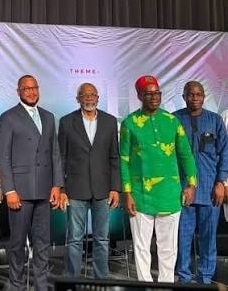
After the conversation, Rt. Hon. Femi Gbajabiamila, Chief of Staff to the President of the Federal Republic of Nigeria, joined us on stage for a group photograph.