DD
MM
YYYY

PAGES

DD
MM
YYYY

spot_img

PAGES

Home Blog Page 5

Rise of Decentralized Prediction Markets on Solana with World_xyz

0

The emergence of world_xyz as Solana’s native prediction market marks another important milestone in the evolution of decentralized finance and on-chain forecasting.

Built to operate seamlessly within the Solana ecosystem, the platform allows users to trade on the outcomes of future events directly through the Phantom wallet while relying on Chainlink as its primary oracle infrastructure.

This combination of fast blockchain performance, user-friendly access, and reliable data delivery demonstrates how decentralized prediction markets are becoming increasingly practical for everyday crypto participants.

Prediction markets have long been recognized as powerful tools for aggregating information. Instead of relying solely on expert opinions or polls, these markets enable participants to buy and sell positions based on what they believe will happen in the future.

Prices fluctuate according to collective market sentiment, often providing a real-time estimate of the probability of an event occurring. These events can range from cryptocurrency price movements and economic indicators to elections, sporting events, technological developments, and global news.

By positioning itself as Solana’s native prediction market, world_xyz benefits from the blockchain’s core strengths. Solana is known for its high throughput, low transaction costs, and rapid settlement times, making it particularly well suited for applications that require constant trading activity.

Prediction markets often experience significant trading volume as participants react to breaking news or changing expectations, and a high-performance blockchain helps ensure that users can enter and exit positions efficiently without excessive fees.

Integration with the Phantom wallet further lowers the barrier to participation. Phantom has become one of the most widely used wallets within the Solana ecosystem, serving millions of users across decentralized applications.

Allowing prediction market trading directly within the wallet simplifies the user experience by reducing friction. Instead of navigating multiple platforms or complex interfaces, users can interact with prediction markets using familiar tools they already trust for managing digital assets.

Equally important is the platform’s reliance on Chainlink as its primary oracle infrastructure. Oracles serve a critical role in decentralized applications because blockchains cannot independently verify real-world events.

Chainlink bridges this gap by securely delivering external data to smart contracts. Whether a prediction concerns cryptocurrency prices, financial markets, or other measurable outcomes, reliable oracle infrastructure is essential for determining winners accurately and preventing disputes.

The use of trusted oracle technology also strengthens confidence among traders. In decentralized finance, transparency and verifiable data are fundamental to maintaining market integrity.

A dependable oracle network reduces the risks associated with inaccurate reporting or manipulation, enabling prediction markets to settle contracts fairly based on independently verified information.

The launch of world_xyz also reflects the growing diversification of Solana’s decentralized ecosystem. Lending protocols, liquid staking platforms, and NFT marketplaces have driven much of Solana’s growth, prediction markets introduce another category of financial applications that expands the network’s utility.

They transform market opinions into tradable assets, encouraging greater participation from users interested in forecasting rather than traditional investing. As prediction markets mature, they may play an increasingly valuable role beyond speculation.

Businesses, researchers, policymakers, and investors have long explored the potential of collective forecasting to improve decision-making. Decentralized prediction markets can harness diverse viewpoints from participants worldwide, producing market-driven insights that evolve continuously as new information emerges.

Of course, widespread adoption will depend on regulatory clarity, responsible platform governance, and continued improvements in user education. Prediction markets often intersect with legal frameworks governing financial products and event-based contracts, making compliance an important consideration as the sector grows.

World_xyz’s debut as Solana’s native prediction market, integrated with Phantom and powered by Chainlink’s oracle infrastructure, represents a significant advancement for decentralized forecasting.

By combining scalable blockchain technology, accessible wallet integration, and secure data verification, the platform showcases how blockchain networks are expanding beyond payments and trading into sophisticated information markets.

If adoption continues to grow, decentralized prediction markets could become an essential component of the broader Web3 economy, offering users a transparent and efficient way to express, trade, and refine collective expectations about the future.

Tokenized Asset Spot Volume on Solana Doubled from $2.69 Billion in Q1 to $5.7 Billion in Q2

The rapid expansion of tokenized real-world assets (RWAs) is becoming one of the most significant trends in blockchain technology, and the latest figures from the Solana ecosystem highlight just how quickly this market is evolving.

Tokenized asset spot trading volume on Solana surged from $2.69 billion in the first quarter (Q1) to $5.7 billion in the second quarter (Q2), more than doubling within just three months. This remarkable growth reflects increasing institutional interest, improved blockchain infrastructure, and growing confidence in tokenized financial products.

Tokenization involves converting ownership rights to traditional assets such as stocks, bonds, commodities, real estate, or treasury securities into digital tokens that exist on a blockchain.

These tokens can then be traded around the clock, settled almost instantly, and accessed by investors worldwide. By eliminating many of the inefficiencies associated with conventional financial markets, tokenization has the potential to make investing more transparent, accessible, and cost-effective.

Solana has emerged as one of the preferred blockchain networks for this transformation due to its high throughput, low transaction fees, and fast settlement speeds. Unlike many legacy financial systems that require multiple intermediaries and lengthy processing times.

Solana enables transactions to be completed in seconds while maintaining relatively low costs. These characteristics make it an attractive platform for both institutional issuers and retail participants seeking efficient exposure to tokenized assets.

The jump from $2.69 billion to $5.7 billion in quarterly spot trading volume suggests that tokenized assets are moving beyond experimental use cases into mainstream financial activity. Investors are increasingly recognizing the benefits of blockchain-based ownership, including fractional investing, improved liquidity, and continuous market access.

Assets that were once difficult or expensive to trade can now be divided into smaller units, allowing a broader range of participants to gain exposure with lower capital requirements. Institutional participation has also played an important role in this expansion.

Banks, fintech companies, and asset managers are actively exploring blockchain infrastructure to modernize capital markets. As regulatory clarity improves in several jurisdictions, financial institutions are becoming more comfortable issuing and managing tokenized securities.

This institutional momentum contributes to higher trading volumes and strengthens market confidence. Another factor behind Solana’s impressive growth is the rapid development of decentralized finance.

Many tokenized assets can be integrated directly into lending, borrowing, liquidity provision, and collateral management protocols. This interoperability creates additional utility beyond simple ownership, allowing investors to generate yield while maintaining exposure to their underlying assets.

As more financial products become available, trading activity naturally increases across the ecosystem. Despite the encouraging growth, challenges remain. Regulatory frameworks continue to evolve, and ensuring compliance across different jurisdictions is essential for long-term adoption.

Security, custody solutions, and accurate valuation mechanisms also require continued improvement as larger amounts of institutional capital enter the market. Addressing these issues will be critical to sustaining the industry’s rapid expansion.

The doubling of tokenized asset spot volume on Solana within a single quarter represents a powerful indicator of where financial markets may be heading. Blockchain technology is steadily transforming how assets are issued, traded, and managed, while tokenization is unlocking new levels of efficiency and accessibility for investors around the world.

As adoption accelerates, Solana’s growing role in tokenized finance demonstrates that digital asset infrastructure is becoming an increasingly important component of the global financial system. If current trends continue, tokenized real-world assets could become one of the defining innovations shaping the future of capital markets.


The Future of Programming in the Age of Artificial Intelligence

0

Artificial intelligence has rapidly become one of the most influential forces in software development, changing how programmers write, test, debug, and deploy code. From AI-powered coding assistants to automated testing tools, these technologies promise greater productivity and faster development cycles.

The response from software engineers has been anything but unanimous. Rather than viewing AI as either a revolutionary breakthrough or an existential threat, many developers hold nuanced opinions that reflect both optimism and caution.

The impact of AI on coding is reshaping the profession in complex ways, making engineers rethink not only how they work but also what skills will matter most in the future.

One of the strongest arguments in favor of AI is its ability to improve developer productivity. Modern AI coding assistants can generate boilerplate code, suggest solutions, identify bugs, and even explain unfamiliar programming concepts.

Tasks that once consumed hours can often be completed in minutes, allowing engineers to dedicate more time to designing software architecture, solving business problems, and improving user experiences. For startups and enterprises alike, these efficiency gains can accelerate product development while reducing costs.

Yet increased productivity does not eliminate the need for human expertise. Experienced engineers frequently point out that AI-generated code still requires careful review. Language models may produce code that appears correct but contains logical errors, security vulnerabilities, or inefficient implementations.

Software development extends beyond writing syntax; it involves understanding customer requirements, balancing technical trade-offs, ensuring maintainability, and collaborating with teams. These responsibilities remain deeply human and require judgment that AI cannot consistently replicate.

The rise of AI has also sparked concerns about career opportunities, particularly for junior developers. Traditionally, entry-level engineers build experience by handling straightforward coding tasks before progressing to more complex responsibilities.

If AI automates much of this work, newcomers may find fewer opportunities to gain practical experience. Some engineers worry that companies could reduce hiring for junior positions, potentially creating a skills gap in the long term.

Others believe AI will instead serve as a mentor, helping beginners learn faster by providing explanations, examples, and instant feedback.

Another important issue is trust. Software engineers are trained to verify assumptions, and many apply the same skepticism to AI-generated code. Blindly accepting AI suggestions can introduce hidden defects that are difficult to detect.

Developers increasingly emphasize the importance of understanding the code rather than merely accepting machine-generated solutions. AI is proving to be a powerful assistant, but not an infallible one. Beyond technical concerns, AI is changing workplace dynamics.

Teams are revising development workflows to integrate AI responsibly, establishing policies on code review, intellectual property, data privacy, and security. Organizations are also investing in AI literacy so employees can effectively use these tools while recognizing their limitations.

Success increasingly depends on engineers who know when to rely on automation and when to apply independent critical thinking. Software engineering is unlikely to disappear because of AI. Instead, the profession is evolving.

Developers who embrace continuous learning, strengthen their problem-solving abilities, and understand AI’s capabilities will be well positioned for future opportunities. Coding may become faster and more accessible, but creativity, communication, ethical decision-making, and systems thinking will remain indispensable.

Software engineers’ attitudes toward AI are far from binary because the technology itself presents both opportunities and challenges. AI is neither a complete replacement for human developers nor merely another software tool.

It is a transformative technology that is redefining how software is created, requiring engineers to adapt while preserving the critical thinking and expertise that remain at the heart of successful software development.

Iran-Qatar Maritime Trade Resumes After Five-Month Suspension As Gulf Shipping Gradually Recovers From Conflict

0

Maritime trade between Iran and Qatar has resumed after nearly five months of disruption, marking another step toward restoring commercial activity across the Gulf following last month’s U.S.-brokered agreement that ended months of conflict between Tehran and Washington.

Iran’s commercial attaché in Doha, Abbas Abdolkhani, confirmed on Sunday that shipping operations between Iran’s Dayyer Port and Qatar’s Al Ruwais Port have restarted after coordination between the Iranian Embassy in Doha and Qatari authorities.

The resumption restores an important regional trade corridor that had been suspended during the conflict, disrupting the movement of goods between the two neighboring countries.

According to Abdolkhani, the shipping link resumed following diplomatic and logistical coordination designed to restore normal commercial operations after the ceasefire agreement.

The reopening follows the interim agreement signed last month between Iran and the United States that formally ended four months of hostilities and called for the restoration of pre-war maritime traffic across the Gulf.

Although the agreement significantly reduced military tensions, shipping conditions in the region remain fragile. Commercial vessels continue to face uncertainty as transit into and out of the Gulf remains contested, denoting lingering security concerns and the continued military presence of regional and international forces.

The restoration of the Dayyer-Al Ruwais route nevertheless represents one of the clearest signs that Gulf trade is gradually normalizing. The two ports primarily handle regional cargo, supplying food products, construction materials, manufactured goods, and other commercial shipments that support trade between southern Iran and northern Qatar.

Dayyer Port, located along Iran’s southern coastline, sustained repeated attacks during the conflict, disrupting port operations and damaging infrastructure that serves local exporters and importers. Its reopening is expected to provide relief for traders who had been forced to seek alternative, often more expensive, shipping routes during the conflict.

The latest development follows another indication that commercial ties across the Gulf are recovering. In late June, Iran’s Trade Promotion Organization announced that Iranian cargo was once again being cleared through the United Arab Emirates’ Jebel Ali Port, the Middle East’s largest commercial port and one of the world’s busiest container terminals.

The resumption of cargo handling at Jebel Ali signaled a gradual restoration of trade flows between Iran and Gulf Arab states after months of disruption caused by the conflict.

Together, the reopening of shipping links with Qatar and renewed cargo processing in the UAE suggest regional supply chains are slowly returning to normal, although businesses remain cautious given the possibility of renewed geopolitical tensions.

The normalization of maritime trade bears enormous weight because the Gulf serves as one of the world’s most strategically important shipping corridors. Beyond regional commerce, the waterway carries a substantial share of global energy exports and connects major ports across the Middle East with markets in Asia, Europe and Africa.

During the conflict, heightened security risks disrupted shipping schedules, increased freight insurance premiums, and forced some vessels to alter routes, adding costs for exporters and importers across the region.

Analysts say the gradual reopening of trade routes is likely to support broader economic recovery in Gulf economies by lowering transportation costs, improving supply chain reliability and restoring confidence among regional businesses. However, they caution that commercial activity remains vulnerable to geopolitical developments, as the durability of the ceasefire and broader regional stability will ultimately determine how quickly trade volumes return to pre-conflict levels.

The reopening of maritime trade with Iran’s neighboring Gulf states also offers an opportunity to revive non-oil exports, strengthen regional commercial ties and ease some of the economic pressures created by months of disrupted trade and logistics.

NFT Adoption Starts with Emerging Artists and Early Collectors

0

Before the explosive NFT boom of 2021, many of the artists, collectors, and communities that eventually defined the space were relatively unknown. They grew alongside the marketplaces that supported them, creating an ecosystem where both platforms and users benefited from each other’s success.

As the NFT market continues to recover from its prolonged downturn, platforms such as OpenSea and Blur face an important strategic decision. If they genuinely believe that NFTs are positioned for another growth cycle, the smartest investment may not be in expensive marketing campaigns or short-term trading incentives.

Instead, it should be in recruiting, supporting, and nurturing smaller creators and collectors today. Every successful digital ecosystem begins with a grassroots community.

Large creators and high-profile collections may generate headlines, but they rarely build the foundation of a sustainable marketplace. That role belongs to emerging artists experimenting with new ideas, passionate collectors purchasing affordable pieces, and small communities that grow organically over time.

These participants create diversity, encourage innovation, and establish long-term engagement that extends beyond speculation. One of the biggest lessons from previous NFT cycles is that marketplaces thrive when their users succeed. The relationship is symbiotic.

As creators gain visibility and collectors discover valuable projects, trading activity naturally increases. Platforms benefit from transaction fees, stronger network effects, and increased brand loyalty. Rather than viewing users simply as customers, marketplaces should see them as long-term partners whose growth directly contributes to the health of the ecosystem.

Investing in smaller accounts can take many forms. Platforms could introduce dedicated onboarding programs for new artists, educational resources explaining NFT creation and marketing, grants for promising collections, and mentorship opportunities with established creators.

Lower listing costs, improved discovery algorithms, and curated showcases for emerging talent would also help reduce barriers to entry. These initiatives require patience, but they build a stronger marketplace over time.

Collectors deserve similar attention. Many newcomers are hesitant to enter the NFT market because they perceive it as dominated by whales, influencers, and established collections with prohibitively high prices.

By highlighting affordable art, rewarding consistent participation, and encouraging community engagement rather than pure speculation, marketplaces can cultivate a broader and healthier collector base. Smaller collectors often become larger investors as their confidence and experience grow.

Timing also matters. Building relationships during a bear market is significantly more effective than chasing users once excitement returns. When trading volumes are low, creators have more time to develop their craft, communities become more authentic, and platforms can provide meaningful support without competing against overwhelming market noise.

If marketplaces wait until the next bull run to recruit users, they may find that loyalty has already formed elsewhere or that new competitors have captured emerging talent. The idea is simple: the platform and the user should grow together.

As creators improve their skills, expand their audiences, and launch more ambitious projects, the marketplace that supported them from the beginning benefits from their success. Likewise, collectors who begin with modest portfolios often remain loyal to the platforms that made discovery easy and participation rewarding.

This shared growth creates stronger communities than those built solely on financial incentives. A healthy NFT ecosystem requires more than blockbuster collections.

It needs thousands of independent artists, niche communities, experimental projects, and dedicated collectors contributing fresh ideas. Diversity increases resilience and reduces dependence on a handful of high-value assets that can distort market activity. Supporting smaller participants today lays the groundwork for a more balanced marketplace tomorrow.

If OpenSea and Blur truly believe that NFTs are preparing for another major comeback, their strategy should begin long before trading volumes return. By investing in emerging creators and collectors now, they are not simply preparing for the next market cycle—they are actively shaping it.

When momentum eventually returns, platforms that helped their communities grow during difficult times will likely find themselves leading an ecosystem built on trust, loyalty, and shared success rather than short-lived speculation.

BlockDAG’s 100% World Cup Bonus Drives Rapid Buying Activity While Polkadot & Chainlink Struggle

0

Public focus is currently split between long-standing infrastructure protocols and a fast-moving, reward-heavy entry point surrounding BlockDAG. The Polkadot price prediction stays firmly tied to its place around the $10 mark, backed up by its custom network setup and multi-chain framework that focuses heavily on long-term connection capabilities. At the same time, Chainlink crypto maintains a stable place among the top twenty digital assets, with its overall demand rooted deeply in data services that feed real information to smart contracts across various decentralized finance applications. Both of these options keep showing quiet, utility-based market steps instead of sudden, explosive growth periods.

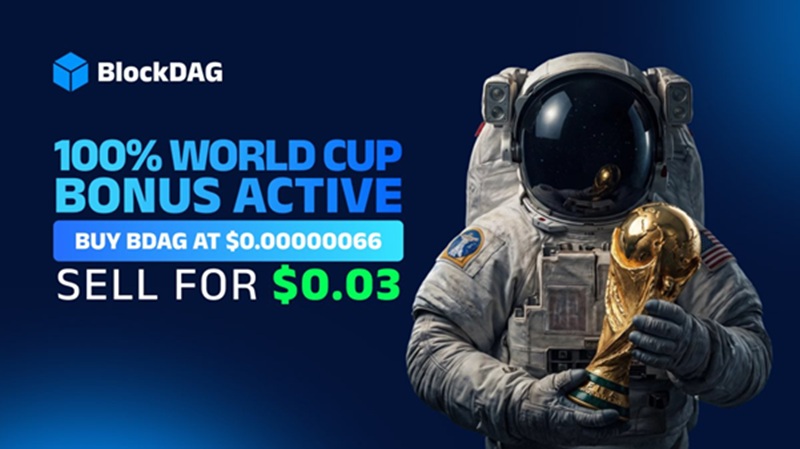
In contrast, BlockDAG (BDAG) is charting a completely unique path, pushed forward by a 100% World Cup reward that instantly doubles coin balances at a low entry cost of $0.00000066. This special arrangement is pulling in lots of eager buyers and forcing BDAG right into the middle of the debate regarding the best crypto to buy list. The difference is becoming much more visible when you compare the slow technical growth of older systems against the rapid, reward-driven accumulation that defines the current speed of BDAG.

Polkadot Price Prediction Explores Network Connection Trends

The current Polkadot price prediction stays very close to its actual task as a shared protocol constructed around slot sales and unified protection. This system allows independent chains to link together via a central hub, which helps run many actions at the exact same time and pass information between different networks. Most long-term Polkadot price prediction tools put future targets inside a wide range, spanning from high single figures up to the middle teens, usually settling near the $8 to $15 area depending on general market sentiment and how many people use the network.

Any future Polkadot price prediction is altered by how much the connected chains are utilized, the total number of builders making applications, and the general cash flow available in the broader market. Even though the core tech allows smooth growth by splitting up the heavy data work, the expansion of the system is still completely dependent on new projects joining over time. People in the market generally judge the Polkadot price prediction based on the need for cross-chain connections, how many coins are locked for rewards, and the speed at which new external networks find a permanent place within the system.

Chainlink Crypto Stays Balanced on Stable Data Feed Use

Chainlink continues working as a decentralized data network that hooks up automatic agreements with real-world facts like current market values, external software links, and off-chain math. It is heavily utilized across a wide variety of decentralized finance protocols and stays a mandatory base piece for applications that cannot work without trustworthy information feeds. It stays in a top position among the leading twenty digital assets, which shows that it is used constantly across many different blockchain setups.

The actual movement of Chainlink is generally looked at inside a big, long-term line, mostly bouncing between roughly $7 and $15 depending on general market trends and cash availability phases. Value trends are shaped heavily by new integrations, the need for data agreements, and deployments on multiple networks. The general pattern is tied closely to the total amount of decentralized finance activity instead of standalone events, with use patterns deciding its long-term spot inside the foundational blockchain market.

BlockDAG’s Special World Cup Bonus Offers Twice the Coins

BlockDAG is moving through a highly unusual phase of high interest where the 100% World Cup offer completely changes how the entry cost of $0.00000066 per coin is viewed, because every single purchase gets an instant match that multiplies the initial quantity by two. This setup gets even more powerful when country-specific keywords are typed in during checkout, since those special codes open up different reward levels going from 50% up to 100% extra coins, instantly growing your stash right from the start.

This clear system means that if a person buys BDAG with $100 at the $0.00000066 rate, they get roughly 151 million BDAG coins, and when the 100% World Cup Match gets applied, the final balance climbs to around 303 million BDAG coins, creating a far bigger holding without needing to spend more cash. This specific mechanic is why BDAG shows up so frequently in discussions about the best crypto to buy, as these allocation rules change how early entries are judged in this current period.

From that point, interest moves to how that allocation looks when placed against the current repurchase floor of $0.03, which sets up a very wide gap from the early entry price and alters how buyers view their positions. This high speed reaches right into the broader creation roadmap, where the arrival of BlockDAG’s custom artificial intelligence and its large language model brings fresh visibility at a time when community participation is already scaling up. This is backed up by an announced $500M jump in book value, showing how much interest is gathering.

All of this leads directly into the upcoming phase, where a fully compliant trading platform and a connected mobile system are being added to the future plan, pushing the growth cycle deep into core infrastructure and making the steps around the development of BDAG much tighter.

To Sum Up

Market spots for the Polkadot price prediction and Chainlink crypto stay very steady, with Polkadot moving around the $8 to $15 area based on connection hopes and Chainlink crypto holding its top twenty place through steady data demand and finance links. Both projects keep showing utility-based patterns that are guided by steady adoption steps rather than fast valuation jumps.

BlockDAG takes a different road where speed, coin rules, and ecosystem growth all come together. The general talk about the best crypto to buy focuses more and more on its 100% World Cup match at $0.00000066, which is made stronger by the rollout of new AI tools, a massive $500M jump in value, and the upcoming launch of its custom trading platform and app setup. Focus stays locked on BDAG as more people join quickly to catch the World Cup offer before it leaves.

Presale: https://purchase.blockdag.network

Website: https://blockdag.network

Telegram: https://t.me/blockDAGnetworkOfficial

Discord: https://discord.gg/Q7BxghMVyu