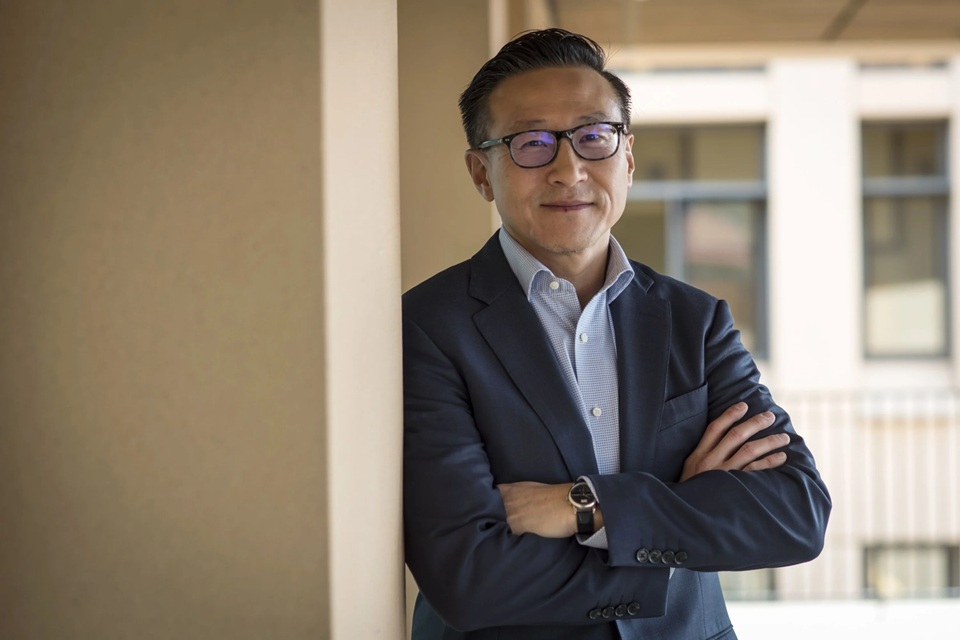
For a company that helped define China’s internet economy, Alibaba’s struggle to sustain innovation is a story its own leadership does not shy away from.
Joe Tsai, the group’s cofounder and chairman, says the tech giant has already paid the price for losing its innovative edge — and the experience has reshaped how he thinks about building for the future inside a large organization.
Speaking in an interview at Stanford University released on Wednesday, Tsai offered a rare, reflective look at how scale, structure, and success can quietly work against creativity. His message was blunt: innovation does not disappear because people stop being talented, but because organizations stop giving those people the room — and the responsibility — to think ahead.
“We’ve gone through periods where we stopped innovating, and we suffer from it as a large company,” Tsai said. “Everybody has their role. It’s very difficult to get people to think about new things about the future, innovate.”
Alibaba’s experience mirrors a broader pattern across global technology firms that have matured from scrappy startups into sprawling institutions. As companies grow, processes multiply, risk tolerance narrows, and employees often become more focused on internal expectations than external change. Tsai argued that many companies respond to this problem in the wrong way — by creating isolated “innovation labs” or special divisions meant to think differently from the rest of the business.
That approach, he said, misses the point.
Creating a separate innovation unit can actually reinforce the idea that creativity is someone else’s job. Tsai believes innovation only becomes durable when it is embedded across the organization, not parked at the edges.
Instead, he identified two values that he sees as essential if large companies want to keep reinventing themselves: ownership and agility.
Ownership, in Tsai’s view, goes beyond stock options or job titles. It is about who employees believe they ultimately answer to. He returned to a principle long championed by Alibaba founder Jack Ma — that workers should think of themselves as serving customers, not pleasing their managers.
“They’re not just working for their boss. Everybody should work for their customers,” Tsai said.
That distinction matters because it changes how people define success. When employees optimize for internal approval, they tend to protect existing processes and products. When they optimize for customers, they are forced to confront shifting needs, emerging behaviors, and future demand — even when those insights challenge the status quo.
Tsai said that mindset naturally pushes people to ask harder questions: what customers will want next, how their expectations are changing, and which assumptions no longer hold. In his telling, innovation is less about sudden breakthroughs and more about constantly adjusting to those signals.
The second value Tsai highlighted — agility — speaks to how decisions are made under uncertainty. In fast-moving technology markets, he said, waiting for perfect information is often the biggest risk of all.
“There is always a deficiency of information,” Tsai said. “You’d have to be able to tolerate not having full information and then just making a decision and committing to it.”
Crucially, he paired decisiveness with humility. Acting quickly only works, Tsai argued, if leaders and teams are equally willing to admit mistakes and pivot when reality proves them wrong. That ability to change direction without paralysis or blame is, in his view, one of the hardest traits for large organizations to maintain.
Tsai’s comments come at a moment when Alibaba is trying to prove that it can still move with speed after years of turbulence. The company has spent the past two years restructuring its business, breaking itself into semi-independent units in an effort to restore accountability and sharpen execution. At the same time, it has placed artificial intelligence at the center of its growth strategy, betting that AI can reinvigorate everything from e-commerce and logistics to cloud computing.
That push has already begun to reshape Alibaba’s public narrative. After a period marked by regulatory pressure and slowing growth, the company has staged a rebound driven in large part by AI-related investment and product development. Management has been explicit that this is not a tentative experiment.
In an earnings call late last year, CEO Eddie Wu dismissed concerns about an AI bubble and said Alibaba was accelerating, not moderating, its spending on the technology.
“We’re not even able to keep pace with the growth in customer demand,” Wu said, adding that AI resources are likely to remain in short supply for years to come.
Wu framed the surge in demand as practical rather than speculative, pointing to real-world adoption of AI across industries. Alibaba’s Qwen family of AI models, which compete with global peers on benchmark tests, has become a cornerstone of that strategy, underpinning services across the group’s platforms.
Seen in that context, Tsai’s reflections read less like abstract management theory and more like a post-mortem on Alibaba’s own missteps — and a blueprint for avoiding them again. His emphasis on ownership aligns with the company’s effort to push decision-making closer to individual business units. His focus on agility mirrors Alibaba’s willingness to commit heavily to AI even as the broader debate about its long-term impact remains unsettled.