DD
MM
YYYY

PAGES

DD
MM
YYYY

spot_img

PAGES

Home Blog Page 5

ADNOC Distribution Signs MoU with AL Maryah Community Bank for Stablecoin Payments

0
A customer makes a purchase. 

ADNOC Distribution, the UAE’s largest fuel and convenience retailer a subsidiary of ADNOC, has signed a Memorandum of Understanding (MoU) with Al Maryah Community Bank to integrate AE Coin—the UAE’s first Central Bank-licensed stablecoin, backed 1:1 by the Emirati dirham (AED)—as a payment option.

Payments will be accepted at nearly 980 service stations across three countries whichever includes; UAE (562 stations) Saudi Arabia (172 stations) Egypt (243 stations). Customers can use AE Coin via the AEC Wallet for fuel, Oasis by ADNOC convenience stores, and car washes.

This marks one of the largest real-world deployments of a regulated stablecoin in retail, enabling instant, blockchain-powered transactions. It positions ADNOC Distribution as the first fuel retailer in the UAE to offer this, aligning with the country’s push for digital payment innovation.

The MoU was revealed during Abu Dhabi Finance Week in December 2025, with rollout planned across the network. This development highlights the UAE’s leadership in regulated crypto adoption for everyday use, distinct from speculative assets.

ADNOC Distribution’s rollout of AE Coin—a fully regulated, 1:1 AED-backed stablecoin issued under UAE Central Bank oversight—across nearly 980 stations in the UAE, Saudi Arabia, and Egypt represents one of the largest-scale integrations of a licensed stablecoin into everyday retail.

This shifts stablecoins from speculative or niche crypto use to practical, high-volume daily transactions like filling up gas or buying groceries. Exposes millions of mainstream consumers—many new to digital assets—to blockchain payments without volatility risks, potentially driving rapid user growth for AE Coin.

Unlike USD-dominated stablecoins like USDT, USDC, this is a local-currency pegged asset embedded in national infrastructure. Its positions the UAE as a global pioneer in compliant digital finance, contrasting with slower or contested adoption in regions like the US.

Its builds on prior steps (e.g., AE Coin’s 2024/2025 approval, integrations with airlines like Air Arabia and telecom giant e&), signaling coordinated government-private sector push. Could inspire similar regulated stablecoin deployments in the MENA region and beyond, serving as a model for integrating blockchain without compromising security or AML/CFT standards.

Its enables instant, low-friction, blockchain-powered settlements, reducing reliance on traditional card networks or cash. Potential for lower transaction costs and faster processing, especially in retail and cross-border contexts within the covered countries.

Useful for expatriates a large UAE demographic sending/receiving money, with lower fees than traditional remittances. It sets a precedent for other industries (e.g., retail, transport, public services) to adopt AE Coin, expanding its ecosystem.

Boosts blockchain’s role in modernizing infrastructure, aligning with UAE’s digital economy goals (e.g., alongside the upcoming Digital Dirham CBDC). Its demonstrates enterprise demand for regulated stablecoins, potentially increasing AE Coin’s circulation and influencing global shifts toward fiat-backed, non-speculative digital assets.

Rollout is gradual and starts as a pilot-like integration; full scale and user adoption remain to be seen. Depends on wallet accessibility, user education, and seamless integration at points of sale.

Regulatory oversight ensures stability but limits it to compliant, non-speculative use—distinct from decentralized stablecoins. Overall, this deployment is a landmark for bridging traditional finance and blockchain, highlighting how regulated stablecoins can achieve mass retail utility faster in proactive jurisdictions like the UAE.

It underscores a maturing crypto landscape focused on real-world efficiency over hype.

Iran Seizes Foreign Tanker Allegedly Carrying 6 Million Liters of Smuggled Diesel

0

Iranian authorities seized a foreign-flagged oil tanker in the Gulf of Oman, accusing it of transporting 6 million liters approximately 1.585 million gallons of smuggled diesel fuel. Iranian state media, including IRIB and Fars News Agency, reported the operation, describing the fuel as contraband.

6 million liters of alleged smuggled diesel. Reports vary slightly, but sources indicate around 17–18 crew members, primarily from India, Sri Lanka, and Bangladesh, who have been detained. The tanker’s name and exact nationality were not disclosed in initial state media reports.

Combating fuel smuggling, which is rampant due to Iran’s heavily subsidized domestic fuel prices among the world’s lowest and the devalued rial, making exports to neighboring countries or Gulf states highly profitable.

Iran frequently conducts such operations in the Persian Gulf and Gulf of Oman to curb organized fuel smuggling by sea and land. Similar seizures have occurred throughout 2025, often involving smaller volumes or different vessels.

This seizure occurred shortly after a U.S. operation seizing a tanker off Venezuela accused of transporting sanctioned oil linked to Iran and Venezuela. Some outlets have speculated on a possible retaliatory motive, though Iranian reports frame it purely as an anti-smuggling action.

The incident highlights ongoing tensions in key maritime routes, where Iran has a history of intercepting vessels for alleged violations.

Iran’s fuel smuggling economy is a massive illicit trade driven primarily by the country’s heavily subsidized domestic fuel prices, which create enormous profit opportunities when fuel is exported to neighboring countries or sold on international markets.

This phenomenon drains billions from Iran’s state budget annually, exacerbates domestic shortages, and involves organized networks, including allegations of involvement by powerful entities like the Islamic Revolutionary Guard Corps (IRGC).

Massive Price Disparities from Subsidies

Iran maintains some of the world’s lowest fuel prices through government subsidies, a policy dating back decades to support domestic consumption and social stability.

As of 2025, gasoline is often around $0.02–$0.04 per liter for subsidized quotas (e.g., 60 liters/month at ~15,000 rials/liter). Diesel is typically $0.07–$0.12 per liter— two-tier system, up to ~6,000 rials/liter. In contrast, neighboring countries charge market rates.

Pakistan/Afghanistan/Turkey/Iraq: Often $0.70–$1.00+ per liter. This gap allows smugglers to buy fuel cheaply in Iran and resell it abroad for 10–20 times the cost, yielding huge profits with minimal risk. The devalued Iranian rial due to sanctions and inflation further widens this disparity, making Iranian fuel artificially cheap in dollar terms.

Daily volume estimates between 2024–2025 is ~20–30 million liters of fuel mostly diesel and gasoline, though some reports cite 12–50 million liters depending on the source and period. $3–5 billion in subsidized fuel diverted equivalent to a significant portion of the national energy subsidy budget, which exceeds $50 billion yearly in some estimates.

Up to $4 billion in revenue, with much of it “pure profit” after low acquisition costs. Smuggling accounts for 10–20% of Iran’s total refined fuel production, forcing the country, an oil exporter to import gasoline/diesel at higher global prices to meet domestic demand.

The majority, using tanker trucks, pickup vehicles, or even pipelines. To Pakistan, up to 35% of Pakistan’s diesel supply reportedly from Iran and Afghanistan— thousands of vehicles cross daily.

Organized networks: Involves border communities, syndicates, and allegations of corruption/collusion by officials or IRGC-linked groups, who control ports, borders, and distribution. Iran conducts frequent seizures by the IRGC Navy like the tankers with millions of liters of “smuggled” diesel intercepted in the Gulf of Oman/Persian Gulf.

Iran aims to combat “fuel mafia” and recover subsidized fuel. Reforms attempted: Rationing (e.g., monthly quotas), higher prices for excess use. Tech monitoring (IoT/AI tracking from refineries to stations). Partial subsidy cuts (e.g., on diesel for certain sectors).

However, efforts are hampered by corruption and alleged institutional involvement. Full subsidy removal risks protests as in 2019. Sanctions limiting infrastructure upgrades. Subsidies intended for citizens fund smuggling instead, contributing to shortages, blackouts, and inflation.

Spikes in consumption like 140+ million liters/day peaks in 2025 lead to rationing and imports costing billions. Fuels informal economies in neighbors but strains relations. Iran’s fuel smuggling is a symptom of distorted energy policies under sanctions and mismanagement.

While profitable for smugglers, it costs the state dearly and perpetuates a cycle of inefficiency and illicit trade. Recent anti-smuggling operations highlight ongoing efforts, but structural reforms remain elusive due to economic and political risks.

U.S. SEC Issues a No Action Letter to Depository Trust Company

0

The U.S. Securities and Exchange Commission (SEC) issued a no-action letter to the Depository Trust Company (DTC), a subsidiary of the Depository Trust & Clearing Corporation (DTCC).

This letter provides regulatory relief, allowing DTCC to proceed with a three-year pilot program for tokenizing certain real-world securities on approved blockchain networks. The pilot focuses on highly liquid securities, including: Stocks from the Russell 1000 index.

DTCC will create tokenized representations (1:1 mirrors) of securities already held in its custody. These tokens will maintain the same ownership rights, investor protections, and entitlements as traditional book-entry securities.

Transfers occur on pre-approved permissioned blockchains, but DTCC retains control over the underlying assets and can fallback to its legacy systems.  The service is expected to launch in the second half of 2026.

This is a controlled pilot, limited to DTC participants like broker-dealers, custodians with registered wallets. It’s designed to test benefits like faster settlement, improved collateral mobility, and potential 24/7 access while preserving regulatory safeguards.

This marks a significant step toward integrating blockchain into mainstream U.S. financial infrastructure, as DTCC handles custody for over $100 trillion in securities and settles quadrillions in transactions annually.

Tokenized securities are digital representations of traditional financial assets like stocks, bonds, treasuries, or ETFs issued and recorded on a blockchain. They represent 1:1 ownership rights to the underlying asset while leveraging blockchain’s distributed ledger technology.

This is distinct from cryptocurrencies, as tokenized securities remain regulated like traditional ones. Traditional securities often settle in T+1 or T+2 days, involving multiple intermediaries and risking delays or failures. Tokenization enables near-instantaneous settlement via smart contracts, reducing counterparty risk, administrative overhead, and costs.

High-value assets can be divided into smaller tokens, allowing investors to buy fractions like a tiny share of expensive real estate or blue-chip stocks. This democratizes access, lowers entry barriers for retail investors, and opens markets to global participants without geographic restrictions.

Illiquid assets such as private equity or real estate become easier to trade on blockchain platforms. Combined with potential 24/7 markets, this enhances liquidity, especially for traditionally hard-to-sell securities.

Blockchain’s immutable ledger provides a tamper-proof record of ownership and transactions, reducing fraud, errors, and disputes. All parties can verify history in real-time.

Assets tokenized on the blockchain shows diverse asset classes and enhanced transparency. By automating processes with smart contracts and removing iintermediaries like brokers, custodians in some cases, tokenization lowers transaction fees, compliance costs, and operational expenses.

Tokens can be used more flexibly as collateral across platforms or in DeFi. Smart contracts enable programmable features, like automated dividends or conditional transfers. In the DTCC pilot context, this includes better collateral use, new trading models, and potential 24/7 access.

These benefits are driving institutional adoption, as seen in the recent DTCC pilot for tokenizing U.S. stocks, ETFs, and treasuries. While challenges like regulatory hurdles and technical risks remain, tokenization is poised to modernize capital markets by blending blockchain efficiency with traditional investor protections.

Coverage from Bloomberg, CoinDesk affiliates, and others confirms the news without contradictions. This is not a full overhaul of the system but a regulated experiment to explore tokenization’s efficiencies.

U.S. OCC Conditionally Approves Ripple’s National Trust Bank Charter, amid U.S. Home Prices Turning Negative YoY

0

The U.S. Office of the Comptroller of the Currency (OCC) announced conditional approval for Ripple’s application to charter Ripple National Trust Bank, a federally supervised national trust bank focused on digital asset custody and related fiduciary services.

This is not a full commercial banking license, it does not allow taking deposits or making loans like traditional banks, but a national trust bank charter, which enables nationwide operations under federal oversight for trust and custody activities.

The OCC conditionally approved five applications in total, including de novo charters for Ripple National Trust Bank and Circle’s First National Digital Currency Bank. Conversions from state to national trust charters were approved for BitGo, Fidelity Digital Assets, and Paxos.

Comptroller Jonathan V. Gould stated: “New entrants into the federal banking sector are good for consumers, the banking industry and the economy.” Final approval depends on meeting specific pre-opening conditions.

Ripple issued a statement highlighting the milestone for its RLUSD stablecoin, noting it will now have dual federal (OCC) and state (NYDFS) oversight—described as setting “the highest standard for stablecoin compliance.”

CEO Brad Garlinghouse called it “huge news” and pushed back against banking lobby critics. This development follows Ripple’s application in mid-2025 and represents a significant step toward greater regulatory integration for crypto firms in the U.S. banking system.

RLUSD (Ripple’s USD stablecoin, already over $1B market cap) will now fall under both federal (OCC) and state (NYDFS) supervision. Ripple calls this the “gold standard” for stablecoin transparency, reserve management, and holder protections.

Institutions wary of regulatory risks may now more readily adopt RLUSD for payments, collateral, or cross-border settlements. It reduces counterparty risks and aligns with the GENIUS Act signed in July 2025 for clear stablecoin rules.

Operational Advantages — Nationwide operations without state-by-state licensing; potential pathway to Federal Reserve master account for direct USD settlements though not yet granted.

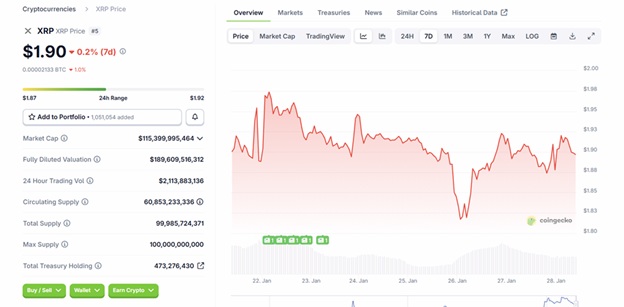
While the charter focuses on custody and RLUSD, it integrates Ripple deeper into the U.S. banking system. This could increase institutional confidence in Ripple’s payment solutions, where XRP serves as a bridge asset for liquidity.

Community sentiment views this as a catalyst for greater XRP adoption in institutional flows. Analysts note it reinforces Ripple’s post-SEC settlement momentum, potentially driving long-term demand.

Simultaneous approvals for Ripple, Circle (USDC issuer), BitGo, Fidelity Digital Assets, and Paxos signal a shift toward integrating crypto firms into federal banking. It brings stablecoin issuers and custodians under direct OCC oversight, promoting innovation within regulated frameworks.

This will encourages more crypto-native firms to pursue charters; aligns with pro-crypto policy trends like Trump’s administration appointee leading OCC. Broader Integration — Facilitates tokenized assets, on-chain payments, and custody for ETFs/treasuries, bridging traditional finance and blockchain.

Groups like the Bank Policy Institute criticize it as a “backdoor” into banking with lighter rules no FDIC insurance. They argue it could fragment oversight or unfairly compete. Final operations depend on meeting OCC requirements like capital, governance, risk management. Delays or denials remain possible.

This approval marks a pivotal step toward mainstream crypto legitimacy in the U.S., prioritizing compliance over isolation. It positions regulated stablecoins like RLUSD and competitors like USDC as trusted alternatives in institutional finance, while setting a template for the industry’s evolution.

Short-term market reactions have been positive, with community excitement around long-term absorption into traditional systems.

U.S. Home Prices Turns Negative on a YoY Basis

Recent data indicates that U.S. home prices have turned negative on a year-over-year basis nationally for the first time since mid-2023.

This shift was reported in mid-December 2025, based on daily tracking from Parcl Labs, a real estate data firm that monitors both new and existing home prices in real time. According to their index: National home prices are now slightly below levels from a year ago a decline of less than 1%.

Prices have fallen about 1.4% over the past three months. This marks the end of positive year-over-year growth that persisted through the post-COVID surge and into 2024–early 2025. The decline follows years of rapid appreciation during 2020–2022, driven by low mortgage rates and high demand.

Sharp rate hikes in 2022–2023 pushing 30-year mortgages above 7% created an affordability crisis, reducing buyer activity and forcing some sellers to lower expectations.

Inventory has risen modestly active listings up ~13% year-over-year in November 2025, but new listings remain low, and many sellers are delisting homes rather than accepting lower offers.

Logic Case-Shiller, FHFA, NAR median prices, and Redfin/Zillow still show slight positive year-over-year growth around 1–3% as of late 2025, but with slowing momentum and some monthly declines. Parcl Labs’ daily data captures this turning point earlier than lagged monthly/quarterly reports.

Experts note this softness could persist if mortgage rates remain elevated and inventory continues to build gradually, though a full crash is unlikely due to still-low overall supply and strong homeowner equity. This development signals a cooling market after years of gains, potentially improving affordability for buyers in 2026 if trends continue.

Trends vary significantly by region: Strongest growth in the Northeast and Midwest often called Rust Belt areas, driven by tight inventory, lower pandemic-era overheating, and resilient demand. Cooling or outright declines in the Sun Belt, particularly Florida, Texas, and parts of the Mountain West/Pacific, due to post-COVID supply increases, higher insurance costs, and reduced migration inflows.

The most recent comprehensive regional breakdown covering conventional conforming mortgages. All divisions except Pacific showed positive YoY changes; prices rose in 44 states + DC.

Real-time data from sources like Parcl Labs, Realtor.com, and analyst reports highlight faster cooling in overbuilt or high-cost areas: Many Florida metros like Tampa, North Port, Cape Coral, Miami: Down 3-10% YoY or from peaks; statewide listing prices down ~6% in parts of 2025

Las Vegas, NV; Phoenix, AZ; Seattle, WA; Dallas, TX: Significant slowdowns 6+ percentage points drop in growth rate. New York, Chicago, Cleveland, Boston, Minneapolis: Modest to strong gains, NY up ~7% in some measures.

Rust Belt areas like Milwaukee, Cincinnati, Detroit, Philadelphia, holding up best with rising sales and prices amid low inventory. This split reflects a “two-speed market”: Overheated pandemic boomtowns are adjusting with more inventory and price concessions, while undersupplied northern/urban areas continue appreciating slowly.

In 2026, Analysts from Zillow, Redfin, etc. forecast continued divergence: Sun Belt cooling may persist or deepen slightly, offering more buyer leverage. Northeast/Midwest likely to see steadier if modest gains.

National YoY growth expected ~1-2%, with affordability improving gradually as rates stabilize and inventory builds unevenly.

Overall, the market is rebalancing after years of rapid gains, but no widespread crash is anticipated due to low supply and high equity levels. Buyers in cooling regions may find better opportunities soon.

U.S. Treasury Proposes Draft Designs, Featuring Trump on the $1 Coin

0

The U.S. Treasury has proposed draft designs for a commemorative $1 coin featuring President Donald Trump’s likeness, planned for issuance in 2026 to mark the nation’s 250th anniversary— semiquincentennial of independence.

Reports from across outlets like CNN, CNBC, NBC News, Fox Business, USA Today, Politico, and Reuters indicate the Treasury released initial drafts showing Trump’s profile on the obverse side, with inscriptions like “Liberty,” “In God We Trust,” and “1776-2026.”

The reverse side depicts Trump raising his fist referencing the July 2024 assassination attempt photo, with “Fight, Fight, Fight” inscribed.U.S. Treasurer Brandon Beach confirmed the drafts as real on X, and Treasury spokespeople described them as reflecting “the enduring spirit of our country and democracy.”

The authority stems from the Circulating Collectible Coin Redesign Act of 2020 signed by Trump in his first term, allowing special $1 coin designs in 2026 emblematic of the anniversary. The proposal is controversial, as U.S. tradition and laws like restrictions on portraying living persons on currency to avoid monarchical appearances typically prohibit living presidents on coins.

Some reports note potential legal hurdles, and Democrats such as Sens. Jeff Merkley and Catherine Cortez Masto introduced bills to block it. As of late 2025, later U.S. Mint updates show candidate designs with Trump’s face on the obverse but an eagle on the reverse—no final design has been approved or minted yet.

This is a real proposal under consideration, not a hoax, though earlier private “Trump coins” or novelty items have been scams unrelated to official currency. The Circulating Collectible Coin Redesign Act of 2020 (Public Law 116-330, H.R. 1923) is a bipartisan U.S. law signed by President Donald Trump on January 13, 2021.

It amends Title 31 of the United States Code to authorize the U.S. Department of the Treasury via the U.S. Mint to redesign and issue new circulating collectible coins from 2022 through 2030. The primary goals are to honor prominent American women, youth sports, and the nation’s semiquincentennial.

The Act establishes several coin redesign programs: American Women Quarters Program. Up to five quarter-dollar coins issued each year, with reverse designs honoring prominent American women from diverse backgrounds. The obverse retains George Washington’s likeness modified for distinction.

Youth Sports Program: Reverse designs emblematic of sports played by American youth up to five per year.

Half-dollar coins: Reverse designs emblematic of Paralympic or adaptive sports for athletes with disabilities one new design per year.

Semiquincentennial: One-year redesign of multiple circulating denominations emblematic of the U.S. semiquincentennial: Up to five different designs one must highlight women’s contributions to the nation’s founding or history. Other denominations like cent, nickel, dime, half-dollar: Redesigned obverse and/or reverse.

$1 Dollar Coin: Specifically authorizes the Treasury to mint and issue $1 coins in addition to ongoing Native American and American Innovation $1 series with designs emblematic of the semiquincentennial during the one-year period starting January 1, 2026. All 2026 coins bear a dual date (1776–2026).

Silver Bullion Coins: Authorizes duplicate silver bullion versions including 5-ounce and fractional sizes of the redesigned quarters and half-dollars. Medals and marketing allows accompanying medals for sports-themed coins with surcharges and promotional programs to encourage collecting.

Designs must consult the Citizens Coinage Advisory Committee and Commission of Fine Arts. For certain coins including those under the youth sports and semiquincentennial programs, the reverse cannot include a head-and-shoulders portrait or bust of any person— living or dead or a portrait of a living person.

After 2026, most coins revert to prior designs except quarters and half-dollars continuing youth sports themes. This Act provides the legal basis for special 2026 $1 coins celebrating the 250th anniversary, which has led to proposals including controversial drafts featuring living figures.

However, traditional U.S. policy and separate laws generally prohibit portraying living persons on currency, and the Act’s reverse portrait restrictions apply to specified designs. The U.S. Mint has begun implementing programs like the American Women Quarters and recently unveiled 2026 semiquincentennial designs focused on themes of liberty without individual portraits in contested ways.