DD
MM
YYYY

PAGES

DD
MM
YYYY

spot_img

PAGES

Home Blog Page 5040

Agility in Workplaces – 7pm WAT Today

0

How do you build agility in the workplace? Like the damp-proof course (DPC) in civil engineering, agile firms must have a solid foundation that powers 4 critical pillars. I will explain those elements. Join us at the temple where innovators and project champions master the mechanics of business. Let’s meet in class; Zoom link in the Board. 

Tekedia Mini-MBA – registration for the next edition is ongoing. Register here.

How to Secure funding in Nigeria from Venture Capitalists and Angel Investors

0
Fund, money cash dollar

In my previous article on this subject matter, I named certain means of raising Investment, Seed and Working funding in Nigeria and got in response feedback mostly on the topic of Venture Capitalists & Angel Investors, something I have touched on in previous articles. 

But most of these feedback enquiries came with some misconceptions about how Venture Capitalists or Angel Investors work or the Regulatory Framework governing the raising of funds through these means. It also came to my notice that many investment platforms operating do so without any idea of the legal framework governing Investment of such nature in Nigeria as well. 

As a result, this supplementary article aims to provide some clarification on:- 

  1. What Venture Capitalists are and how they work along with their pros & cons. 
  2. Who Angel Investors and the Legal implications of how they work in Nigeria. 
  3. The legal safeguards to be adopted by entrepreneurs seeking Venture Capitalist & Angel Investor funding. 

What is a Venture Capitalist

A Venture Capitalist or VC is a firm of licensed Professional Managers specializing in providing early stage financing or start-ups or new companies seeking quick growth and is a profit seeking vehicle by entrepreneurs who have the objective of profiting(usually in the long run) from providing funding for start-ups mostly. 

Are Venture Capitalists firms required to be licensed in Nigeria

Yes, Venture Capitalists are required to be registered and licensed by the Securities & Exchange Commission. 

What are the Legal implications of obtaining financing from offshore or overseas venture capitalists

This is a growing topic of legal discussion in certain quarters. Offshore Venture Capitalists tend to feature most prominently in Tech start-ups and usually emerge as seed funding or round-based funding specialists hoping to profit on corporate acquisitions. 

It is illegal according to SEC rules to operate as an unlicensed Venture Capitalist in Nigeria. 

Okay, in that case how can overseas funding be routed without being legally defined as Venture Capital

Offshore Venture Capitalists seeking to operate in Nigeria can do so legally as Foreign Portfolio Investors (with their Investments to be registered with SEC and given certificates of Capital Importation) or they can directly register a company structure dedicated to funding start-ups under Convertible Debt or outright Equity purchases.

They can also work through individual proxies, usually experienced professionals appointed to operate as Angel Investors. 

Who is an Angel Investor

This is simply an individual who makes available capital funding for a business or start-up, usually in exchange for convertible debt or ownership equity in the business. 

How exactly do Venture Capitalists differ from Angel Investors? 

The two types of investors differ mainly in the sense that Venture Capitalists are usually Professional Fund Managers investing money belonging to other people like High Net Worth Individuals, Insurance Companies or Pension Fund Managers while Angel Investors are usually individuals investing their own money through their personal structure. 

Also, Angel Investors in Nigeria do not need any licensing unlike Venture Capitalist firms. 

What are the typical stages of Venture Capitalism? How do their funding arrangements come to an end

Venture Capitalists usually go through the stages of Fundraising, Investment, monitoring/Value enhancement & then exit. 

What are the pros and cons of using both Venture Capitalists and Angel Investors in Nigeria

Pros 

– They both provide easier private funding alternatives for start-ups as against traditional bank loans; 

– They sometimes come with value additions such as business coaching and mentorship; 

– They share the risks of business along with their start-up funding subjects and demand no extra or continuous liabilities in the event of business losses and even bankruptcy; 

– They serve as a very quick step to exponential business growth for start-ups. 

Cons 

– Venture Capitalists and Angel Investors are responsible for some of the most rampant cases of founding shareholder dilution ( company takeovers). 

– Venture Capitalists and Angel Investors are not particularly quick or easy to access and a funding application can take months. 

– Venture Capitalists and Angel Investors are also responsible for some of the most rampant cases of intellectual property hijackings, sometimes converting business ideas they initially rejected into major profits. 

– Venture Capitalists and Angel Investors sometimes seek to exert operational control over the businesses they lead, leading to the stifling of entrepreneurial and business management creativity. 

So what are the necessary safeguard measures I need to take as a start-up seeking funding

These are the following measures you should take, some of them i  already mentioned in my previous article on this subject matter :- 

  1. Always hire a company promoter, preferably, a lawyer to represent you to the extent of providing legal guidance and documenting initial funding applications. 
  2. Always have a non-disclosure agreement in place for your business idea and if possible, a registered Copyright, Trademark or Patent on your product/service offering. 
  3. Always have a registered company through which you can have an equity structure to bargain with. 
  4. Always offer first, preferably, convertible debt instruments as against equity when seeking funding. 
  5. Always upwardly review your company’s share structure  in your favour whenever you receive Venture Capitalist or Angel Funding. 
  6. Ensure that you have a Shareholder’s Agreement written before seeking funding. 
  7. Seek constant legal advice on the nature of funding via Private placement which typically covers Angel Investors and Venture Capitalists. 

Conclusion:- It is my hope going forward that this supplementary write-up will provide some clarity regarding previous enquiries seeking further advice on the nature of Venture Capitalist & Angel Funding, especially from Offshore sources, gaining ground especially in Nigeria’s Tech Industry.


Agility in Workplaces – One-Way, Two-Way Door Scenarios

0

I believe in speed and speed matters in business. In business, I consider two scenarios as I make a decision – is that decision reversible under managed risk? If so, then, I can make it without fully understanding all associated components. Simply, I do not have to do much research and studies (it is a two-way door, I can enter and come out). But where the decision is not reversible, it means the stakes are high. On that one, I have to spend more time to understand all critical components (one-way door).

When I write on LinkedIn, on a business topic, I see it as a two-way door (can edit quickly or delete). The business updates are reversible and I can write them without much effort, in minutes. But if Harvard Business Review asks me to review an upcoming book, the stakes are high, because once I send that review, I have no way to reverse my work. In that case, it is a one-way door.

Join me tomorrow at Tekedia Mini-MBA as I explain Agility in Workplaces. You can move fast and accomplish a lot in a day if you efficiently adopt the two-way and one-way door scenarios. Most times, we waste time at work on things we should not waste time, on the pretense of “understanding well”! If you cannot make calculated risks for two-day door scenarios, you may struggle to lead an agile team in this knowledge fast age.

Time is 7pm WAT (Thursday)

Fintech Start-up, Sendprint Hits The Market With $5 Flat Fee For Money Transfers

0

The most prevalent start-up business models are no doubt Fintech start-ups, as they continue to provide solutions to payments, savings, and mobile money transfers. The Global fintech market size has been predicted to reach USD 332.5 Billion by the year 2028.

Fintech company SendSprint, a money switch start-up based in the UK with operations within the US and Nigeria, has launched with a distinctive feature of a $5 flat fee for all transfers.

SendSprint enters the remittance market that is dominated by business veterans such as MoneyGram and Western Union, as well as the comparatively new fintechs like Zepz, Remitly, and Wise.

However, SendSprint’s $5 flat fee for all international money transfers might give it an edge over its rivals. The company targets three preliminary vacation international spot locations like South Africa, Kenya, and Nigeria.

SendSprint is no doubt coming big into the fintech ecosystem, as it has already partnered with Africa’s highest valued start-up, Flutterwave with the company’s valuation at $3 billion.

This partnership is indeed a strategic one as it will help SendSprint to cross-border transfers to 34 of the continent’s 54 international locations. It will also assist the company in rapidly complying with laws in its international locations of operation.

The CEO of SendSprint Damisi Busari, who has been identified as a former staff of Flutterwave, disclosed that the Fintech start-up was set up to connect Africans in the diaspora to their loved ones, by enabling fast, simple, and hassle-free International transfers. From set up to transfer confirmation within minutes of signing up for an account, transfers with Sprint are completed in minutes.

In her words, “We understand the connection that people have with their home countries and the importance of sending money and gifts home to support loved ones. SendSprint is about connecting the African diaspora to their loved ones at home by enabling fast, simple, and hassle-free international transfers as well as an innovative gifting experience. 

This is a product for the African diaspora. All of us at SpendSprint understand the multiple demands that Africans living abroad need. Our service recognizes and reflects this”

The company has already launched operations in the UK as its first step, as it plans to expand into the U.S and Canada in the coming months. With SpendSprint’s $5 flat fee for money transfers, as opposed to a sliding scale from other providers, it is safe to say that Africans in the diaspora will not hesitate to try them out and possibly make them their preferred option for money transfers back home.

The company has also partnered with top companies like Jumia, Game, Shoprite, St. Nicholas Hospital, Healthplus Pharmacies, and film house cinema among others.

The fintech industry has continued to gain momentous significance in the past few years, as the fintech ecosystem makes up a multi-billion dollar industry, with these start-ups providing high-tech solutions to financial products and services. The fintech market is significantly growing at a fast rate and is expected to reach almost $700 billion by 2030.

The Reason Nations Struggle on the Illusion of Oil Wealth

5

Case A: You sleep in your house, someone pumps oil in your backyard, sells it, and credits you $10 million at the end of the month. The economic activity for the production of the “finished goods”, in this case, crude oil at this phase, is $1 million. That $1m is the GDP – value added, created through the production of goods and services.

Case B: Another person cultivates palm trees, employs many people to weed, trim, harvest, process to palm oil, soaps, sells, ships, etc. The person deposits $2 million at the end of the month. But the economic activity for that translation is worth $5 million because many things are done within the area, generating massive economic activities. Here, there are jobs.

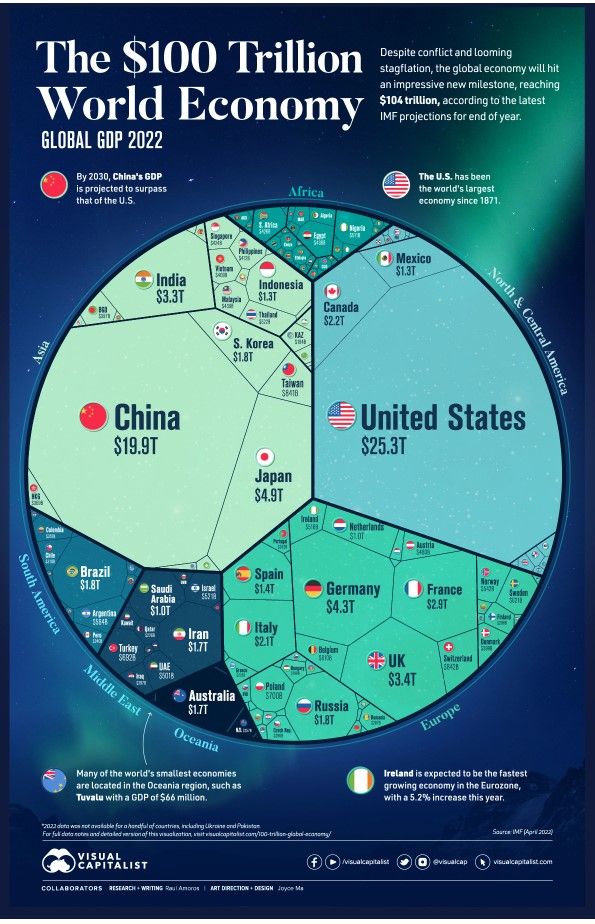
Have that in mind as you look at the GDP map of countries. Africa could be making money on natural resources but we are missing a lot on the economic activities. That explains why our GDP remains very small. We belong to Case A and account for a small component of the global economy.