DD
MM
YYYY

PAGES

DD
MM
YYYY

spot_img

PAGES

Home Blog Page 5055

Navigating the Supply Chain Matrix: How Tesla is Scaling with Centralized Operational Model

0

In production economics, three questions are important to finding the key to unlocking the market opportunities. First is what to produce, second is how to produce, and third is for whom to produce. These questions also guide the efficient use of scarce resources in bridging the demand and the supply gap. The flow of production resources from the supplier to the manufacturer through to the eventual delivery of the final products to the end-users is known as the supply chain.

Since companies want to optimize their cost, minimize risks of leakage and circumvent other complexities involved in getting their supplies and the flow of their products to the point of demand, they create structures that shape the dynamics of their supply chain and determine how efficiently they serve their customers.

One of such structures is the centralized supply chain model wherein all supply chain decisions, from procurement to distributions are centrally determined, usually from the headquarters. An alternative to this is the decentralized supply chain model which spreads decisions among a series of small units within the same business.

Unlike the decentralized model which usually involves too many stakeholders’ decisions; the centralized model is more responsive to change and adopted by companies that want to have firm control over their entire supply chain. Such comprehensive control enables firms to inwardly innovate and tailor their operation to the new market ordinance while still having a minimal operational cost and a higher profit margin.

The hiatus of the centralized model and that of the decentralized model are offset by a third model known as the hybrid model. The hybrid supply chain model is the fusion of both the centralized and the decentralized models.

A Case for Centralized Supply chain Model

Tesla is one of the leading brands in the automobile industry that centrally plans its supply chain operations. Founded in 2003, Tesla specializes majorly in electric vehicle production and is known for the aesthetics and long ranges of its electric vehicles. The company currently sells 4 fully electric vehicles (EV) models which includes; the model S sedan, the model X Sport Utility Vehicle (SUV) the model 3 and the model Y SUV through its own branded stores.

In September 2020, Elon Musk, Tesla’s founder and chairman, announced Tesla’s goal to build a US $25,000 mass-market electronic car and ramp up annual production to 20 million cars. In the year 2021, about 911,000 units of its Model 3 and model y were sold pushing the revenue base of the brand to $53 billion up from $31 billion in 2020. Since 2009 Tesla has produced 1.91 million electric vehicles. By 4Q2021, the brand’s market value already surpassed the $ 1 trillion dollar market cap. Tesla is able to achieve this great fit by having comprehensive control of its supply chain.

By centralizing some crucial elements of its supply chain, from resource procurement to product distribution and add-value services such as its self-reliant charging network, Tesla is able to enjoy economies of scale and efficiencies to improve performance, minimize cost and deliver a superior customer service experience. The company is also able to adapt changes to its customs manufacturing process, prevent patent loss and increase the speed of innovation, and have quick access to the market.

For example, while experts forecast that battery cost needs to come down to about 100 US Dollars per Kilowatt for EVs to witness mass adoption in the industry, Gigafactory, Tesla’s $ 5 billion battery production company in Nevada presents an interesting playbook that can reduce production cost by up to 35 percent by streamlining labour, time and transport. Thus, through Gigafactory, Tesla gets the best possible chance to reduce operational costs and still achieve maximum output. Also, Tesla’s in-house distribution channel gives it leverage to sell directly to the end-users through the company’s website and showrooms without having to incur extra costs from dealers’ mark-ups and excesses of investors.

Furthermore, where many of its competitors have had to endure production delays, suspend their models and increase prices due to ongoing semiconductors shortages in the industry, Tesla is able to navigate this shortfall more effectively through its unified computing architecture. By owning its own software, the company’s AI engineers were able to access, modify and rewrite the software according to their needs and thereby make use of available chips from other vendors.

Thinking Forward

A Supply chain model should be customer-centric and contingent upon changes within an industry. Whereas Tesla is scaling with its centralized supply chain model, other businesses in other industries may find the alternative models more expedient to the peculiarities of their supply chain ecosystem. Understanding these dynamics informs the efficiency of the scarce resources used in bridging the supply-demand gap.

References:

Statista. April 2022. Insights on the competitive landscape in eMobility
MTN MoMo Responds On N23bn ($55m) Customers’ Fund Lost in Erroneous Transactions

0

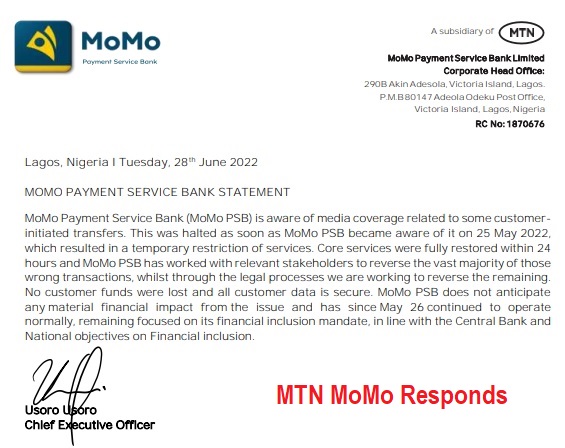
Good People, this is a note from MTN Nigeria Mobile Money.  I am sharing it as I posted here when the news broke. The good news is that the banks are reversing the transactions.  No customer money was ever lost and everything is fine.

To the CEO of MoMo, Usoro Anthony Usoro, I want to commend you for co-building one of the fastest growing financial products in the history of Africa. MTN’s Q1 2020 showed the giant at a consolidated level processed $60 billion through its financial technology platforms; a big chunk of that is from Nigeria.

Usoro, you have done really well. By 2025, you may be running the largest financial service business that does not have a bank license in Nigeria! Keep winning for MTN, Nigeria and Africa.

(Disclosure: Usoro used to be my “boy” [he is a really big man now, lol] – we rode together in a car for two years in Diamond Bank ITGroup. He remains one of the finest strategists and visionaries in the Nigerian corporate world. I gave him the nickname “OCP” because he understood everything like an Oracle database. Give him an assignment, go home and sleep; brilliant.)

Nigerian Fintech Operators Account For 63% Funding Raised In 2021

0
FILE PHOTO: (L-R) Solomon Islands Prime Minister Manasseh Sogavare, Solomon Islands Foreign Minister Jeremiah Manele, Chinese Premier Li Keqiang and Chinese State Councillor and Foreign Minister Wang Yi attend a signing ceremony at the Great Hall of the People in Beijing, China October 9, 2019. REUTERS/Thomas Peter/File Photo

The fintech association of Nigeria disclosed that Fintech operators accounted for 63 percent of the 1.37 billion dollars in funding raised in Nigeria in 2021.

This was disclosed by the President of the association Mr. Ade Bajomo who made this statement at the dinner event held at the fintech platinum awards ceremony. Mr. Bajomo noted that Nigeria has been well-positioned in Africa and the global fintech ecosystem.

In his words, “Nigerian start-ups raised $1.37 billion of the four billion dollars raised in Africa in 2021. Of these, the fintech space alone accounted for about 63 percent of all total funding, compared with just 25 percent in 2020. 

The growing investor confidence in African fintech reflects the continent’s huge potential due to deepening mobile and internet penetration, a youthful population, and increasing consumer sophistication and income, among many other factors.

When you think about how far fintech in Nigeria has come, you should thank the incredible entrepreneurs who envisioned, pioneered, and executed strategic moves that have now crystallized into strong and growing companies”

There is no disputing the fact that Nigeria has become a hotbed for Fintech innovation, with the country home to about 250 fintech companies. Despite the huge financial, regulator, and infrastructure challenges, the sector continues to defy all odds by recording more groundbreaking achievements.

With 7 start-up unicorns in Africa, Nigeria is home to 5 unicorns doing exceptionally well. Impressive! It might interest you to know that the country constantly witnesses a surge of fintechs as there is no slowing down in the fintech ecosystem. Statistics have it that as of 2021, 144 fintech start-ups existed in Nigeria, which makes Nigeria the country with the highest number of fintech start-ups in Africa.

This trajectory has been predicted not to slow down, that by 2025, Africa would be home to 1.5 billion people, most of whom would have grown up with the internet.

One may be tempted to ask why there are so many fintechs in the country, with more still emerging, since they all perform almost the same thing?

The truth is the challenge of financial inclusion still exists even with all these fintech start-ups sprinkled in the country. These fintechs are solving the persistent problems of traditional banking in Nigeria. They typically focus on the myriad of problems that traditional banks are unable to solve.

According to the United Nations world population estimates, Nigeria’s population will hit 400 million by 2050, which means that the number of unbanked people will increase, which is why the country needs much more fintech start-ups.

These fintech start-ups are doing exceptional things, by offering faster, better, and simpler ways of doing things most especially in the area of savings and mobile money transfer. They also make the process of acquiring loans easy, with their ability to provide loans through a digitized lending process.

These fintechs offer personal reliable savings solutions available on mobile phones with companies like Cowrywise and Piggyvest doing exceptionally well in that area.

Different global statistics have shown that fintechs all over the world are making huge impact to grow nation’s economies.

Fintech has no doubt positively impacted Nigeria’s economy, and is also responsible for most exponential growth visible in most Nigerian organizations and financial institutions.

With fintech, most of these organizations have been able to come up with amazing products and services that make things easy for their customers which has no doubt improved the organization’s revenue.

Zenith Bank Retains Position As Nigeria’s Best in Commercial Banking, Corporate Governance

1

Zenith Bank Plc has continued to prove its mettle in Nigeria’s banking industry, maintaining its lead in many fronts to earn itself local and international recognitions.

Zenith Bank has been named the best commercial bank in Nigeria at the World Finance Banking Awards 2022, and also the Best Corporate Governance ‘Financial Services’ Africa 2021 by the Ethical Boardroom, for the second consecutive year.

World Finance Magazine presented the awards to the Group Managing Director/Chief Executive of Zenith Bank Plc, Ebenener Onyeagwu, at the London Stock Exchange yesterday, in recognition of the bank’s ability to embrace digital transformation and best-in-class sustainability and corporate governance practices, leading to a stellar business performance in a difficult economic climate.

Commenting on the awards, Onyeagwu praised the commitment of the bank’s management and staff to carry out its operations in line with global best practices.

“These awards reflect our strong business fundamentals, resilience and ability to adapt to the ever-changing dynamics of the market through our innovative solutions, as well as our commitment to global best practices. As a member and signatory to various domestic and international sustainability frameworks including the United Nations Global Compact (UNGC) and the Central Bank of Nigeria Sustainable Banking Principles, we continue to support the achievement of the Sustainable Development Goals (SDGs) by creating value for our shareholders, customers, clients, investors, communities and the environment through our practices, operations and investments.” he said.

A statement issued by the bank noted that it places a premium on its core business strategy anchored on People, Technology and Service, to create value for its numerous clientele. It said the tier-1 bank leverages its team of dedicated professionals, to harvest its robust Information and Communication Technology (ICT) infrastructure to provide cutting-edge solutions and products through its network of branches and electronic/digital channels.

The awards, which were published in the June 2021 edition of The Ethical Boardroom magazine, is in recognition of the bank’s adherence to global best practices and institutionalization of corporate governance, setting an industry-wide example of best practices in that field.

Zenith Bank has racked up several awards in recent years. The long list goes as follows: Zenith Bank was voted as Bank of the Year (Nigeria) in The Banker’s Bank of the Year Awards 2020, Best Bank in Nigeria in the Global Finance World’s Best Banks Awards 2020 and 2021, and Best Corporate Governance ‘Financial Services’ Africa 2020 by the Ethical Boardroom. Also, the bank emerged as the Most Valuable Banking Brand in Nigeria in the Banker Magazine Top 500 Banking Brands 2020 and 2021, and Number One Bank in Nigeria by Tier-1 Capital in the “2020 Top 1000 World Banks” Ranking by The Banker Magazine.

Similarly, the bank was recognised as Bank of the Decade (People’s Choice) at the ThisDay Awards 2020, Retail Bank of the year at the 2020 BusinessDay Banks and Other Financial Institutions (BOFI) Awards, and Best Company in Promotion of Good Health and Well-Being as well as Best Company in Promotion of Gender Equality and Women Empowerment at the Sustainability, Enterprise and Responsibility (SERAS) Awards 2020.

“Zenith Bank has been generally adjudged a Corporate Governance compliant bank by the Nigerian Stock Exchange (NSE) hence its listing on the Premium Board of the Exchange. The bank continues to sustain this reputation and reappraise its processes to ensure that its business conforms to the highest global standards at all times,” the bank said in a statement.

Inflation, High Interest Rate Centralizes Bitcoin and Cryptos as Facebook’s Novi Crypto Wallet Shuts Down

1

It took the paralysis created by Russia’s war in Ukraine for many veils to be lifted on cryptocurrency investment (not as a means of exchange of value). Yes, with inflation skyrocketing and interest rates jumping,  the world of cryptocurrency which was built on “decentralization” has simply demonstrated that it is nothing but a big part of our centralized world.

Indeed, if you need Naira, US dollars, etc to buy cryptos, the implication is this: if you cannot find those Naira, USD, etc, cheaply, cryptos will struggle. And as that happens, because of high interest rates, other asset classes (treasury bills, fixed deposits)  in the centralized world become enticing to investors. Magically, BTC investment becomes less optimal when other options are evaluated.  In the end, BTC has been centralized where it matters: allocation of funds to asset classes.

As that rages, Meta (Facebook’s parent company) has seen enough and is shutting down Novi! This showdown is not coming from regulatory activism or lawmakers fiat instructions. Rather, this is a pure play market force in action. And Meta might have done it since the exuberance of a decentralized currency has been stymied by a centralizing inflationary paralysis.

As the cryptocurrency industry nosedives further, plummeting investors’ funds and crippling the market’s value along the way, companies in the industry are being confronted with the tough decision of whether to stay in business or shut down operations.

The headwinds that have forced leading crypto asset bitcoin to stay below and a little above $20,000 dollars, is also forcing many institutions’ crypto-linked operations to shut down. Meta, Facebook’s parent company, has been caught in the wind.

Facebook expects a recession and it is phasing out many products while hiking performance for workers: ‘You might decide this place isn’t for you, and that’s OK with me’.

Facebook parent Meta is cutting back on hiring and turning up the heat on its employees as slow growth and macroeconomic headwinds push the company to downgrade its economic outlook.

In a weekly employee Q&A session on Thursday, the social media giant’s chief executive Mark Zuckerberg told employees that Meta is reducing its plans to hire engineers by at least 30% this year. Citing the market downturn and the looming recession, Zuckerberg said Meta will now only hire around 6,000 to 7,000 new engineers in 2022—a stark drop from its initial plan to hire more than 10,000.

Facebook’s Parent, META, is Shutting Down its Novi Crypto Wallet