DD
MM
YYYY

PAGES

DD
MM
YYYY

spot_img

PAGES

Home Blog Page 5055

SMEs – The Backbone of Nigeria Economy

0

The United Nations industrial development organization (UNIDO) recently disclosed that small and medium-scale enterprises account for 96 percent of all business activities in Nigeria.

The regional director of UNIDO, Mr. Jean Bakole disclosed that the MSME sector in Nigeria currently contributes about 50 percent of the GDP, and has provided over 48 percent of all employment opportunities in the country.

Unfortunately, despite the major roles these SMEs play in the country’s economy, they are still faced with a myriad of challenges that stifles their growth. Nigeria is home to approximately 40 million MSMEs that are employing 87.9 percent of the labor force.

Small and Medium enterprises play major roles in most economies, most especially in developing countries. They account for the majority of businesses globally and are major contributors to job creation and global economic development.

According to an estimation by Worldbank, 600 million jobs will be needed by 2030 to absorb the growing global workforce, which is why SMEs development should be a top priority for many governments around the world. In most emerging markets, most formal jobs are generated by SMEs which see them create 7 out of 10 jobs.

However, the operation of SMEs in most countries, with Nigeria inclusive, is not usually smooth. One major challenge these SMEs face is lack of access to finance to grow their business.

Among other problems are stiff competition from larger companies, low capacity utilization, lack of management strategies, difficulties in sourcing raw materials, etc. Due to these tons of problems that are currently ravaging the SMEs ecosystem, most of them in Nigeria die within their first five years of existence, while only about five to ten percent survive, thrive, and grow to maturity.

No doubt the unstable policies of the government has also caused some of these SMEs to crumble, also not forgetting multiple taxations that have been a problem, especially given the role of tax consultants and agents hired by the local governments.

They tax these SMEs on everything in their bid to generate revenue without considering its adverse effects on these businesses. The government must understand that the growth of SMEs is very pivotal to the growth of the economy, therefore they should be given a conducive environment to run their businesses, as anything that stifles or poses a challenge to their growth should be jettisoned.

In every economy in the world, it is an established fact globally that SMEs play a very vital role in economies which is why they are often referred to as the engine of economies. Since one major problem of these SMEs is access to finance, therefore there is a strong need for the government to intervene in funding these businesses by making credit facilities available to all sectors of SMEs.

These SMEs have for years called on the government for support, and it is ideal that the government heed to their call. The government keeps talking about tackling the high unemployment rate in the country which rose from 27.1 percent to 33 percent in the second quarter of 2020.

One thing they must understand is that once these SMEs are properly funded, the issue of unemployment among youths will be drastically reduced, because these SMEs in Nigeria account for 84 percent of employment in the country.

Also, as much as the government is saddled with the responsibility of creating an enabling environment for SMEs with financial support, big organizations can also play a role by supporting these SMEs either through funds or partnership. Once problems challenging these SMEs are tackled, Nigeria’s economy will no doubt experience a massive turn around.


What is your business friction? Send to Tekedia Institute

0

What is your business friction? Can you engage learners at Tekedia Institute to help you? By doing that, you give young people the opportunity to work on real business cases over hypothetical or post ones. We unveiled “DesignLab for Companies by Tekedia Learners” to bring a new domain on how to prepare and master the mechanics of entrepreneurial capitalism.

Our community likes it. Send us your business friction, and experience quality from our learners who are already exposed to cutting-edge business models, frameworks and systems which are redesigning the ordinances of markets and global economies.  They will provide world-class solutions and help your mission.

Begin here

Join Me At Blockchain Vibes tomorrow in Lagos

0

Join me at Blockchain Vibes tomorrow (July 9) as I keynote the largest blockchain-themed summit in Africa. My keynote is scheduled at 10am WAT. The venue is Glover Memorial Hall, Marina, Lagos Nigeria. The summit theme is Demystifying Decentralized Finance (DeFi) and Web 3.0.

In my keynote, I will connect from how my JS3 math teacher (Mr Bukar, ABU Zaria Mech Eng), SS1 (Mr Aham, UNN Mech Eng), SS2 (Mr Alaohuru, UNN Math) and SS 3 (Mr Onyezewe, UNN Mech Eng) connected the fundamental element of everything we’re discussing today. Simply, winning the future of finance and web 30.0 is numbers.

 Go here and learn more about this event –internationalblockchainsummit.org

Nigeria And The EU Partner For Innovative Modern Agriculture

0

The European Union is investing €1.3 billion in the Nigerian agricultural sector. This was disclosed in Lagos by the head of the European Union Delegation to Nigeria and the Economic Community Of West African States (ECOWAS), ambassador Isamuela Isopi, during the official launch of team Europe.

The launch was disclosed to be part of the activities that marked the 8th edition of EU-Nigeria Business Forum that was held in Lagos between June 30 and July 1st, 2022, with the theme ‘Nigeria and the New Economy’.

The TEI- Green economy would put forward innovative, modern solutions to established sectors like agriculture as a new growth engine. According to ambassador Isamuela Isopi, she disclosed that the launch of the TEI-Green economy will bring together projects that would create jobs for unemployed youths and accelerate economic growth in the country.

In her words, “We launch the TEI-Green Economy, which brings together projects and measures of access to finance, promoted and funded by the EU, the EU member states and EU Development finance institution with the objective to achieve low carbon, resource-efficient and climate-resilient development that would create jobs for the youth and accelerate economic growth through the development of climate-smart agriculture, as well as the circular digital economy”. 

The aim of this objective is built on three (3) pillars, which are, the expansion of renewable smart energy, the development of climate-smart agriculture, and the sustainable transformation of Agri-SMEs in selected value chains.

Through the implementation of the TEI-Green economy, it is expected to yield the emergence of new, and existing growth in Agribusiness to achieve improved growth in production and exportation, as well as the improvement of smallholder livelihood through capacity building and investments.

The TEI-Green economy is also expected to reduce the loss of livestock and crop, as well as the improvement of food security. Indeed this partnership is loaded with so many benefits. Looking at the list of development that the TEI-Green economy will bring in the Agricultural sector, it will no doubt positively impact Nigeria’s economy.

Despite the fact that the agricultural sector in Nigeria has received few fundings from the government of Nigeria, it is still faced with a myriad of problems. With the Russian-Ukraine war that has led to severe famine in most countries in the African region, which is the worst hit, African countries need to revamp their agricultural sector so that they can start producing their food and quit the heavy reliance on foreign countries for food aid.

In Nigeria, the country has been ravaged by heavy reliance on the importation of food commodities which is affecting the economy. Hopefully, this partnership with the EU will improve the production scale of Agricultural commodities in the country as well as ensure that there is food security.

Also, looking at the high percentage of unemployed youths, the project will enhance the employability of Nigerian youth and women. This TEI program has been disclosed to run till 2027, hopefully before it elapses, a lot of transformation  would have happened in the agricultural sector.

The EU, having observed Nigeria, identified agriculture as one of the backbone of the Nigerian economy, which was revealed to be providing the main source of livelihood for most Nigerians and contributing about 22 percent to the nominal GDP of the country.

Unfortunately, the country continues to rely on oil with so much dependence on the mineral resource. A nation cannot grow without the diversification of its economy. The EU, therefore, disclosed that its reason to invest in the agricultural sector, is to diversify it as well as help Nigeria attain the SDGs and put the country on a sustainable development path.

Agile Leadership: How High-Performance CEOs Make Headways with Boldness

0

Have you ever considered escaping into the farthest east, seeking respite in the tiniest hole of the mount Himalayas? Such is usually the thought of most Chief Executive Officers hired to stir the wheels of companies when they are in their most lonely and clueless periods. Building a successful business is often heaped with too many frictions and uncertainties, yet CEOs are expected to navigate these bottlenecks and create category-king companies.

From circumventing the disruptive tendency of the invisible hands (demand and supply) to weathering the brute competition in their industries, CEOs also have to deal with several incidences of backstabbing from disgruntled and disloyal employees or colleagues or board members. All of these are not calling for the timid, apparently.

In the law 28 of his 48 laws of power, Robert Greene generalized the necessity of knowing how to enter actions with boldness. The American classic writer espoused his proposition with a somewhat radical thought from Niccolo Machiavelli, adapted from the latter’s book, the Prince, which superimposes impetuousness over cautiousness. According to Machiavelli, it is better to be impetuous than to be cautious because fortune is a woman that would rather be attracted to the impetuousness of the bold than the cautiousness of the cold and timid.

Observers of the law in the corporate ecosystem are often called agile leaders or ruthless pragmatists. Several reports reveal the ability to make quick and sound decisions as one of the strongest hallmarks of successful CEOs across industries and cultures. According to a 2019 McKinsey & Company’s report on the mindsets and practices of excellent CEOs, the CEO’s biggest move account for 45 percent of a company’s performance and 3 out of 5 newly appointed CEOs that live up to performance in their first 18 months share certain mindsets and practices that evokes agility.

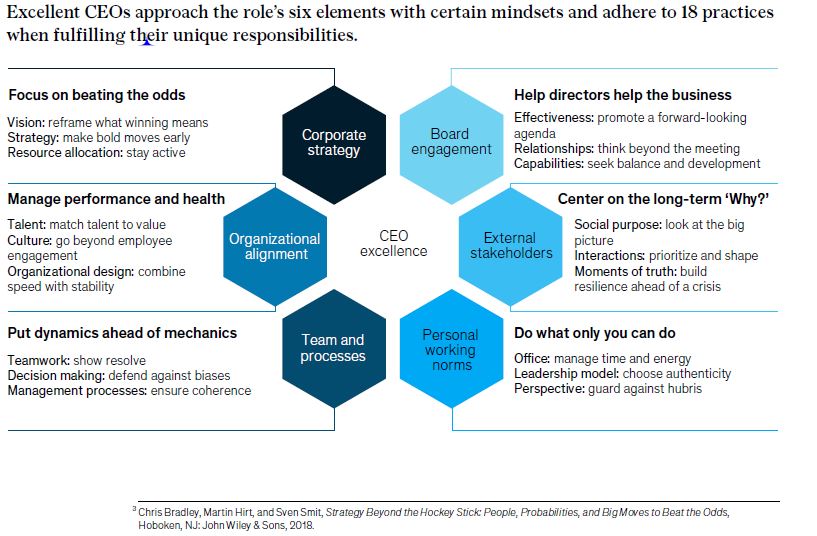
McKinsey researchers, Carolyn Dewar, Martin Hirt and Scoff Keller, developed a model of CEOs excellence following extensive research into factors that constitute the mindsets and practices of successful CEOs. The research drew largely from Company’s proprietary database on CEO performance, containing 25 years worth of data on 7800 CEOs from 3500 public companies across 70 countries and 24 industries.

The model encompasses six core elements of an excellent CEO which include; setting corporate strategy; aligning the organisation; leading the top team; working with the board; being the face of the company to external stakeholders and managing personal resources like time and energy. These elements further decompose to 18 specific responsibilities that are exclusively characteristic of CEOs.

The first call to action for a CEO is to develop the corporate strategy, and this involves setting the company on a clear goal path and having a roadmap or grand plan to always refer to in the face of uncertainty. By this, one could think about the vision and mission statements, philosophies and objectives of the company. It is reported that most CEOs tend to focus on options with the firmest business case to reduce strategic uncertainties, however, this should not detract from their ability to make bold moves in strategic decisions, especially in cases of resource allocation, pragmatic mergers, acquisition, and divestitures, capital expenditure, productivity improvement and differentiation improvement.

According to the researchers, moving boldly means to shift at least 30 percent more than the industry median. This increases one’s chances of rising from the middle quintiles of economic profit to the top quintile. CEOs that make bold moves earlier in their tenure outperform those who move later and those who do so multiple times avoid common decline in performance. Furthermore, findings show that CEOs that are hired externally tend to make bold moves faster than those promoted to the position from within. This is likely because internally promoted CEOs are already accustomed to some set of structure and routines that may be impeding their tendencies to change.

Some leaders are often too tardy and hesitant in making strategic decisions even with the most basic and inevitable aspects of their businesses such as resource allocation. Report shows that one-third of companies reallocate a mere one percent of their capital from year to year. Companies that reallocate more than 50 percent of their capital expenditures among business units over ten years create 50 percent more values than companies that reallocate more slowly. Furthermore, it was found that the top 10 percent of high performing CEOs are 35 percent more likely to dramatically reallocate capital than average performers.

Another function of the CEO is Organisational alignment. This is the art of strategically positioning people to perform optimally towards achieving the overall goal. High performance CEOs think systematically about their people; which roles they play, what they can achieve and how the company should operate to improve people’s impact. However, it is instructive to note that strategic alignment extends from matching talents with values to making bold moves with pruning the organisation of irrelevances including helplessly redundant employees. Thus, the best CEOs are described as those that put equal rigor and discipline into achieving greatness on both strategy and talents.

Study shows that almost half of senior leaders say that their biggest regret is taking too long to move lesser performers out of important roles or out of the organization completely. Many CEOs also express worries about asking the same few overstretched individuals to take on extra assignments because they cannot trust the people who would otherwise perform them. Furthermore researchers agree that CEOs who tolerate poor performance and bad behaviours diminish their own influence.

‘’Agility is one of the most widely used and misunderstood management buzzwords’’ argue these researchers from the McKinsey & Company. Contrary to most people’s belief, agility is not just about quick decision and execution; it also involves accelerating at a deliberate, stable pace. These researchers suggest that companies that are both fast and stable are nearly three times more likely to rank in the top quartile of organizational health than companies that are fast but lack stable operating disciplines.

Thus, according to the researchers, excellent CEOs increase their companies agility by determining which features of their organisational design will be stable and unchanging and creating dynamic elements that adapt quickly to new challenges and opportunities, for example; temporary performance cells, flow-to-work staffing models, and minimum viable product iterations etc.