DD
MM
YYYY

PAGES

DD
MM
YYYY

spot_img

PAGES

Home Blog Page 5073

China Announces New Rules to Regulate Its Private Pension Market Via Mutual Funds

0

After what appeared to be a brief break, China is resuming its industries’ regulatory exercise, shifting attention this time to sectors that were not touched when it started about two years ago.

Early this week, the Chinese authority released new rules designed to curb comments on social media and live-streaming, a move said to target dissent. But another set of rules announced on Friday is giving attention to the pension market.

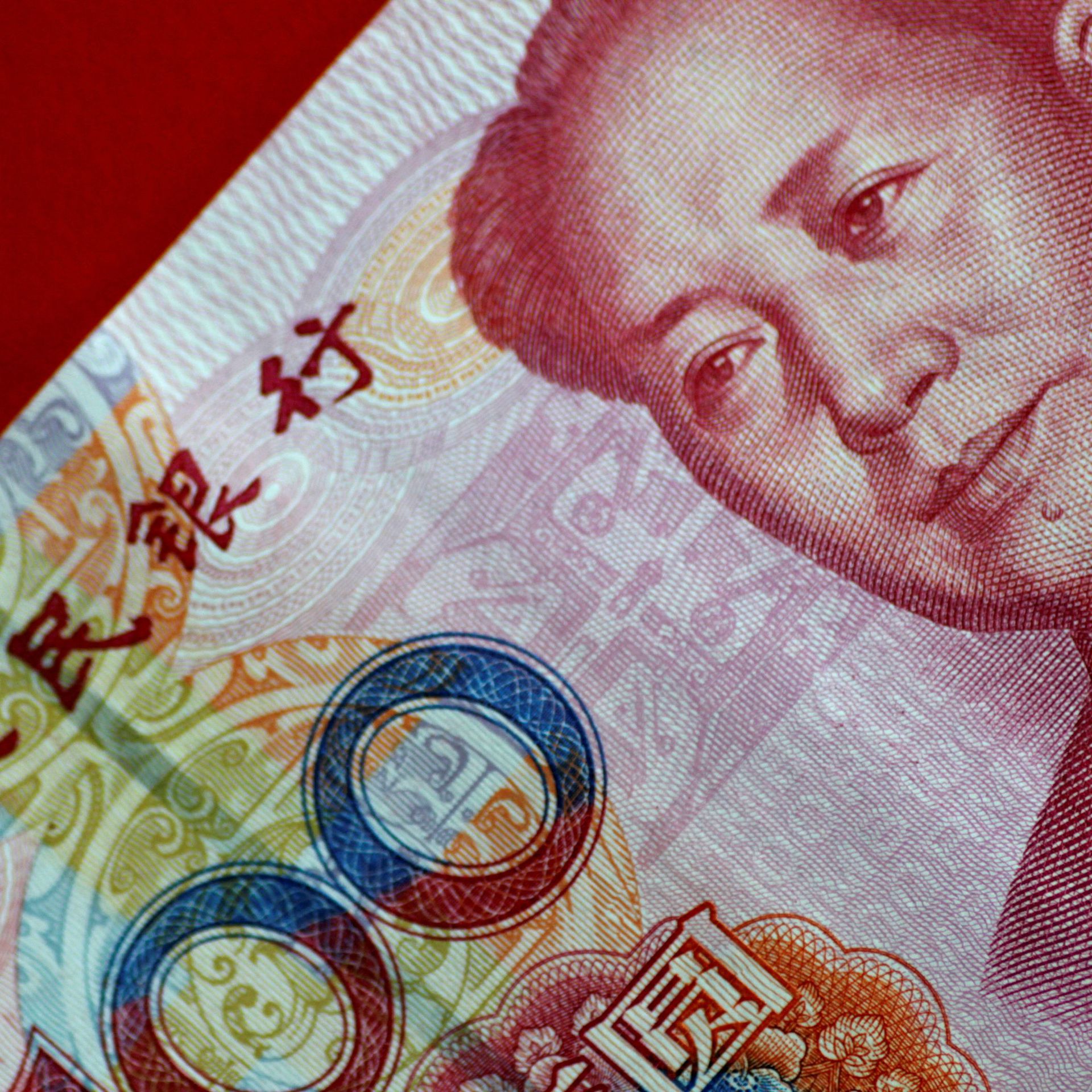
China Securities Regulatory Commission (CSRC) has announced new rules that will regulate private pension investment via mutual funds, Reuters reports. The move is geared towards tackling the challenges facing China’s aging population, and it follows the private pension scheme that Beijing launched in April.

Under the new rules published by the CSRC late on Friday, qualified products and sales agents will come under a scheme that will channel fresh savings into the country’s capital markets.

Under the scheme, individuals will be able to invest their pensions in a range of financial products such as mutual funds, savings deposits and insurance products – providing more options for wealth building and financial stability while opening up a lucrative new market for banks and financial companies. Reuters noted that the lucrative pension market has lured foreign asset managers including Fidelity International and BlacRock.

The proposed rules “have set a relatively high bar for products and institutions, and are designed to ensure safety of pension fund investment and protect investors’ interest,” the CSRC said in a statement on its website.

Initially, pension target funds with at least 50 million yuan ($7.48 million) of assets over the past four quarters are eligible under the pilot pension scheme, the CSRC said.

Other types of retail funds with clear investment strategies and good long-term track records will be gradually added to the eligibility list as the scheme expands, the CSRC said.

The scheme enables people to make annual contributions of up to RMB 12,000 (US$1,846) into a pension account set up through a centralized platform. China has a robust pension market expected to grow from US$300 billion to US$1.7 trillion in 2025.

However, ‘the financial institutions and financial products permitted to be involved in the operation of individual pensions will be determined by the relevant financial regulatory authorities and released to the public through the service platform.’

Currently, there are 91 pension target funds that meet the CSRC’s criteria, according to TF Securities.

The rules require fund managers and sales agents participating in private pension business to set up internal control systems, adopt long-term incentives, and ensure independent operation of the pension assets.

China is planning to sustain economic growth by giving its aging population spending power. China’s population will be made up largely by old people in years to come. According to the World Health Organization, in 20 years, 28% of China’s population will be more than 60 years old, 18% up from what it is today.

China has early legal retirement ages; 60 for men, 55 for female white-collar workers, and 50 for female blue-collar workers. Besides creating a gap in the country’s workforce contribution to economic growth, early retirement means reduction in employee taxes.

Thus, China is seeking to ensure that the golden age population will continue to have access to disposable income after retirement. This, in addition to other strategies such as common prosperity, will ensure that everyone has sufficient spending power, boosting the country’s financial stability,

Study Shows How Robots Become Racist Due To Flawed AI

0

According to an international study conducted by a few universities, including the John Hopkins University, disclosed in a statement that a robot operating with a popular internet-based artificial intelligence system consistently gravitates toward men over women.

The robot is said to have a preference for White people over people of color, and it also jumps to conclusions about people’s jobs after a glance at their face.

A research conducted by a few experts, reveals that this is the first-ever research carried out that shows that robots loaded with an accepted and widely-used model, operate with significant gender and racial biases.

A study by author Andre Hurdt who carried out research on these robots, disclosed that these robots learned those toxic stereotypes through flawed neural network models.

He added “we are at risk of creating a generation of racist and sexist robots, but people and organizations have decided that it’s okay to create these products without addressing the issue. Those building artificial intelligence models to recognize humans and objects often turn to vast datasets available for free on the internet. But the Internet is also notoriously filled with inaccurate and overtly biased content, meaning that algorithms built with these datasets could be infused with the same issues”.

A test was also carried out by a team of researchers to test a widely downloadable artificial intelligence model for robots, that was built with the chip neural network which allows these robots to see and identify objects by names.

The robot was tested with a few tasks, and the team of researchers found out that these robots were incapable of carrying out their assigned task without bias, where it played out certain significant stereotypes on many occasions.

For instance, the robot picked white people more over black people, it also profiled black men as criminals while it preferred white men. These groups of researchers disclosed that such findings are sadly surprising.

It is quite disheartening that even AI robots that should be void of biases have been infiltrated with weird traits. To prevent future AI machines from adopting these weird stereotypes, researchers disclosed that a systematic change to research and business practices is needed.

Such systems need to be changed because they can pose a very big challenge in society. It might interest you to know that it is fast becoming a thing that AI robots are enacting malignant stereotypes which call for serious intervention, because of the high probability of a negative outcome.

Unfortunately, manufacturers of these robots have shown autonomous racist and scientific behavior which is already encoded into robots with AI.

Zendesk Acquisition Ended At $10bn, As Global Economic Headwinds Create Market Chaos

0

As inflation and economic headwinds accelerate with negative impacts across markets, companies caught in the whirlwind effects are telling not so profitable stories. The markets’ turmoil has been sparked mainly by rapid dramatic changes in political events in Europe, forcing both companies and investors to settle for less.

Markets have been spiraling downwards as the Russia-Ukraine conflict heats up, and companies, especially those seeking a way out of the resulting financial mess, are receiving anticlimax business results.

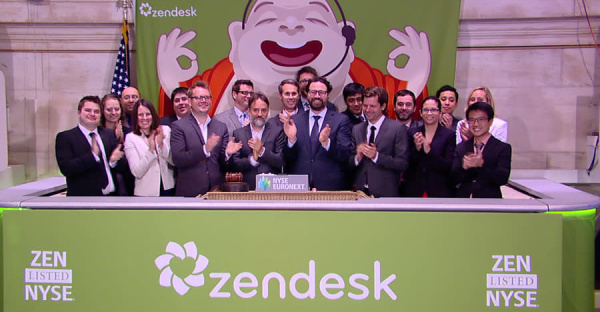
Zendesk, a company that builds software to help other firms keep their business in sync, is among the latest victims of the current market chaos. The company was up for acquisition earlier in the year for a value that ended up being nearly halved. TechCrunch reports on its ordeal below.

Zendesk has had a difficult time over the last several months. It has been hounded by activist investors, Jana Partners. It turned down a $17 billion acquisition in February believing it was worth more. Its investors turned down a deal to buy Survey Monkey’s parent company, Momentive, the same month.

Today, the drama concluded when Zendesk was acquired for $10.2 billion by a consortium of private equity firms, well below that original offer.

But the SaaS market has shifted dramatically over the last few months, and Zendesk has been caught in the middle of it in a maelstrom of investor drama. Earlier this month, the company concluded it would stay independent, a move that caused the stock price to plunge.

Now it’s been sold to an investor group led by Permira and Hellman & Friedman. The deal is for $77.50 per share, a 34% premium over yesterday’s price, according to a statement from the company but still well below the $17 billion private equity offer in February.

Zendesk stock was $57.95 per share this morning with a market cap of $7.1 billion, prior to the marketing opening. It was up to over $74 as of publication, a significant boost the company hadn’t seen in some time.

For Zendesk, it gave unhappy investors a way to get some return on their investment, something that independent board director Carl Bass acknowledged in a statement announcing the deal. “The Board concluded that this transaction was the best alternative and the Board voted unanimously to support this transaction.”

Stephen Ensley, a partner at Hellman & Friedman said his firm believes the company still has tons of potential with a huge customer base. “We see tremendous value in Zendesk’s platform and ability to grow at scale. Its intuitive yet powerful offering serves over 100,000 companies, ranging from the smallest businesses to the largest enterprises,” Ensley said in a statement.

Company co-founder and CEO Mikkel Svane was conspicuously absent from the official announcement, but shared a statement with TechCrunch by email after we published the story:

“This is the start of a new chapter for Zendesk with partners that are aligned with the strength of our agile products and talented team, and are committed to providing the resources and expertise to continue our growth trajectory. With Hellman & Friedman and Permira’s support, we’ll continue to execute on our long-term strategy with our customers as our top priority, taking full advantage of the opportunity we see to help businesses navigate the ever changing expectations and demands of their customers.”

Svane launched the company with his co-founders in 2007, raising more than $85 million, according to Crunchbase data, before going public in 2014.

When the company turned down the $17 billion offer, a TechCrunch analysis concluded it was the right decision, based on the financial data. Perhaps, but now, it will be off the board for far less, as market conditions shifted.

The deal is expected to close in the fourth quarter, at which point Zendesk will go private again.

‘Nneka’ – And Why Igbos See “Mothers as Supreme”

1

In a post here on LinkedIn, a comment from a member made it look like ancestral Africa was all against women. While every culture has many regrettable components (think of killing of twins, slavery/imperialism of Europe, etc), I will like to note, on many instances, that Africa actually treasured women and put so much power in the hands of women, despite men appearing to be in charge.

In the Igbo Nation, a mother is supreme. That is why the Igbos name their daughters “Nneka”. The peerless Chinua Achebe wrote “a man belongs to his fatherland and stays there when life is good, but he seeks refuge in his motherland when life is bitter and harsh.” So, if things become hard, you run to your mother’s place.

And when you get there, things open up. When a man arrives at his mother’s birthplace, he automatically assumes rights over most indigenes. If you check, as elders break kola nuts and drink palm wine, they first ask “do we have nwa-ada [child to our daughter] here?” If there happens to be nwa-ada, they will acknowledge him, and once after taking the palm wine, they will give him over the sons of the soil. The idea is this: no matter what brought you to your mother’s birthplace, you are welcome! We will feed you before we eat!

And those daughters – Umu-ada (some communities use Ndi Ada Nwanyi)- have an unusual influence in their fatherlands despite being married many miles away. In Ovim, my village, you are better off dealing with the Nigeria Police than them because with them, you have no chance. The anticlimax of a troublesome man happens when the elders (men) invite Umu-ada to come and help. 

Let us not see globalization as all evidently pure with the mindset that Africa’s culture is all primitive. Many practices were bad and those cut across all cultures including Europe, Asia and Africa. This is the key – we need to push for an equal world on gender, race, nationality, etc.

My agric science teacher made raising organic chicken, goat, etc as being “bad” [they’re small, take years to grow, etc}. But when I got to US, I noted that only the “rich” actually eat organic because they are expensive.  Africa has got many things right even before the world comes along. The Igbo Apprenticeship System is the ancestral version of the stakeholder capitalism we preach today in Wall Street.

Feedback on LinkedIn Feed

Comment: The rights/priviledges of the “child of a daughter” is news to me given that married daughters do not seem to hold privileges even in their compound. I guess the principles are different across villages.

My Response: That is one distortion of African culture which many push, comparing it with the European model, without taking a wholistic viewpoint. A daughter does hold rights in her father’s compound and land. When a lady is being married, families sell properties, take loans, etc to buy her things which will help her begin a new life in the husband’s place.  They do this to make sure her standard of living does not degrade after the marriage.

Boys do not get that. And when the parents die, they automatically assume what remains. Sure, you can argue that the sons get more. But understand that the daughter’s husband assumes his own parent’s which seems to balance out, under the ancestral agrarian system. What we can say is this: African culture is unfair  to unmarried daughters who get nothing!

Every daughter in the ancestral Igbo nation holds “privileges even in their compound” and that is on display on her Igba nkwu day (traditional wedding) as the family shares her “inheritance”.  Sure, because we have shares, bonds, etc as assets now, those have to be updated. But no one should accuse ancestral Africa of discriminating against daughters.

Comment 2: Apt! Umu-ada is indeed a very powerful traditional institution in Igbo land till date. However, I’m not quite sure as to the extent our modern day umu-ada particularly the ones that live in Lagos, Abuja, and other cities recognize and play their roles in those families and villages they come from.

We must sustain our rich traditions as we outplay each other in effort to perfect the imported ones white men foisted on us!

Nneka – “Mother is Supreme”

The Supremacy of Business Model – A Tekedia Mini-MBA Course

0

Business model encapsulates the logic of a firm and the way it uses factors of production to create value for stakeholders. To a large extent, that is the outcome of any business strategy framework. A good strategy decides on the best business model through which a company will compete and operate in the market.

In the scheme of things, you can have many models at the end of the strategy session. The business model you commit your business to has a catalytic impact on your success. Period – business model is supreme.

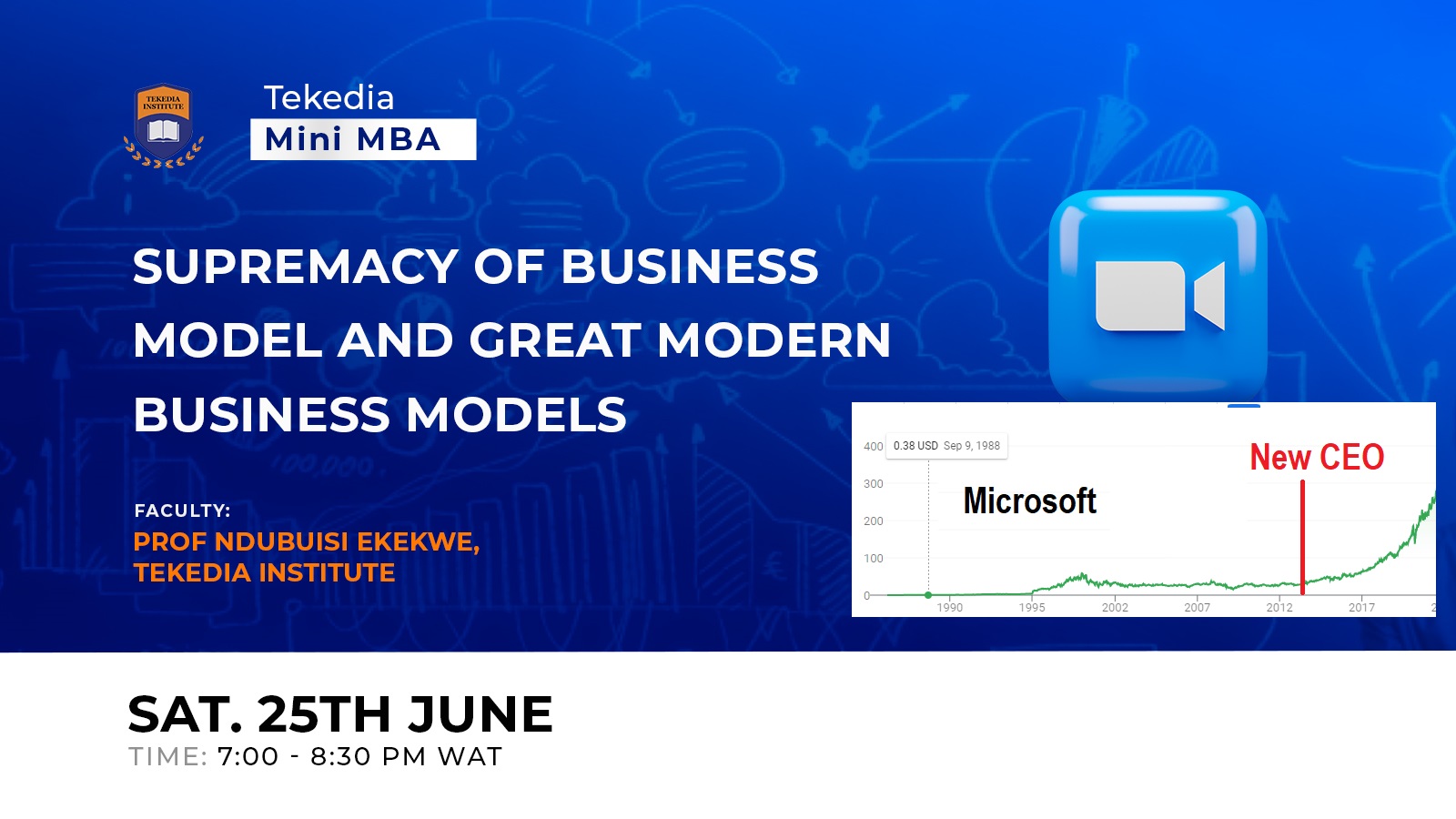
At Tekedia Mini-MBA Live today, I will explain that supremacy and why leaders must pay attention to the business models they operate. Microsoft had a lost decade until they changed a CEO. When the new boss man came, he changed the business model. Looking at the plot, the impact is significant and well correlated. I will present more cases to show why a change in CEO who comes with a new business model has transformed the destinies of firms.

Yes, the company has been bleeding revenue, but they changed the CEO. Magically, using the same staff on the products, the revenue started going north. What happened? New business model has been deployed.

Join me at Tekedia Mini-MBA live; Zoom link in the Board.