DD
MM
YYYY

PAGES

DD
MM
YYYY

spot_img

PAGES

Home Blog Page 5111

New York Moves to Ban Crypto Mining, Posing Further Threat to Cryptocurrency Market

0

On Friday, New York lawmakers passed a bill that will prohibit crypto mining operations running on carbon-based power sources, in a first of its kind move in the United States that  poses further threat to the troubled cryptocurrency market.

The move comes along with the push for cleaner energy being spearheaded by President Joe Biden’s  administration. Governor Kathy Hochul is expected to sign or veto the bill, which could mean a win or loss for cleaner energy transactions.

Industry insiders told CNBC that a ban could have a domino effect across the U.S., which is currently at the forefront of the global bitcoin mining industry, accounting for 38% of the world’s miners.

In further report on the bill below, CNBC said it was previously passed by the State Assembly in late April before heading to the State Senate, and calls for a two-year moratorium on certain cryptocurrency mining operations which use proof-of-work authentication methods to validate blockchain transactions.

Proof-of-work mining, which requires sophisticated gear and a whole lot of electricity, is used to create bitcoin. Ethereum is switching to a less energy-intensive process, but will still use this method for at least for another few months.

The push for an eleventh-hour vote came as leadership in the state capitol managed to flip some of the senators who were previously undecided.

Lawmakers backing the legislation say they are looking to curb the state’s carbon footprint by cracking down on mines that use electricity from power plants that burn fossil fuels. If it passes — for two years, unless a proof-of-work mining company uses 100% renewable energy, it would not be allowed to expand or renew permits, and new entrants would not be allowed to come online.

The net effect of this, according to Boring, would be to weaken New York’s economy by forcing businesses to take jobs elsewhere.

“This is a significant setback for the state and will stifle its future as a leader in technology and global financial services. More importantly, this decision will eliminate critical union jobs and further disenfranchise financial access to the many underbanked populations living in the Empire State,” Boring tells CNBC.

It is a sentiment echoed by Galaxy Digital’s Amando Fabiano, who says that “New York is setting a bad precedent that other states could follow.”

As for timing, the law would go into effect as soon as the governor signs off.

The crypto industry has been facing a pushback from environmental activists who are concerned about the carbon footprint from its mining operations. The US offered the crypto market a lifeline after the Chinese authorities clamped down on mining last year, due to its heavy energy consumption that resulted in power outages in some Chinese provinces. China was leading global cryptocurrency mining then.

The New York bill said Cryptocurrency mining operations running proof-of-work authentication methods to validate blockchain transactions are an expanding industry in the State of New York; and the continued and expanded operation of cryptocurrency mining operations running proof-of-work authentication methods to validate blockchain transactions will greatly increase the amount of energy usage in the state of New York, and impact compliance with the Climate Leadership and Community Protection Act.

If more US states follow the steps of New York, assuming the bill is not vetoed by Hochul, it will also mean loss of jobs in the cleaner energy sector.

“The regulatory environment in New York will not only halt their target – carbon-based fuel proof of work mining – but will also likely discourage new, renewable-based miners from doing business with the state due to the possibility of more regulatory creep,” said John Warren, CEO of institutional-grade bitcoin mining company GEM Mining.

But there is another concern. Beyond potentially stifling investment in more sustainable energy sources, industry advocates tell CNBC that each of these facilities drives significant economic impact with many local vendors consisting of electricians, engineers, and construction workers. An exodus of crypto miners, according to experts, could translate to jobs and tax dollars moving out of state.

“There are many labor unions who are against this bill because it could have dire economic consequences,” said Boring. “Bitcoin mining operations are providing high-paying and high-grade, great jobs for local communities. One of our members, their average pay is $80,000 a year.”

Stakeholders In Agriculture Advocates For Use Of Technology For Development

0
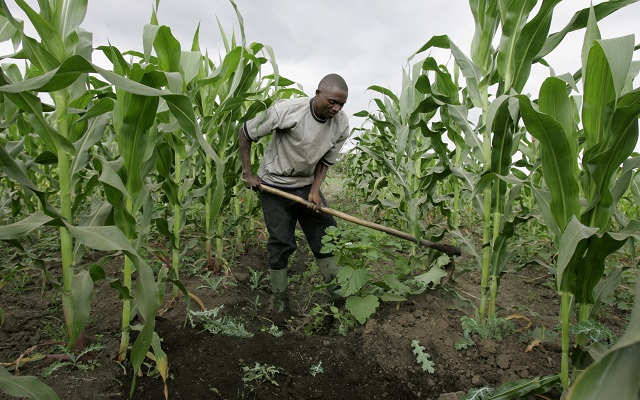
A farmer prepares water channels in his maize field in Ngiresi near the Tanzanian town of Arusha on Tuesday, July 17, 2007. Millions of farmers around the world will be affected by a growing movement to change one of the biggest forces shaping the complex global food market: subsidies. Many experts agree farmers need help to grow food year in and year out, but Western farmers may get too much and African farmers too little. (AP Photo/Karel Prinsloo)

Stakeholders in the agricultural sector have advocated for the use of technology and innovation in the sector for development and to boost farmers productivity. This was stated at the Agric workshop organized by the Nigerian British chamber of commerce (NBCC) with the theme “Leveraging Technology $ Digital Transformation In Agriculture”.

According to the chairman of Agric and Export Trade group of NBCC, Dr. Olusola Obabori, he disclosed that businesses that do not leverage on the use of technology, have been operating in the past. In his words, “Any business without leveraging technology is operating in the past. This is why we are here today to examine the use of technology in boosting production in Agriculture”.

With the implementation of technology in agriculture, it will scale up production and give best practices in the world, which will translate into more profit. The permanent secretary, federal ministry of Agriculture and Rural Development, Dr. Ernest Umakhihe, stated that the Nigerian agricultural sector has the potential to drive economic growth and create wealth due to the country’s viable agro-ecological zones, strong value chains and youthful population, which can be used to explore and undertake a diversified agribusiness.

There is no disputing the fact that the world is rapidly evolving with a lot of technological advancements that are being invented to make life easy. It has no doubt transformed so many sectors across the globe and is also shaping the world. There have been few technological advancements implemented in the agricultural sector in the country, although the sector is still lagging behind in terms of technological adoption.

With ICT application, it will strengthen the sector due to the fact that farmers will be able to access current information, such as the release of new crops, new prices of agricultural equipment, the emergence of disease and pest control, weather forecast, among others.

With scarcity of food ravaging some parts of Africa, the introduction of technology into the sector will aid in large production of food that will be able to sustain the people in the region. While demand for food is growing, the supply side faces the challenges of changing environment and climatic conditions and shortage of food inputs.

To mitigate these challenges, farmers must embrace digital technology to improve productivity to meet domestic and external demand. Hence, the need to adopt the use of technology to boost productivity.

With technologies such as internet access, Artificial Intelligence, robotics, remote sensor technology, and many more, it will provide the agricultural sector with the necessary tools needed to make more informed decisions and also boost productivity output.

Leveraging technology and other practices in the agricultural sector will create a pathway for Nigeria as well as other African countries to increase productivity and competitiveness of the agricultural sector which will curb food insecurity and poverty in the region.

It has been estimated that by 2050, feeding about 200 million people will be very challenging. It will only be made possible if technology is leveraged, because with the use of technology, it will aid in the mass production of food commodities.

Technology has no doubt ensured a higher level of growth in almost every industry of the world, therefore there is a need for the agricultural sector in Nigeria to open up to these latest technological advancements, to ensure there is massive production output.

Tekedia Mini-MBA Begins Tomorrow – REGISTER Now

0

Greetings! The academic festival begins tomorrow at Tekedia Mini-MBA. If you want to join, now is the time to get the ticket. I will open it tomorrow with Innovation, Mission of Firms and Building Category-King Companies.

What is your vision? What is your playbook? How is that leadership ascension evolving? Etc. At Tekedia Mini-MBA, more than 250 eminent faculty will bring clarity to advance you professionally and accelerate progress in your firm, community and nation.

Tomorrow starts here 

Political Parties Versus Public Owned Campaign Issues in Four Weeks Ahead of Osun 2022 Election

0

Normally, Osun State should be among the states that have governorship elections every four years, in keeping with the general election cycle. The Alliance for Democracy, which was voted in 1999, was defeated by the People’s Democratic Party in 2003. Prince Olagunsoye Oyinlola, the winner, ruled the state from 2003 to 2007. The incumbent (Governor Oyinlola) and Engineer Rauf Aregbesola of the Action Congress fought hard during 2007 election.

During the pre-election period, there were widespread verbal and physical attacks across the state, particularly in cities and towns where candidates believed they could garner the most votes. The incumbent eventually won the election, and the opposition party (AC) threatened to dispute the victory all the way to the Supreme Court. Engineer Rauf Aregbesola was pronounced the election winner by the Court of Appeal in November 2010. This event shifted the year in which Osun people go to the polls to elect a new governor.

Actors and supporters worked hard and used various techniques to advertise their candidates to the electorate in all of the state’s elections. Our analyst observes that, similar to what is observed at the national level, actors and their supporters rarely engaged the public during campaign periods by highlighting essential concerns and demands. Political parties, politicians, and their followers believe in participating in extremely intensive personality disparagement rather than discussing socioeconomic and political concerns that require holistic solutions through evidence-driven policies and initiatives.

Part of the damage to Nigeria’s long-term democracy, according to our analyst, is participating in personality shaming and failing to comprehensively explore important concerns or requirements of the people. This is based on the fact that voters are not given the opportunity to make the best decision during the voting process. In developed democracies, parties and candidates are expected to focus on systemic concerns and needs rather than performance issues, as has been the case in Nigeria’s election campaign ecosystem since the country’s restoration to democracy in 1999.

While the parties and candidates who have ruled and are still in power emphasize performance issues (what they have done previously) over systemic issues and people’s needs, opposition parties and candidates often take solace in disparaging the personality traits, competence, and leadership style of those in power. Over time, it has also become clear that the ruling party prefers to court workers and retirees by approving welfare packages prior to primary and general elections, providing free monthly meals to selected people, and using established performance indicators, as well as possible involvement in vote buying and collusion with electoral bodies and security agencies.

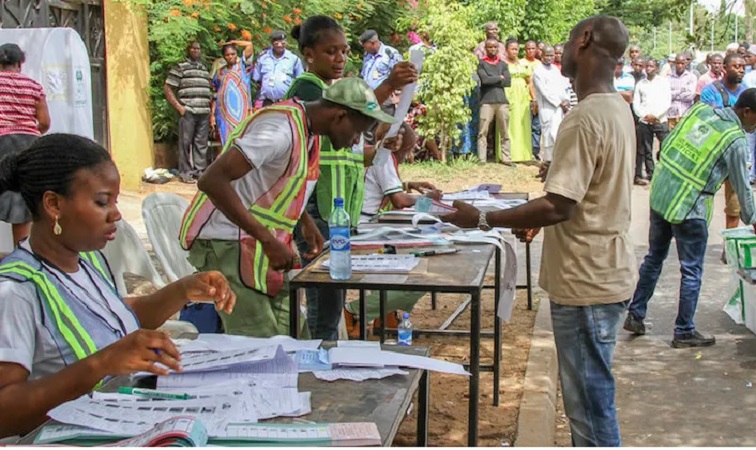
Meanwhile, this piece focuses on the upcoming governorship election in Osun state, with an emphasis on how political parties have created and owned issues in the last four weeks of campaigning in physical settings (cities and towns), on virtual platforms (social media), and in newspapers. It also looks at how the public has taken ownership of issues and gained a better understanding of politicians and political parties by using the Internet to gather information.

Political Parties and Public Issues Owned: Divergence and Convergence

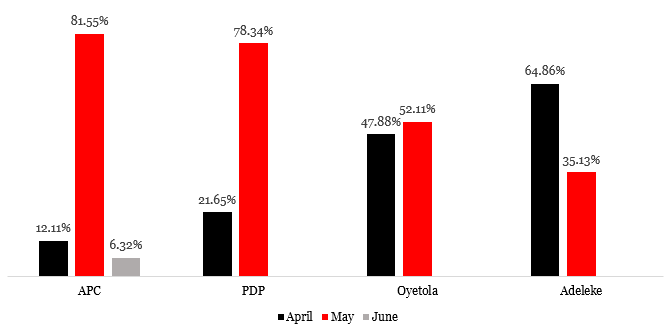
Exhibit 1: Osun Public Searches of Political Parties and Candidates

Source: Google Trends, 2022; Infoprations Analysis, 2022
Key: APC=553, PDP=411, Oyetola=71, Adeleke=37

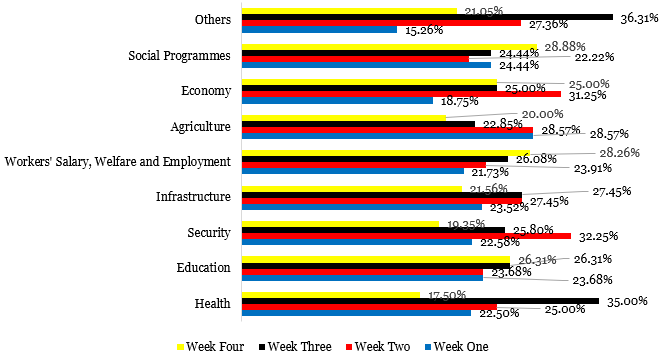
Our analyst and other researchers at the Positive Agenda Nigeria observed campaign activity of the actors (parties and candidates) between April 6 and June 1, 2022, and discovered that reputational issues dominated the period rather than systemic challenges in the state. The dominating owned issues of political parties in week one were agricultural and social programmes. Before they could own the health issue, they switched to security and the economy in week two, then to personality assaults, vote buying, and threats to life in week three. They owned the issues of social programs, workers’ salaries, welfare, and employment in week four (see Exhibit 2).

Exhibit 2: Campaign and/or Policy Issues by week

Source: Positive Agenda Nigeria, 2022
Key: Health=40, Education=38, Security=31, Infrastructure=51, Workers’ salary, welfare and employment=46, Agriculture=35, Economy=48, Social Programmes=45, Others=190

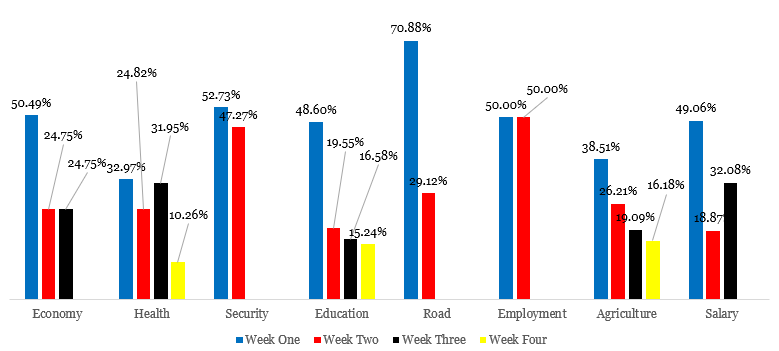
Our analyst and his colleagues noticed a glaring mismatch between what interested the public and what the political parties owned and disseminated to them (Osun public) during the monitoring period. In week one, people were interested in learning about road conditions, which falls under the infrastructure category, and the economy, according to the analysis, but political parties primarily highlighted agriculture and social programmes. People were concerned about work and security in the second week. During the week’s assessment of this, as well as the parties’ personal difficulties, a mismatch was noticed (see Exhibit 3) and in week four. When discussing and seeking information regarding salary and health, the parties and the public only aligned during week three of the campaign activities.

Exhibit 3: Issues and/or needs searched by Osun Public based on weeks

Source: Positive Agenda Nigeria, 2022
Key: Volume of issues and/or needs search (Economy=404, Health=1277, Security=366, Education=1043, Road=467, Employment=200, Agriculture=618, Salary=530)

According to the findings, issues are owned differently by different parties. Throughout the four weeks, the ruling party (APC) concentrated on performance issues, with particular attention paid to the health sector, worker salaries, welfare and employment, social programs, and infrastructure. The PDP, the main opposition party, addressed concerns of reputation (personality assaults, party attacks), security, and agriculture. After the PDP, Accord was determined to be equally responsible for addressing reputational issues. The party (Accord) also engaged the public by discussing concerns and/or needs related to education and security. Like the PDP, Labour party was also discovered to owned economy, reputational issues of the members and candidate of the ruling party as well as agriculture and found them worthy of discussing.

Exhibit 4: Campaign and/or Policy Issues by Political Parties

Source: Positive Agenda Nigeria, 2022
Key: Health=40, Education=38, Security=31, Infrastructure=51, Workers’ salary, welfare and employment=46, Agriculture=35, Economy=48, Social Programmes=45, Others=190

Strategic Options

Political parties should modify their campaign communication approach in the future, according to our analyst. For example, media handlers could monitor citizens’ Internet searches on a daily basis in order to produce and disseminate targeted messaging. Parties must also focus on addressing systemic issues or needs in the state rather than on reputational issues that are important to governance competencies and democratic leadership style expectations. The ruling party’s emphasis on performance issues without specifying what it plans to do in each area or industry over the next four years if elected is insufficient to make it the best candidate for the job. On the other side, the main opposition party’s continual debate of non-critical reputational concerns does not portray it as the best alternative for the electorate.


Welcome to Tekedia Mini-MBA 8 [video]

0

Welcome. From all of us at Tekedia Institute, we say Welcome to the 8th edition of Tekedia Mini-MBA. And thank you for choosing us. This is the temple for the mastery of Africa’s entrepreneurial capitalism. We begin tomorrow at 12 noon WAT here 

I used Zoom while on transit for this recording, it is laggy. Will make a better one.