DD
MM
YYYY

PAGES

DD
MM
YYYY

spot_img

PAGES

Home Blog Page 5114

I am for remote work. I am also for onsite. Find what works for you.

0

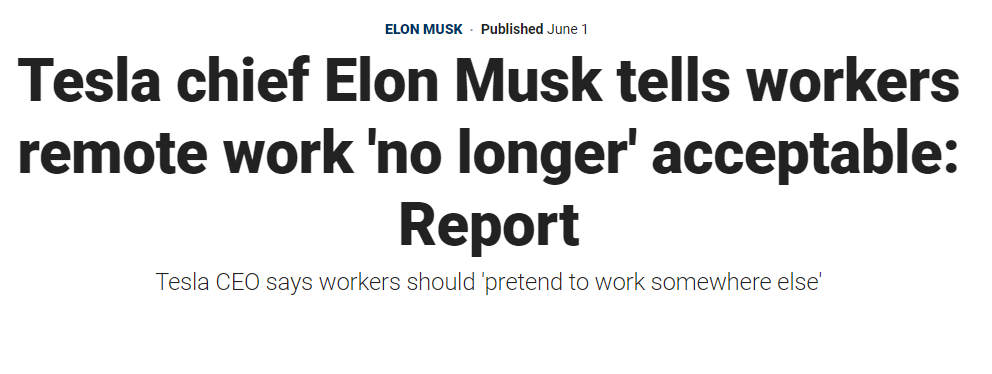
Elon Musk is his generation’s finest innovator, but on this one, he may not be providing a template for everyone to copy blindly. Yes, that Elon has said it does not mean it is the best model. My position is simple: market systems are different, and you need to check what works for your business.

Remote work offers many advantages because of the improving marginal cost efficiency which makes it easier to tap talent from anywhere on earth.

But that does not mean that if your business is on the quasi-industrial age type (making cars) that factory workers will not revolt if “soft” colleagues are at home working. To maintain equilibrium, HR might have told Elon to pause remote work. Do not follow blindly.

I am for remote work. I am also for onsite. Find what works for you.

Elon Musk has reportedly told Tesla employees that they must put in a minimum of 40 hours per week in the office if they also wish to do remote work.

“If there are particularly exceptional contributors for whom this is impossible, I will review and approve those exceptions directly,” he wrote, according to the screenshot, which was shared on Twitter.

Comment on LinkedIn Feed

Comment 1: It depends on nature of work and culture, not every job makes sense remotely. There are things that happen when people are in a room trying to figure out what works, trying to replicate same remotely is a joke. For elite and experienced employees, remote can get things done, but for others, expect inefficiencies and frustration at intervals.

Comment 2: Remote work was not designed for the kind of work we do here in nigeria. But every organization will choose which option will be favourable to them.

BusinessDay + Tekedia Institute = HUGE PROFIT for your company; Register for Tekedia Mini-MBA

0

I begin my Nigerian day with BusinessDay. It is Africa’s finest business journalism. It brings the cases  live, and prepares me for the market day. You have your team; you want them to be knowledge-ready, on business frameworks/models and market news.

Tekedia Mini-MBA provides world-class business education (the frameworks and models). BusinessDay provides the news and leading practical fresh perspectives. You get both when you register for the next edition of Tekedia Mini-MBA which begins June 6 here: https://businessday.ng/tekedia/

(Once you register, you will get access to BusinessDay online portal and the team will send your email to Tekedia for login to the course. Companies, speak with Ihaza Anthonia of BusinessDay to guide you).

BusinessDay + Tekedia Institute = HUGE PROFIT for your company

Have a Vision and a Plan – And Become A Legend in Markets

0

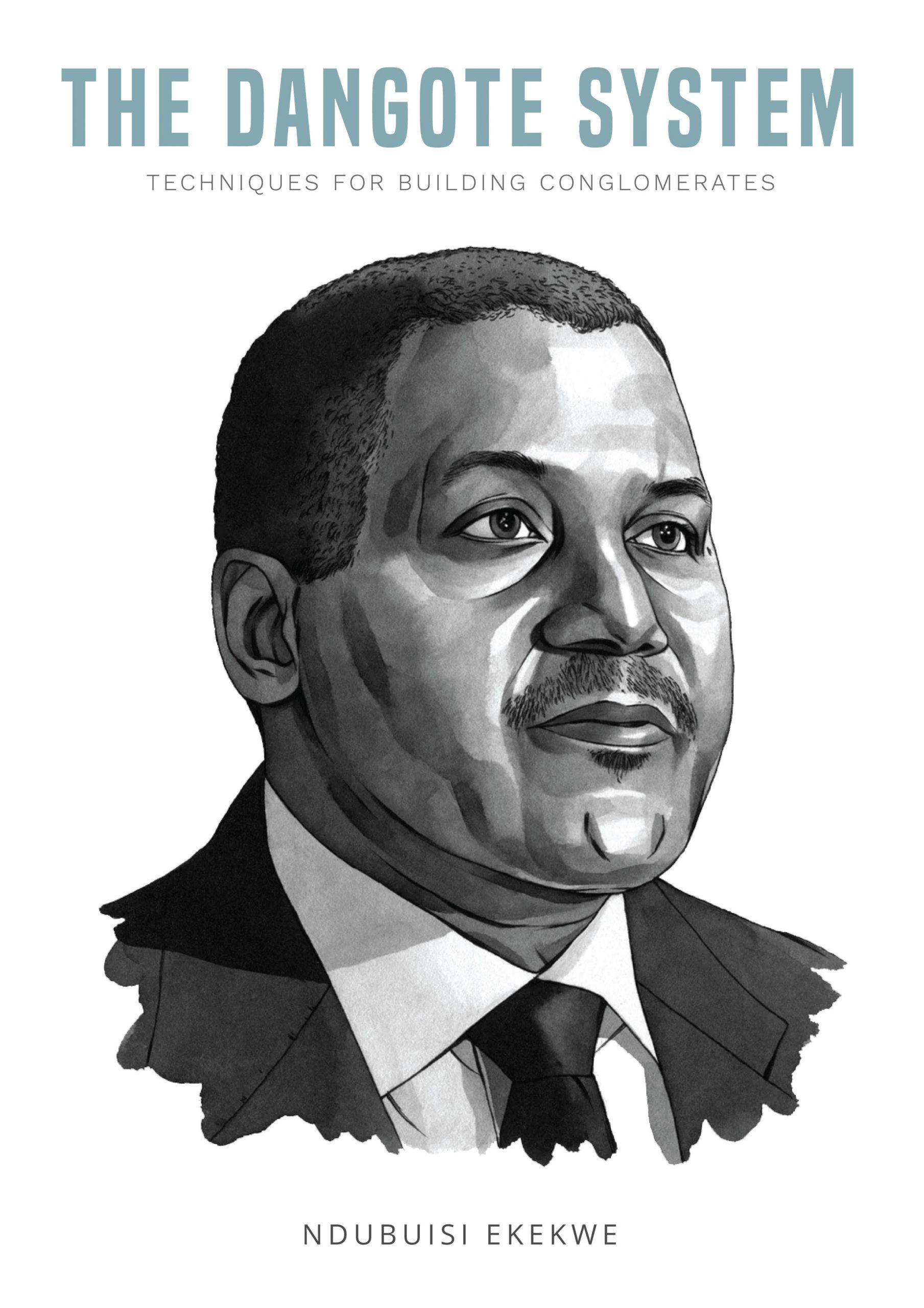
“You must have a vision, and not just a vision; you must have a plan that would make you fulfil that vision.” – Aliko Dangote

A trader like others. But he had a Vision and a plan. And over time, he has built Africa’s leading industrialized conglomerate. “The Dangote System: Techniques for Building Conglomerates” will explain to you how great category-king companies are built, from Amazon to IBM, Dangote Industries to Apple, etc. It is about accumulating capabilities, and compounding them, to fix market frictions at the upstream where few players can participate.

Begin reading the book the critics wrote “a revelation on making legends out of ordinary men”. It has been updated; start here.


Nigeria’s Internet Population Increases By 108%

0

The Nigerian Communications Commission (NCC) has disclosed that, according to available data within its reach, Nigerians with access to fast Internet had grown by 108.39 per cent in four years.

The commission’s portal revealed that broadband penetration increased from 38.72 million (20.28 per cent) in March 2018 to 80.68 million (42.27 per cent) in March 2022.

According to the ‘Nigerian National Broadband Plan (2020 – 2025),’ broadband commonly refers to high-speed Internet connection.

It added that broadband penetration was measured by the number of broadband subscribers per 100 inhabitants.

In the broadband plan document, the President, Muhammadu Buhari, was quoted as saying, “I am told that every 10 per cent increase in broadband penetration results in about 2.6 per cent to 3.8 per cent growth in GDP.”

According to data from the NCC’s portal, the contribution of the telecoms industry to GDP increased from 9.19 per cent in Q1 2018 to 12.61 per cent in Q4 2021.

The broadband plan intends to effectively cover 90 per cent of the population and deliver 25 Mbps in urban areas, and 10 Mbps in rural areas.

It added, “Rapid rollout of broadband services will address various socio-economic challenges faced by the country, including the need to grow its economy, create jobs, rapidly expand the tax base, and improve digital literacy and educational standards.

“This will also address identity management and security challenges through the effective use of technology, increase financial inclusion and deliver a broad range of services to its people to improve the quality of life and work towards attainment of Social Development Goals set by the UN for 2030.”

It further stated that a 4G LTE network was needed to achieve the kind of download speeds Nigerians need.

When the broadband plan was released, most of the Internet service in the country was reportedly on 2G and 4G. It said, “Internet services in the country are currently provided on 2G, 3G, and increasingly 4G mobile networks.

“However, though 4G coverage is available to 37 per cent of the population, download speeds in the country are noted to be generally uncompetitive with other countries in the same income bracket.”

According to the plan, it costs $3.5 – $5bn to achieve its aim. Much of the growth in broadband penetration is being driven by telecommunication firms.

In their recent earnings reports, MTN Nigeria Communications Plc. and Airtel Africa disclosed that they invested a combined N208.56bn in the Fourth-Generation (4G) network and others in the first quarter of 2022.

MTN also disclosed that 4G, which implies faster Internet, now accounts for 76 per cent of its data traffic and covers about 72 per cent of the population. Airtel added that 99 percent of its sites in Nigeria now had 4G capabilities.

According to the World Bank, a 10 per cent increase in mobile broadband penetration could lead to about a 2.46 per cent growth in Africa.

This is also a clarion call to the government to tighten regulations in the telecom sector, so consumers would acquire the exact services of what they are paying for. This would definitely encourage more access to the internet on a regular basis, thereby boosting the country’s economic worth.

Hence, the existing policies are required to be reviewed and updated for greater efficiency.

Only 12.1% Of The Nigerian Population Enjoys Meaningful Internet Services

0

According to an in-depth research by the alliance for affordable Internet (A4I), it disclosed that only 12.1 percent of the Nigerian population currently enjoys Internet services. Explaining further, it explains that 81 percent meaningful connectivity gap exists in Nigeria and claims that in the rural region, 0.6 percent enjoy meaningful Internet service, while urban region, 16.4 percent enjoy meaningful Internet connectivity.

This is coming as broadband penetration in Nigeria hits 42.3 percent, while users increased to 80.7 million in March. The Nigerian community commission (NCC) statistics, which revealed this, also informed that Internet users via the narrowband rose to 145.8 million within the same period.

With a focus on nine countries, such as Kenya, South Africa, Nigeria, Mozambique,  Columbia, Ghana, India, Rwanda, Kenya, the broadband body informed that across these nine countries surveyed, rural areas lagged behind their urban counterparts in terms of Internet, which having a meaningful access to the Internet, Urban areas have levels that are three times greater than that of the rural areas.

It also carried out a survey on the number of PC owners in Nigeria, which disclosed that only 68.7 percent of the entire population own a PC. These statistics aforementioned, indeed shows that Nigeria has a long way to go in terms of meaningful Internet connectivity.

With 81% of Nigerians lacking meaningful Internet access, this is almost the entire population, and it will no doubt stifle economic growth. It is a major concern that requires urgent attention from the government.

Lack of meaningful Internet connectivity, apart from the fact that it hampers the country’s economic growth, will also affect job creation and inhibit the country’s move to keep up with global trends of innovation and creativity.

According to the world bank, it states that broadband Internet connectivity is a strong catalyst for economic growth, with every 10 percent increase in connectivity enabling a 1.38 percent growth in a country’s GDP. Also, Nigeria’s average Internet download speed is abysmally poor, which according to OOkla speed test global index, it reports that the country’s Internet speed as at 2021 stands at around 10.02 megabytes per second, which is way below the global average per second.

Despite the fact that the country recorded progress in the information technology sector, it was not enough to compete with the rest of the world. Looking at how the future has evolved where Internet connectivity now goes beyond connecting devices and people, to the creation of different  technological tools, it is a wake up call for the Nigerian government to speed up the implementation of the National broadband policies, so as to explore the potential of its massive Internet users to revolutionize the nation’s socio-economic status and as well compete with the rest of the world.

However, in all of this, with the recent news of Elon Musk Starlink Fast Internet provider coming to Nigeria, I am very ecstatic because it has a lot of benefits for the Nigerian internet service connectivity, which will no doubt improving the internet speed in the country that will also enable small businesses to thrive thereby improving the country’s economy.

Star link, which is a high speed Internet access delivered via low earth orbital satellites, will no doubt solve the country’s problem of Internet access and speed, most especially in the rural areas in the country. With the arrival of starlink, what this means is that a child in ‘Ovim’ Abia state, can also enjoy faster Internet services like those in urban areas.

Starlink Fast broadband Internet access will no doubt scale up all sectors in the country which will also see a fall in the price of data, making it affordable to a large number of Nigerians who cannot afford data.