DD
MM
YYYY

PAGES

DD
MM
YYYY

spot_img

PAGES

Home Blog Page 5144

Embedded Finance, a key to unlocking mass prosperity

0

Graduating amongst the top 5% of her class gave Olayinka a sense of accomplishment. She felt on top of the world until subtle insults from her family replaced songs of adornment as she grew dependent on them after struggling to find a job.   

“Sapa, no good o,” she said, while tears rolled her eyes as she lamented to her friend Ope. 

Realizing that tears would not count and the only sensible way forward was entrepreneurship, she took to the street. 

Quickly, she drafted a business plan and organized a team. But in securing a loan she understood that the street also had its woes. 

Drafting up a business plan was not hard, neither was management, her major obstacle off hardship was securing a common loan of 300,000 naira. 

Like Yinka, many Nigerians who have ventured into entrepreneurship- joggling one kind of SME or the other to meet ends need- find it hard to secure working capital. This unpleasant incident has resulted in heavy cash handling as many hardly see the benefits of banks. Thus, relying heavily on direct interaction between customers and sellers- fostering relationships. 

Yet, while handling cash has costly ripple effects, reliance on relationships holds value. These relationships, now enabled by technology, fosters inclusion and strengthen the supply chain. This inclusion has led to non-financial entities offering financial services, which is known as Embedded Finance. 

While not a new ideology, Embedded finance has in recent times become a buzzword. Primarily, it aims to simplify financial service processes for consumers, making it easier for the public to access money- and the related services- they need, anytime, anywhere. (Amosu, 2022). 

It includes the following;  

Embedded payment. This refers to the blending of payment infrastructure to create a seamless payment flow within an app or a platform. Flutterwave is an example of a company that offers such a service, and its most common use is for payment within the ride-sharing app like Uber.   

Embedded Credit. The burden of buying has always created the need for short-term loans, yet all mechanisms to fix this friction seem to be a misfit. Buy now, pay later (BNPL), an example of embedded credit, solves this need.  

This bespoken loan empowers businesses to grow and manage capital as it best suits them. This crediting system also includes Payrolling assistance, as offered by Earnipay, and B2B lending by Tradedepot. 

Embedded Insurance. While many still hold on to the Blood of Jesus as their source of coverage, statistics show that SMEs experience costly accidents, and always struggle to find stability in the aftermath. Embedded Insurance services offered by Curacel and Insurpass make it easy for individuals and businesses to make claims on what is duly theirs. 

While the concept may still be finding its way into the mainstream, if maximized, it can transform an everyday side hustle business into a conglomerate.   

Prepare for #ModernBanking with Kladot, a Tekedia Capital Startup

0

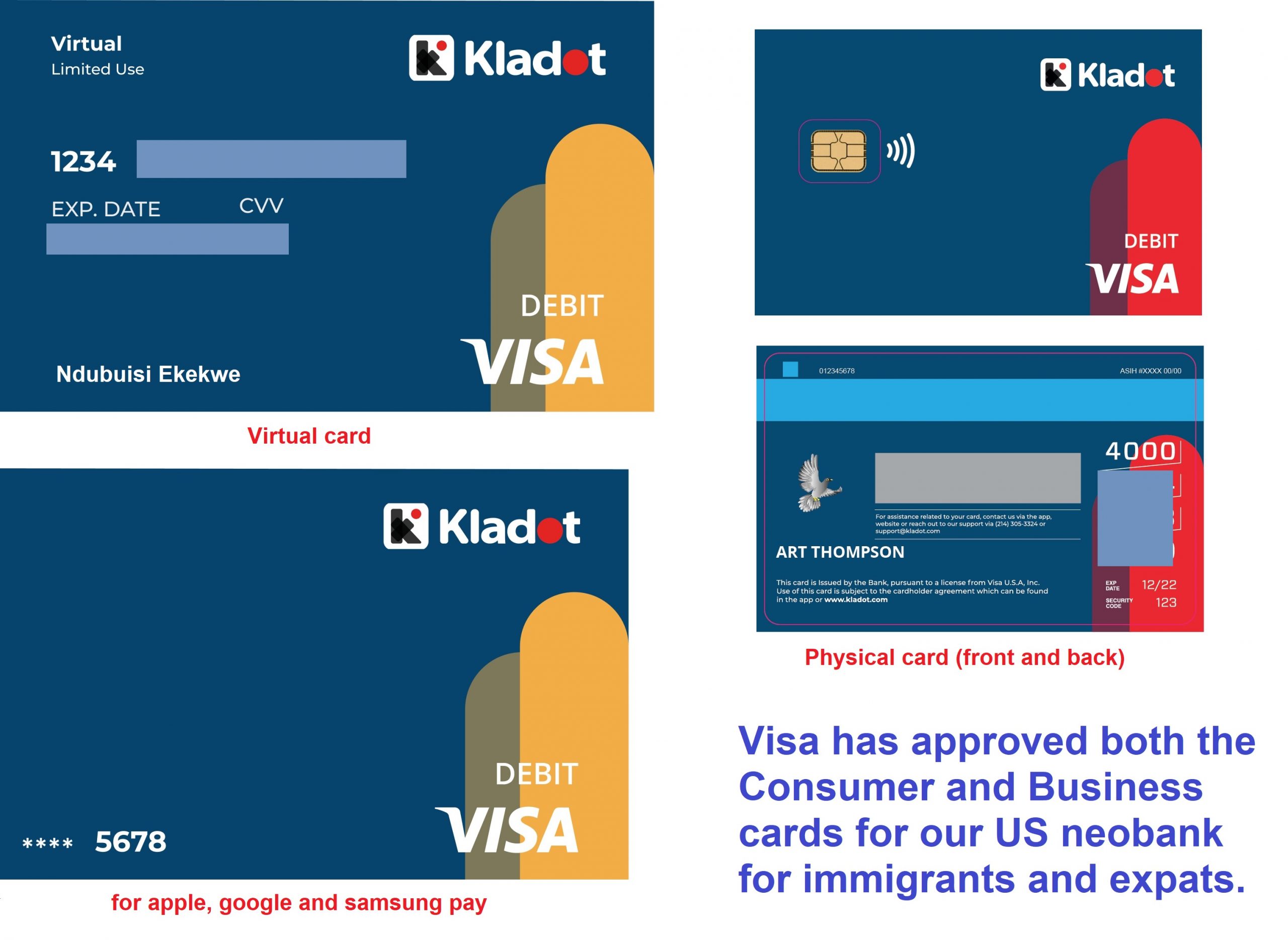
Happy to share that Visa has approved for KlaDot , a Tekedia Capital portfolio firm, to issue individual and business debit cards in 33 countries including US, UK, Canada, European Union, Nigeria, etc. Our neobank is launching in America and I am hoping that you will register – and bank with Kladot for a multi-currency bank account system. We’ve built this neobank for immigrants, expatriates and global citizens.

Many years ago, I landed on the soil of New York City from Lagos via Nigeria Airways.  With my friend Kunle, we took Greyhound from NYC to Tuskegee Alabama. It took 3 days, connecting Charlotte, Richmond, Atlanta, etc. That was a trip that would have taken less than 2 hours with a flight. But we had no payment system to buy a flight ticket!

Though that specific issue has been fixed, many challenges remain for new immigrants and minorities. We hope that our vision will bring solutions to these communities and others around the world. Our multi currency banking system will bring a new layer in global consumer banking.

Prepare for #ModernBanking with Kladot

When Speed Always Matters: Bank Transfers

0

Late transfers, slow deposits, and delays are real and expensive nightmares. Banks make errors; you take the hit. Trust us; we know the pain. Slow transactions affect income earners, family members, and friends. They also impact entrepreneurs, investors, and governmental organizations.

Many of us have experienced the frustration of waiting in line at a bank or supermarket only to find that the cashier is having trouble making a payment. We’ve all been there: you’ve been standing in line for 20 minutes, only to be told that your bill can’t be processed because of problems with your bank. It’s frustrating—not just for you but for everyone behind you who has waited just as long!

Most Nigerians Expect Slow Transactions

Recently, I heard a woman, a single mom, nagging about the stress of handling her small business while still having to keep up with uncleared bank transactions. It’s that bad. Most people expect their transactions to be delayed. This one affected a friend of mine. Some time ago, she felt unsafe walking through a dangerous environment. She knew how late it was, so she stopped at every available taxi. My friend had no physical cash and was completely relying on her Bank’s mobile transfer. Unfortunately, each driver refused to cooperate after considering their payment option. They were all sure about having slow transfer issues. The drivers even felt justified about avoiding the potential hassles they’ll go through if their payment delays.

For a long time, the Raven team considered the issue of slow bank transfers. It’s something that customers talk to us about all the time, and it’s something that many companies have tried to address in different ways. We considered this at length before launching our product last year and decided that what was needed was a solution that didn’t require any additional effort from our customers. First, let’s discuss the problems transactions face.

Why are bank transactions slow?

Suppose you complete a transfer checkout process instructing your bank to send money into another account. Your transfer begins as your bank notifies the recipient’s bank. The notification carries encrypted data with details about the executed transaction. The information is essentially permission for the recipient’s bank to make the payment on your behalf – using they are stored up money (assuming they have enough to go around).

Your bank knows that their message was successfully sent, and you receive a debit alert. (Regardless of your recipient’s account balance). In the end, both institutions take their time to balance their accounts and settle themselves.

This collection used to be a good enough method to maximize speed. Traditional Banks only had to trust that other institutions would follow the plan. The process, however, came with potential disadvantages for all parties. One challenge was that settlement depended on transferring large sums of physical cash constantly and needing to move them from bank to bank. But, payments between traditional institutions have the potential for many drawbacks. During unexpected events like the Pandemic, travel restrictions, curfews, etc., the process can take days. During that time, settlement funds can get delayed, lost, or stolen. Unfortunately, such events will lead to challenges that affect future transactions.

A temporal solution

The rise of digital banking made this process easier. Many banks reduced their reliance on human input when executing transactions (From interpreting bank tellers to forwarding transaction data to other banks), and most of the process became automated. The upgraded tech helped reduce the overall time per transaction; it also cut down certain errors that usually led to payment delays.

A digitized banking system was a significant step forward for the industry, but it still left room for improvement. While transactions were now faster, they still required human intervention. There were still points in which errors could be made – especially when dealing with non-standard transactions.

The growing population of banking services with the expansion of digital tech added gravity to the existing responsibility of traditional banks. The process needed for the management, interpretation, and settlement of multiple external bank accounts is already a tedious one, with mistakes ultimately resulting in delayed transaction processes for many banks.

In recent years, several technological innovations have changed this reality once again. To overcome slow transactions, innovative digital-only banks, including Raven, rely on transaction processes that improve speed.

Solution

Raven Bank uses a centralized system that specializes in clearing transfers. The system utilizes a centralized process focused on executing transactions well enough to deliver your money faster!

The process involves a secure receiving depository financial institution. They receive batches of transactions, sort them out, and make them available to the bank or financial institution of the intended recipient.

The receiving depository financial institution then checks for the authenticity and validity of the transaction before authorizing it for settlement recipients.

Because regulators have vetted these institutions, they provide security and convenience for banks and other financial service providers.

Conclusion

With our quick and seamless transfer system, you can send money to anyone. You don’t even need to worry about the recipient’s bank—it doesn’t matter which one they use! Because there is no need for the complex personal bank-to-bank settlement process, processing transactions reduces the cost of transfers.

If you’re one of the many people affected by a late transfer, slow deposit, or hold on your account, you need to act fast. Get started with Raven Bank, download our App on Google Play store and Apple Store; enjoy high-speed transfers.

Register for Tekedia Mini-MBA Which Begins June 6, 2022

0

Invent, innovate and drive organizational transformation, performance, and growth. Capture emerging opportunities in changing markets while optimizing innovation and profitability. Digitally evolve your business or functional area, turning digital disruption into a competitive capability and advantage. Master the concepts of building category-king companies, and thrive.

Registration for another edition of Tekedia Mini-MBA (June 6 – Sept 3, 2022) continues. Tekedia Mini-MBA, from Tekedia Institute is an innovation management 12-week program, optimized for business execution and growth, with digital operational overlay. It runs 100% online. The theme is Innovation, Growth & Digital Execution – Techniques for Building Category-King Companies.

All contents are self-paced, recorded and archived which means participants do not have to be at any scheduled time to consume contents. Our programs are designed for ALL sectors, from fintech to construction, healthcare to manufacturing, agriculture to real estate, etc.

More so, we have thrice weekly LIVE Zoom sessions, anchored by leaders in markets. REGISTER today (N90,000 or $170) for many early benefits and experience the best business school for African entrepreneurial capitalism. BEGIN here 

OSUN 2022: PAN Applauds Slight Improvement in Campaign Messages, Warns against Vote Buying, Verbal Attacks

0
Sample of political parties in Nigeria (Source: Punch)

A non-governmental organisation with data-driven research interest, Positive Agenda Nigeria (PAN), has applauded some new approaches some political parties in Osun State recently deployed to promote their candidates ahead of the state’s governorship election come July 16, 2022. However, PAN warns political parties to refrain from statements that depict vote buying and showcase verbal attacks, as such practices are unhealthy for democratic principles.

The organisation dropped these hints in its second weekly report on election campaigns ahead of Osun 2022 Governorship Election.

Although the report had instances where candidates and their supporters attacked the personalities of their opponents, the level at which they keyed into campaign issues improved better than the first week’s campaign traces. Campaign issues such as agriculture, economy, social welfare, education, health, among others, reflected more in this week’s report. This means the rate of acclaims outweighed the level of attacks among political parties and their supporters.

The report reads, “We implore all the parties, especially the two major parties, to sustain the atmosphere of increased acclaims instead of being attack-inclined in their campaigns. In the same vein, we enjoin the political parties to as well keep on focusing on issues of the state.  The improved focus on programmes and policies of the candidates and their political parties should be continued. PAN commends the positive slight deviation observed in the parties and candidates’ engagement this week.

However, we condemn the introduction of insinuation of vote buying capacity by one of the candidates.  It is too early for such issues to rear its ugly head in the campaign atmosphere for the Osun 2022 election. For a state like Osun, bringing up policy issues and campaign programmes using radio as a means of communication is commendable. It allows the people at the grassroots level to have access to campaign issues.”

Animasahun Adekunle Mojeed, a Senior Research Analyst with the Group and Lecturer at Fountain University Osogbo’s Department of Political Science, notes that the electoral body and agencies in charge of regulating party finance should begin developing strategies to ensure that vote buying is effectively controlled during the election. This, he stresses, is critical because ‘vote buying intent’ appears earlier than expected, which has tendency of jeopardizing a credible poll on July 16th, 2022.

It would be recalled that PAN’s objective is to monitor pre-election campaigns in Osun for 69 days. This report marks the end of day 14 of the 69 days.

The full report is available here